In short
Batwoman debuts as Kathy Kane in Detective Comics #233 (1956), created by Edmond Hamilton and Sheldon Moldoff under editor Jack Schiff. She is removed in 1964 and killed in Detective Comics #485 (1979). A new Batwoman, Kate Kane, appears in the 2006 weekly series 52 and takes over Detective Comics from #854 (2009), where Greg Rucka and J. H. Williams III make her a headliner. Her own series followed in 2011, and the original Kathy returned in Grant Morrison's Batman Incorporated.
Few Gotham names have been handed from one person to another as completely as this one. The woman who wore the costume in 1956 and the woman who wears it today share a surname, a cape and a city, and almost nothing else. A collector who follows the name through a catalog is following two lives, and the second one was built deliberately on the ruins of the first.
Every credit in this timeline, from Hamilton and Moldoff to Rucka and Williams III, was read in publication histories of Kathy and Kate Kane. The editorial patterns we point out between those dates are our own interpretation.
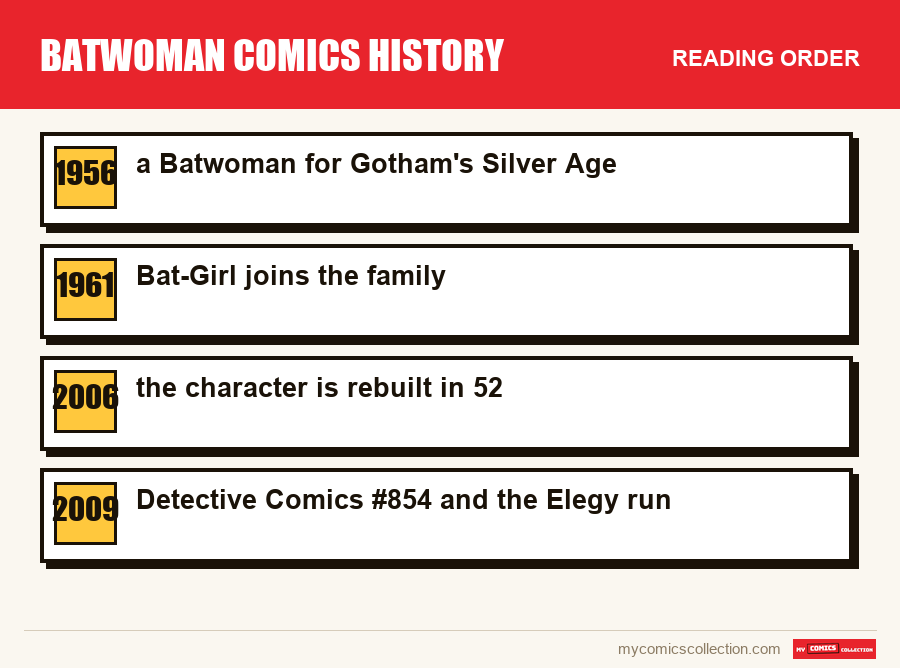
1956: a Batwoman for Gotham's Silver Age
Kathy Kane first appears in Detective Comics #233, cover-dated July 1956. Edmond Hamilton wrote the story and Sheldon Moldoff drew it, with Jack Schiff as the editor of the Batman line. The era matters: the character was created to help offset the accusations about Batman's sexuality raised in Fredric Wertham's Seduction of the Innocent. Batwoman arrived in that climate as a female counterpart to Batman's world, an editorial function that is written into her as plainly as the costume.
For a collector the issue to watch is the first, since it sets the premise that every later Silver Age story repeats. The character then stayed in the Batman titles until 1964.
1961: Bat-Girl joins the family
In 1961 Batwoman gained a partner: her niece Betty Kane, who debuts as Bat-Girl in Batman #139 (April 1961), written by Bill Finger and drawn by Sheldon Moldoff. The pairing mirrored the Batman and Robin team and gave the franchise a third pair of heroes. Bette, as the name later became, matters well beyond that year. She is the reason Batwoman has a family tree in the comics, and in the 2005 "Titans Tomorrow" future she is Batwoman herself, in a costume similar to Kathy's. In the 2007 "Titans of Tomorrow... Today!" arc she remains Flamebird, and Cassandra Cain wears the Batwoman name instead.
1964 to 1979: removal, return and death
In 1964 editor Julius Schwartz revamped the Batman books and dropped Batwoman, whom he considered inappropriate for his new direction. The Batgirl comics history shows how the franchise filled the vacancy she left, and the Julius Schwartz author hub collects the editor's wider revisions.
She comes back in 1977 for guest appearances, and then the character is written out. In Detective Comics #485 (August to September 1979) she is killed off, seemingly by the Bronze Tiger, a death much later revealed to be a ruse. An Earth-Two version appears in The Brave and the Bold #182 (January 1982).
2006: the character is rebuilt in 52
Kate Kane enters in 2006, inside 52, DC's weekly series. Issue #7 shows her past romance with Renee Montoya. Alex Ross drew the costume from the modified Batgirl outfit he had designed for Barbara Gordon, and Ross and Paul Dini had first planned to revive Barbara Gordon herself.
The new Kate Kane is a former West Point cadet forced to leave after admitting she is a lesbian, of Jewish descent, an identical twin, and Bruce Wayne's maternal cousin, who trains for two years across the globe with her father's friends. Her main love interests are Renee Montoya and later Maggie Sawyer. Dan DiDio described the decision as part of a push for a cast more reflective of today's society and fanbase.
What changes for the franchise is the function. Kathy Kane was created to fill a slot in the Batman family; Kate Kane is created to be a protagonist whose motives come from the military, grief and identity, and who needs no tie to Batman beyond being his cousin.
2009: Detective Comics #854 and the Elegy run
Batwoman then took over the lead of Detective Comics, starting with #854, and this is where the modern character is defined for most readers. Greg Rucka wrote the "Elegy" story arc and J. H. Williams III drew it. It ran in Detective Comics #854 to #860 across 2009 and 2010, and Batwoman: Elegy collected it in 2011.
The art is the draw of this run: Williams III drew the story, and the pages are where collectors look when they compare Batman-family books. Rucka's script is credited again on #859 (January 2010). A 2017 volume, Batwoman by Greg Rucka and JH Williams III, extends the collected material to #854 through #863.
2010 to 2015: a Batwoman series and its end
An ongoing Batwoman series was announced in 2010, with J. H. Williams III and W. Haden Blackman as writers and Williams III as artist, with Amy Reeder alternating on some arcs. A zero issue came out in late 2010, and Batwoman #1 launched in the 2011 New 52 relaunch, delayed from its original plan.
Williams III and Blackman then announced they would leave after a December issue because of conflicts with DC over storylines. Issue #17 had featured Kate's proposal to Maggie Sawyer, and DC said she could not marry because heroes should not have happy personal lives. The series was canceled with #40 in March 2015, along with twelve other New 52 series.
For a collector the cutoff is clear: the Williams III and Blackman issues are one block, and the issues after their departure belong to a different team.
Do you collect this series?
Track what you own, what you are missing and what your collection is worth. 7-day trial.
Start my trial →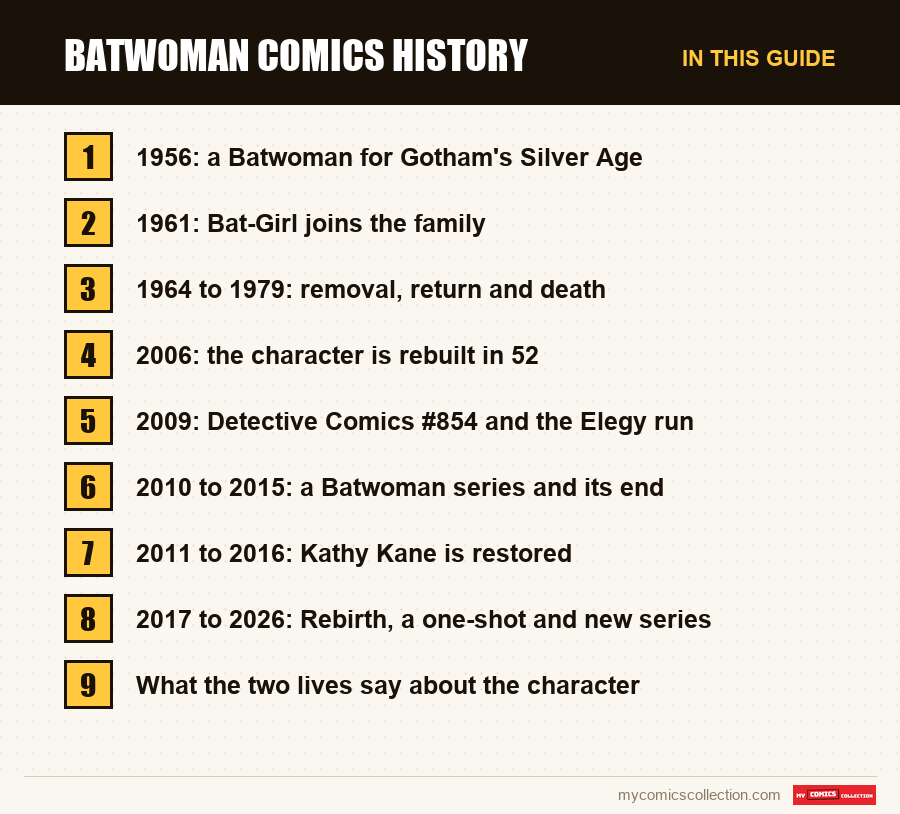
2011 to 2016: Kathy Kane is restored
While Kate was building a series, the original was coming back. In Batman Incorporated #4 (2011) Grant Morrison restored the original Kathy Kane in flashbacks, and in Batman Incorporated volume 2 #13 (September 2013) the series reveals her origin in current continuity, including her recruitment and training as a spy by Spyral. Grayson, by Tim Seeley and Tom King, then gives her a new birth name, Katrina Luka Netz.
The effect is that DC now holds both women in canon. Kathy is no longer an erased Silver Age relic but an assassin with a story, which makes the 1956 issue relevant to collectors of the modern books.
2017 to 2026: Rebirth, a one-shot and new series
With Rebirth, Detective Comics returned to its original numbering at #934, and Kate Kane became a leading character in the title. Batwoman: Rebirth #1 (February 2017), written by Marguerite Bennett, led into Batwoman volume 2 #1 (March 2017), a series in which she works to dismantle a global terrorist group known as the Many Arms of Death.
In 2023 Batwoman and Batwing were announced as the leads of a new Outsiders series after the "Gotham War" crossover. DC then announced another Batwoman series, written by Greg Rucka with art by Dani and colors by Matt Hollingsworth, which returns the writer of the Elegy run to the character; that series began in March 2026. The television version takes liberties with all of this, as our series-versus-comics comparison shows.
What the two lives say about the character
Set the two timelines next to each other and the pattern is plain. Kathy Kane's career runs from Detective Comics #233 in 1956 to her death in #485 in 1979, with an editor's decision in 1964 cutting the middle of it. Her story is shaped by the people around her: Schiff in 1956, Schwartz in 1964, and the story that ended her in 1979. Each editorial change reads as a decision about Batman's cast, not about her.
Kate Kane's timeline is organized differently. It begins in 52 in 2006 with a group of writers, passes to Greg Rucka and J. H. Williams III in Detective Comics #854 in 2009, then to a solo series in 2011, and returns to a team book in Detective Comics #934. At every stage she is the center of the book rather than an accessory to another hero, and the biggest disputes about her, such as the wedding that was refused after the proposal in Batwoman #17, are disputes about what she is allowed to do.
This is also why her back issues sort into two collecting habits. The Silver Age Kathy Kane issues are bought for the character's origin in the 1950s Batman line, while the Kate Kane books are bought for the creators: Rucka, Williams III, Blackman and Bennett. A copy of Detective Comics #854 or Batwoman #1 from 2011 is therefore described first by its team of Rucka and Williams III or Williams III and Blackman.
The key issues across her history
- Detective Comics #233 (1956): the debut of Kathy Kane, by Edmond Hamilton and Sheldon Moldoff.
- Batman #139 (1961): the debut of Betty Kane as Bat-Girl.
- Detective Comics #485 (1979): Kathy Kane is killed off, seemingly by the Bronze Tiger.
- The Brave and the Bold #182 (1982): an Earth-Two version of Batwoman.
- 52 #7 (2006): the reveal of Kate Kane and her history with Renee Montoya.
- Detective Comics #854 (2009): Kate Kane takes the lead, with Greg Rucka and J. H. Williams III.
- Batwoman #1 (2011): the ongoing series begins, with J. H. Williams III and Haden Blackman.
- Batman Incorporated volume 2 #13 (2013): Kathy Kane's origin and survival in current continuity.
How to collect Batwoman
Separate the two women before buying anything. The Kathy Kane material is a Silver Age hunt in Detective Comics and Batman issues from 1956 to 1964, with the 1979 death issue as a later key. The Kate Kane material is easier: the Elegy storyline is available in collected form, in Batwoman: Elegy (2011) and in a 2017 volume that runs from #854 to #863.
The trap in numbering is that Batwoman has several first issues. A zero issue came in 2010, Batwoman #1 launched in 2011, a new Batwoman #1 followed in 2017 after the Rebirth one-shot, another came in 2026, and Detective Comics returned to its original numbering at #934. Always read the year and the creators, not the number alone. For a wider look at where Batwoman sits among the Gotham heroes, the Batman hub and the Black Canary history are useful neighbors.
Frequently asked questions
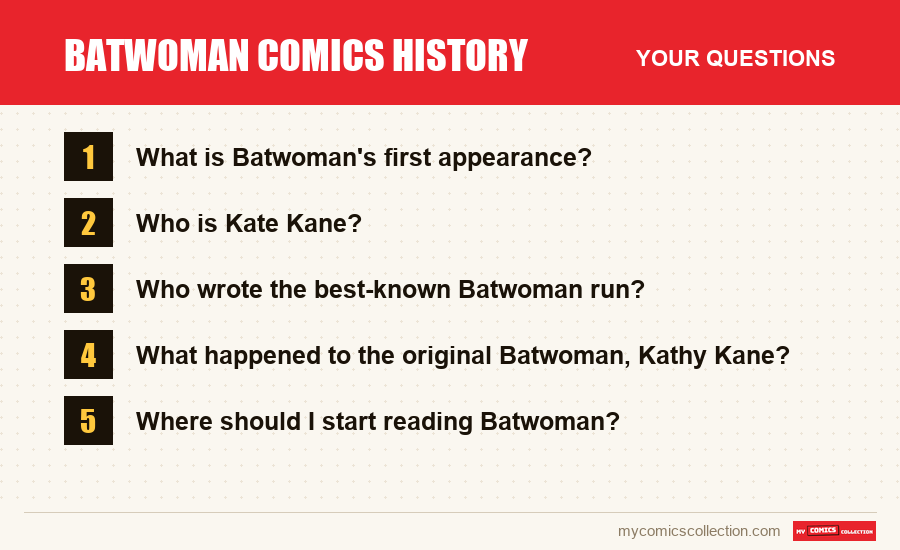
The original Batwoman, Kathy Kane, first appears in Detective Comics #233 (1956), written by Edmond Hamilton and drawn by Sheldon Moldoff, under editor Jack Schiff. Kate Kane, the current Batwoman, is revealed in the weekly series 52 in 2006, with the reveal of her past relationship with Renee Montoya in issue #7.
Kate Kane is the modern Batwoman, introduced in 52 in 2006. She is a former West Point cadet forced to leave after admitting she is a lesbian, and a maternal cousin of Bruce Wayne. Alex Ross designed her costume from his modified Batgirl outfit for Barbara Gordon. She is also written as being of Jewish descent.
The Elegy storyline in Detective Comics #854 to #860 (2009 to 2010), written by Greg Rucka with art by J. H. Williams III. It is collected as Batwoman: Elegy (2011). Williams III and W. Haden Blackman later wrote and drew the ongoing Batwoman series from 2011.
Editor Julius Schwartz removed her from Detective Comics in 1964, and she was killed off in Detective Comics #485 (1979), seemingly by the Bronze Tiger. Grant Morrison restored her in Batman Incorporated in 2011 and 2013, and Grayson gives her a new birth name, Katrina Luka Netz.
Start with Batwoman: Elegy, which collects Detective Comics #854 to #860 by Greg Rucka and J. H. Williams III. For the more recent period, the 2017 Batwoman: Rebirth one-shot by Marguerite Bennett leads into her second series, and Greg Rucka's 2026 series brings back the Elegy writer. Silver Age readers should look for the 1956 debut.
Own a Batwoman key from 1956, 1979 or 2009? Send it for a free estimate.
Estimate my comic