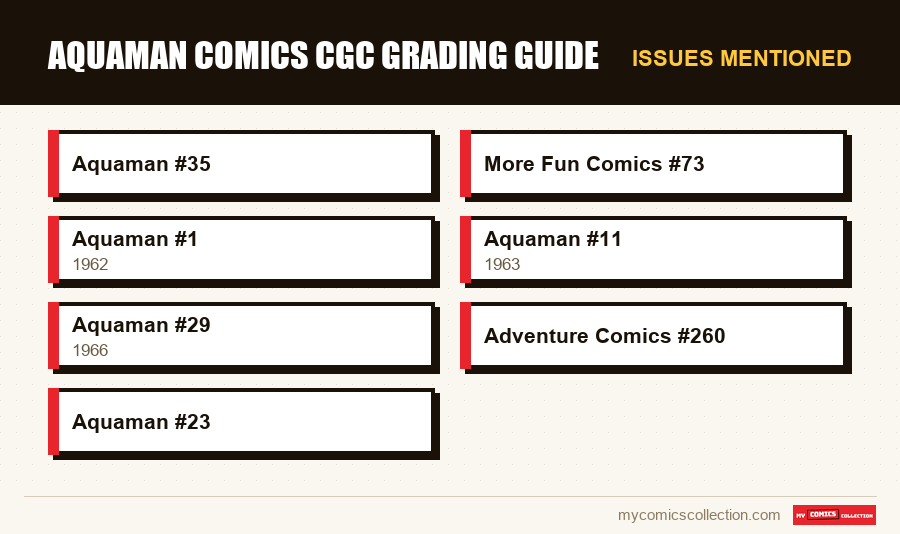
For CGC grading of Aquaman comics: submit as a priority Aquaman #35 (1st Black Manta), #11 (1st Mera), #1 (1962) and modern ones in potential 9.8 condition. Cost: $30-150 depending on the tier. Average delivery time: 60-120 days. The CGC vs raw premium is +200-400% on Silver Age and +50-100% on modern in 9.8.
CGC (Certified Guaranty Company) grading has become essential for serious collectors of Aquaman comics. A CGC slab authenticates the number, certifies its status on a standardized scale and protects it in a sealed case. For Aquaman key issues, the price difference between a raw copy and a graded copy can reach several thousand dollars.
This guide details the optimal grading strategy for Aquaman comics: which numbers to submit, how to prepare your submissions, interpret the results, and maximize your return on investment. Specific advice on recurring problems in the series (colors, paper, printing).
Which Aquaman to grade: cost/benefit analysis
Grading is only justified if the expected added value significantly exceeds the total cost (CGC costs + shipping + insurance). Here is the decision matrix for the main Aquaman issues:
Always grade (guaranteed ROI)
- More Fun Comics #73: any rank. Even a 1.0 is worth several thousand, the authentication alone justifies the cost.
- Aquaman #1 (1962): from VG (4.0) estimated. Premium CGC: +100-200% vs raw.
- Aquaman #35 (1967): from GD (2.0) estimated. The demand for Black Manta in CGC is constant.
- Aquaman #11 (1963): from estimated FN (6.0). Significant premium CGC on Mera.
Grade if high condition (probable ROI)
- Aquaman #29 (1966): in VF+ (8.0+) estimated. Ocean Master has enough demand to justify grading in high condition.
- Aquaman #1 (2011): only if potential 9.8. A 9.6 is only worth $40-50 vs $80-120 for a 9.8.
- Adventure Comics #260: in FN+ (6.5+) estimated.
- Aquaman #23.1 (3D cover): if 9.8 potential. The lenticular cover makes the 9.8 rare.
Do not grade (cost > benefit)
- Modern Aquaman (post-2000) below estimated 9.6: not enough premium.
- Non-key issues from the 60s-70s in medium grade: the raw value is already low.
- Full Peter David/Abnett runs: keep them raw for reading and reselling in bulk.
Aquaman specific issues: what CGC penalizes
Aquaman comics have specific vulnerabilities that CGC graders sanction:
Covers predominantly blue/green
Blue and green inks (ubiquitous on Aquaman) are chemically more sensitive to UV fading. A specimen stored in direct light for decades will show "fading" which CGC notes as "color-breaking stress" or "sun-fading." Always check covers under neutral light and compare with reference scans.
Silver Age DC Paper
DC used a slightly different paper than Marvel in the 60s. Silver Age Aquaman tends to brown more quickly. CGC distinguishes between “Off-White” (OW), “Off-White to White” (OW/W) and “White” (W) pages. The quality of the paper can vary the grade by 0.5 points and the value by 20-30%.
3D covers (Aquaman #23.1)
Lenticular covers are extremely fragile. The slightest support creates a visible distortion which causes the grade to drop. CGC is particularly strict on these covers: an apparently perfect copy can return to 9.4 for a tiny pressure on the lenticular.
Preparing your submission: practical steps
- Pre-screening: examine the comic under strong light at a low angle to detect folds, finger prints, and edge stress invisible from the front.
- Light cleaning: a professional dry cleaner ($15-25 per comic) can gain 0.5 to 1.0 grade points. Recommended for all Silver/Bronze Age subject to grading.
- Choice of CGC tier:
- Economy ($30 per comic, 60+ days): for modern and moderate value issues.
- Standard ($65 per comic, 30-45 days): for mid-value Silver Ages.
- Express ($100+, 15-20 days): for premium parts requiring rapid certification.
- Value statement: declare honestly. Under-declaration may invalidate insurance in the event of damage.
- Shipping: use rigid comic mailers with internal protection. Ensure shipment at the declared value.
Interpret your result: the CGC label
The CGC label contains crucial information for Aquaman:
- Blue label (Universal): standard grade, no restoration defects detected. It’s the ideal label.
- Purple Label (Restored): restoration detected. On Aquaman Silver Age, restoration is common (cover recoloring, edge reinforcement). A purple label can reduce the value by 40-60% vs a Universal of the same numerical grade.
- Green label (Qualified): a single significant defect prevents a higher grade (cut page, library stamp). Relatively rare on Aquaman.
- Yellow Label (Signature Series): signature authenticated by CGC witness. Signings of Nick Cardy, Geoff Johns or Ivan Reis add a 20-50% premium.
CGC Census: real rarity of Aquaman in high condition
The CGC census (public register of all graded comics) reveals the real rarity of Aquaman in high condition:
- Aquaman #1 (1962): less than 10 copies in 9.0+, less than 30 in 8.0+. Extremely rare in high condition.
- Aquaman #35 (1967): approximately 15 copies in 9.0+, 50 in 8.0+. Demand far exceeds supply.
- Aquaman #11 (1963): less than 10 copies in 9.0+. One of the rarest Silver Age DCs in high condition.
- Aquaman #1 (2011): more than 500 copies in 9.8. Abundant, but the demand is proportional.
CGC vs CBCS vs raw: what strategy for Aquaman
CGC remains the dominant standard for Aquaman, with a 10-15% premium over equivalent CBCS grades on eBay sales. However, CBCS offers shorter lead times and slightly lower rates, which may be suitable for volume submissions on mid-value issues. For premium coins (estimated raw value $500+), CGC is the undisputed choice to maximize liquidity and resale price.
Do you own Aquaman comics? Estimate the value of your collection for free to know their current rating.
Frequently asked questions
More Fun Comics #73 is worth grading whatever its condition, since authentication alone justifies the cost. Aquaman #1 (1962), #35 (1967) and #11 (1963) are also worth submitting from a modest estimated condition, as demand for Black Manta and Mera is steady.
Modern Aquaman issues (after 2000) estimated below 9.6 do not offer enough added value. The same goes for non-key issues from the 1960s and 1970s in middling condition, and for the complete Peter David or Abnett runs, which are better kept raw for reading and for resale as a lot.
The blue and green inks found everywhere on Aquaman covers are chemically more sensitive to UV fading. A copy exposed to direct light for a long time can show fading, which grading penalizes. Covers should therefore be checked under neutral light.
The blue label (Universal) indicates a standard grade with no restoration detected, and it is the most sought after. Purple signals restoration, green (Qualified) a single significant defect, and yellow (Signature Series) an authenticated signature. Restoration is common on Silver Age Aquaman books, hence the importance of reading the label carefully.
CGC remains the dominant standard for Aquaman, with a resale premium over equivalent CBCS grades. CBCS, on the other hand, offers shorter turnaround times and slightly lower fees, which suits volume submissions of mid-value issues. For premium pieces, CGC is the recommended choice.