Rogue did not enter publishing with an ordinary monthly issue but, in 1981, with an annual: an oversized notebook published once a year, with its own numbering, printed outside the regular rhythm of the series. This manufacturing detail has a lasting consequence on the way this issue circulates today. An annual bears a number that does not refer to anything in the monthly sequence, is poorly classified in the bins, is difficult to find in the search engines, and is almost always placed somewhere other than the series to which it belongs. The August 29, 2026 statement shows two populations of announcements of comparable weight: eighty-seven requests without certification, between $7.25 and $875.00, median $100.19; seventy-nine requests for verified copies, between $39.50 and $2,000.00, median $279.99. These are amounts claimed by sellers that day, not completed transactions, and a single photograph says nothing about a trend.
In serial publishing there is a category of issues that no one really knows where to put: neither quite an issue of the series, nor quite a separate object. The annual belongs to this category. It bears the name of the series on its banner, it uses the characters, it sometimes extends the plots, but it does not occupy any place in the sequence of monthly issues. Its numbering starts at one and advances at the rate of one notch per year. A reader who owns the complete series may very well have never held a single one of his annuals, without anything in his collection pointing out the gap.
Snape's first appearance, in 1981, occurs in exactly this type of issue. This is not a bibliographical anecdote: it is the factor that explains why this issue behaves differently from others on the second-hand market. A monthly issue is found by accident: you leaf through the bins, you come across it, you recognize it by its rank. An annual must be sought voluntarily, knowing what one is looking for, and this asymmetry structures both the advertisements and the private catalogs of collectors.
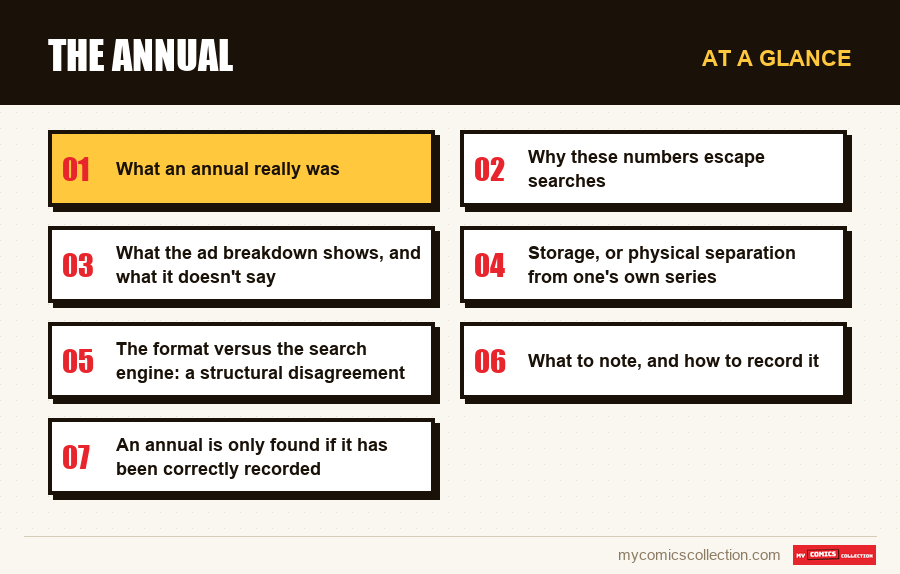
What an annual really was
The annual is not a thicker monthly issue. It is a distinct editorial product, designed according to other constraints. The first difference is due to the pagination: an annual offers significantly more pages than an ordinary booklet, which allows a complete story, closed on itself, where the regular series cuts its stories into sections intended to follow one another. The reader who opens an annual does not need to have followed the previous episodes; he goes in, he reads, he comes out. This narrative autonomy is a choice of production as much as a choice of writing.
The second difference is the calendar. The annual is published once a year, generally in the middle of summer, at a time when the young public has more reading time and when points of sale sell more volume. It is therefore not part of the mechanics of the monthly meeting: it arrives as an extra, like a seasonal event. This delayed publication takes it out of the ordinary flow, with all that that implies: another positioning on the shelf, another displayed price, another expectation on the part of the buyer.
The third gap concerns the team. Producing a long notebook without interrupting the monthly cadence requires mobilizing other hands. The annuals were therefore often entrusted, in whole or in part, to designers, inkers or scriptwriters who did not work on the regular series. The result is an object that resembles the series without being identical to it: same cast of characters, different hand. For today's enthusiast, this difference in invoice is sometimes the first clue that he is holding an annual in his hands rather than a current issue.
The fourth gap, less visible, relates to the physical format. An annual is thicker and often slightly different in dimensions or cover cardboard compared to issues of the same period. This additional thickness modifies the behavior of the object over time: the back works differently, the cover supports distinct constraints, storage flat or vertical does not have the same effects. A collector who arranges his annuals like ordinary booklets exposes them to damage of another order.
Why did important new releases land in this format?
Simply space
Introducing a new character costs pages. We have to show it, give it a way of speaking, give it a motive, confront it with the distribution in place. A monthly episode that also needs to advance an ongoing plot doesn't have that budget. The long notebook of an annual has it. This is a prosaic reason, and it is probably the main one.
Freedom from continuity
The monthly series is progressing on track: arcs announced, returns expected, a schedule of revelations. Including something new requires renegotiating the entire plan. The annual, a closed story published alongside the flow, offers a margin: you can try something there without rewriting the following six months, even if it means recovering the idea afterwards if it takes hold.
Superior visibility on newsstands
Thicker, often highlighted as a seasonal event, the annual occupied a privileged position in the displays. An object that is taller, wider or simply more visible sells to readers who would not have opened that month's issue. Introducing a new figure to this wider audience had obvious commercial value.
A contained risk
If the novelty does not convince, an annual closes without any after-effects. Nothing was promised to the monthly reader, no long plot was started on this basis. The format therefore serves as a test bed: low cost of failure, high potential gain. This calculation explains the surprising density of first appearances housed in out-of-sequence fascicles.
These four logics are not mutually exclusive: they reinforce each other. A publisher who has free pages, a relaxed continuity constraint, a better sales location and limited risk has no reason to reserve his new releases for the monthly flow. Contrary to intuition, it is therefore not despite its peripheral status that the annual has hosted significant debuts, but thanks to it. The format was peripheral on the production line side, and central on the public exposure side: the exact combination we're looking for to launch a trick.
The logical extension can be seen in the figures for August 29, 2026. Eighty-seven announcements concern uncertified copies, with requests ranging from $7.25 to $875.00 and a median at $100.19. Seventy-nine listings are for copies that have gone through a verification process, between $39.50 and $2,000.00, median $279.99. Two segments almost equal in number, which is rare: on most fascicles, one of the two overwhelms the other.
These amounts must be read for what they are: sums claimed by sellers on a given date, never sales concluded, and the two populations counted separately because they do not describe the same object. A single reading provides no point of comparison over time: it therefore shows neither increase, nor decline, nor stability. As for the $2,000.00 at the top of the range, they express the expectation of an isolated seller, not an observed level.
Why these numbers escape searches
The number does not mean the same thing
An annual number ten has nothing to do with number ten in the monthly series. Two parallel sequences coexist under a common name. Any search that treats the series name and the number as a sufficient pair silently merges two distinct objects.
The numbering restarts at
Each cycle of annuals starts from one and progresses by one unit per year. A low number therefore does not indicate an old publication, and a high number does not indicate a long series. The rank no longer codes a position in a sequence, but a count of years.
Wording varies from seller to seller
The word which designates the format is sometimes written in full, sometimes abbreviated, sometimes placed before the number, sometimes after, sometimes purely omitted. A private catalog built on free text produces as many graphics as entries, and none of them match.
The object is stored elsewhere
Thicker, often in a slightly offset format, the annual ends up in a box of oversized items or in a “miscellaneous” section rather than in its alphabetical place. It is physically present in the stock and absent from the bin where we look for it.
Digital filters reject it
A search by number range, say one to fifty, catches the monthly sequence and drops the annual, or worse, moves it back to an outlier position. Sorting by rank, which works for a continuous series, becomes misleading as soon as two counters are mixed.
No one describes it as a first
A seller who does not know what the booklet contains describes it by its format and its condition, not by its content. The ad is then correct and perfectly invisible for anyone searching by character name. The booklet circulates without mentioning what is of interest.
These six obstacles combine instead of adding up. A booklet that is poorly named, poorly numbered, poorly arranged and described without its contents combines four reasons to miss a buyer who was looking for precisely this object. This is the heart of the thesis: the annual is the most poorly indexed format of serial publishing, and this weakness in indexing is old: it already existed when publishers placed their new releases there. It was not a fault from their point of view, since they sold from newsstands to a passing public. It becomes so forty years later, when the same object must be found in a database.
What the ad breakdown shows, and what it doesn't say
The statement of August 29, 2026 should be read with caution. Two blocks almost equivalent in number: eighty-seven announcements without certification, seventy-nine announcements on verified copies. These are comfortable numbers, sufficiently nourished for a median to have a descriptive meaning; we are not in the case of a handful of announcements where any conclusion on a price level would be an extrapolation. But sufficient staff does not transform a request into a transaction.
The difference between the two medians: $100.19 on one side, $279.99 on the other: has nothing to do with the intrinsic value of the issue. It compares two offers which do not relate to the same thing: on the one hand an object whose condition is described by the seller, on the other hand an object whose condition has been subject to an external procedure and which is presented in closed packaging. The second lot includes service, a case, a description guarantee and, mechanically, examples that their owner considered good enough to justify this cost. Comparing the two medians is like comparing two different goods.
Forks tell a different story. Seven dollars twenty-five at the bottom of the unverified scale, two thousand dollars at the top of the verified scale: the ratio exceeds two hundred and fifty. Such a amplitude indicates that the advertisements mix very different states, from heavily worn copies to copies that their holder considers exceptional. It also points out that the upper limit does not measure anything: an isolated maximum reflects what a seller hopes to obtain, never what a buyer has paid.
Finally, this statement is dated. It corresponds to what was displayed on August 29, 2026, at a given time, on an ad set that changes daily. A single measurement, by construction, cannot establish any movement: to say that a level is rising or falling, there would need to be at least two comparable readings spaced over time. Any reading of these figures as a trend would be pure invention. What they provide is an order of magnitude on a date, and that's already useful: provided you don't make them say more.
Collecting this series?
Track what you own, what you are missing and what your collection is worth. 7 day trial.
Start my trial →Storage, or physical separation from one's own series
An annual is thicker. This sentence seems trivial; it has considerable practical consequences. In a standard long box, where the booklets are tightly packed vertically, an object of greater thickness creates a rupture: it pushes its neighbors, it bends if the box is too full, it lies down if it is not full enough. The collector's natural reflex is therefore to take it out of the sequence and place it elsewhere: in a box dedicated to particular formats, or flat at the bottom of a pile.
From this gesture, the annual is no longer stored with the series it completes. It no longer appears when you browse through the bin corresponding to this series. It is no longer counted when we check that a series is complete, because the eye follows the continuity of the figures and no hole is seen. A collector can thus own all the monthly issues and the annual that accompanies them, and have no place in his collection where these two facts are visible together.
The problem worsens at the time of resale or inheritance. A transmitted collection can be read by its boxes: the box bears the name of a series, we assume that what it contains is this series. Objects stored “elsewhere” lose their connection as soon as the person who knew the logic of storage is no longer there to explain it. The most sought-after issue of the set can then find itself described as a miscellaneous item, in an indistinct lot.
The conservation itself differs. A thick notebook does not undergo the same constraints as a thin booklet: the spine works more, the staples support a greater load, the cover deforms along other axes. Stored flat under the weight of other objects, it crushes; stored vertically without lateral support, it sags and its back becomes marked. None of these deteriorations is spectacular, and all reduce the appreciation of the state: which, as shown by the gap between the two ad segments noted, is not neutral.
There is a simple answer, which is to separate physical storage from logical inventory. The object can live perfectly in an oversized box, provided that the sheet which describes it indicates which series it belongs to, which year it covers, and that it bears its own numbering. The catalog then reestablishes the link that the box broke. This is exactly the role of an inventory kept elsewhere than in the bins themselves.
The format versus the search engine: a structural disagreement
A booklet database is built around an implicit hypothesis: a title plus a number identifies an object. This hypothesis works as long as only one sequence of numbers circulates under a given title. The annual breaks it, since it makes two independent meters coexist under the same name. The system must therefore carry additional information, the type of publication, without which two different objects become confused.
However, this additional information is precisely that which is lost the fastest. It does not appear in the number, it is contained in a word, and a word can be abbreviated, translated, omitted or moved. An entry made on the keyboard on a sorting evening rarely retains the same spelling as an entry made six months later. After a few dozen entries, the same format exists in four spellings which never intersect during a search.
The consequence is asymmetrical and that is what makes it costly. An indexing error never manifests itself by a message: it manifests itself by an absence. We search, we find nothing, we conclude that we do not have the item, or that no advertisement exists. The silence of an engine is so similar to a negative answer that we don't think to doubt the question asked. This is the mechanism by which a booklet remains invisible even though it is there.
The parade is methodical rather than technical. It consists of never searching for an annual by its number alone, always doubling the search by mentioning the format written in two or three ways, consulting the oversized and miscellaneous sections before concluding that it is absent, and recording the year of publication as an attribute in its own right: since, for this category of issues, the year is a more reliable key than the rank.
What to note, and how to record it
Note the format as data, not as a comment. The word which distinguishes an annual from a monthly issue must not live in a free note, where it will be lost in the variability of the spellings, but in a dedicated field which only accepts a set of fixed values. As long as this word remains text, each entry invents its own spelling, and the search only finds entries written like today's. A constrained field solves the problem once and for all.
Record the year of publication separately from the issue. For an annual, the year is the truly discriminating identifier: it corresponds to the publication cycle, it is printed on the object, and it is not confused with any other sequence. The number is repeated identically in the monthly sequence. A file that has the year in its own field remains searchable when the rank becomes ambiguous.
Write in black and white the link with the parent series. Since the storage box will not say it (the object is elsewhere, for good physical reasons) it is the sheet which must bear the connection: this booklet completes such a series, it covers such and such a year. Without this explicit mention, verification of the completeness of a series will indefinitely be missed, and a third party who takes over the collection will never make the link.
Record the actual physical location, not the logical location. The annual is not found where the alphabetical order predicts. It's in an oversized box, in a flat pile, in a container that only you can identify. This indication is as valid as the identification of the booklet: an object correctly described but not found in the accommodation is an object lost until further notice.
Date each price record you keep. The August 29, 2026 amounts: eighty-seven unverified claims from $7.25 to $875.00, median $100.19, and seventy-nine verified claims from $39.50 to $2,000.00, median $279.99: only mean something when related to their date and the nature of the announcements noted. Noted without date, they become a belief; noted with their date and segment, they constitute a starting point to which a subsequent reading can be compared. Also specify that these are requests from sellers and not completed sales: this distinction is quickly erased in a hastily written note.
Both answers are defensible, and that is the difficulty. Editorially, it is one of them: same title, same characters, often references to what happens in the monthly sequel. Bibliographically, it constitutes a distinct sequence, with its own numbering which starts at one and progresses by one unit per year. Concretely, it is better to treat it as an object attached to the series but identified separately, with its format and year clearly written on the sheet.
Because the format combined four advantages: space, a story closed on itself and therefore freed from current continuity, better visibility at the point of sale thanks to its thickness, and limited risk in the event of failure. Introducing a new figure costs pages that a monthly episode does not have, and requires continuity that an annual does not. The calculation naturally leaned in this direction.
The thickness is the first signal: the notebook has significantly more pages than an ordinary issue of the same series. The cover banner generally bears a format mention next to the title, and the accompanying figure is often low even though the monthly series is already advanced. The graphic design may also differ, since these notebooks were frequently entrusted to teams distinct from that of the regular series.
Let him compare two different goods, and not two prices of the same object. The verified segment includes an external condition assessment service, closed packaging, and it brings together by construction examples that their owner considered good enough to justify this expense. The unverified segment is based on the seller's description. The gap between $100.19 and $279.99 describes this mismatch in nature; it does not measure a value.
No, and we have to be clear about that. All of these amounts come from a single reading, taken on August 29, 2026. A single measurement is a point, not a curve: it contains no information about what comes before or what comes after. It would take at least a second survey, constructed in the same way and spaced out over time, to say the slightest word about an evolution. Furthermore, these amounts are claimed by sellers and do not prove that a transaction took place at this level.
An annual is only found if it has been correctly recorded
Format, year of publication, series of attachment, actual location in your boxes, dated and qualified price statements: these are five fields, and they are the ones which decide whether an out-of-sequence issue remains consultable or disappears in a miscellaneous section. My Comics Collection maintains this inventory for you, with constrained attributes rather than free text, so searching stops depending on how you typed a word on a sorting night.