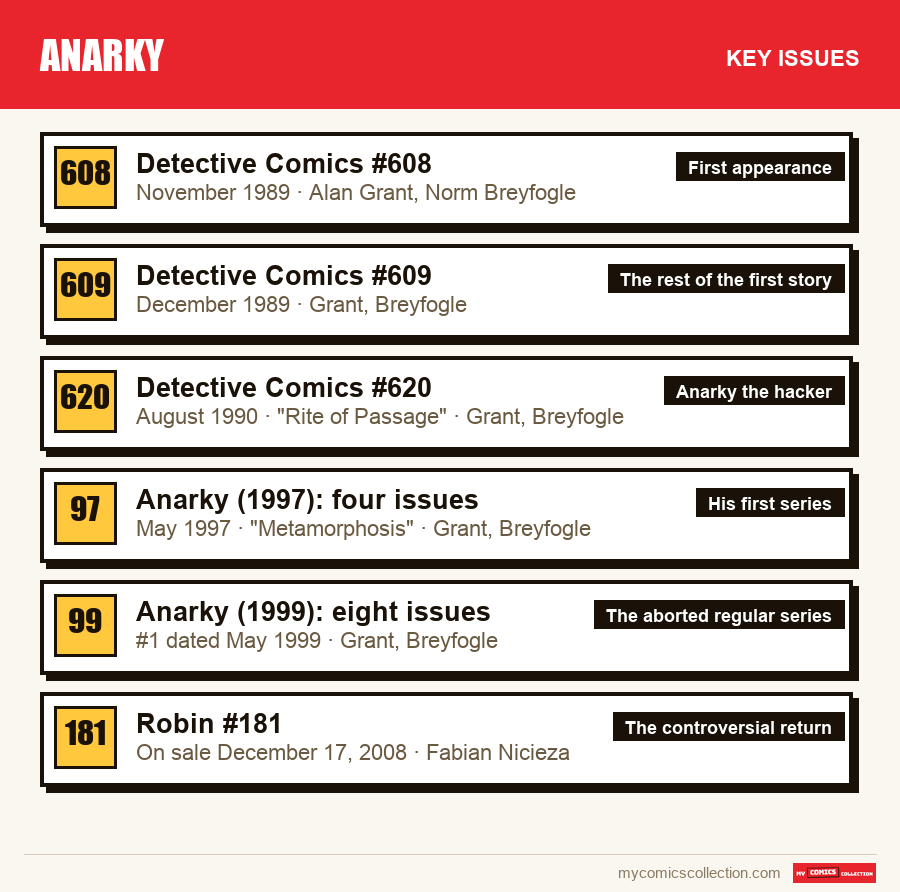
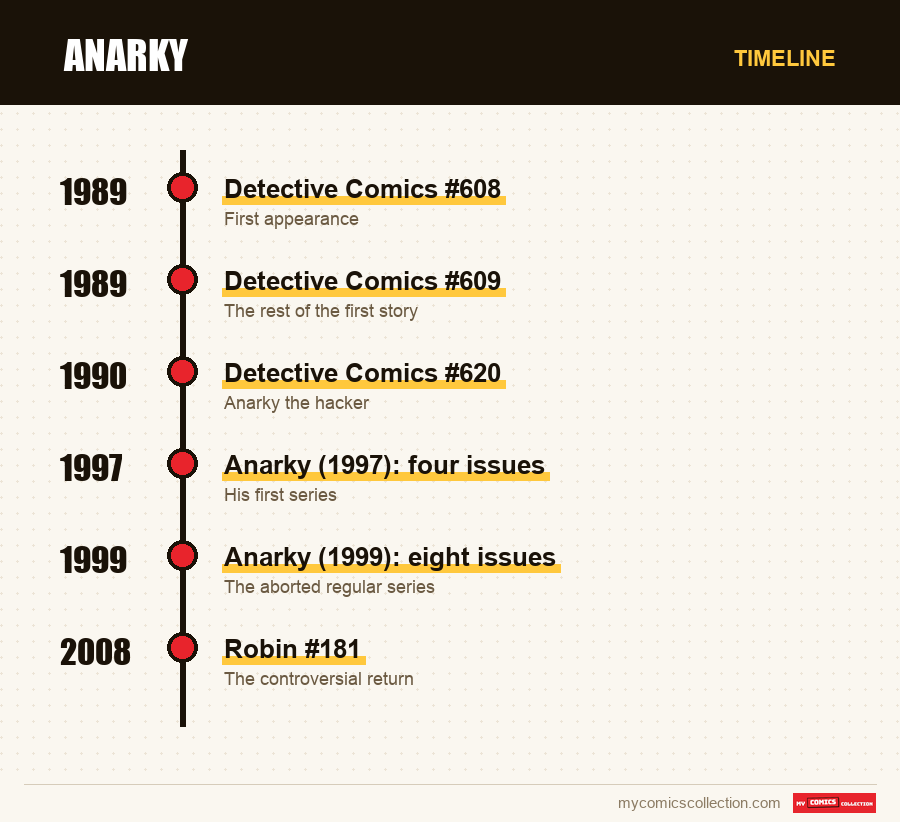
Anarky first appears in Detective Comics #608, dated November 1989, created by Alan Grant and Norm Breyfogle: Lonnie Machin, a gifted teenager who goes after polluters and the powerful in the name of anarchism. The key issues that follow are #609 (the rest of the first story), #620 (August 1990, Lonnie becomes a computer hacker), the 1997 Anarky miniseries (four issues) and the 1999 series (eight issues). After a long eclipse, the character returns in Robin #181 (2008), then under other identities in Green Lantern Corps #25 (2013) and the New 52 period. He will be at the heart of Gangs of Gotham #1, announced by DC for November 4, 2026 (Cantwell and Henderson). For a collector, Detective #608 remains the centerpiece.
Anarky has never been a top-tier Batman enemy. That is exactly what makes him interesting: a character with no superpowers, who does not kill, and whom even his writers hesitated to call a villain or a hero. Created for a single story, he came back at his writer's insistence, got his own series, vanished for nearly ten years, then was reinvented several times.
The launch of Gangs of Gotham, scheduled for November 4, 2026 with Anarky at the center, puts attention back on his original issues. This guide goes through them in order, explains what each one brings, and says which deserve a place in a collection.
Who Anarky is, in two paragraphs
Lonnie Machin is introduced as a twelve-year-old boy, the only child of a middle-class Gotham family, with an exceptional intelligence and political education. He reacts to complaints published in a newspaper's letters column by going after those responsible, for example the owner of a factory polluting a river. Batman stops him, but quickly realizes he is dealing with a child.
The character is named after his philosophy, anarchism, and his stories are often political parables. Alan Grant, who wrote him almost alone from 1989 to 1999, used them to channel the evolution of his own ideas. Norm Breyfogle, who drew him, described him in turn as a misunderstood hero and as a villain "technically." That blur is Anarky's signature.
The key issues, in order
Detective Comics #608
First chapter of "Anarky in Gotham City," subtitled "Letters to the Editor." Lonnie Machin appears directly under the name and costume of Anarky, with his origin kept for later. Breyfogle later ranked this cover among his favorite work.
Detective Comics #609
Second part of the origin story. Its cover pits Anarky as champion of the oppressed against Batman as champion of the law, an image that sums up the whole character. #608 and #609 are collected together.
Detective Comics #620
Second major appearance, in the story "Rite of Passage." Lonnie reveals hacking talents there, which let him divert large sums from corporations. He is one of the first important computer hackers in the DC universe. The issue is also known for one detail: a copy of V for Vendetta sits on Lonnie's shelf, an openly acknowledged nod to Alan Moore's work.
The 1990s appearances
Grant brings Anarky back occasionally. He places him in the Robin annual #1, "The Anarky Ultimatum," where the character is fourteen, in the Knightfall saga, and in Batman: Shadow of the Bat, whose #40 again shows a copy of V for Vendetta in his room. He also gives him an episode of The Batman Adventures, #31, where Anarky stages the televised trial of industry bosses. These issues matter to a complete collection, without having the status of the previous three.
Anarky (1997): four issues
After the 1996 market crash, Breyfogle was looking for a project at DC and pushed Grant to write a miniseries about the character. The result, four issues published from May 1997, was well received by critics and readers. Grant would count it among the peaks of his career. Lonnie is fifteen there, and his ideas now rest on a rationalist philosophy that Grant was then defending.
Anarky (1999): eight issues
The miniseries' success led DC to launch a regular series. Grant doubted its chances, and what followed proved him right: the series was canceled after eight issues, poorly received by critics. Grant himself said he did not like it. It reportedly found an audience in Latin America, though. Lonnie is sixteen there.
The eclipse, then the reinventions (2000-2018)
After the series was canceled and Grant left DC, Anarky nearly disappears for about nine years, apart from a few brief appearances. In 2005, James Peaty brings him back in Green Arrow #51, "Anarky in the USA," whose cover announces his return; nothing of the sort happens. In 2006, despite repeated requests from the public, he does not appear in the series 52, contrary to what its writers had hinted.
Robin #181
Anarky reappears, but the costume is worn by another villain, Ulysses Armstrong, while Lonnie Machin is shown paralyzed, hooked up to computers. The choice provoked negative reactions, including from Alan Grant. Nicieza then picks up both characters in Red Robin, from #16 in 2010.
The New 52 relaunch then multiplies the versions. DC announced on August 12, 2013 the reintroduction of Anarky in Green Lantern Corps #25, published November 13, 2013, tied to the Batman: Zero Year event. Another version appears in Detective Comics under Francis Manapul and Brian Buccellato: a corrupt politician, Sam Young, who takes on the identity of Anarky to get revenge. A female Anarky from a parallel Earth appears in Earth 2: Society. With the Rebirth period, a redesigned Anarky offers his help to Spoiler in Detective Comics #957, and a one-shot, Red Hood vs. Anarky, pits him against Jason Todd in 2018.
In that same year 2013, the character gains new visibility outside comics: he is the main antagonist of the animated series Beware the Batman, then one of the opponents in the game Batman: Arkham Origins. Our article Beware the Batman, the series versus the comics shows how far that version departs from Lonnie Machin.
Gangs of Gotham: what we know as of October 3, 2026
DC has scheduled Gangs of Gotham #1 for November 4, 2026, written by Cantwell and drawn by Henderson, with Anarky as the central figure. As of writing, no further detail is confirmed by a primary source: neither the version of the character used, nor the length of the series. Any claim on these points would be premature.
For a collector, this kind of announcement has a known effect: attention shifts to the character's first appearance. If the series durably establishes Anarky, Detective #608 will benefit. If it remains a one-off project, interest will fade. In both cases, the 1989 issues remain the reference.
How to build an Anarky collection
The core: Detective #608 and #609
The first appearance and the end of the origin story. If you can only buy one thing, it is this pair.
The second circle: Detective #620 and the 1997 miniseries
#620 adds the hacker dimension, the 1997 miniseries the character's best story according to its own writer.
The 1999 series
Eight issues, easy to gather. #1 is enough for a key-issue collection; the full run interests those who want all of Grant and Breyfogle's work.
The modern versions, on demand
Robin #181, Green Lantern Corps #25 and Red Hood vs. Anarky document the reinventions. They are only useful if you follow the character in all his incarnations.
To place Anarky among Batman's enemies, our list of Batman key issues and the Batman reading guide put the Grant and Breyfogle period in the context of the character's history. For the link with Tim Drake, see our Robin reading guide.