This antagonist has never had a monthly series in his name, and this absence is not an editorial oversight: it is a consequence of the format. A monthly series assumes a protagonist who prevails often enough to keep the reader coming back; an opponent who wins regularly ceases to be an opponent. His appearances are therefore distributed among the titles of the heroes he faces, with no entry point, no obvious reading order and no closed list. The asking price statement from August 29, 2026 reflects this dispersion: median of $5.59 on 132 raw ads for a general question on the character, compared to $24.99 on 145 raw ads when the question targets its beginnings.
A character without a series in his name exists differently than a character who has one. It has no numbering, no rhythm, no place to look for it: it has passages, in titles that belong to someone else.
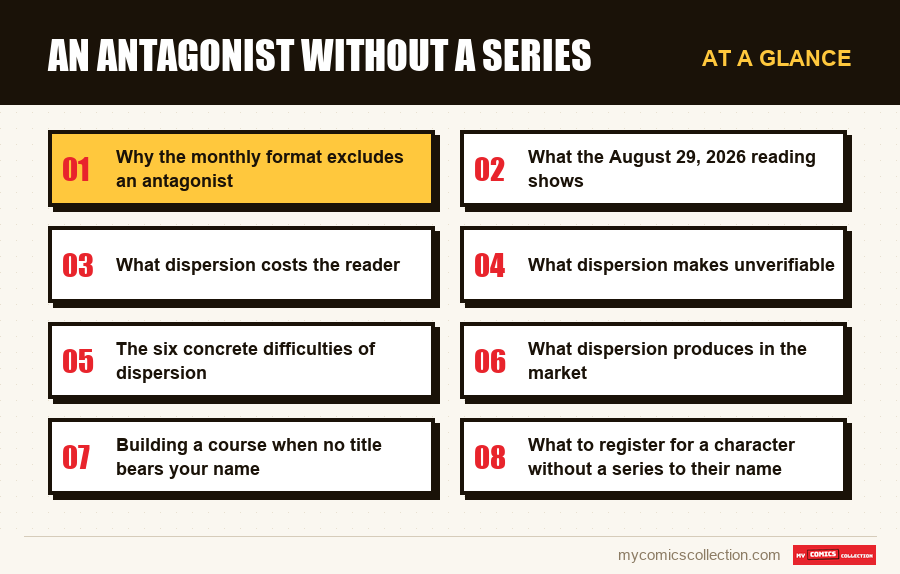
The following explains why the monthly format structurally excludes an antagonist, what dispersion costs the reader, what it makes unverifiable for those documenting a collection, and what it produces on an ad statement.
Why the monthly format excludes an antagonist
The reason is mechanical and relates to the implicit contract of a periodic series. A monthly title asks the reader to come back, and for them to come back, a central character must go through the episodes while remaining recognizable. This character must lose sometimes, but prevail often enough that following his journey makes sense.
An adversary cannot fulfill this contract without destroying himself. If he wins repeatedly, the universe around him becomes empty of its stakes and he becomes a backdrop rather than a threat. If he loses repeatedly, what made him formidable erodes issue after issue, and the reader stops believing in the danger he represents.
The monthly format therefore requires from the protagonist a property that the antagonist cannot have: the ability to conclude regularly to his advantage without damaging his function. A hero who wins remains a hero. A winning opponent becomes the established order, and there is no more story.
The editorial solution consists of making it appear elsewhere, in others. He enters an existing title, occupies the obstacle position for the duration of an arc, then exits. Its menace is preserved because it is never subjected to the test of monthly repetition.
This economy works perfectly from a narrative point of view. However, it produces a side effect that no one has decided on: the character no longer has an address. He only exists as a guest in series whose title names someone else.
What the August 29, 2026 reading shows
Two interrogations carried out on the same day give two very different images of the same character. All values that follow are asking prices observed on August 29, 2026, never sales concluded, with the gross and the certified counted separately.
The general question, in raw form
132 ads, of $1.92 to $219.95 requested, for a median of 5,59 $. Half of the offer is therefore under six dollars.
The general questioning, in certified
12 ads only, of $56.00 to $289.00, median $91.97. The verified segment here is marginal in number.
The targeted questioning on its beginnings, in raw form
145 ads, median $24.99. A population comparable in size, but whose center is located almost five times higher.
Targeted questioning, certified
38 ads, median $108.50. Three times more copies checked than in the general query.
These two questions do not delimit watertight sets: they are porous, and some of the advertisements can answer both. The gap they reveal is no less clear.
The overall median, $5.59, is nearly five times lower than the median achieved by targeting its debut, $24.99. The careful reading of this gap is simple: it does not measure a hierarchy of quality, it measures the difference between identified fascicles and a mass of ordinary apparitions that nothing distinguishes from each other.
It is necessary to add a reservation which applies to all of the above. A statement carried out on a single day describes the status of the offer on that date, never an evolution. Nothing here allows us to say that a price is rising, falling or remaining stable: these figures capture what sellers were asking for on August 29, 2026, and that's all they say.
The dispersion produces a flat reading because no fascicle belongs to the character. In a series bearing his name, each number would by construction be a number of this character, and the whole would form an identifiable column in the market.
Here, each issue first belongs to the series that publishes it. The character is just one content among others, and the asking price reflects the object (the title, the number, the condition) much more than the presence we are looking for there. Hence a low median despite an abundant ad population.
What dispersion costs the reader
A character with a series offers three things for free to the newcomer: an entry point, an order, and a boundary. The number 1 tells where to start, the numbering tells which direction to move forward, the end of the series says where the object stops. A scattered antagonist offers none of the three.
There is no entry point. The question “where do I start?” » has no single answer, because each candidate imposes a context: entering through a title where he appears is entering the story of the hero of this title, with his own issues, his secondary characters and his state of advancement. The reader discovers the character through a plot that does not concern him.
There is no obvious order. The appearances are dated, therefore orderable chronologically, but this order is not a reading order: it jumps from one title to another, cuts current arcs, and assumes knowing at each stage situations explained elsewhere. The chronological order is an archivist's order, not a reader's order.
There are no borders. It's impossible to know when we've finished, since nothing closes the whole thing. The character can reappear in any title, on any date, and the list that was thought to be complete becomes partial again.
These three gaps accumulate in the same reader, at the same moment, and produce the most common effect when faced with this type of character: we don't know where to take the object, so we don't take it. Curiosity does not turn into reading, for lack of a first step.
What dispersion makes unverifiable
The documentary problem is of another nature, and more stubborn. For a series with its name, completeness is a closed question: there is a first number, a last number, and a series of integers between the two. We can check.
For a scattered antagonist, completeness is not a difficult question: it is an ill-posed question. There is no closed list of his appearances, because there is no single criterion that decides what counts. A full plot obviously matters. An appearance of a box? A mention by a third party? A silhouette on the last page announcing an upcoming arc? An alternative version from another continuum?
Each of these answers is defensible, and each produces a different list. The catalog makes it possible to establish solid records of appearances, but it documents occurrences; it does not decide for you what a given collector decides to include within their own scope.
The practical consequence is that a collection dedicated to this character can never be declared finished. It can only declare itself complete according to a definition, and this definition must be written down somewhere, otherwise it drifts over time without anyone noticing.
This is the exact opposite of the usual situation. The collector of a series knows the denominator and looks for the numerator; here the numerator accumulates without a denominator, and the percentage of progress, which is reassuring elsewhere, simply has no meaning.
The six concrete difficulties of dispersion
They manifest themselves when searching, classifying or purchasing, and they reinforce each other.
No entry door
There is no number 1 to recommend, so no simple answer to the most common question.
An exploded bibliography
The appearances are spread over dozens of titles, none of which bear his name.
An undefined perimeter
Single box, mention, silhouette, alternative version: nothing says in advance what counts as an appearance.
Incomplete arcs
An appearance often belongs to a story that begins and ends in other issues of the same title.
A counterintuitive classification
Arranged by title, the collection scatters the character; row by character, it dismembers the series.
Porous research
Questioning the name alone brings up unrelated objects; specifying it makes real apparitions disappear.
These six difficulties explain why two collectors of the same character almost never have the same collection, while two collectors of the same series end up converging on the same object.
Collecting this series?
Track what you own, what you are missing and what your collection is worth. 7 day trial.
Start my trial →What dispersion produces in the market
The market effect arises directly from the absence of property. A booklet does not belong “to it”: it belongs to the series that publishes it, and its asking price is first formed on this basis.
The first effect is a flat reading. With 132 gross listings on August 29, 2026 and a median of $5.59, most of the supply sits in a narrow, low band. This is not a sign of disinterest: it is a sign that the majority of the issues concerned are valued as ordinary issues of their respective series.
The second effect is misleading amplitude. The same question goes from $1.92 to $219.95. A gap of this magnitude could suggest a market structured in tiers; above all, it reflects the heterogeneity of what the research brings back, from the random booklet to the object identified as important.
The third effect is the scarcity of the certified. Twelve ads verified only on the general query, compared to thirty-eight on the targeted query. Certification has a cost which is only justified if the object is identified; on a mass of ordinary apparitions, no one engages him.
The fourth effect is the identification premium. Going from $5.59 to $24.99 in median, for comparable populations, amounts to measuring the value of being designated. It is not the character that changes between the two questions, it is the degree to which a booklet is recognizable as an object in itself.
It is necessary to repeat the limit here: these four observations describe the offer of a day. None allows us to affirm a movement, nor to project anything for the following months.
Building a course when no title bears your name
The absence of a series does not prohibit reading the character: it forces you to decide for yourself what the publisher has not decided. Three choices are enough to make the object usable.
Choose an axis rather than exhaustiveness. Following the character through a single hero, or through a single narrative form such as cross-stories between titles, produces a coherent and finished reading. It is an assumed renunciation, preferable to an open list that will not be completed.
Read by arc, not by appearance. An isolated appearance taken out of context is often incomprehensible. Taking the full arc of the relevant title costs a few more issues and makes the passage readable, something the raw chronological list never does.
Write your own inclusion criteria. Decide once and for all whether a statement, a single box, or an alternate version counts, then stick with it. This criterion will not be fair to anyone else, and that is exactly why it must be recorded.
These three decisions transform a borderless whole into a bounded project. They do not restore the convenience of a series, but they make possible what dispersion made discouraging: knowing where we are.
What to register for a character without a series to their name
The useful card is not that of a serial number: it must bear what the dispersion erases.
The host title and character's position in the issue. Each line first belongs to a series which is not its own. Noting the title, and especially the nature of the presence (central plot, supporting role, appearance of a panel, mention) is to give yourself the means to reread your own scope later without reopening the booklets.
The arc to which the apparition belongs and its neighboring numbers. An isolated passage is almost never autonomous. Recording the story of which it is part and the numbers which surround it avoids purchasing the same reading hole twice, and immediately indicates that an acquired booklet is unintelligible without the two which surround it.
The inclusion criterion applied to this line. Since no closed list exists, each entry results from a decision. Writing it down (“retained because it acts,” “retained although it is only evoked”) is what distinguishes a defined collection from an accumulated collection, and it is the only thing that makes completeness questionable.
The source that made this appearance known. Catalogue, personal statement, indication of a seller: the three do not have the same solidity. An appearance known through an announcement and never confirmed elsewhere must be marked as such, otherwise it circulates in your inventory with the status of an established fact.
The asking price noted on the date of the consultation. On a character whose offer is flat and scattered, an amount without a date means nothing. Saving “asking price, such date” (like the values of this item, recorded on August 29, 2026) preserves the only information that will remain usable: the status of the offer at the time you looked.
Because the monthly format assumes a protagonist who wins often enough that we want to follow him. An adversary who wins repeatedly nullifies the stakes of his universe; an opponent who loses repeatedly ceases to be threatening. The editor therefore preserves his function by having him intervene in others, in passages, rather than by giving him a title.
There is no single answer, and this is precisely the problem posed by dispersion. The feasible solution consists of choosing an axis: following it through a single hero, or through a single form of story. Reading by full arc rather than by isolated appearance makes each passage understandable, something raw chronological order does not do.
No, not in the usual sense. There is no closed list of his appearances, because no single criterion decides whether a mention, a unique box or an alternative version counts. A collection of this type can only be complete according to a definition written by its owner, and this definition must be recorded so as not to drift.
On August 29, 2026, the general poll yielded 132 gross listings, from $1.92 to $219.95 asked, for a median of $5.59. This level is explained by the fact that no issue belongs to it: each issue first belongs to the series which publishes it and is valued as such. These figures describe the supply of that day and say nothing of an evolution.
These are the raw medians of two questions conducted on the same day, one general on the character, the other targeted on his beginnings. The cautious reading is that the gap measures the difference between identified fascicles and a mass of ordinary apparitions that nothing distinguishes. The two interrogations are porous and do not isolate watertight assemblies.
A bibliography without series, it’s in the hand
Host title, nature of presence, inclusion criterion, date of price recorded: enough to know where you are on a character who does not have a number 1.