A print series launched in 2019 around Loki found itself covered by the adaptation that followed shortly. The reflex would be to believe that the screen brings up everything that already exists on the character: the opposite is observed. An adaptation that arrives just after a series does not make it discovered, it makes it outdated. The public that arrives is looking for what they have just seen, and a title published before cannot resemble something that did not yet exist when it was written. The publisher immediately puts back on the shelves a title based on the adaptation, which becomes the official entry point. The previous one slips into the blind spot. On the second-hand market, on August 29, 2026, this series appears under 61 uncertified advertisements, between $1.49 and $39.99, with a median of $6.70: these are amounts claimed by sellers on this date, not concluded transactions. A single verified listing exists at $226.98; an announcement is not a market and strictly does not authorize any conclusion.
There is a comfortable belief among readers and sellers alike: the screen is a machine for rehabilitating paper. A character appears in the image, his notoriety increases, and everything that bears his name in bookstores would mechanically benefit from the movement. The recent editorial history of Loki says something else, and says it clearly enough for us to draw a rule from it. The series launched in 2019, in the window immediately preceding the adaptation, was not carried by it. It was erased by her. Not because it is weak (on this point I make no claims, I have no element with which to judge it) but because the calendar has deprived it of its function. She was no longer the gateway to the character, and a series that is no longer a gateway becomes invisible even when it remains available.
This text is not a price article. The figures for August 29, 2026 are used only once, as an illustration of what becomes of a series eclipsed on the second-hand shelf, and with all the necessary reservations: a reading taken on a single date does not draw any trajectory, shows neither increase nor decrease, and cannot therefore be used to tell an evolution. What interests me here is editorial: understanding why a launch date, within two years, decides the visibility of a title for its entire life, and what a reader can do with this mechanism once they have understood it.
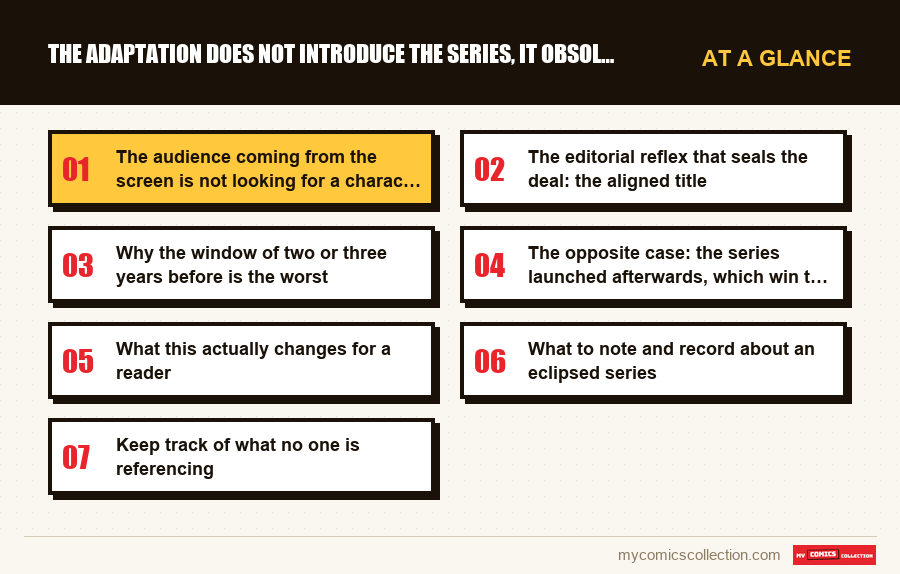
The audience coming from the screen is not looking for a character, they are looking for a resemblance
This is the point we almost always miss. When someone finishes an adaptation and heads to the comic book section, they don't phrase their request as "I want to read Loki." He formulates it, without admitting it, as “I want to find what I just saw”. The tone, the rhythm, the relationship between the characters, the range of humor, the way in which the plot is framed. It's not a request about a character, it's a request about an experience. And a series written before the adaptation cannot satisfy this demand, for a reason which has nothing to do with its quality: it was conceived in a context where the object of comparison did not exist.
The bookseller or online consultant who receives this reader knows this instinctively. Handing him a 2019 title and telling him “it’s very good” is a bad commercial calculation, because disappointment is likely: the reader will look for references there that he will not find and conclude that the comic “is not like the series”. The advice therefore moves towards what looks like. There's nothing malicious about the mechanism, it's purely functional, but it dooms the previous window to never being recommended again at the exact moment when the character attracts the most people.
We must add a nuance which aggravates the phenomenon. Adaptation does not simply offer a version; it installs a reference version. Once millions of people have seen a character in a given form, that form becomes the default, and anything that deviates from it is seen as a variation, or even an error. A previous series cannot be perceived as the original version by this audience, because for them the origin is the screen. It is received as a deviation. And a gap, no one recommends it to a beginner.
This shift in the reference also explains why the problem does not resolve over time. One could imagine that once the excitement has died down, curious readers go back and rediscover what came before. It happens, but marginally, and especially not when it would count. When the wave passes, the recommendations are already written, the lists already fixed, the reissues already oriented. The title of the pre-adaptation window crosses the wave without being mentioned, and emerges on the other side with an additional handicap: it is now dated without having been read.
The editorial reflex that seals the deal: the aligned title
An official entry point is made
When an adaptation is approaching or has just been released, the publisher relaunches a title based on it. This title is not just another product: it is designated, by the promotion and by the cover, as the place to start. Once an official entry point exists, all others become annexes.
The previous series loses its role, not its quality
A title has two values: what it is worth when reading, and the function it occupies in the landscape. The second can be removed overnight without the first moving a millimeter. This is exactly what an aligned relaunch produces.
Reissues follow alignment
What we reprint, what we put forward, what we translate and what we recompile into a collection obeys the same logic. An unaligned series is reprinted more rarely, therefore less seen, therefore less in demand, therefore even less reprinted. The loop closes on itself.
Tip lists crystallize the state of the moment
The recommendations written during the wave become the lasting reference, because they concentrate the audience. They photograph a moment where the aligned title is in front and the previous one in retreat, then freeze this photograph for years.
None of these four stages is a decision against the previous series. No one bury him voluntarily. It is simply ruled out by a succession of rational choices taken at the individual level: the publisher wants to capture the available public, the seller wants to avoid returning merchandise, the list editor wants to give advice that works, the reader wants to find what he liked. The cumulative result is an eviction, but nowhere is there an intention to evict. This is what makes the phenomenon so regular: it does not depend on any will, only on a sequence.
A clarification on the figures cited above, because it completely changes their reading. The 61 listings noted on August 29, 2026, ranging from $1.49 to $39.99 with a median of $6.70, are prices posted by sellers at a given time. No one has demonstrated that a single one of these copies found a buyer for this amount. An asking price expresses an intention to sell, not an agreement between two parties. And as it is a single statement, with no previous point of comparison, it does not show any movement: writing that these amounts “have fallen” or “are being maintained” would be an unsupported assertion.
The case of the verified ad deserves to be treated separately, and treated firmly. There is only one, priced at $226.98. An ad is not a deal. It constitutes neither a level, nor a reference, nor an order of magnitude, nor a floor, nor a ceiling. We don't calculate anything on it, we don't average it with anything, we don't contrast it with uncertified announcements to deduce a difference. It proves exactly one thing: that a verified copy exists and is being offered. Any sentence that goes beyond that would be invented.
Why the window of two or three years before is the worst
Too new to be a classic
A series several decades old benefits from a status: it is cited for its seniority, it has had time to establish itself in the references. A pre-adaptation window series built nothing like this. She is too young for history to have decided in her favor, and already too old to be news.
It occupies the place that the relaunch will take
The aligned title fills exactly the niche of the previous title: same character, same format, same radius, same target audience. It's not a competition from afar, it's a substitution. Two titles cannot simultaneously be "the current series" of the same character.
Its cover no longer refers to anything recognizable
The visual of a previous series cannot play on the resemblance with the screen, since it was designed before. On the shelves, next to a title whose cover immediately evokes what the reader has seen, it does not trigger any recognition. The visual sorting is done in a second, and it is done against him.
It circulates without being asked
However, second-hand circulation does not stop: copies exist, they pass from hand to hand, they are put back on sale. What is lacking is not the supply, it is the demand directed towards them. A regular supply in the face of poorly directed demand produces a stocked and calm second-hand section.
She didn't have time to produce her own benchmarks
A series needs several years for the community of readers to identify what matters in it, to talk about it, to refer to it. The pre-adaptation window cuts this process midway: attention shifts elsewhere before the collective work of designation has taken place.
She is judged on a criterion she never aimed for
The only criterion available after adaptation becomes fidelity to it. A previous series is evaluated against a specification written after it. She fails an exam for which she did not take, and this verdict then sticks with her for a long time.
Collecting this series?
Track what you own, what you are missing and what your collection is worth. 7 day trial.
Start my trial →The opposite case: the series launched afterwards, which win then age with the wave
Symmetry is instructive. A series launched after the adaptation leaves with everything that the previous one lacks. It can play on resemblance, it is designated as the natural extension, it captures the public when it is most numerous and most available. Its first issues circulate widely, they are commented on, recommended, offered. In this segment, the momentum is real and there is nothing to dispute.
But this advantage has a price, and it is paid for later. A series which owes its visibility to the momentum of an adaptation is indexed to this adaptation. It is read as its accompaniment, and it embraces its life cycle. When the adaptation ceases to be current, when another production takes over and redefines the reference version again, the aligned series finds itself with a particular fault: it is dated not by its time of publication, but by the screen version to which it was attached. This is faster aging, because it follows a moving object.
This difference in mechanism deserves to be clearly stated, because it greatly qualifies the usual advice. The pre-adaptation series is ignored but autonomous: it does not depend on any external version to be understood, and nothing will expire in that respect. The post-adaptation series is visible but dependent: it needs the memory of the screen to remain vivid to maintain its most obvious interest. Ten years later, it’s not necessarily the second that holds up best.
There is a third case, rarer and more enviable: series old enough to be beyond the reach of the cycle. They are neither eclipsed nor carried, they are elsewhere. No one asks them to look like anything, because everyone admits that they are way ahead of them. This protective status is not available to a 2019 title, which is precisely too close to benefit from it and too early to benefit from the momentum. The pre-adaptation window is an in-between, and it is an in-between without shelter.
What this actually changes for a reader
The practical conclusion is frankly encouraging, and it is rarely stated. The series in the pre-adaptation window form a set which combines three properties: they are often good, they are never recommended, and they are very accessible. These three properties are linked together by the mechanism described above, which means that we can search for them methodically rather than stumbling upon them by chance.
Often good, first of all, for a structural reason: a series launched in the months preceding an adaptation generally benefits from serious editorial investment, because the publisher anticipates the attention to come and does not entrust such a slot to just anyone. On the other hand, it has no fidelity constraints, since the object to be imitated does not yet exist. It's a rather favorable combination: means and freedom. I don't claim that this guarantees a result, but the starting conditions are rarely bad.
Never recommended, then, we saw why: they leave the field of advice at the precise moment when advice is produced en masse, and they no longer fit into it. This is not a judgment made on them, it is an absence of mention. The difference is crucial for a reader: actively looking for what no one is talking about is not the same thing as looking for what everyone advises against.
Very accessible, finally. This is the only point where the figures for August 29, 2026 have something to say, and they say it modestly. Around sixty uncertified ads, half of which are below $6.70, describe a second-hand section where there is no shortage of copies and where no one is rushing. Once again, these are requests from sellers and not concluded sales, recorded on a single date, so nothing is demonstrated on any movement. But for a reader who simply wants to read, the useful information is there: the offer is abundant and the choice is wide.
The method that comes from all this can be summed up in one sentence: when a character interests you and there has been an adaptation, deliberately look at what was published in the two or three years preceding it. This is the area that recommendations systematically skip, and it is the area where the relationship between what we find and what we look for is the most favorable. The rest (what precedes the adaptation by a long way, what follows it) is already covered by everyone.
What to note and record about an eclipsed series
Note the launch date in relation to the adaptation, not in absolute terms. For this type of title, the year alone doesn't say anything useful. What matters is the gap: how many months separate the launch from the release of the adaptation, and on which side. A file that bears “2019” without this relationship loses the most explanatory information in the entire file. Record the position in the cycle, it will later explain why the series is missing from all the lists.
Distinguish in your notes the previous title from the aligned title that followed it. Both bear the name of the same character and look similar in the catalog to the point of being confused, including in second-hand ads where the seller sometimes only mentions the character. A collection that does not clearly separate the two series produces unintentional duplicates and invisible holes. The reliable benchmark is the series it belongs to, not the name on the cover.
Record the observed availability, not the asking price. For a series in this category, the information that will really help you is to know whether the copies meet often or rarely, and in what condition. An amount displayed by a seller tells you almost nothing as long as no sale has validated it. Instead, write down what you actually saw pass, with the date of observation, so that the reading retains meaning when you read it again.
Explicitly mark verified copies as a separate category. In this series, there is only one available for August 29, 2026, which prevents us from getting anything out of it. But the habit applies to everything else in your collection: a copy passed through a verification body does not belong to the same set as a raw copy, and mixing them in the same column makes any subsequent reading misleading. Two categories, two counts, never a common average.
Record why you chose this title, while the reason is fresh. This is the most specific advice for eclipsed series: as no one will write for you what is interesting in it, your note is the only trace that will exist. A line on what led you to this series, on what you were looking for in it, on what you thought of it, is better than a reference to a recommendation article which, for this title, has never been written and will not be.
This is the intuitive expectation, and it is poorly verified for the series published just before. The public who arrives after the screen is looking for a resemblance to what they have just seen, and a title written before cannot provide it. At the same time, the publisher highlights a title based on the adaptation, which becomes the designated entry point. The discovery does take place, but it is directed towards this new title, not towards the previous one.
Nothing described here relates to its quality. The eviction mechanism has everything to do with timing and how the recommendations are made, not what's on the pages. A series can lose its function as a gateway without losing any of its reading value. The two things are independent, and that is precisely what makes this category interesting to explore.
That a verified copy is offered at this amount, and nothing more. A single announcement does not constitute a market: it defines neither a level, nor a range, nor a point of comparison with the raw copies. It cannot be averaged, nor compared, nor presented as the value of a certified copy. With a headcount of one, no conclusion on a price is possible.
They are easier to find and much better recommended, which is a real advantage when starting out. In return, they are indexed to the adaptation that carried them and age with it: when the reference version changes, they appear dated more quickly. An earlier series is ignored but autonomous. The choice depends on what you are looking for, not general superiority.
Starting from the date of adaptation and going back two to three years, for each character that interests you. The area immediately preceding a screen output is the one that advice lists most consistently skip, because they were written during the wave and geared toward the aligned title. This calendar scan is more effective than any keyword search.
Keep track of what no one is referencing
Eclipsed series do not appear in any advice list, and it is precisely for them that personal follow-up is most valuable. My Comics Collection allows you to record your issues series by series, separate verified copies from the rest, and record your own dated observations rather than prices posted by others.