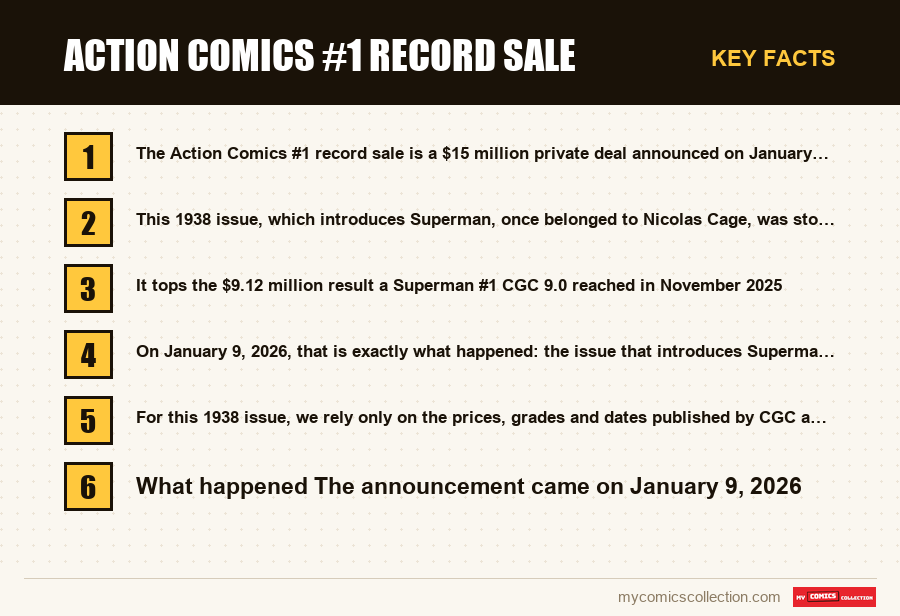
The Action Comics #1 record sale is a $15 million private deal announced on January 9, 2026: the CGC 9.0 copy of Superman's debut changed hands through Metropolis Collectibles and ComicConnect, with no auction room involved. Buyer and seller stayed anonymous. This 1938 issue, which introduces Superman, once belonged to Nicolas Cage, was stolen from him in 2000 and was recovered in 2011. It tops the $9.12 million result a Superman #1 CGC 9.0 reached in November 2025.
It is rare for a single sale to reshuffle a ranking that everyone assumed was settled. On January 9, 2026, that is exactly what happened: the issue that introduces Superman retook the top spot among comic book sales just weeks after the November 2025 result, and it did so without a public auction, without a gavel, without a catalog.
For this 1938 issue, we rely only on the prices, grades and dates published by CGC and the market press; the commentary on method is our own, and no Siegel and Shuster page is reproduced here.
What happened
The announcement came on January 9, 2026. A copy of Action Comics #1, the 1938 issue that contains the first appearance of Superman, sold for $15 million. The book carries a CGC 9.0 grade. The deal was a private sale: it was negotiated by Metropolis Collectibles and ComicConnect, two specialist intermediaries, and neither the buyer nor the seller was publicly identified.
Several elements of this announcement are worth keeping apart, because headlines sometimes blur them. The amount is the sale price. The grade is the one assigned by the grading company CGC. The channel, finally, is private: one general news outlet used the word "auction" in its headline, whereas every press release and the specialist press describe a negotiated deal between the parties. For a collector the difference is real, and we come back to it below.
The official account published by CGC also lists the benchmarks around this issue. Fewer than a hundred copies appear in its population registry. Only two carry a 9.0 grade. The grader's page states that the sale is the most expensive ever made for a pop culture collectible, a press-release formula that we report as such, without extending it to other categories of objects.
The creators of Superman here are a duo: Jerry Siegel as writer and Joe Shuster as artist, published by DC Comics. The issue is cover-dated June 1938. It is this specific copy, not the title in general, that has just crossed the $15 million mark.
The immediate context matters too. The previous peak belonged to a Superman #1 CGC 9.0, which sold for $9.12 million at a Heritage Auctions auction in November 2025. Before that, an Action Comics #1 CGC 8.5 held the top spot, hammered at $6 million in a public sale in 2024. The record therefore changed hands twice in a little over two months. The combined sale of a Batman #1 and a second Superman #1, announced in February 2026, followed without topping this ceiling for a single issue; it has its own separate article on this guide.
Point 1: A copy with a turbulent history
What the press remembered most is this copy's journey, because it is documented over more than thirty years and is unusual. CGC and the specialist press give the milestones, which we repeat in order.
In 1992, the issue sold at Sotheby's for a little over $82,000, a figure the grading company presents as a record for a comic at that date. In 1996, Metropolis Collectibles sold it to Nicolas Cage for $150,000, another comic record. In 2000, the book disappeared during a party held at the actor's home. It was found in 2011 in a storage unit in California, recovered by law enforcement and returned to its owner.
About six months later, the actor consigned the book to ComicConnect, which sold it for $2.16 million. According to CGC, that made it the first comic to pass $2 million. Metropolis president Vincent Zurzolo compared the theft and recovery to the 1911 theft of the Mona Lisa, a comparison that, in the firm's telling, partly explains the iconic status this copy has taken on.
For anyone who follows the market methodically, this timeline has a concrete consequence. A copy whose every owner is known sells with a story that other copies lack. After its return, the book was re-encapsulated by CGC with a label bearing the notation "From the collection of Nicolas Cage." That notation has become part of the object: it does not change the grade, it documents the provenance.
Point 2: The steps from 1992 to 2026
Putting the results side by side shows how far this single title has come. Here are the confirmed steps, each with its grade, channel and date, because that triplet is what keeps comparisons honest.
- 1992: the issue from this story sells at Sotheby's for more than $82,000, public sale.
- 1996: sold to Nicolas Cage for $150,000, a private deal through Metropolis Collectibles.
- 2011: the same book, CGC 9.0, sells for $2.16 million through ComicConnect.
- 2014: the other CGC 9.0 copy of Action Comics #1 sells for $3.2 million.
- 2024: a CGC 8.5 copy sells for $6 million in a public sale.
- November 2025: on a different title, Superman #1 in CGC 9.0, the Heritage Auctions bidding stops at $9.12 million.
- January 2026: the 9.0 copy that passed through Nicolas Cage's collection changes hands for $15 million, without an auction room.
A table like this calls for two methodological warnings. First warning: you do not compare a private sale and a public sale as two lines of the same ledger. A public sale exposes a price in plain view, under a lot number, with a hammer date; a private sale exposes a figure announced by the parties or their intermediaries, sometimes without the payment terms. Second warning: the grades differ. The 2024 result concerns an 8.5, the 2011 and 2026 results a 9.0, and the November 2025 result is about a different book.
Point 3: The census, or why the 9.0 matters so much
A CGC 9.0 grade only makes sense in its population context. The CGC registry counts fewer than a hundred copies of Action Comics #1, and only two are graded 9.0. In other words, these two 9.0 copies form a very small pair, and it is one of them, the one tied to Nicolas Cage's name, that has just been sold, the other having been the subject of the 2014 sale.
To understand what this census measures, keep three reading points in mind, which we detail in our guide to the CGC census. First, it counts the books that have passed through the grader, not the ones that exist: a copy never submitted does not appear in it. Second, it moves, because a copy can be regraded or resubmitted. Finally, it is most valuable at the top: knowing that two copies share the best known grade says more than knowing how many exist in total.
Once the grade is read, the book itself remains to be read. In the case of Action Comics #1, remember that the 1938 issue introduces Superman to readers who did not yet know the costumed-hero formula: it is the character's first appearance, which is why it remains the benchmark of the Golden Age.
Do you collect this series?
Track what you own, what you are missing and what your collection is worth. 7-day trial.
Start my trial →
Point 4: What the word "private" tells you
The nature of the transaction deserves its own section, because it shapes how the result should be read. A private sale has no public lot, no bidding period, no posted buyer's fees, and the price is known only because the two parties or their intermediaries chose to disclose it. Here, the disclosure came from CGC, Metropolis Collectibles and ComicConnect, and it was relayed by the general and specialist press.
That does not make the figure doubtful: several independent sources repeated it identically, and we found no discrepancy among them. It simply means that some information a public sale publishes automatically, such as the number of bidders or the fees, does not exist here. If you follow the market, keep two separate columns in your notes, one for hammer prices, the other for announced private sales.
The public sale of an issue at this level, on the other hand, remains an event you can follow step by step. If you ever consider bidding on a vintage book, our auction guide describes the method: read the lot, check the certificate, calculate the fees before bidding.
What this means for a collector
For the vast majority of readers, the answer is short: nothing in your collection is changed by this result, and it would be misleading to suggest otherwise. A $15 million copy is not a benchmark for a modern issue, nor for a Silver Age key, nor even for another, lower-grade copy of Action Comics #1. Each copy is judged on its grade, its history and its sales channel. Here is what the news offers you in practical terms, with no figure to extrapolate.
First takeaway: a vocabulary for checking. When you examine a vintage book, ask yourself what this story teaches. Is the grade from a recognized grader, can the certification number be verified, does the pedigree or collection notation appear on the label? In the case of Action Comics #1, the collection notation was added at the time of re-encapsulation, and it is an example of how a label can carry a history.
Second takeaway: the importance of preservation. A 1938 book that reaches 9.0 has come through more than eight decades without its corners, spine or paper being altered enough to downgrade the copy. At home, that comes down to a modest routine: neutral bags and boards, rigid boxes, books stored without pressure, a room away from sunlight and humidity. None of this creates value; it simply keeps an issue from losing points.
If you want to estimate a book you own, start from its issue number, its edition and its real condition, not from a news headline. To see what separates two copies of the 1938 issue, read our dossier on the value of Action Comics #1; for an issue on your own shelf, simply open its page.
What remains to be confirmed
The information in this article comes from press releases by the grading company and the intermediaries, and from the specialist press. Some points are not public, and we do not invent them:
- the identity of the buyer and of the seller, who remained anonymous;
- the precise terms of the transaction, which are not detailed in the sources we read;
- the page quality of this copy, which is not specified in the documents consulted;
- any possible resale or display of the copy, about which no announcement has been made;
- the exact date the sale closed, since the press gives only the date of its announcement, January 9, 2026.
The CGC census is not frozen: new copies arriving at the grader can change its numbers, and the ones we cite describe the known state at the time of writing.
Frequently asked questions
The price is $15 million, paid for a private sale that the press reported on January 9, 2026. The copy carries a CGC 9.0 grade and the transaction was negotiated by Metropolis Collectibles and ComicConnect. The buyer and seller were not publicly identified.
No. CGC's press releases and the specialist press describe a private sale. One general news outlet used the word auction in a headline, but that wording does not match the channel described. A private sale publishes neither a bidding period nor buyer's fees.
The actor bought it in 1996 from Metropolis Collectibles for $150,000. It vanished from his home in 2000, then police located it in 2011 in a California storage unit before returning it to him. He then consigned it to ComicConnect, which sold it for $2.16 million.
According to the CGC population registry, fewer than a hundred copies of this issue are recorded, and two carry the 9.0 grade. As for its twin at the same grade, CGC says it changed hands in 2014 for $3.2 million.
No, not directly. A result concerns one specific copy, with its grade, its history and its sales channel. Compare your issue with sales elsewhere rather than with eight-figure results: same book, same grade, same method of sale.
Do you own a Golden Age book or a Superman issue you want appraised? Start with its page.
Estimate my comic