Among the announcements noted on August 29, 2026 around the 1981 issue which contains a highly requested first appearance, one of them does not offer the issue: it offers a single page, taken from the issue and sold alone, at $17.98. This is neither an error nor a scam, it is a calculation. When an issue reaches a high price, a copy too damaged to sell properly whole can fetch more cut page by page. The consequence is simple and definitive: each page sold separately removes a complete copy from the world stock, and no one will ever recompose it.
On August 29, 2026, two surveys were made in parallel on this 1981 issue. The first, raw, without sorting: forty advertisements, asking prices ranging from $1.99 to $1,999.99, a median of $240.29. The second, restricted to ads actually verified as relating to the correct item: forty-seven ads, from $139.99 to $2,230.80, median at $399.99. These figures are amounts claimed by sellers on a given date. None proves that a transaction took place at this level, none says in which direction the market is moving, and the isolated maximum, whatever the reading, reflects above all the hope of a seller who has fixed a price and who is waiting.
What makes the first reading interesting is not its median: it is its composition. At the bottom of the range, we find a recent booklet that has nothing to do with the subject at $1.99, two copies of a 2009 booklet whose cover cites that of 1981, listed at $4.99 and $5.98, a collective publication at $9.00, and this single page at $17.98. In other words: the bottom of the list is not made up of cheap copies of the booklet you are looking for. It is made of objects different. And one of them is a piece of the desired object.
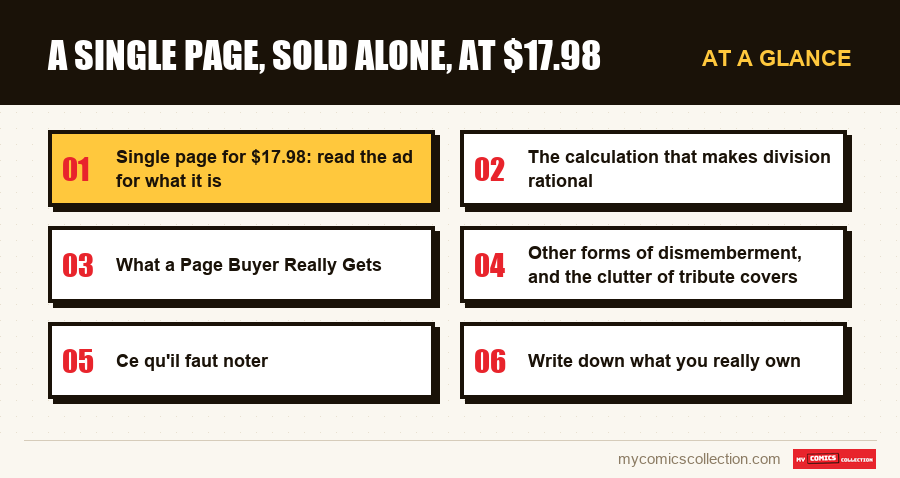
Single page for $17.98: read the ad for what it is
Let's start by dispelling all suspicion. Selling a page taken from a booklet is legal, and the advert noted on August 29, 2026 is explicit: it advertises a page, not a number. The buyer knows what he is buying. There is no deception or hidden practice here. There was a perfectly rational business decision made by someone who owned a copy and felt it was worth more in pieces than in one lump. The whole point of the case is there: it is not an accident of the market, it is a logical consequence of the price.
Let's look at the gap. The verified statement from the same day places the middle of requests at $399.99, with a floor at $139.99. A single page at $17.98 therefore represents a fraction of the floor. For the buyer, this is the only two-digit entry point that really affects the 1981 issue: everything else at the bottom of the range concerns other objects. For the seller, this is a modest amount taken in isolation, but he is not selling a page, he is potentially selling as many as the booklet contains.
It is this shift that we must understand: from a certain price level, a booklet ceases to be a single object and becomes a batch of pages which can circulate separately. The trigger is not rarity in itself, it is the relationship between what a whole copy brings in as it is and what the sum of its parts would bring in.
The calculation that makes division rational
A damaged copy does not follow the market
The high amounts recorded on August 29, 2026 concern copies presented as desirable. A copy with yellowed pages, a tired spine, with a loose cover or a missing corner does not sell at this level: it ends up far below, and above all it stagnates, because the buyer who spends several hundred dollars is looking for a clean object, not a tired object. The seller of a degraded copy therefore finds himself with an unsaleable item at the price he is interested in.
The pages do not have any defects.
A booklet is judged first on its exterior: cover, central fold, staples, edge, corners. However, most of these defects do not affect the interior layers. An interior page may be in very good condition within a copy that is generally in poor condition. By removing it, the seller mechanically gets rid of everything that weighs down the price: he no longer sells a damaged item, he sells a correct sheet.
The sum of the parts exceeds the whole
The seller's reasoning can be summed up in one sentence: if the amount I can hope for for the entire copy, in its actual condition, is less than what I can hope for by adding up the pages sold one by one, then I cut it. He doesn't need to sell all the pages to win, he just needs to sell enough of them. A page at $17.98 takes on its meaning when you multiply it by the number of pages that a booklet contains.
Commercial risk also decreases
Selling an item for several hundred dollars requires a rare, cautious buyer who is demanding on description and shipping. Selling a page for less than twenty dollars requires a large number of buyers, with little commitment, who will not ask for expertise. Slicing doesn't just shift value: it moves the seller from a tough market to an easy one, with light shipping and unlikely disputes.
Add these four elements together and the practice ceases to be amazing. It becomes predictable. As long as a booklet remains cheap, no one cuts it: the game is not worth the effort, the time spent photographing and sending thirty pages costs more than it brings in. As soon as an issue reaches the level observed on August 29, 2026 in the verified statement, the calculation is reversed for all degraded copies in circulation. The high price of the complete issue is precisely what makes destroying complete copies profitable.
We must name the loop, because it is counterintuitive: demand raises the prices charged; the prices asked make dismemberment profitable; dismemberment removes complete copies; the disappearance of complete copies reinforces the rarity which had driven up prices. The mechanism is self-powered, and it does not have any reversible steps.
A cut page cannot be glued back together. We can collect all the pages of the same issue scattered among thirty buyers, we will never obtain the original copy: we will lack the staples, the original fold, the continuity of the paper, and above all the certainty that these pages really come from the same object. Destruction is final, even when every piece survives.
What a Page Buyer Really Gets
An image, not a documentary object
A single page shows drawings and text. It's real, it's pleasant, it's framed. But a collector's booklet is not only worth what it shows: it is worth what it attests: a date, an edition, an editor, a place in a series. The page carries none of this. We buy an illustration, not a documentary piece.
Ni date, ni numéro visibles
The cover date, the number, the publisher's mention and the face price live on the cover and on the legal notices, almost never in the middle of the booklet. Detached, the page loses all these marks at once. There is nothing on the sheet itself to suggest that it comes from the 1981 issue rather than a later reprint with the same content.
Provenance dies with cutting
As long as the page is in the booklet, its provenance is obvious: it is linked to the others. Once separated, the only proof of provenance is the word of the seller. It can be perfectly sincere, but it is no longer verifiable by the object itself, and it does not survive the next resale.
Resale becomes much more difficult
A complete booklet always finds a buyer: it is a unit that everyone understands and that the catalog describes. An isolated page is aimed at a much narrower audience, without a common reference, without a comparison grid. What can be bought in one click is not necessarily sold as quickly.
It does not complete any collection
A collection is counted in numbers owned. One page doesn't check any boxes: it doesn't fill the line of the 1981 issue, it doesn't fit anywhere in a series, and it leaves the gap exactly where it was. It’s a purchase that sits alongside the collection instead of adding to it.
She returns a missing copy
The heaviest point is collective. Buying a cut page means economically validating the operation that destroyed a copy, and therefore encouraging the next one. No one is individually at fault: the seller announces what he is selling, the buyer knows what he is getting. The result is nonetheless one less booklet.
The right question to ask yourself before buying a page is therefore not “is the price right?” » but “what do I think I’m buying?” ". If the answer is “a nice picture that I will frame and look at,” the purchase is consistent and the amount is modest. If the answer includes the words investissement, pièce de collection ou morceau d'histoire, then the purchase is based on a misunderstanding: we pay for a fragment on the grounds that it comes from a rare object, whereas the cutting has removed precisely what made this object identifiable. A second question, just as useful: would I be able to prove the provenance of this leaf to someone who questions it? If not, you must treat it like a decoration, and set your budget accordingly. On this point, the general logic of amounts requested and what they are worth as information worth re-reading before any purchase.
Collecting this series?
Track what you own, what you are missing and what your collection is worth. 7 day trial.
Start my trial →Other forms of dismemberment, and the clutter of tribute covers
The page alone is just a variation. As soon as a number becomes sought after, we see several ways of selling it in pieces appear in the lists, and they all respond to the same calculation.
La couverture vendue seule is the most frequent and the most paradoxical. This is the most recognizable part, the one that bears the title, number, date and image that everyone has in mind; it is also the most damaged part in a tired copy. A seller who has a copy whose interior is correct but whose cover is torn can do the opposite of classic cutting: keep the interior, sell the cover as a graphic object. Result: a decapitated booklet on one side, an orphaned cover on the other, and two objects, neither of which is the number.
L'affiche centrale: the middle double leaf, designed to be unfolded: is a special case, because the publisher himself had thought of it as detachable. Many copies were amputated at the time, by readers who wanted to hang it on the wall. This does not change the effect: a copy without its central double leaf is incomplete, and the double leaf sold alone will never become part of a booklet again. The original legitimacy of the cut does not make the loss any less definitive.
La page publicitaire is the most discreet form, and it has its own audience: period advertisements interest people who do not collect booklets at all. An advertisement from a 1981 issue sells as a period document, regardless of the series in which it appeared. It is even the most profitable cutting in appearance, since it concerns pages that collectors consider secondary, but it mutilates exactly the same copy as the others.
These three forms have one thing in common with the page alone, and it is the only one that counts: they transform an object into fragments whose sum is never recomposed. We can combine the cover, the double page, the interior pages and the advertisements; you will get a stack of paper, not a booklet. The collectible was not the content, it was the assemblage, and the assemblage is precisely what cutting removes.
Alongside these fragments, the statement of August 29, 2026 reveals another source of clutter, of a completely different nature: two advertisements at $4.99 and $5.98 relating to a 2009 issue whose cover explicitly cites that of the 1981 issue. This is what we call a tribute cover: a new design which deliberately adopts the composition, posture, framing or layout of an old cover famous, so that the reader recognizes the quote. Publishers produce them because it's effective at little cost: it signals the lineage of a story, it flatters long-time readers, it gives an immediate visual argument on the shelves, and it creates a piece that some people buy to put next to the original. The approach is explicit, assumed, and in no way misleading.
Its effect on a search is a little less so. A 2009 booklet whose cover reproduces that of 1981 shares its most identifying image with the original. A visual search brings it up; a keyword search also brings it up, since its description will readily mention the tribute and the year cited. Two ads for less than six dollars are therefore placed in the same list as ads for several hundred. They are not counterfeits, they are not fragments: they are other fascicles, perfectly legitimate, which are in the field of research by resemblance. To situate this type of graphic quotation in the long term of a series, the editorial history of the character and his publications provides the necessary benchmarks.
Ce qu'il faut noter
The $17.98 page is not a bargain on the 1981 issue. It's the only item at the low end that actually touches this number, and that's precisely why it's misleading: seeing a double-digit amount in a listing where the verified half is $399.99 gives the impression of an opportunity. There is no opportunity, there is another object, which costs less because it is incomparably less complete.
The median of the raw reading does not describe any specific object. Out of forty advertisements, several of which do not relate to the issue in question (a recent unrelated issue, two tribute covers from 2009, a collective publication, a cut-out page) the $240.29 in the middle is only the midpoint of a heterogeneous list. It is the composition of the segment that informs, not its median. The verified statement, at 47 listings and a median of $399.99, is the only one of the two that speaks of an identified object.
An isolated maximum is an intention, not a price. That the high end of the range is $1,999.99 in one statement and $2,230.80 in the other says nothing more than this: on August 29, 2026, someone asked for this amount. An ad can remain online indefinitely without ever finding a buyer, and an amount claimed is never a recorded transaction. None of these figures allows us to say anything about the direction in which prices are moving.
The high price of the full issue finances its own scarcity. This is the most important point of this article, and the least obvious. It is not despite its value that a booklet is cut up, it is because of it: below a certain level, dismemberment yields nothing. Each degraded copy that goes into pages is one complete copy less, which tightens the offer and reinforces exactly the price logic which had made cutting profitable.
A fragment does not fit into any collection. Page, cover, central double page or advertisement: none of this fills the number box in a followed series. Serious collection monitoring includes identified issues, with their number, year and condition. A fragment does not fit into any of these three columns, and if we choose to keep it anyway, we must note it separately, as a decorative object, indicating that it does not complete anything.
Yes. An owner does what he wants with the paper copy he owns, including cutting it out, and the advertisement noted on August 29, 2026 clearly indicates that it concerns a single page and not the issue. There is therefore no concealment or reprehensible practice. The subject is not legality, it is the cumulative effect: each cut copy disappears definitively from the population of complete copies.
By reading the title to the end, then the description, then looking at the photos one by one. Fragment sellers write it, but the mention often comes after the name of the series and the year, where the eye no longer goes. Two useful reflexes: ask yourself if you see the cover AND the spine in the photos, and be wary of an amount much lower than the rest of the list: in the statement of August 29, 2026, everything under ten dollars concerned another object.
With difficulty, and never by the leaf alone. The date, number, publisher and face price appear on the cover and the legal notices, not in the middle of the booklet. Once detached, the page no longer bears any of these markings and is indistinguishable from a leaflet from a reprint with identical content. There remains the word of the seller, who may be sincere but who is not attached to the object and does not survive the next resale.
Because its cover deliberately cites that of 1981. It is a graphic homage: a new design which uses the composition of an old cover so that the reader recognizes it. As it shares the most identifying image of the original, it comes up in visual searches, and its description generally mentions the year cited, which also brings it up in textual searches. The two copies raised at $4.99 and $5.98 on August 29, 2026 fall into this case.
Yes, but never instead of the number. A fragment must be recorded as a fragment, with explicit mention of what it is (interior page, cover, double page, advertisement) and the corresponding number must remain marked as missing. This is the only way to avoid, years later, believing that a box is checked when it is not, and buying back by mistake or giving up by mistake.
Write down what you really own
Complete booklet, damaged copy, cover alone, detached page: these are not the same objects, and a collection that mixes them ends up telling stories. My Comics Collection allows you to track your issues one by one, with their condition and your personal notes, and see at a glance what's really missing from your series.