Elektra regularly returns to the screen and the result almost always disappoints. It's not a question of casting, budget or talent: it's a property of the character. A figure built on withdrawal, silence and ambiguity does not provide readable motivation in a format that demands a goal stated within the first twenty minutes. Her strongest relationship links her to another character, which condemns any adaptation to a losing choice: import her and she becomes secondary again, omit her and she loses her anchor. Its visual register relies on choreography and silence, two things that are expensive to film and difficult to edit. And the strongest original material is formally experimental, therefore untransposable as is. In other words: the difficulty is not a fault of execution, it is a characteristic of the material.
There is a category of characters who are told, with each new attempt, that they “deserve better”. Elektra has been part of it for a long time. At regular intervals, a production takes hold of it, the comic book public rejoices, then the result arrives and the verdict falls with metronome regularity: it's not her. It's never quite her. We then blame the writing, the direction, the format, the production schedule, the reluctance of a studio. These explanations sometimes have truth, but they have a logical flaw: they assume that different execution would produce a different result, while failure repeats itself across teams, eras and formats that have nothing in common. When a variable changes every time and the result does not change, the cause is not in the variable.
The hypothesis that this article defends is more uncomfortable: certain comic book figures are structurally difficult to adapt, and Elektra is a textbook case. Not because it is poorly designed, in fact the opposite, but because the qualities which make it memorable on the page are precisely those which resist the transition to the screen. This is not a problem that can be solved with more resources. It is a problem of translation between two narrative grammars which do not have the same constraints of time, rhythm and explanation. Understanding this changes the way we approach the character, and especially the way we approach the booklets after an adaptation.
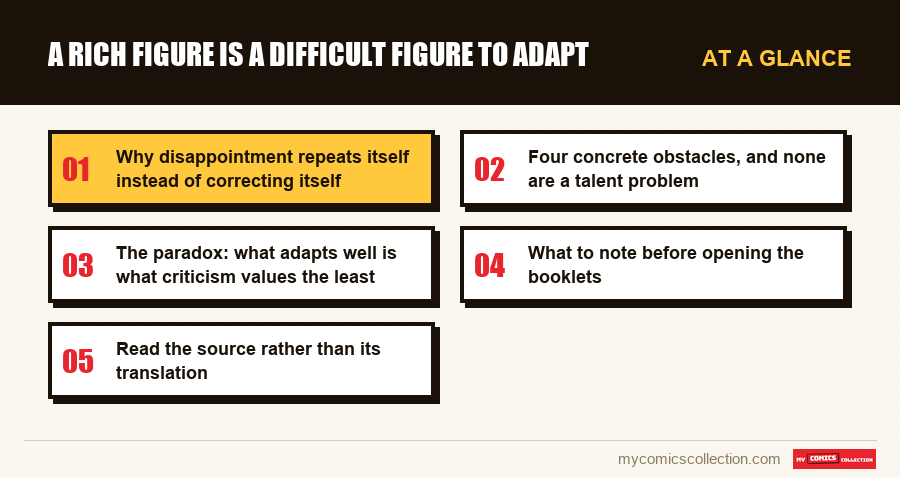
Why disappointment repeats itself instead of correcting itself
An industry learns from its mistakes. When a type of sequence doesn't work, we stop shooting it; when a narrative mechanism exhausts the audience, we put it away. If the adaptations of a given character failed for contingent reasons, we would observe an improvement curve: each attempt would correct the previous one. But this is not what we observe with figures of this type. We observe attempts that fail differently, which is the clinical sign of a structural problem. Some seek to explain psychology and produce a talkative heroine who no longer has anything of the character; others preserve silence and produce a silhouette that the spectator is unable to invest. Both fixes make sense, they go in opposite directions, and neither works: suggesting that the problem lies ahead of both. It is this structural hypothesis that must be developed, obstacle by obstacle, before drawing consequences for the reader.
Four concrete obstacles, and none are a talent problem
A motivation that refuses to be stated
The feature film format imposes an almost inevitable convention: the audience must know early enough what the main character wants, otherwise they do not know what to hope for or what to fear. But Elektra is defined by withdrawal. What characterizes her are the things she doesn't say, the gestures she doesn't justify, the loyalties we don't know if they still hold. On the page, this opacity reads like depth: the reader accepts not knowing, because he turns the pages at his own pace and can go back. In a two-hour story, the same opacity reads like a writing defect. The screenwriter then has only two options: verbalize the motivation, and the character ceases to be himself; or leave it implicit, and the story seems hollow. None of these releases are satisfactory, and there is no third release in the standard format.
A central relationship that cannot be imported or cut
The character's strongest bond is not a bond with an antagonist, it is a bond with another figure in the same universe-a bond made of debt, mutual betrayal, and thwarted attachment. That’s where its dramatic force on the page comes from, and that’s exactly what traps the adaptation. If the production imports the other character, the mechanics of the story shift: the audience knows the imported figure, finds its emotional entry point there, and Elektra becomes again what she was when she first appeared, that is to say an element in someone else's arc. If, on the contrary, production chooses to isolate her and finally give her the leading role, she is cut off from the only relationship that explains her choices, and a replacement anchor must be invented for her. An invented anchor has no story behind it: it is declared, not earned.
An economically hostile visual register
On the page, the character is expressed through choreography and silence. A plank can hold stillness for six squares and build tension without a word; a double page can break down a sequence of combat that the eye goes through in the order it wants. On screen, these two things are among the most expensive there is. A readable choreography, shot in long shots so that we can see the bodies, requires weeks of preparation, stuntmen, rehearsals and slow filming. Silence costs screen time without advancing the plot, and it's the first thing the editing removes when it needs to be tightened up. The economic grammar of action cinema therefore pushes towards the exact opposite of the character's register: rapid cutting, short shots, dialogue which explains the stakes during the action.
Formally experimental source material
The stories that made the character's reputation are not just good stories: they are formal objects. They play on the composition of the page, the break in the gutter, the symbolic color, the text which contradicts the image, the narration which takes place out of sync with what we see. Their power lies in what only comics can do. Adapting this is not transposing a plot: it is translating an effect which has no direct equivalent in another medium. The usual result of translation is the summary: we keep the events and we lose the form, that is to say precisely what made the work. And if we try to reproduce the experiment on screen, we obtain a difficult object which no longer corresponds to the audience targeted by a mainstream action film.
These four obstacles have one thing in common that must be emphasized: none of them is due to incompetence. These are constraints that would be imposed on any team, with any budget. We can reduce them (a long series relieves the time constraint a little, an author's format relieves the formal constraint a little) but we do not eliminate them, because they arise from the definition of the character. A figure whose identity is withdrawal cannot become legible without ceasing to be itself. There is an internal contradiction there, and an internal contradiction cannot be resolved by effort. She pays herself.
The most common confusion is treating the failure of an adaptation as a verdict on the character. It is the opposite that must be read: the more a figure resists adaptation, the more likely it is that its value is housed in properties specifically linked to comics: the pace of reading, the composition, the ellipse, the text-image relationship.
In other words, the disappointment felt in front of the screen is in reality information on the booklets: it indicates where what could not be found is. It's a reason to read, not a reason to give up.
Collecting this series?
Track what you own, what you are missing and what your collection is worth. 7 day trial.
Start my trial →The paradox: what adapts well is what criticism values the least
The one-sentence concept always wins
The characters who go through the adaptation best are those whose driving force can be summarized in a tenable sentence: he wants to find someone, he must repair a mistake, he refuses an inheritance. This sentence gives the viewer an immediate compass and the screenwriter an already half-written structure of three acts. This is not a weakness of cinema, it is its constraint of readability in real time.
Wealth is a format handicap
A rich character is a character whose driving force cannot be expressed in one sentence without betraying it. It carries unresolved contradictions, periods that contradict each other, areas that successive authors have left open on purpose. Over the life of a library, this density is a strength. Over the duration of a closed story, it becomes a mass that must be cut, and each cut removes precisely what made it valuable.
Two juries which note the opposite
Comic book criticism rewards ambiguity, ellipsis, the refusal to explain. The logic of mainstream adaptation rewards clarity, a stated objective, and verifiable progress. These two scales are not simply different: on several criteria, they are reversed. A character highly rated by the first is therefore mechanically poorly placed for the second.
Difficulty is not an accident
If we accept the two previous points, a consequence follows: the difficulty of adaptation becomes an indicator, almost a measurement. She doesn't say "this character is poorly constructed." She says “the value of this character is housed in non-transportable properties”. It is a property of the material, like the density of a metal, and not a mistake made by someone.
Half measures fail on both sides
Faced with this paradox, the temptation is to arbitrate in the middle: keep a little opacity for readers, add a little explanation for others. The result rarely satisfies one or the other. The novice viewer finds the character vague, the reader finds that too much has been explained. The compromise does not reconcile two opposing grammars, it adds their disadvantages.
What the paradox does not say
He is not saying that good adaptation is impossible. He says that it cannot be obtained by transposition, only by assumed reinvention: which supposes accepting from the start that the result will be a different object, judged for itself. Few productions can afford this, because the initial audience comes precisely to look for a resemblance.
What to note before opening the booklets
Failed adaptation widens the gap instead of narrowing it. This is the most counterintuitive consequence of all of the above. We readily imagine that a display on screen, even an average one, brings the general public closer to the source: it makes a name, a silhouette, a posture known. In practice, when the adaptation misses the character, it installs in the viewer's mind a version that does not correspond to the booklets. The name becomes familiar, but it designates something else. The potential reader who then opens a collection will not find what he had seen, and he will have the feeling of having gone to the wrong door: even though the previous door did not lead there.
The audience coming from the screen is not converted, and the reason is not disappointment. We readily repeat that a bad adaptation “disgusts” the curious. The observation is more subtle: even a satisfied spectator does not become a reader, because he has encountered a different character. What he liked, or not, is not what he will find on the page. There is therefore no continuity of appetite between the two experiences: the bridge that we believe we are building connects two banks which do not face each other. This is true for all difficult figures, and especially for this one.
You have to enter through the form, not through the plot. A reader who arrives with the reflexes of a spectator first seeks out what is happening: who wants what, who betrays whom, how it ends. Summarized like this, a large part of the corpus seems thin. The density is elsewhere: in the cutting, in the silences, in what the layout makes the images say. The right way to approach these stories is to deliberately slow down, look at the plates as compositions and accept that certain pages work on atmosphere rather than action. It's an adjustment of attention, and it changes everything about the outcome.
Ambiguity is the subject, not an obstacle to overcome. Many readers give up because they wait for clarification that doesn't come. The best pages do not seek to decide between the character's loyalties: they keep the tension open, sometimes over dozens of issues, sometimes indefinitely. This must be read as an intention and not as a lack. Once this contract is accepted, what seemed frustrating becomes the driving force of reading, and we understand in passing why no short format manages to reproduce it.
A coherent library is better than a list of famous titles. In a figure of this type, the periods are not equal and are not alike: intentions change from one creative team to another, the tone shifts, certain phases extend a previous story while others start almost from scratch. Creating a coherent reading requires knowing what you already have, what is missing in the middle of a series and what is part of a parallel continuity. This is precisely the job that structured collection tracking makes simple, relying on catalog data rather than memory.
Because the attempts fail in opposite ways. Some explain too much and lose the character, others don't explain enough and lose the viewer. If the cause were execution, we would see a progression: each new attempt would correct the previous one and get closer to the goal. A failure that persists while all the variables change indicates an upstream constraint, included in the very definition of the figure.
It attenuates it without removing it. More hours make it possible to leave implicit motivation for longer, but the constraint of readability returns with each episode: the viewer must know why he is watching. And the other three obstacles remain intact: the central relationship, the cost of choreography and silence, the formal experimentation of the source. Time only resolves one obstacle out of four.
There is no reason to avoid them, but it is better to consider them as separate works rather than introductions. Approaching them while waiting for a faithful overview sets up disappointment on both sides: on the screen first, then on the page. Treating them separately allows each object to be judged according to its own rules, which is fairer and much more pleasant.
Three signals are usually enough. We cannot formulate our objective in one sentence without betraying it; her strongest relationship links her to a character better known than herself; and the most esteemed stories which concern it are those whose graphic form is the most elaborate. When these three signals are united, the adaptation will leave with a handicap which has nothing to do with the means employed.
The mechanism is general: any figure whose value is based on ellipse, ambiguity and graphic form is poorly transported. The case is simply particularly clear here, because the four obstacles add up instead of offsetting each other. On other characters, only one obstacle is present, and an attentive team can get around it without distorting the whole.
Read the source rather than its translation
If what makes the character valuable is on the page, then the only way to truly encounter him is to open the booklets, and know which ones you already have, which ones are missing in the middle of a series and how the periods fit together. My Comics Collection maintains this inventory for you, relies on catalog data to spot gaps and lets you build a coherent reading instead of accumulating isolated titles.