The number that kills the second carrier is sold explicitly as such, the ads mention it in the title, and it fetches between $1.34 and $2.95. As of August 29, 2026, it displays $8.65 gross median out of 82 ads and only 4 certified announcements. A notable character death, announced on the cover, which is worthless: it is the clearest demonstration that the market does not pay for narrative events.
This number is also a textbook case of what a death can accomplish when it is used well.
Here is what this death produced narratively, what the reading shows, why it is worthless, and what it cost the character.
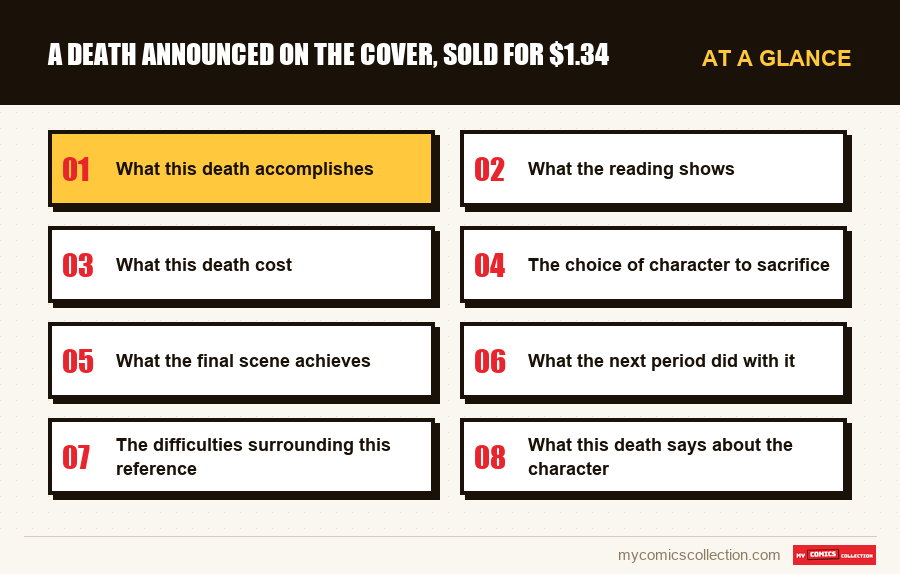
What this death accomplishes
It is used as a signal, and this use deserves to be described precisely.
She announces a change of tone. The character killed belonged to a period marked by humor and lightness. Removing it means that this period is over, and says it more effectively than any editorial statement.
It establishes the seriousness of an upcoming event. Placed at the opening of a major operation, it proves that it will have consequences: the reader knows from the first page that the threat is real.
She gives the character her best scene. Faced with an impossible choice, he refuses to give in even though nothing forces him to and no one will know. It’s an ending that makes him grow.
These three functions are combined in a single number. This is a sparing and brutal use of a secondary character, and it illustrates exactly the mechanism observed elsewhere: a death that costs the story is the only one that produces an effect.
What the reading shows
The number concerned
Raw : 82 ads, of $1.34 to $94.70 requested, median $8.65. Certified: 4 ads, median $50.00.
Several copies at $2.95 carry the mention of death in their title.
A death announced in the title
The sellers explicitly mention the event, which proves that they consider it a seller, and the price shows that this is not enough.
The first carrier, for comparison
His 1960s numbers wonder $40.00 of raw median, without any particular event occurring there.
A certified anecdotal side
Four announcements, which confirms the absence of organized demand for this reference.
Statement from August 29, 2026 on fixed price, gross and certified announcements counted separately. Amounts displayed by sellers.
Why is this death worthless?
Three causes, and they say something general about what the market measures.
An event draw. This number opens a major operation and was printed accordingly, at a deliberately low call price. The supply is massive and will remain so.
A death is not a first appearance. The entire grammar of the collection market is organized around points of origin. An ending, however striking it may be, has no equivalent in this grammar.
The character was not a headliner. His death affected those who followed him, that is to say a loyal but limited readership: insufficient to organize a market.
These three causes converge and the result is clear. A major narrative event may produce no market value, and the reverse is just as true: issues with no narrative interest fetch considerable sums because they contain a first appearance.
This dissociation is the most useful fact of this whole file. It means that a reader can own a character's most memorable moments for a few dollars, while a collector will pay a lot for issues where nothing happens.
Both are correct in their logic. What would be a mistake is to believe that one of the two criteria measures the other: an expensive number is not a good number, and a good number is almost never expensive.
What this death cost
We must examine the other side, because this decision did not only have benefits.
She deleted a registry. The character carried a tone (humor, self-deprecation, friendship) that the following period did not replace. It's not just someone who disappears but a color.
She caused lasting dissatisfaction. A part of the readership did not accept it and is still saying so years later, which is a sign that the character mattered more than his secondary status would suggest.
It weakened the duo. The character formed an association with another that worked, and the survivor lost what made him interesting along with his partner.
These three costs are real. A narratively successful death can be a net loss for a catalog, and the two assessments do not have to coincide: that's what makes these decisions difficult.
The choice of character to sacrifice
A prior decision deserves to be examined, because it explains why it is this one who dies and not another.
Opening a major event with a death requires choosing someone whose disappearance will be felt without costing the catalog too much. This is precise arbitration and eliminates most candidates.
A headliner is untouchable: too many farms depend on it. An unknown figure produces no effect: no one mourns her. The character you're looking for is exactly in between: loved enough that his loss matters, secondary enough that his removal is bearable.
This carrier fulfilled these two conditions to perfection, which explains his fate. This is a dangerous and well-identified position: the most popular characters among the supporting roles are statistically the most exposed.
The paradox is cruel for the readers concerned: it is precisely the attachment they have to a character that makes them a candidate for sacrifice.
What the final scene achieves
It is worth describing why this scene is still cited twenty years later, because it is not obvious.
The character is offered to join the adversary, without witnesses, in a situation where refusing means dying immediately and where no one will ever know what they have chosen.
It is the purest moral configuration there is: no benefit, no recognition, no posterity. The refusal has no other justification than itself.
It works all the better since the character was treated as a second-rate comic. A heroic figure who refuses is fit for purpose; this one surprises, and this surprise gives the scene its weight.
It’s a pretty neat lesson in writing. The best moments of bravery are given to characters from whom we did not expect them: attributing them to an established hero makes them predictable and therefore inert.
What the next period did with it
A final point on the consequences, because they shed light on the solidity of the decision.
This death held. The character wasn't brought back by circumstance, which is rare and worth noting: most of the notable deaths examined in this campaign were undone.
The reason is probably due to inheritance. The costume having been taken over by someone else, bringing back the previous wearer would create a duplicate and deprive the new one of its legitimacy. Transmission protects death.
This is an interesting and generalizable mechanism: a death followed by a replacement is much more stable than a death followed by a void, because bringing her back would then cost someone else something.
This suggests a rule of thumb for a reader wondering if a disappearance will stick: look to see if someone has taken the place. If so, death is likely to last; otherwise, it is reversible at any time.
Collecting this series?
Track what you own, what you are missing and what your collection is worth. 7 day trial.
Start my trial →The difficulties surrounding this reference
A generic event title
The name of the issue does not mention the character, and only the mention added by the sellers indicates it.
Several covers
Variants exist, and advertisements do not always specify which one is offered.
Republished content
This story appears in several collections, making the original issue optional for reading.
A misleading maximum
A request for $94.70 appears, isolated, in a market whose median is $8.65.
What this death says about the character
An overall observation is worth making, because it sheds light on the place of this figure.
This bearer is the only one of the three whose ending is told. The first has been replaced, the third continues: only he has a written conclusion, and she shows it to her advantage.
It's a paradoxical position: he is the carrier best treated by the story and the least well treated by the catalog. His disappearance deprived him of future series while giving him the only scene that readers still cite.
This explains the persistence of his memory. A character that continues wears out; a character who stops on a good scene remains as he was left.
This is an unintended benefit of the editorial decision, and probably the only one that offsets the costs listed above.
How to approach this period
Three recommendations, which clearly separate the reading from the collection.
Read the earlier period first. This death only produces its effect if we know the character as he was. Read in isolation, it's a decent scene, nothing more.
Buy the issue at its price. At $1.34 or $2.95, there is no reason to pay more, and copies at this price are described correctly.
Don't expect any valuation from it. The three causes outlined above are structural and there is no indication that they are changing.
This approach gives access for three dollars to what remains the most commented moment in the life of this character. This is the best possible ratio between narrative importance and price, and it exactly illustrates the dissociation described above.
What to record
On an event number with multiple coverages, the sheet must fix what the announcement leaves unclear.
The cover specifies which you own, and the exact title of the issue. The event title does not mention the character, and several variant covers circulate without the announcements always distinguishing them: a stored copy quickly becomes impossible to identify without reopening it.
This is also what avoids buying the same issue twice in different presentations, a common error regarding event references.
The collection where you read this story, if it differs from the number owned: the content having been republished several times, knowing which one you have read allows you to find the context that each edition provides differently: some place this story in a continuity, others isolate it.
These two mentions deal with a reference whose identity is due to details of presentation rather than to its content, a frequent case on event numbers and rare elsewhere.
Frequently asked questions
Three causes: a massive event draw at a premium price, the fact that a death is not a first appearance: the entire grammar of the market is organized around points of origin -, and a character who was not a headliner. Its readership was loyal but too small to organize a market.
Three things in one issue: it announces a change in tone by removing the character who embodied the previous period, it proves that a big upcoming event will have real consequences, and it gives the character his best scene: a refusal to give in when no one will know.
A suppressed register: the humor and self-deprecation that this character carried have not been replaced -, a lasting discontent on part of the readership, and the weakening of a duo whose survivor has lost what made him interesting. A narratively successful death can be a net loss for a catalog.
At $1.34 or $2.95, there's nothing wrong with it and no reason to pay more. But the story has been republished in several collections, so the issue is optional to read: it's an item purchase, not access to the content.
Paradoxically yes: he is the only one of the three bearers whose ending is told, and it shows it to his advantage. A character that continues wears out; a character who stops on a good scene remains as he was left: that's probably the only benefit that outweighs the costs of that decision.
What cover, what exact title?
The event title does not name the character, and several variants circulate without distinction.