1992 was the most speculated year in the commercial history of the medium, and its first issues are now fetching around $5.00. As of August 29, 2026, the first issues launched that year display $5.00 median requested out of 175 gross announcements, several major titles being at $1.00 piece. Only two certified advertisements come up from this search. This is the result of a documented mechanism: we printed for buyers who weren't buying to read.
Understanding what happened that year explains half of the prices we still see today on comics from the 1990s.
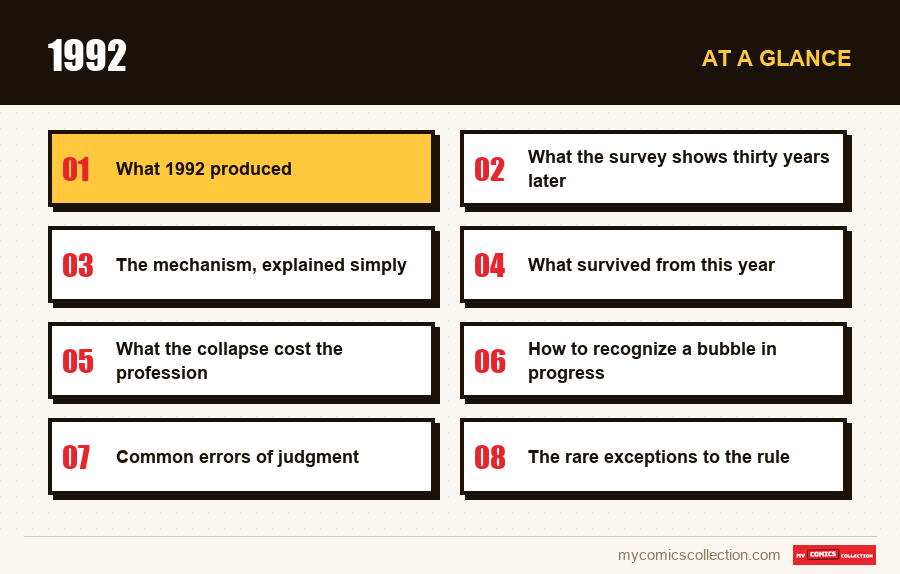
This article explains what 1992 produced, what the survey shows thirty years later, the mechanism that explains these prices, and what a buyer should remember.
What 1992 produced
The year condenses two distinct phenomena that we systematically confuse, and separating them is essential.
An editorial event: a group of authors leaves the big houses to found a structure where they keep their rights. It is a decision of principle, the effects of which on the profession can still be measured.
A commercial boom: these launches arrive at the top of a speculative bubble where people bought comics as investments, in several copies, without opening them.
The two are simultaneous and unrelated in nature. The first was successful and still continues; the second collapsed within two years by taking away a considerable part of the sales network.
Almost all judgments made about this period confuse the two, which produces either misplaced nostalgia or unfair contempt.
What the survey shows thirty years later
The following is from fixed price listings taken on August 29, 2026, with raw and certified copies counted separately. An asking price expresses a seller's expectation.
The first issues of the year
175 ads raw, of 0.99 to $149.99 requested, median $5.00. A plethora of offerings for titles deemed major.
The median is lower than the cover price of a current new issue.
Dollar bills
Several first numbers of series launched that year noted at $1.00 requested, in conditions described as correct.
These are launches that caused quite a stir when they were published.
The certified side
2 ads only on this search, at $59.90 and $700.00 asked. Two observations do not describe any market.
A detail that sums it all up
A $0.99 ad explicitly indicates a missing tear-off coupon. The coupon was worth more than the number on it.
The mechanism, explained simply
It is perfectly documented and can be summarized in a chain of three steps.
Step one: we buy to resell. Buyers take five or ten copies of a first issue, convinced that it will be worth a lot one day. They do not read them and keep them in perfect condition.
Step two: Publisher prints accordingly. Orders explode, production follows, and unprecedented print runs come off the presses: for a demand that is not a demand for reading.
Step three: no one sells to anyone. When everyone has ten copies of the same issue in perfect condition, there is no longer a buyer for the eleventh.
The result is mechanical and definitive. An item produced in unlimited quantity and kept intact by all its owners cannot become rare, regardless of its quality or historical importance.
This is the most useful counterexample that exists in collecting. Old comics that are worth a lot today have increased in value because they were treated like disposable paper: read, loaned, dog-eared, thrown away.
Those from 1992 were treated as investments from day one. This is precisely what prevented them from becoming so: scarcity cannot be decreed, it results from destruction.
What survived from this year
The assessment deserves to be made in both columns, without complacency or excessive severity.
What didn't survive: the market value, the dominant aesthetic, a significant part of the store network, and the trust of a generation of buyers who never returned.
What survived: the principle of ownership of authors, which has become a real option rather than a marginal position, and a structure which still publishes thirty years later in registers that its founders did not practice.
The disproportion between the two columns is instructive. What was so exciting at the time has completely disappeared; what passed for a contractual detail structured everything.
It's a useful reminder every time an editorial movement presents itself as historic: what will remain is almost never what is highlighted.
What the collapse cost the profession
The human part of this story is rarely told, and it explains the severity of the judgments passed since.
When the bubble deflates, it is not the speculators who pay the heaviest price: it is the shops. They had ordered based on apparent demand, tied up their cash in stocks, and sometimes expanded their premises.
A considerable part of the specialized sales network disappears in a few years. With it disappears the place where an ordinary reader discovered series that he had not come looking for, which has had a lasting impact on the way in which the medium recruits its audience.
Authors also pay, differently. Series are stopped for lack of orders, projects are canceled, and a generation of publishers is learning to be careful: that is to say, to renew what already works.
This context illuminates one thing: the contempt which still surrounds this period is not only aesthetic. It carries the memory of real damage, suffered by people who had not participated in the runaway.
How to recognize a bubble in progress
The episode serves as a warning, and the signs it left are recognizable elsewhere.
The first sign is the purchase of several copies. As soon as a buyer takes the same object in three copies, he no longer acts as a reader, and the request he expresses is fictitious with regard to usage.
The second is the unopened copy. An item purchased not to be used never enters the cycle that produces scarcity.
The third is the discourse on future value, when it precedes the appreciation of the content. A pitch that talks about performance before talking about what you are going to read describes an investment, not a book.
These three signs were all combined in 1992, and the 2026 survey gives the result: $5.00 median for the most purchased year in the history of the medium.
They are now found in other segments, with other objects and a renewed vocabulary. The lesson remains the same and it costs nothing to learn.
Collecting this series?
Track what you own, what you are missing and what your collection is worth. 7 day trial.
Start my trial →Common errors of judgment
Wait for a revaluation
This year's draws prohibit any shortage of current titles. The expectation has no basis.
Discard everything as a whole
Contempt for the period causes us to miss series that were better than their context.
Confusing importance and price
Stocks that truly changed the industry are asking for $1.00. The two scales do not overlap.
Read extreme values
A single certified $700.00 ad among two says nothing about what these numbers are worth.
The rare exceptions to the rule
A nuance is necessary, because the general flatness of this year has a few holes.
The statement shows a maximum of $149.99 requested gross, well above the median of $5.00. These cases exist and they obey identifiable logics rather than chance.
These are generally issues taken apart from the runaway: a title launched at the end of the year when orders were already contracting, a variant distributed outside the usual circuit, or a copy carrying an element that most have lost.
What these exceptions have in common is that they were not purchased en masse. They confirm the rule rather than refute it: what has escaped speculation is what has retained value.
For a buyer, the consequence is clear. If an issue from this year commands significantly more money than its neighbors, the question to ask is what made it rare, and the answer is almost always that it was printed less or preserved less, never that it is better.
What this year offers a reader today
The situation is actually very favorable, provided that we give up any prospect of valuation.
Total abundance. 175 ads in a single search, all titles available, no search difficulty. It's the opposite of a hunt.
Excellent conditions. Copies kept intact for thirty years by disappointed speculators circulate today at one dollar. The average quality is much higher than other periods.
A real documentary interest. These issues give access to a tipping point in the profession, with its excesses visible on every page.
In other words: the medium's most misjudged year is also the easiest to explore. For the price of a single recent bound volume, we cover most of what was published that year.
What to record
Over this period, the decisive field documents a history that the objects themselves erase.
The number of identical copies you have. This is specific to this year: many inherited or repurchased collections contain three or five copies of the same issue, vestiges of speculative purchasing. Without this field, we believe we have a series where we have our first number five times.
Knowing this changes two things: what you can give up without losing anything, and what you really need to complete.
The presence of the detachable coupon, a feature of several titles from this year which separates two otherwise identical copies, without any cover photograph allowing a decision to be made.
These two fields deal with the only real problem posed by this period: not finding the numbers, which are everywhere, but knowing what we already have in several copies.
Frequently asked questions
Because they were purchased as investments from day one, in multiple copies, without being read. The print runs followed this request which was not one, and an object produced without limit then kept intact by all its owners cannot become rare. The median found is $5.00 from 175 ads.
Nothing suggests this on the current titles. Rarity results from destruction, and these examples have never been destroyed: they have been lying in reserve for thirty years and still supply the market. This is the most useful counterexample that exists in collecting.
The principle of author ownership, which has become a real option rather than a marginal position. Everything that made the event at the time (the prints, the covers, the aesthetic) disappeared, while what passed for a contractual detail structured what followed.
Not at all, and dismissing it altogether misses out on series that were better than their context. It is even the easiest period to explore: total abundance, excellent condition thanks to thirty years of speculative conservation, and real documentary interest in a tipping point for the profession.
The search only turns up two, at $59.90 and $700.00 asking. Two observations do not describe any market, and reading the highest value as a benchmark would be exactly the mistake not to make in a period when the gap between importance and price is so wide.
How many copies of the same issue?
In that year, we often believe we have a series where we have our first issue five times.