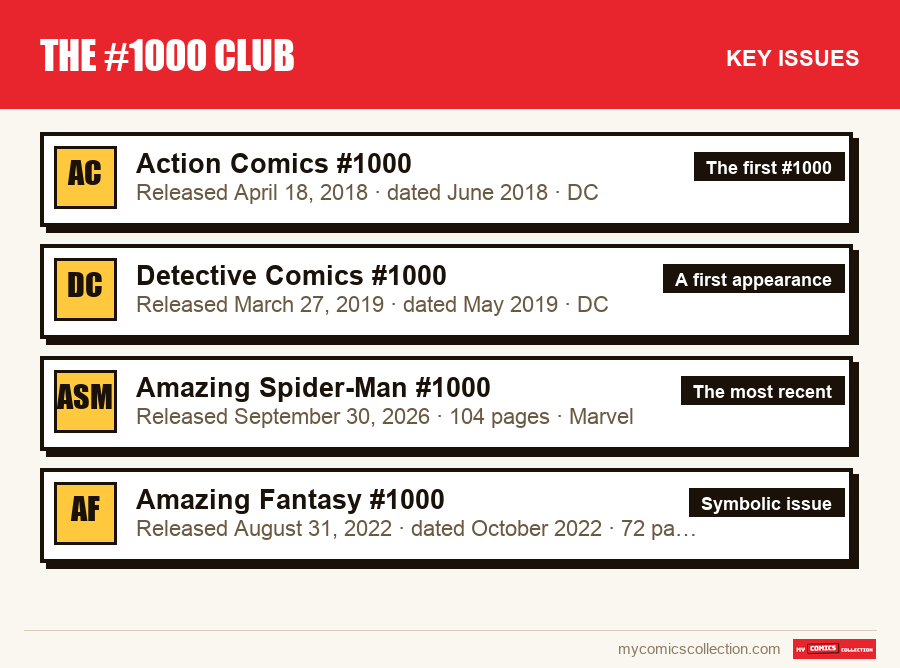
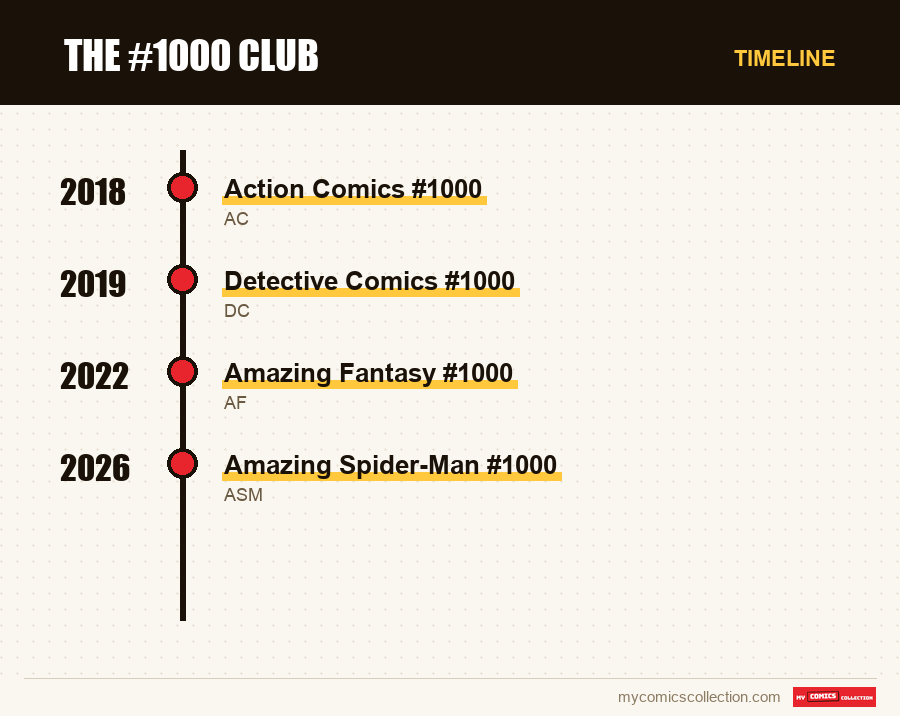
Three American superhero series have truly reached their thousandth issue: Action Comics #1000 (released on April 18, 2018, for Superman's 80th anniversary), Detective Comics #1000 (released on March 27, 2019, for Batman's 80th anniversary) and Amazing Spider-Man #1000 (released on September 30, 2026). All three got there thanks to an inherited numbering, restored after relaunches at number 1. A fourth case muddies the waters: Amazing Fantasy #1000, released on August 31, 2022, never had issues 19 to 999. It is a symbolic number chosen for Spider-Man's 60th anniversary, not an achievement. Comparing these four objects helps understand what a "#1000" really says, and what it does not.
The number 1000 impresses because it evokes an uninterrupted continuity: a thousand months, or nearly, of unbroken publication. The reality is more tortuous. None of the three series concerned has published a thousand issues in a row under the same numbering. All have gone through relaunches, resets, successive volumes, then a return to the original numbering at the opportune moment.
That takes nothing away from their symbolic value. But for a collector, the difference between a true accumulation and a facade number has very concrete consequences: on how to shelve the series, on what you need to own to call it "complete", and on how the market treats these issues. This article compares the three true #1000s with each other, then explains why the fourth does not play in the same category.
How a series reaches issue 1000
There are two ways to reach a thousand. The first is to publish without interruption, issue after issue. No superhero series has managed it without a hitch. The second is to add up the volumes: when a publisher relaunches a series at number 1, it can later decide to resume the count where the old volume stopped, adding the issues published in the meantime. This is called inherited numbering, or "legacy".
Both major American publishers have used this mechanism, with different calendars. At DC, the 2011 general relaunch put Action Comics and Detective Comics back at number 1. In 2016, the editorial initiative called Rebirth gave these two titles back their original numbering. At Marvel, Amazing Spider-Man was relaunched several times at number 1 since 1999, and the publisher regularly restored the cumulative count as a round number approached. The volume opened in April 2025 is the latest illustration: its first issue also carried the notation #965.
This mechanism explains why the three #1000s fall on such different dates, even though the three series have comparable ages on the scale of comics history.
Action Comics #1000: Superman's anniversary
Action Comics #1000
The first superhero title to cross the threshold, eighty years after the 1938 number 1 that introduced Superman. The issue is an anthology: about ten short stories entrusted to teams of different generations, including Dan Jurgens, Geoff Johns with director Richard Donner and Olivier Coipel, Tom King and Clay Mann, Paul Dini and José Luis García-López. It also contains unpublished pages by Curt Swan, the character's historic artist, reused for a story written by Marv Wolfman.
In reality, if you count the special issues interspersed over the decades (zero issues, the one million issue, the fractional issues of 2013), Action Comics #1000 is the 1,007th issue of the original series. This detail illustrates the conventional nature of the number: the official count retains only the main numbering.
What gives this object its strength is the age of the series. Issue 1 of Action Comics is the first appearance of Superman and the starting point of the entire genre. #1000 inherits part of this prestige, but only part: it was printed in very large numbers, with a range of variant covers, like all modern anniversaries. To understand the gap between the two issues, read our article on the value of Action Comics #1, and the page devoted to Action Comics #1000.
Detective Comics #1000: Batman's 80 years
Detective Comics #1000
Eleven months after Action Comics, Detective Comics reaches the number in its turn, for the eightieth anniversary of Batman, who appeared in issue 27 in 1939. Same anthology formula: Scott Snyder and Greg Capullo, Kevin Smith and Jim Lee, Paul Dini, Warren Ellis and Becky Cloonan, Dennis O'Neil, Christopher Priest and Neal Adams, Geoff Johns and Kelley Jones, Tom King and Tony Daniel, among others.
Detective Comics also has a calendar particularity: it had resumed its original numbering in 2016 at issue 934, and reached #1000 in under three years by running at a twice-monthly pace for part of this period. The round number was therefore reached faster than the mere passing of months would have allowed.
Bendis, again, also does a story in this issue, with Alex Maleev, his Daredevil artist. He is thus the only writer present in all three true #1000s: Action Comics in 2018, Detective Comics in 2019, Amazing Spider-Man in 2026.
Amazing Spider-Man #1000: Marvel's first #1000
Amazing Spider-Man #1000
Planned for September 16 and delayed two weeks by a printing problem, it combines a main story from the ongoing series, "Ravaged" by Joe Kelly and Pepe Larraz, which introduces the villain Ravage, and six anniversary stories by Slott and Martin, Bendis and Immonen, Miller and Momoko, Hawley and Gleason, DeMatteis and Ramos, Lieber and Camuncoli. More than 400,000 copies were ordered, and a second printing is scheduled for October 28, 2026.
The path to this number was the most winding of the three. The first volume stopped in 1998 at issue 441. The second volume, launched in 1999, resumed the cumulative numbering in 2003 with an issue 500. Then came other relaunches, in 2014, 2015, 2018 and 2022, each followed by a return to the cumulative count. The April 2025 volume, finally, started at issue 1, also counted as #965. The detail of the seven stories and the associated reading paths is in our article devoted to the stories and creators of #1000.
The comparison table
| Criterion | Action Comics #1000 | Detective Comics #1000 | Amazing Spider-Man #1000 |
|---|---|---|---|
| On sale | April 18, 2018 | March 27, 2019 | September 30, 2026 |
| Series launched in | 1938 | 1937 | 1963 |
| Anniversary celebrated | Superman's 80 years | Batman's 80 years | The series' thousandth issue |
| Return to inherited numbering | 2016 | 2016 | Several times since 2003 |
| Formula | Anthology | Anthology | Main story and six tributes |
| Lasting novelty | Rogol Zaar, Bendis's debut on Superman | The Arkham Knight | Ravage (future unknown) |
The table reveals a fundamental difference. The two DC issues were commemorative anthologies with no major narrative stake for the series. Marvel's issue, for its part, is structured around a real continuity episode. It is an editorial choice, not an accident: it makes #1000 an issue that regular readers cannot skip.
The Amazing Fantasy #1000 case
Amazing Fantasy #1000
Published for the sixtieth anniversary of Spider-Man's first appearance, this issue gathers notably Neil Gaiman and Steve McNiven, Jonathan Hickman and Marco Checchetto, Dan Slott and Jim Cheung, Kurt Busiek and Terry Dodson, Rainbow Rowell and Olivier Coipel. The number 1000 there is not the result of an accumulation: Amazing Fantasy never published issues 19 to 999.
Amazing Fantasy #1000 is therefore an object apart. The issue pays tribute to Amazing Fantasy #15, one of the most sought-after issues in history, by borrowing a round number. It is an elegant editorial idea, but it has a consequence for the collector: this issue is part of no "race to a thousand". It completes no series and closes no cycle. It is shelved with Spider-Man's special issues, not with the three true #1000s.
This case deserves to be known, because the confusion is frequent in sales listings. A hurried seller may present the issue as "Spider-Man's first #1000". That is inaccurate: the first true #1000 tied to Spider-Man is the one of September 2026.
What the collector should remember
First lesson: a modern #1000 is not rare. The three true #1000s were printed in very large quantity, with many covers. The most recent exceeded 400,000 copies ordered even before its second printing. Their interest lies in the symbol and the content, not in the difficulty of finding them.
Second lesson: what lastingly distinguishes an anniversary issue is what it introduces. Detective Comics #1000 has the advantage over Action Comics #1000 because a character born in its pages had a career afterward. For Amazing Spider-Man #1000, the question remains open: everything will depend on what Ravage becomes. Our article on round numbers and their value details this mechanism on a wider sample.
Third lesson: inherited numbering complicates shelving. The same issue can carry two numbers on its cover, the volume's and the cumulative one. Decide once and for all which you use in your tracking, and stick to it. For a general method on anniversaries, see also our collecting strategy for anniversary issues.
Identify the volume
Find in the indicia, in small print, the volume number and the real number. It is what counts, not the big cover number.
Choose a convention
Shelve either by volume or by cumulative numbering, but not both. The three series discussed here change convention several times.
Separate the symbolic issues
File Amazing Fantasy #1000 with the specials, not in a series. Otherwise, your missing list will show 984 gaps that do not exist.