
Purchased in sets, the booklet costs $1.43 on series whose individual median is between $9.99 and $14.99. As of August 29, 2026, a set of three numbers costs $4.28 and a set of two costs $2.99. But two of the five cheapest listings contain the character as only one of several names: In an overview title, its name functions as a keyword, not as a description of the content.
This is the most economical route to character acquisition, and the one that produces the most false inventories.
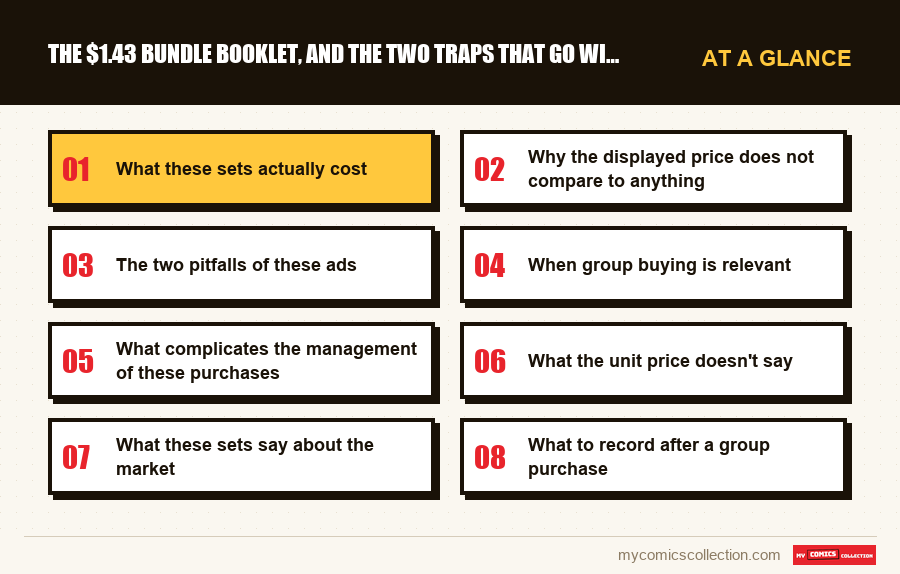
We will see what these sets really cost, why their displayed price does not compare to anything, the two traps they set, when they are relevant, and how to register them without error.
What these sets actually cost
Two issues of the same series
A set of two fascicles from 1986 wonder 2,99 $, soit $1.50 the unit.
Three issues of the same series
A set of three fascicles from 2006 wonder 4,28 $, either 1,43 $the unit.
Le point de comparaison
These same series display 9,99 $et $14.99 of raw median to unity. The difference ranges from seven to ten times.
The certified segment
Only one ad verified out of 199, none out of the 97 from the second query. The verification concerns a copy, never a set.
These are asking prices observed on August 29, 2026, gross and certified counted separately, never sales concluded. The unit prices indicated are obtained by dividing the amount requested by the number of issues announced in the title.
The gap is considerable and perfectly real in these specific examples. This is not a constructed average but two advertisements whose content is listed number by number in the title, which makes the calculation verifiable.
It's this verifiability that most other set announcements lack, and that's where the difficulties begin.
Why the displayed price does not compare to anything
The median found on these sets: $19.99 on one question, $29.03 on the other: has no usable meaning, and we must explain why.
A set does not have a standard size. Two advertisements at the same price can offer two issues or forty. The amount requested therefore measures a volume before measuring a price level.
The number of issues is not always announced. Some titles indicate it, others are content with a word designating the whole. Unitary calculation then becomes impossible without reading the entire description.
The composition varies completely. A homogeneous set of the same series and a heterogeneous set of ten different titles appear under the same name.
This results in a clear methodological conclusion. A median calculated over sets is meaningless, and I only use it here to say that it is useless: only the unit prices calculated on ads listing their content can be used.
This limit extends well beyond this character. Each time a price concerns a set whose size varies, the figure obtained mixes two sizes and measures neither.
The only honest reading consists of reducing each announcement to unity, which presupposes enumerated content, and in fact excludes the majority of proposals. Better three usable ads than a median calculated on two hundred incomparable ads.
The two pitfalls of these ads
They are distinct, and the second is more expensive than the first.
The first is that of the name used as a keyword. Two of the five cheapest ads found mention the character in a title where he appears among three or four other names. The set contains perhaps one issue about it, perhaps none: the name is used to capture the research, not to describe the contents.
The second is that of non-enumerated content. A set advertised without a specific list leaves the buyer to discover what they are receiving. On a character spread across several series and several carriers, this uncertainty concerns the essential.
The first trap is identified by reading the title to the end, which costs a few seconds. The second cannot be identified at all before receipt, and it is he who produces the falsely complete collections.
The resulting rule is simple: only buy a set if its contents are listed number by number, and consider any other proposal as a lottery whose price, even low, does not compensate for the documentary disorder.
When group buying is relevant
It really is in three situations, and it is better to identify them than to suffer them.
To complete an interrupted and cheap series. When the goal is to put together a finished set where each issue is worth a few dollars, group purchasing divides the cost and especially the number of shipments.
To discover a period without commitment. Receiving a dozen booklets from an unknown period for the price of a single sought-after issue is the cheapest way to know if it interests you.
For collective series where the character appears. These titles are sold almost exclusively this way, and purchasing them individually would multiply the shipping costs beyond the price of the issues.
In these three cases, the saving is real and the documentary risk limited. On the other hand, no set is suitable for acquiring a precise number: targeting an identified part in a lot amounts to paying for content you don't want, with uncertainty as a bonus.
One last case deserves to be noted, because it is frequent and rarely anticipated: the set purchased for one series turns out to contain issues from another, homonym. The seller did not lie, he used the current title without specifying the time. It is the intersection of the two difficulties dealt with here and in the article on numbering, and it is the configuration which produces the most lasting errors: a poorly attached booklet is only corrected if the box is reopened years later.
What complicates the management of these purchases
The difficulties begin after reception, and they are underestimated.
Content to inventory
Each fascicle received must be entered individually, which represents the true cost of the operation.
An undetermined unit price
Distributing the overall amount between installments of unequal values has no obvious solution.
Systematic duplicates
The sets overlap, and buying back what you already own is the norm rather than the exception.
Heterogeneous states
A set combines very different examples under a unique and optimistic description.
Unspecified series
On a character with several homonymous series, the title does not always say which one it is.
Immediate congestion
The volume received often exceeds what is of interest, and the rest occupies a lasting place.
These six difficulties have one thing in common: they all appear after payment, when the advantageous price has already been paid and can no longer be part of the decision.
Collecting this series?
Track what you own, what you are missing and what your collection is worth. 7 day trial.
Start my trial →What the unit price doesn't say
Reducing a set to the price per issue is necessary, but this operation hides two real costs.
The entry time. Twenty booklets to inventory represent work unrelated to the few dollars saved. On a large scale, this cost far exceeds the gain.
The useless part. If you're not interested in half of the content, the actual unit price is double the calculated one, and the honest calculation is to divide by the number of booklets wanted, not by the number received.
This second correction completely changes the assessment. A set at $1.43 per booklet of which only a third concerns you actually costs $4.29 per unit, which remains advantageous but is no longer spectacular.
It is therefore necessary to calculate before purchasing, on the contents listed. This is precisely what listless ads make impossible, and this impossibility is a sufficient reason to dismiss them.
What these sets say about the market
Their very existence is information about the place a character occupies, and it is worth reading.
A character sold primarily in packs does not have a unit market. The booklets sought are sold alone, described precisely, photographed carefully. Those that circulate in bulk are those that no one expects to justify an announcement on their own.
The proportion of sets in the proposals is therefore an indicator, just like the number of copies verified. Both say the same thing in different ways.
This is in no way demeaning to the character., and we must resist the temptation to see it as a judgment. Many excellent series sell like this, precisely because their quality has never met rarity.
For a reader, this situation is even the best possible. A character without a unit market is a character that can be read in full, which is not true of the figures in which each number is contested.
What to record after a group purchase
These acquisitions require particular discipline, otherwise they degrade the inventory they were supposed to enrich.
Enter each issue upon receipt, not later. A set not inventoried the same day is generally never inventoried, and becomes a box whose contents are unknown.
Note the overall price and the number received, separately. Keeping both allows a unit cost to be recalculated later, while a rounded unit price saved as is erases the original information.
Mark unwanted booklets as such. They are part of the purchase but not the collection; mixing them with others distorts both the accounts and the research.
Record the assembly reference. A common purchase identifier for the fascicles received makes it possible to find their common origin, particularly in the event of a disappointing homogeneous condition.
Check the series and year of each copy separately. This is the point where group purchases produce the most errors: a set announced under one title may contain issues from different homonymous series, and nothing indicates this.
On the advertisements listed on August 29, 2026, the issue costs $1.43 and $1.50 compared to the median of $9.99 to $14.99 per unit, or seven to ten times less. But this calculation assumes that all the content interests you: if only a third concerns you, the real cost is tripled and the advantage becomes ordinary.
Because a set does not have a standard size: two advertisements at the same price can contain two issues or forty. The requested amount measures a volume before measuring a level. Only unit prices on advertisements listing their content have any meaning, and they are in the minority.
Not always, and that's the first pitfall. Two of the five cheapest listings found list it among three or four other names, where it serves to capture search rather than describe content. Reading the title to the end is enough to spot these cases.
This is the only use to frankly discard. Buying a set for an identified part amounts to paying for content you don't want, with uncertainty about the actual presence of the targeted number. Sets are suitable for broad supplementation or discovery, never for targeting.
Almost never: only one announcement out of 199, none out of 97 in the second statement. The verification concerns a single copy and is too expensive to be applied to issues intended to circulate in packets. These two markets do not meet.
Twenty fascicles received, how many seized?
A set not inventoried on the day of its receipt becomes a box with unknown contents.