Harley Quinn est née le 11 septembre 1992 dans Batman: The Animated Series, dans l'épisode « Joker's Favor », créée par Paul Dini et Bruce Timm. Sa première apparition en comics remonte à septembre 1993 dans The Batman Adventures #12 (un CGC 9.8 dépasse aujourd'hui les 5 000 $). Elle fait ses débuts dans le DC mainstream en octobre 1999 avec le one-shot Batman: Harley Quinn de Paul Dini. Côté séries régulières : Vol.1 2000-2004 (38 numéros), Vol.2 New 52 2014 (30 numéros), Vol.3 Rebirth 2016-2020 (75 numéros), Vol.4 2021 Stephanie Phillips (28 numéros), Vol.5 2024 Elliot Kalan. Cet article retrace la chronologie complète : naissance à la télé, passage aux comics, runs majeurs, numéros clés et grands arcs.
Aucun personnage de l'écosystème DC n'a connu un parcours aussi atypique que Harley Quinn. Née non pas dans les pages d'un comic mais à la télévision en 1992, acolyte comique improvisée du Joker dans Batman: The Animated Series, il lui faudra 30 ans pour devenir la deuxième héroïne la plus collectionnée de DC derrière Wonder Woman. Sa popularité a explosé dans les années 2010 grâce au run Conner/Palmiotti, à l'incarnation par Margot Robbie sur grand écran (Suicide Squad 2016, Birds of Prey 2020, The Suicide Squad 2021), puis à la série animée HBO Max (2019-en cours). En 2026, Harleen Quinzel est devenue l'un des symboles culturels les plus puissants de DC.
Ce guide couvre l'histoire complète de Harley Quinn en comics : de sa naissance télévisuelle en 1992 à son arrivée permanente en 1999 dans le DC mainstream, jusqu'aux runs récents. Nous distinguons les volumes principaux de ses séries régulières, les nombreuses séries dérivées (Gotham City Sirens, Suicide Squad, Harleen, Birds of Prey…), les numéros clés incontournables (The Batman Adventures #12, Vol.1 #1, Heroes in Crisis #1) et les grands arcs qui ont façonné le personnage. Si vous voulez savoir quand Harley Quinn est née, par où commencer et quelle série collectionner en premier, vous êtes au bon endroit.
La naissance de Harley Quinn en 1992 : un cas unique dans l'histoire de DC
Pour comprendre la naissance de Harley Quinn, il faut sortir des comic shops et entrer dans les studios Warner Bros Animation. À la fin des années 1980, après le succès phénoménal du Batman de Tim Burton (1989), Warner lance une série animée prestige censée redéfinir le personnage à la télévision. Bruce Timm, animateur passionné par l'esthétique des cartoons des années 1940, et Paul Dini, scénariste tout juste sorti de Tiny Toon Adventures, prennent les commandes de Batman: The Animated Series (BTAS), lancée sur Fox Kids en septembre 1992.
Pour le quatrième épisode, intitulé « Joker's Favor » (diffusé le 11 septembre 1992), Paul Dini écrit l'histoire d'un homme ordinaire contraint de rendre un service au Joker. Dini avait besoin d'une assistante silencieuse pour le Joker, qui apparaît à la fin en surgissant d'un gâteau d'anniversaire. Il a donc esquissé un personnage féminin déguisé en arlequin, inspiré de l'actrice Arleen Sorkin (qui doublera Harley en version originale anglaise), qu'il avait vue jouer un rôle de bouffon dans le soap Days of Our Lives. Harley Quinn ne devait avoir qu'une seule scène. Mais le personnage a tellement plu à l'équipe, et le public a réagi si fort, qu'elle est devenue récurrente dès la fin de la saison.
« Joker's Favor » (septembre 1992) : l'épisode fondateur
L'épisode « Joker's Favor » reste l'une des origines les plus atypiques de tout le panthéon DC. Pas de super-pouvoirs, pas de traumatisme défini à l'écran, juste une silhouette en costume rouge et noir bondissant d'un gâteau pour fêter un dîner du Joker. Le nom Harley Quinn est un jeu de mots phonétique sur « harlequin », l'archétype du bouffon de la commedia dell'arte italienne. Bruce Timm a dessiné le costume définitif : une combinaison mi-rouge mi-noire, une capuche à grelots, un masque en forme de losange et des gants et bottes bicolores. Cette silhouette traversera 30 ans de comics et de cinéma sans que son ADN visuel ne soit jamais remis en cause.
Au fil des saisons de BTAS (1992-1995), Harley devient la petite amie officielle du Joker, « Mr. J ». Paul Dini lui écrit des dizaines d'épisodes, dans lesquels elle oscille entre comédie et tragédie : une femme amoureuse d'un homme qui la maltraite, complice involontaire de la violence du clown. Le ton est posé : Harley est drôle, mais profondément dysfonctionnelle. C'est exactement ce mélange qui passera dans les comics.
De la télé aux comics : The Batman Adventures #12 (septembre 1993)
Le succès de Harley dans BTAS a poussé DC à demander une apparition en comics. Le titre The Batman Adventures, publié en parallèle de la série animée et calé sur son style « Animated Universe » (DCAU), est devenu la rampe de lancement idéale. The Batman Adventures #12 (septembre 1993), écrit par Kelley Puckett et dessiné par Mike Parobeck, marque la première apparition de Harley Quinn en comics. La couverture la montre en plein saut entre Batman et le Joker. Cet exemplaire est devenu l'un des numéros les plus collectionnés de DC ces 30 dernières années : un CGC 9.8 dépasse aujourd'hui les 5 000 $, et les exemplaires CGC 9.6 et 9.4 s'échangent eux aussi par milliers de dollars.
Pendant six ans, Harley reste cantonnée à l'univers DCAU (série télé, comics dérivés). Sa première apparition dans le DC mainstream ne viendra qu'en octobre 1999, avec le one-shot Batman: Harley Quinn, écrit par Paul Dini lui-même et dessiné par Yvel Guichet. Ce numéro réintègre Harley dans la continuité principale de DC et lui donne une origine développée : Harleen Frances Quinzel, brillante psychiatre affectée à l'Asile d'Arkham, tombe amoureuse de son patient le Joker, finit par l'aider à s'évader et devient sa complice. Cette origine sera le socle canonique de toutes les versions ultérieures (films, jeux Arkham, série animée HBO).
Ironie historique : Harley Quinn est l'un des très rares personnages majeurs de DC créés en dehors des comics. Elle est entrée dans le canon par la « porte de derrière » (un unique épisode télé en 1992, un comic dérivé en 1993, une intégration tardive au mainstream en 1999) avant de devenir, 30 ans plus tard, l'un des trois personnages féminins les plus rentables de DC (aux côtés de Wonder Woman et Catwoman). En 2017, son personnage a généré davantage de revenus marketing que Batman lui-même, films Suicide Squad inclus.
Les séries principales de Harley Quinn par ordre chronologique
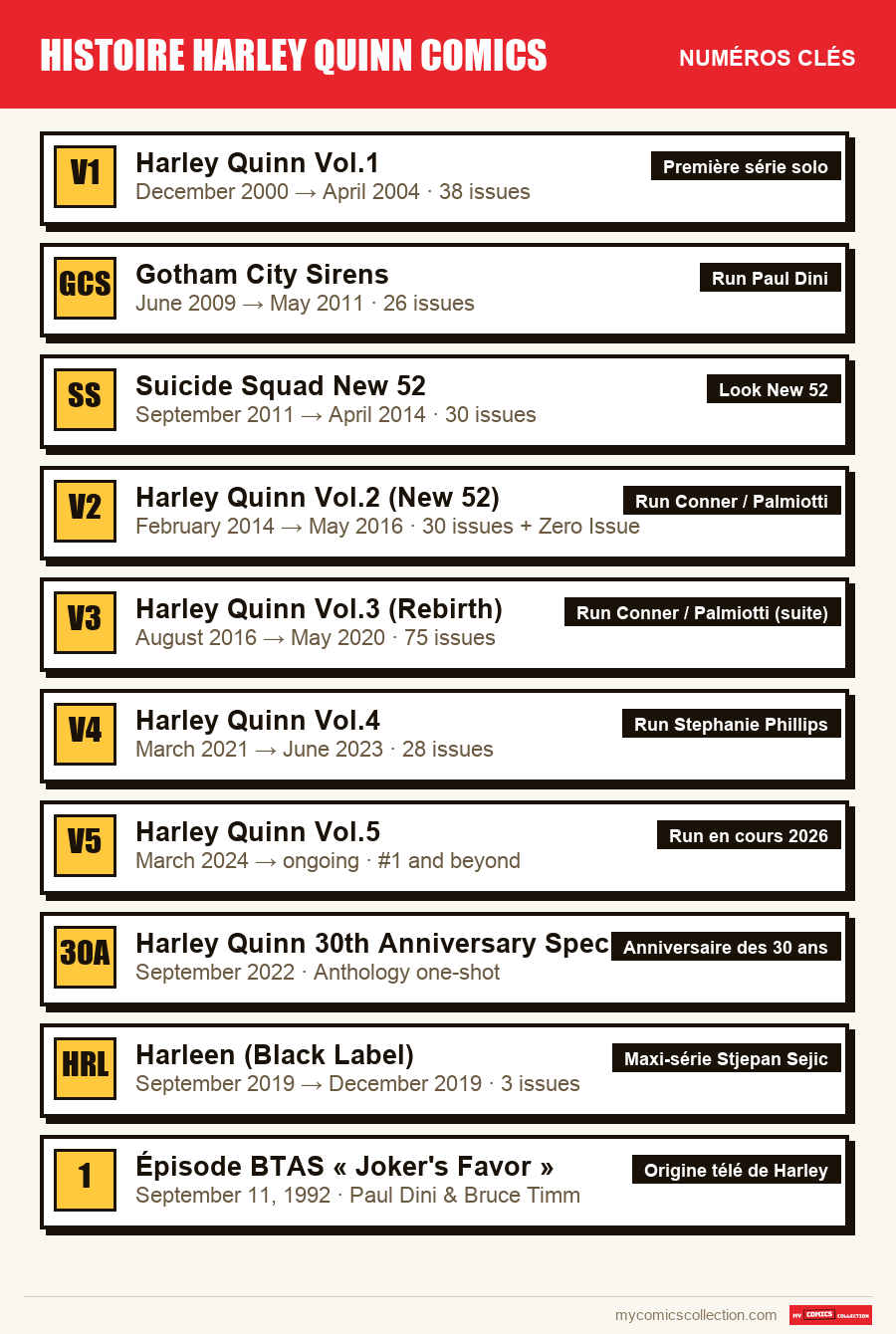
Voici les séries régulières et maxi-séries solo de Harley Quinn dans l'ordre de leur premier numéro :
Harley Quinn Vol.1
La première série régulière solo. Karl Kesel au scénario pour les premiers numéros, suivi de A.J. Lieberman. Couvertures emblématiques de Terry Dodson, qui définissent le look pin-up de Harley pour la décennie. La série développe Harley en criminelle indépendante, affranchie du Joker, et la place pour la première fois sur la durée dans le DC mainstream. 38 numéros avant l'annulation. Le Vol.1 #1 reste un numéro clé accessible (CGC 9.8 entre 80 et 150 $).
Gotham City Sirens
Une série de team-up emblématique réunissant Harley Quinn, Catwoman et Poison Ivy sous la plume de Paul Dini (le co-créateur de Harley de retour aux commandes) et le crayon de Guillem March. C'est dans cette série que la relation amoureuse Harley/Ivy commence à être traitée frontalement. 26 numéros avant le reboot New 52. Le projet de film éponyme (annoncé puis abandonné par Warner) a fait grimper la cote de la série en 2017-2018.
Suicide Squad New 52
Avec le reboot New 52, Harley rejoint officiellement la Suicide Squad, écrite par Adam Glass, puis Ales Kot et Matt Kindt. C'est là qu'apparaît le costume « corset rouge et bleu + short » : le look qui inspirera directement l'incarnation par Margot Robbie à l'écran (Suicide Squad 2016). 30 numéros avant la conclusion du volume New 52. Numéros particulièrement collectionnés : Suicide Squad #1 (sept. 2011) et les variant covers du run.
Harley Quinn Vol.2 (New 52)
Le run qui a tout changé. Amanda Conner et Jimmy Palmiotti écrivent une Harley Quinn déjantée, irrévérencieuse et cartoonesque à Coney Island. Un ton qui mêle comédie absurde et action ultra-violente. La série a explosé en ventes (top 10 mensuel pendant 2 ans), généré des dizaines de variant covers cultes (la cosplay variant cover du Vol.2 #1 par Conner, mai 2014, est l'une des plus collectionnées) et lancé la « Harleymania ». Le Zero Issue de novembre 2013 sert de préquelle. Sans ce run, la Harley moderne n'existerait pas.
Harley Quinn Vol.3 (Rebirth)
La suite « Rebirth » du run Conner/Palmiotti. 75 numéros, l'une des plus longues séries consacrées à un personnage féminin de DC sur 2016-2020. Premiers numéros par Conner/Palmiotti, puis une transition vers Sam Humphries (#43+), puis Mark Russell (#65+). Le run comprend l'arc Harley Loves Joker et des tie-ins Heroes in Crisis. C'est la série de référence pour la Harley post-2016, alignée sur la version grand écran de Margot Robbie.
Harley Quinn Vol.4
La première série régulière entièrement écrite par une femme : Stephanie Phillips, dessins de Riley Rossmo. Le Vol.4 ancre Harley comme thérapeute itinérante de Gotham, soignant les vilains autant qu'elle les combat. 28 numéros, un ton plus introspectif et psychologique. Conclusion en juin 2023.
Harley Quinn Vol.5
Lancée par Elliot Kalan (scénariste pour The Daily Show, Mystery Science Theater 3000), dessins de Mindy Lee. Un ton très comique, plus proche du run Conner/Palmiotti que de celui de Phillips. Run toujours en cours en 2026.
Harley Quinn 30th Anniversary Special
Un one-shot célébrant les 30 ans de Harley Quinn (1992-2022). Une anthologie réunissant Paul Dini, Bruce Timm, Stephanie Phillips, Amanda Conner, Jimmy Palmiotti, Tee Franklin et d'autres. Couvertures par Conner et Olivier Coipel. Un numéro très recherché par les complétistes de Harley.
Harleen (Black Label)
Maxi-série en 3 numéros écrite et dessinée par Stjepan Sejic, l'un des artistes les plus salués de la décennie. Format Black Label (adulte). Réinvente l'origine de Harleen Quinzel sous la forme d'une romance psychologique gothique. Acclamée par la critique, elle est devenue une référence visuelle pour la Harley moderne. Très collectionnée en omnibus et en numéros isolés.
Toutes les séries parallèles de Harley Quinn
Au-delà des volumes principaux, Harley est en vedette dans de nombreuses séries dérivées. Voici les principales :
- Gotham City Sirens (2009-2011, 26 numéros) : team-up Harley / Catwoman / Poison Ivy par Paul Dini.
- Harley Quinn Holiday Special (2014, 2015, 2016) : one-shots annuels de Conner/Palmiotti pour les fêtes.
- Harley Quinn and Power Girl (2015, 6 numéros) : une maxi-série crossover absurde de Conner/Palmiotti, l'une des séries comiques les plus drôles de DC de la décennie.
- Harley Quinn and Her Gang of Harleys (2016, 6 numéros) : maxi-série de Frank Tieri sur le « Gang of Harleys » recruté par Harley à Coney Island.
- Old Lady Harley (2018-2019, 5 numéros) : une maxi futuriste de Conner/Palmiotti, une Harley âgée dans un futur dystopique. Un pastiche d'Old Man Logan.
- Harleen (2019, 3 numéros) : Black Label de Stjepan Sejic. Origine gothique-romantique.
- Harley Quinn: Make 'Em Laugh (2018, 3 numéros) : maxi-série de Conner/Palmiotti, un final alternatif.
- Suicide Squad: Get Joker (2021, 3 numéros) : Black Label de Brian Azzarello / Alex Maleev. Harley et Red Hood traquent le Joker.
- DC vs Vampires : dérivés Harley (2022-2023) : tie-ins à l'événement DC vs Vampires dans lequel Harley joue un rôle clé.
- Harley Quinn Black + White + Red / Black + White + Redder (2020, 2023) : anthologies d'abord numériques puis compilées, plusieurs scénaristes et dessinateurs invités.
- Multiversity: Harley Screws Up The DCU (2023, 6 numéros) : maxi-série de Frank Tieri dans laquelle Harley voyage à travers le multivers DC.
- Harley Loves Joker (2018, 2 numéros) : mini-série de Conner/Palmiotti / Mary Wolfman, complétant les arcs inachevés du Vol.2.
- Harley Quinn 25th Anniversary Special (2017) : one-shot célébrant les 25 ans de Harley.
- Birds of Prey: Harley Quinn (2020, 1 numéro) : tie-in au film Birds of Prey de Cathy Yan.
- Harley Quinn : The Animated Series : The Eat. Bang! Kill. Tour (2021, 6 numéros) : tie-in officiel à la série animée HBO Max, par Tee Franklin.
- Harley Quinn / Catwoman: 80 Page Giant et autres formats spéciaux récurrents.
Les numéros clés de Harley Quinn par ordre chronologique
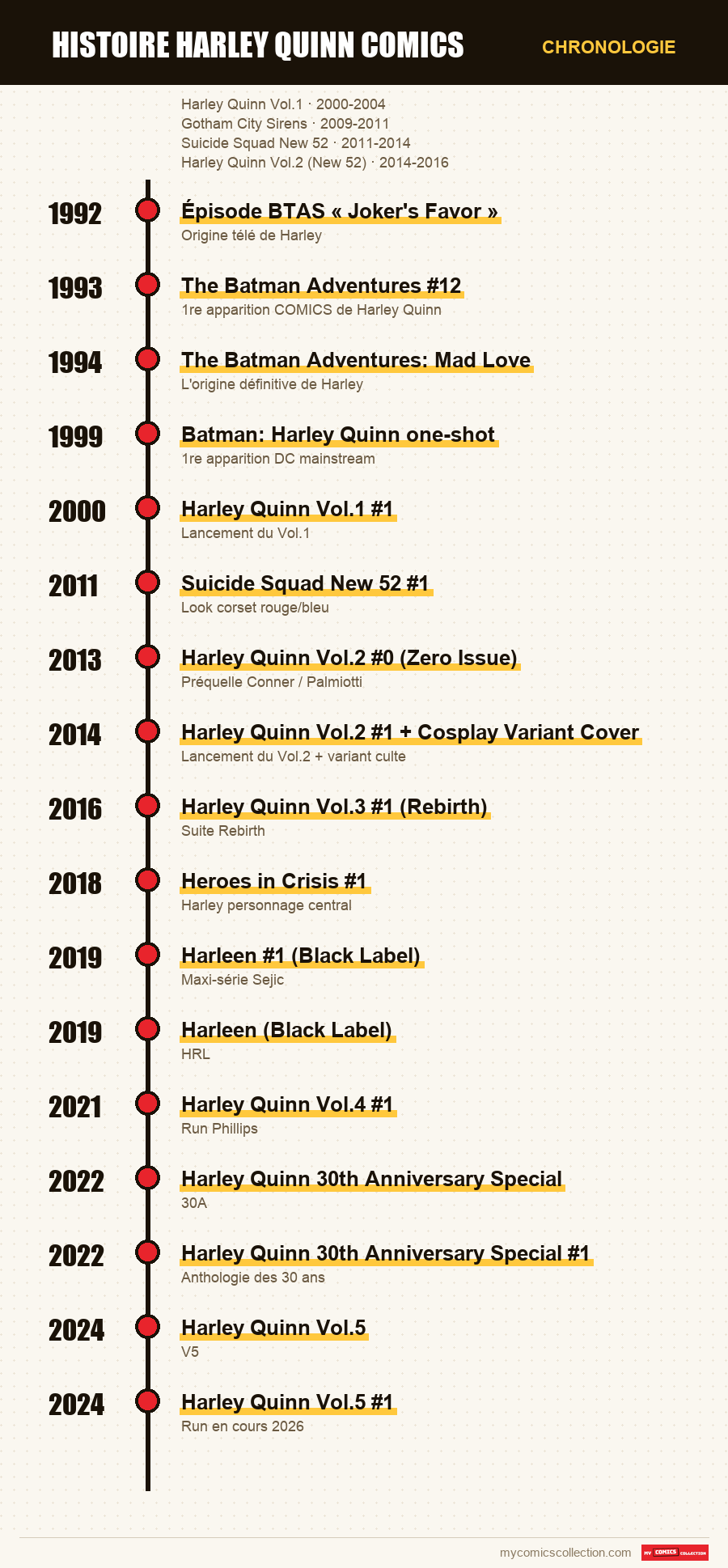
Voici les numéros les plus importants à connaître par ordre chronologique :
Épisode BTAS « Joker's Favor »
Le tout premier moment de Harley Quinn dans la fiction DC. Pas un comic, mais un épisode de Batman: The Animated Series. Sortie d'un gâteau d'anniversaire en costume rouge/noir. Pas une seule ligne de dialogue ne laisse présager qu'elle deviendra l'un des personnages majeurs de DC.
The Batman Adventures #12
Le numéro le plus précieux de toute la collection Harley Quinn. Première apparition en comics, dans la série dérivée de BTAS. Couverture emblématique avec Harley en plein saut. Un CGC 9.8 dépasse aujourd'hui les 5 000 $, un CGC 9.6 entre 1 500 et 2 500 $, un CGC 9.4 entre 700 et 1 200 $. C'est le Graal de tout collectionneur de Harley.
The Batman Adventures: Mad Love
Roman graphique one-shot écrit par Paul Dini lui-même. Pour la première fois, il raconte l'origine définitive de Harleen Quinzel : une psychiatre d'Arkham, séduite par le Joker, complice et victime. Eisner Award 1994. Adapté plus tard en épisode de The New Batman Adventures (1999). Une référence absolue.
Batman: Harley Quinn one-shot
Le moment où Harley Quinn entre officiellement dans la continuité principale de DC, après 7 ans d'existence « DCAU uniquement ». Paul Dini écrit l'origine adaptée à la continuité mainstream : Harleen Quinzel, psychiatre d'Arkham, tombe amoureuse du Joker. CGC 9.8 entre 200 et 400 $, un numéro clé essentiel.
Harley Quinn Vol.1 #1
Premier numéro de la première série régulière solo de Harley Quinn. Couverture de Terry Dodson, qui définit le look pin-up du personnage pour les années 2000. Karl Kesel installe Harley en criminelle solo, affranchie du Joker. CGC 9.8 entre 80 et 150 $.
Detective Comics : Harley rejoint la Suicide Squad
Après Gotham City Sirens et avant le reboot New 52, Harley est progressivement orientée vers la Task Force X. Plusieurs apparitions dans Detective Comics et Suicide Squad précèdent le reboot. Le pivot stratégique qui prépare son rôle central dans le New 52.
Suicide Squad New 52 #1
Premier numéro New 52 de Suicide Squad. Ici, Harley adopte le costume corset rouge et bleu + short qui inspirera directement l'incarnation par Margot Robbie en 2016. Un numéro clé essentiel pour comprendre la transition New 52. CGC 9.8 entre 60 et 100 $.
Harley Quinn Vol.2 #0 (Zero Issue)
Numéro zéro servant de préquelle au lancement du Vol.2. Galerie d'artistes invités (Bruce Timm, Tony Daniel, Sam Kieth, Becky Cloonan…), chacun dessinant Harley dans son propre style. Un concept brillant qui annonce le ton irrévérencieux du run.
Harley Quinn Vol.2 #1 + Cosplay Variant Cover
Lancement officiel du run Conner/Palmiotti. Le numéro qui change tout : ton comique, action ultra-violente, Coney Island, pin-up moderne. La cosplay variant cover d'Amanda Conner (mai 2014) est devenue l'un des variants les plus collectionnés de la décennie : CGC 9.8 entre 150 et 300 $ selon la rareté de la sous-variante.
Harley Quinn Vol.3 #1 (Rebirth)
Lancement du volume Rebirth. Sorti en parallèle du film Suicide Squad (août 2016), qui a propulsé Harley au rang d'icône pop mondiale. Ventes record pour un comic Rebirth. CGC 9.8 entre 50 et 100 $ selon le variant.
Heroes in Crisis #1
La maxi-série en 9 numéros de Tom King dans laquelle Harley joue un rôle central et émotionnel. La série explore le SSPT des héros de DC à travers le refuge Sanctuary. Harley entre en conflit direct avec Booster Gold. Une œuvre controversée mais clé pour comprendre la Harley moderne de l'ère King. CGC 9.8 entre 30 et 60 $.
Harleen #1 (Black Label)
Premier numéro de la maxi-série Black Label de Stjepan Sejic. Origine gothique-romantique de Harleen Quinzel. L'œuvre la plus saluée par la critique du canon Harley, désormais une référence visuelle. CGC 9.8 entre 40 et 80 $ selon le variant.
Harley Quinn Vol.4 #1
Lancement du Vol.4, la première série régulière entièrement écrite par une femme. Stephanie Phillips réoriente Harley vers la thérapie itinérante. Crayonnés expressionnistes de Riley Rossmo. CGC 9.8 entre 30 et 60 $.
Harley Quinn 30th Anniversary Special #1
Un one-shot célébrant les 30 ans de Harley. Réunit Paul Dini, Bruce Timm, Conner/Palmiotti, Phillips, Tee Franklin. Plusieurs couvertures très collectionnées. Le numéro qui clôt symboliquement le premier cycle de Harley.
Harley Quinn Vol.5 #1
Lancement du Vol.5 actuel. Elliot Kalan ramène le ton purement comique, plus proche du Vol.2 que du Vol.4. Run toujours en cours en 2026, à surveiller.
Vous collectionnez cette série ?
Suivez ce que vous possédez, ce qu'il vous manque et ce que vaut votre collection. Essai de 7 jours.
Commencer mon essai →Les arcs majeurs de Harley Quinn dans l'ordre
Joker's Favor (1992)
Origine télé. L'épisode de BTAS dans lequel Harley apparaît pour la première fois.
Mad Love (1994)
Roman graphique Dini/Timm. Origine définitive de Harleen Quinzel à Arkham. Eisner 1994.
Hush Money (Vol.1, 2000-2001)
Arc d'ouverture du Vol.1 par Karl Kesel. Harley criminelle solo affranchie du Joker.
Power Outage (2015)
Maxi-série Harley Quinn and Power Girl. Comédie absurde de Conner/Palmiotti.
Harley Quinn 25th Anniversary (2017)
One-shot anthologie célébrant les 25 ans. Retour de Paul Dini.
Harley Loves Joker (2018)
Mini-série complétant les arcs inachevés du Vol.2 Conner/Palmiotti.
Heroes in Crisis (2018-2019)
Maxi-série de Tom King dans laquelle Harley est un personnage central. SSPT, Sanctuary, Booster Gold.
Old Lady Harley (2018-2019)
Maxi futuriste de Conner/Palmiotti. Harley âgée dans un futur dystopique.
Harleen (2019, Sejic)
Black Label gothique-romantique. Stjepan Sejic. Référence visuelle moderne.
Joker War tie-in (2020)
Harley dans l'arc Joker War de James Tynion IV (Batman Vol.3 #95-100).
Suicide Squad: Get Joker (2021)
Black Label de Brian Azzarello / Alex Maleev. Harley et Red Hood traquent le Joker.
DC vs Vampires : dérivés Harley (2022-2023)
Tie-ins à l'événement DC vs Vampires. Harley joue un rôle clé.
Comment démarrer une collection Harley Quinn en 2026
Choisir un point d'entrée plutôt qu'un objectif global
« Tout Harley » est inatteignable (plus de 250 numéros entre tous les volumes + dérivés). Choisissez-en un : « Run Conner/Palmiotti complet » (Vol.2 + Vol.3 #1-43, soit 73 numéros), « Run Paul Dini complet » (Mad Love + Batman: Harley Quinn 1999 + Gotham City Sirens), ou « Black Label uniquement » (Harleen + Get Joker, 6 numéros).
Importer le catalogue dans My Comics Collection
Avec My Comics Collection, importez Harley Quinn du Vol.1 au Vol.5, Gotham City Sirens, Suicide Squad New 52, Heroes in Crisis et toutes les maxi-séries dérivées. Chaque volume est identifié de façon unique.
Prioriser les numéros clés en CGC
Trois numéros sont incontournables : The Batman Adventures #12 (1re apparition), Batman: Harley Quinn (1999, 1re DC mainstream), et le cosplay variant du Vol.2 #1 (2014). Voir notre top 10 Harley dédié pour un focus sur les numéros clés.
Distinguer le DCAU de la continuité principale
Erreur fréquente du débutant : confondre les comics DCAU (Batman Adventures, Gotham Adventures…) avec la continuité DC mainstream. Les deux univers ont chacun leur propre Harley. The Batman Adventures #12 est DCAU mais reste la 1re apparition canonique en comics.
Suivre la valorisation post-film
La cote de Harley est extrêmement sensible aux annonces de films (Suicide Squad 2016, Birds of Prey 2020, The Suicide Squad 2021, Joker: Folie à Deux 2024 avec Lady Gaga). My Comics Collection met à jour les valeurs chaque jour à partir des annonces eBay en cours.
Pourquoi Harley Quinn est toujours collectionnée en 2026
Aux côtés de Wonder Woman et Catwoman, Harley Quinn est aujourd'hui l'un des trois personnages féminins les plus actifs de DC en ventes mensuelles. Plusieurs raisons expliquent son ascension fulgurante depuis 2014 :
- Les films de Margot Robbie : Suicide Squad (2016), Birds of Prey (2020), The Suicide Squad (2021). Chaque sortie a fait flamber la cote des numéros clés.
- La série animée HBO Max : Harley Quinn (2019-en cours), une série pour adultes acclamée par la critique, 5 saisons en 2026. Coproduite par DC Universe puis HBO Max, elle a doublé la base de fans.
- Lady Gaga dans Joker: Folie à Deux (2024) : une nouvelle incarnation au cinéma musical. Elle ravive la cote des numéros 1992-1999.
- Une fanbase massive et engagée : cosplay, fan art, communauté queer (la relation Harley/Ivy est devenue canon). Harley est l'un des personnages les plus représentés de DC en convention.
- La polyvalence du personnage : criminelle, anti-héroïne, thérapeute, héroïne… Chaque génération réinvente Harley.
- Des numéros accessibles : contrairement à Batman ou Superman, de nombreux numéros clés de Harley sont financièrement accessibles (entre 50 et 5 000 $ selon l'état). Idéal pour le collectionneur intermédiaire.
Biographie de Harleen Frances Quinzel, M.D. (Harley Quinn)
Harley Quinn est un personnage de DC Comics créé par Paul Dini et Bruce Timm. Sa première apparition se fait dans Batman : The Animated Series "Joker's Favor" (1992) : Batman Adventures #12 (comics, 1993), publié en septembre 1992 (TV) : septembre 1993 (comics).
Fiche d'identité de Harleen Frances Quinzel, M.D.
- Vrai nom : Harleen Frances Quinzel, M.D.
- Date de naissance : 11 septembre 1992 (Batman : TAS) : septembre 1993 (premier comics : Batman Adventures #12)
- Lieu de naissance : Brooklyn, New York, USA
- Première apparition : Batman : The Animated Series "Joker's Favor" (1992) : Batman Adventures #12 (comics, 1993) (septembre 1992 (TV) : septembre 1993 (comics))
- Créateurs : Paul Dini (scénariste) et Bruce Timm (designer)
- Éditeur : DC Comics
- Affiliations : Suicide Squad, Joker (ex-partenaire), Birds of Prey, Gotham City Sirens
Origines du personnage
Le Dr Harleen Quinzel, jeune psychiatre de l'Asile d'Arkham, tombe amoureuse du Joker pendant ses séances de thérapie. Manipulée par lui, elle l'aide à s'évader et devient sa partenaire criminelle Harley Quinn. Sa relation toxique avec le Joker évolue vers une rupture, et Harley devient un personnage autonome, parfois alliée des Birds of Prey ou de Poison Ivy.
Pouvoirs et capacités
- Aucun super-pouvoir initial (humaine ordinaire)
- Gymnastique d'élite : ancienne athlète universitaire
- Intellect : psychiatre (M.D. de Gotham State University)
- Combat rapproché : arts martiaux, maillet géant
- Immunité aux toxines (offerte par Poison Ivy dans certaines versions)
- Imprévisibilité psychologique : difficile à anticiper
- Manipulation : capable de retourner les situations grâce à sa folie
Costume et identité visuelle
Costume rouge et noir bicolore classique (style harlequin) ou tenue moderne (short, débardeur "Daddy's Lil Monster", veste). Maquillage clown blanc avec joues rouges. Couettes blondes ornées de rouge et noir/bleu. Maillet géant comme arme signature.
Construisez votre collection Harley Quinn avec méthode
Importez 250+ numéros Harley + Gotham City Sirens + Suicide Squad + Heroes in Crisis + Black Label en un clic, identifiez vos numéros clés manquants et suivez la valeur eBay. Essai gratuit de 7 jours.
🚀 Démarrer l'essai gratuit de 7 joursPour aller plus loin
FAQ, l'histoire de Harley Quinn
D'autres histoires de personnages de comics à découvrir
Notre série complète d'articles « Histoire des comics » couvre les 20 plus grandes franchises Marvel et DC. Chaque article suit le même format : naissance, chronologie complète des volumes, séries parallèles, numéros clés classés chronologiquement, arcs majeurs et méthode de collection.
→ Voir tous les articles de blog « Histoire »