
Les Avengers sont nés en septembre 1963 dans Avengers #1, écrit par Stan Lee et dessiné par Jack Kirby. La formation d'origine réunissait Iron Man, Thor, Hulk, Ant-Man et The Wasp. Captain America les a rejoints dans le numéro 4 (mars 1964) après avoir été retrouvé congelé dans la glace, scellant ainsi l'identité moderne de l'équipe. Plus de 60 ans plus tard, la franchise totalise 700+ numéros en numérotation legacy, 9 volumes principaux de la série Avengers (1963 → le run actuel de Jed MacKay débuté en 2023) et des dizaines de sous-séries (West Coast Avengers, New Avengers, Mighty Avengers, Dark Avengers, Uncanny Avengers, Young Avengers, Force Works, Secret Avengers, Avengers Academy, A-Force, Avengers Forever…). Cet article retrace la naissance de l'équipe, déroule la chronologie complète des volumes dans l'ordre et liste les numéros clés à connaître pour bâtir une collection structurée.
Aux côtés des Fantastic Four et de Spider-Man, les Avengers constituent l'un des trois piliers fondateurs de l'univers Marvel moderne. Mais là où les Fantastic Four incarnent la famille scientifique et Spider-Man le héros adolescent, les Avengers représentent tout autre chose : le rassemblement des plus puissants. « Earth's Mightiest Heroes » : la formule, gravée dans les pages d'Avengers #1, dit tout. Aucun autre titre Marvel n'a réuni autant de personnages vedettes sous une même bannière, généré autant de spin-offs, et surtout, aucune autre franchise comics n'a explosé au box-office comme les Avengers : la saga MCU 2008-2019 a culminé avec un Endgame à 2,8 milliards de dollars, faisant d'Avengers la franchise de super-héros la plus rentable de l'histoire.
Ce guide va vous donner tout ce qu'il faut savoir pour comprendre la naissance des Avengers, suivre la liste complète des comics Avengers dans l'ordre et identifier les numéros clés et arcs majeurs à prioriser. Nous allons parcourir les 60+ années de la franchise, d'Avengers #1 (1963) jusqu'au run actuel de Jed MacKay en 2026, en distinguant les neuf volumes principaux (Lee/Kirby, Roy Thomas, Roger Stern, Kurt Busiek, Bendis, Hickman, Mark Waid, Jason Aaron, MacKay), les séries régulières parallèles (West Coast, New, Mighty, Dark, Uncanny, Young) et les nombreuses mini-séries cultes (Avengers Forever, Disassembled, Time Runs Out, Empyre).
La naissance des Avengers : Marvel en 1963
Pour comprendre comment les Avengers sont nés, il faut remonter à 1961. Marvel Comics, alors connue sous le nom d'Atlas, sortait tout juste d'une décennie creuse dominée par les westerns, les romances et les monstres de poche. Stan Lee, rédacteur en chef, et Jack Kirby, dessinateur vedette, lancent Fantastic Four #1 en novembre 1961, marquant le début de ce qu'on appelle aujourd'hui le Marvel Age. Le succès est immédiat : Spider-Man suit en 1962 (Amazing Fantasy #15), Hulk en mai 1962, Thor en août 1962 dans Journey into Mystery #83, Ant-Man dans Tales to Astonish #27 (puis #35), Iron Man dans Tales of Suspense #39 (mars 1963) et The Wasp en juin 1963.
Stan Lee s'inspire ouvertement de la Justice League of America qui, depuis Brave and the Bold #28 (1960), cartonnait chez DC en réunissant des héros vedettes (Superman, Batman, Wonder Woman, Flash, Green Lantern). L'éditeur Martin Goodman aurait demandé à Lee, lors d'une partie de golf avec Jack Liebowitz (DC), de produire un équivalent. Lee et Kirby acceptent et livrent Avengers #1 en septembre 1963, empruntant le titre à un comic Atlas oublié des années 1950 (Avengers, une série de guerre). L'équipe était composée des héros vedettes de Marvel qui n'avaient pas encore leur propre magazine solo (Thor, Iron Man et Hulk figuraient dans des titres-anthologies partagés), afin qu'ils profitent de la visibilité.
Avengers #1 (septembre 1963)
Les Avengers font leur première apparition dans Avengers #1 (daté de couverture septembre 1963, en kiosque dès juin 1963), dans une histoire intitulée « The Coming of the Avengers! » Le pitch : Loki, le demi-frère banni de Thor, manipule Hulk pour semer le chaos. Iron Man, Thor, Ant-Man (Hank Pym, toujours dans son costume d'origine) et The Wasp (Janet Van Dyne) répondent à un appel et se retrouvent face à Hulk… avant de percer à jour la machination de Loki. À la fin du numéro, c'est Janet qui prononce la réplique fondatrice : « And there's another one we should add to our team! » : donnant son nom au groupe. La couverture, signée Jack Kirby, montre les cinq héros face à Hulk dans une composition explosive.
Le succès est progressif mais durable. Avengers devient l'un des titres pivots de Marvel dès 1964, lorsque Avengers #4 introduit ce qui restera le tournant déterminant : Captain America est retrouvé congelé dans la glace de l'Atlantique Nord, ranimé après 20 ans de sommeil depuis 1945. Cap remplace Hulk (qui avait quitté le groupe dès le #2), devient le leader moral, et c'est cette équipe (Cap, Iron Man, Thor, Ant-Man (devenu Giant-Man), Wasp) qui définit l'identité moderne des Avengers. Plus de 60 ans plus tard, cette même galaxie sert toujours de noyau au MCU.
L'anecdote historique : contrairement à la légende, ce n'est pas Stan Lee mais The Wasp qui baptise le groupe à la dernière page d'Avengers #1. Lee a souvent reconnu en interview que Goodman lui avait imposé le titre pour réutiliser un copyright en sommeil. Plus surprenant encore, l'équipe d'origine ne tient que 8 numéros : Hulk part au #2, et Iron Man / Thor / Hank Pym / Wasp s'en vont tous au #16 (mai 1965). Cap devient alors le leader d'une équipe d'« underdogs » composée de personnages de second plan : Hawkeye, Quicksilver et Scarlet Witch (le « Cap's Kooky Quartet »). C'est ce reset audacieux qui ancre définitivement la matrice « Avengers : une équipe en rotation permanente ».
Les volumes principaux d'Avengers dans l'ordre chronologique
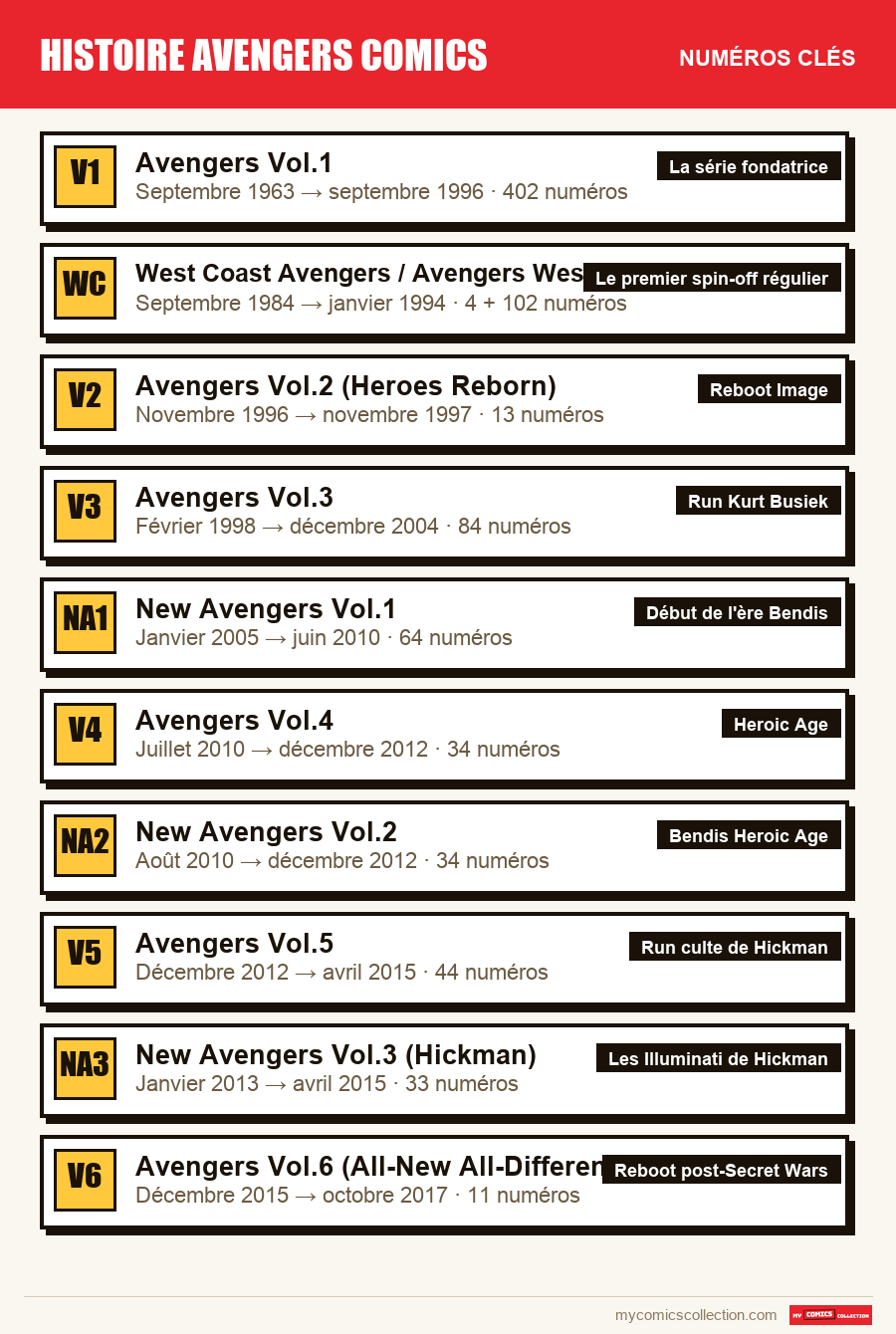
La série Avengers est l'une des plus complexes de Marvel : 9 volumes principaux et plus de 700 numéros en numérotation legacy. Voici la chronologie des principaux volumes solo dans l'ordre de leur premier numéro :
Avengers Vol.1
Le titre d'origine, lancé par Stan Lee & Jack Kirby, qui tient sans interruption pendant 33 ans. 402 numéros couvrant le Silver Age, le Bronze Age et la première moitié du Modern Age. Tournants majeurs : #1 (formation), #4 (retour de Cap), #16 (Cap's Kooky Quartet), #28 (1re apparition de Goliath / identité géante de Hank Pym nommée), #57 (1re apparition de la Vision moderne), #89-97 (Kree-Skrull War par Roy Thomas / Neal Adams), #161-177 (Korvac Saga, Jim Shooter), #213 (l'épisode controversé Hank Pym / Wasp), #241 (crossover X-Factor), #300 (anniversaire), puis le déclin avec The Crossing (1995) et la fin au #402 juste avant Heroes Reborn.
West Coast Avengers / Avengers West Coast
Le premier véritable spin-off régulier des Avengers, lancé par Roger Stern et Bob Hall sous forme de mini-série en 4 numéros (1984), puis en série régulière à partir de 1985 sous la plume de Steve Englehart et le crayon d'Al Milgrom. L'équipe est basée à Los Angeles : Hawkeye (aux commandes), Mockingbird, Iron Man (version Tony Stark, puis Jim Rhodes), Tigra, Wonder Man. John Byrne reprend le titre au #42 (renommé Avengers West Coast) et signe la transformation de Wanda en Scarlet Witch. La série se termine au #102 en 1994. Reprises ponctuelles en 2018 (Vol.3, 10 numéros) et 2023 (Vol.4).
Avengers Vol.2 (Heroes Reborn)
Reboot complet dans le cadre de l'événement Heroes Reborn. Marvel sous-traite Avengers (ainsi qu'Iron Man, Captain America, Fantastic Four) à Rob Liefeld et Jim Lee, deux cofondateurs d'Image Comics, en échange de leur retour. Liefeld s'occupe d'Avengers #1-6, puis Walter Simonson prend la relève sur les #7-13. Univers parallèle « Counter-Earth » pour repartir à zéro avec les héros. La série se termine au #13 (novembre 1997) et l'univers principal est restauré en novembre 1997 par Heroes Return.
Avengers Vol.3
Le run le plus respecté de la fin des années 1990 et du début des années 2000. Kurt Busiek et George Pérez reprennent les Avengers après Heroes Return en février 1998. Pérez livre les #1-34 d'une beauté inégalée, tandis que Busiek écrit jusqu'au #56. Avengers Forever (12 numéros, mini-série Busiek/Carlos Pacheco, 1998) s'intègre à ce run. Geoff Johns prend ensuite la relève, puis Chuck Austen, puis Brian Bendis, qui clôt le volume avec Avengers Disassembled (#500-503). Le numéro #500 (reprise de la numérotation legacy) est l'un des meilleurs vendeurs du run et lance toute l'ère Bendis.
New Avengers Vol.1
Après Avengers Disassembled, Marvel rebote tout. Brian Michael Bendis écrit New Avengers avec une équipe radicalement nouvelle : Captain America, Iron Man, Spider-Man (qui les rejoint pour la première fois !), Wolverine (idem), Spider-Woman, Luke Cage, Ronin. Le run marque l'âge d'or commercial des Avengers : 64 numéros qui couvrent House of M (2005), Civil War (2006-2007), Secret Invasion (2008), Dark Reign (2009), Siege (2010). Bendis devient l'auteur le plus prolifique de l'histoire des Avengers (plus de 200 numéros tous titres confondus, 2005-2015).
Avengers Vol.4
Bendis lance Avengers Vol.4 en juillet 2010 dans le cadre du Heroic Age, après Siege. Équipe principale : Cap, Iron Man, Thor, Hawkeye, Spider-Woman, Spider-Man, Wolverine, Bucky-Cap. John Romita Jr. au dessin. 34 numéros qui mènent à Avengers vs X-Men (2012) et au passage de relais à Hickman.
New Avengers Vol.2
Tout en écrivant le Vol.4, Bendis mène aussi New Avengers Vol.2 en parallèle : une équipe street-level basée à l'Avengers Mansion (reconstruit par Cap) : Luke Cage, Ms. Marvel (Carol), Mockingbird, Iron Fist, Wolverine, Spider-Man. Stuart Immonen au dessin. 34 numéros, qui se concluent en même temps qu'Avengers vs X-Men.
Avengers Vol.5
Le run le plus ambitieux de toute l'histoire des Avengers. Jonathan Hickman arrive après Bendis et redéfinit la franchise comme une saga cosmique de 3 ans. Avengers #1 (2012, équipe élargie à 18 membres dont Hyperion, Captain Universe, Manifold, Smasher), Infinity (2013, méga-événement Builders / guerre de Thanos), Time Runs Out (2014, dernier acte avant Secret Wars), conclusion #44 qui mène directement à Secret Wars (2015). 44 numéros d'une cohérence narrative totale.
New Avengers Vol.3 (Hickman)
Titre compagnon du run Hickman, qui suit les Illuminati (Iron Man, Black Bolt, Mr. Fantastic, Black Panther, Doctor Strange, Beast, Namor). Hickman explore les Incursions (univers parallèles qui entrent en collision), le thème central qui mènera à Secret Wars. Steve Epting et Mike Deodato au dessin. À lire en parallèle du Vol.5 dans l'ordre de « double-shipping » de Marvel.
Avengers Vol.6 (All-New All-Different)
Reboot post-Secret Wars dans l'ère All-New, All-Different. Mark Waid et Mike Del Mundo. Toute nouvelle formation : Iron Man, Captain America (Sam Wilson), Thor (Jane Foster), Spider-Man (Miles Morales), Vision, Nova (Sam Alexander), Ms. Marvel (Kamala Khan). 11 numéros avant le crossover Standoff et le passage au Vol.7.
Avengers Vol.7 (Mark Waid)
La suite de Mark Waid après l'événement Civil War II. Équipe : Hercules, Wonder Man, Spider-Man (Peter), Falcon, Vision, Wasp (Nadia van Dyne). 11 numéros plus le crossover No Surrender (16 numéros hebdomadaires en 2018) qui fait le pont vers le Vol.8.
Avengers Vol.8 (Jason Aaron)
Le run le plus long depuis Bendis. Jason Aaron reprend les Avengers en mai 2018 et y reste 5 ans. Ed McGuinness (#1-12), puis David Marquez et Javier Garrón. Équipe : Iron Man, Cap (Steve), Thor (Jane), Captain Marvel (Carol), Black Panther, Doctor Strange, Ghost Rider (Robbie Reyes), She-Hulk. Sagas Final Host (origines à 1 million av. J.-C.), War of the Realms (2019, méga-événement d'Aaron), King in Black (2020-2021, tie-ins Knull), Enter the Phoenix, World War She-Hulk, conclusion Death Hunters (2022-2023). 66 numéros au total, qui se terminent au #66 en mai 2023.
Avengers Vol.9 (Jed MacKay)
Run en cours en 2026. Jed MacKay au scénario, C.F. Villa au dessin. Équipe triée sur le volet par Captain Marvel (qui mène la formation) : Iron Man, Thor, Black Panther, Vision, Sam Wilson Cap, Scarlet Witch, Captain Marvel. Premier arc : la menace de l'Ashen Combine. Vol.9 #1 est sorti en juin 2023, le run est toujours en cours, avec des couvertures variantes très recherchées par les collectionneurs modernes.
Toutes les séries Avengers parallèles dans l'ordre chronologique
En plus des neuf volumes principaux, Marvel a publié des dizaines de séries Avengers parallèles. Voici la chronologie des principaux titres pour comprendre l'écosystème complet de la franchise :
- Giant-Size Avengers (1974-1975, 5 numéros) : anthologies grand format, 1re apparition de Mantis dans le #4.
- The West Coast Avengers Mini-Series (1984, 4 numéros) : la mini fondatrice avant la série régulière de 1985.
- West Coast Avengers Vol.2 / Avengers West Coast (1985-1994, 102 numéros) : voir les détails dans la section des volumes principaux.
- Solo Avengers / Avengers Spotlight (1987-1991, 40 numéros) : titre back-up pour Hawkeye, Mockingbird, USAgent et d'autres personnages secondaires.
- Force Works (1994-1996, 22 numéros) : spin-off post-Avengers West Coast avec Iron Man, USAgent, Wonder Man, Scarlet Witch, Spider-Woman (Julia Carpenter).
- Avengers: The Initiative (2007-2010, 35 numéros) : suite directe de Civil War, programme d'entraînement pour héros déployé dans les 50 États.
- Mighty Avengers Vol.1 (2007-2010, 36 numéros) : la série régulière « officielle » de Bendis en parallèle de New Avengers (qui était officieuse après Civil War). Frank Cho au dessin.
- Young Avengers Vol.1 (2005-2006, 12 numéros) : Allan Heinberg et Jim Cheung introduisent une nouvelle génération : Patriot, Hulkling, Wiccan, Speed, Stature, Hawkeye (Kate Bishop), Vision (Iron Lad reprogrammé). Un titre culte chez les jeunes lecteurs Marvel.
- Dark Avengers (2009-2010, 16 numéros + Vol.2 en 2012) : Norman Osborn dirige une équipe de vilains déguisés en héros (Bullseye en Hawkeye, Daken en Wolverine, Venom en Spider-Man, Moonstone en Ms. Marvel). Bendis et Mike Deodato.
- Secret Avengers Vol.1 (2010-2013, 37 numéros) : équipe black-ops menée par Steve Rogers (Ed Brubaker / Mike Deodato), puis Warren Ellis, puis Rick Remender.
- Avengers Academy (2010-2012, 39 numéros) : Christos Gage forme une nouvelle génération : Hazmat, Mettle, Reptil, Striker, Veil, Finesse. Fondateur pour les jeunes héros du roster moderne.
- New Avengers Vol.2 (2010-2013, 34 numéros) : voir la section des volumes.
- Uncanny Avengers Vol.1 (2012-2014, 25 numéros) : Rick Remender / John Cassaday. Premier titre crossover Avengers / X-Men post-AvX. Équipe « Unity squad » : Cap, Thor, Wolverine, Rogue, Wonder Man, Wasp, Havok.
- Avengers Arena (2012-2013, 18 numéros) : Dennis Hopeless, Battle Royale entre jeunes héros d'Avengers Academy / Young Avengers. Controversé pour son ton sombre.
- Avengers Undercover (2014, 10 numéros) : suite directe d'Avengers Arena.
- Avengers AI (2013-2014, 12 numéros) : Sam Humphries, équipe d'IA menée par Hank Pym.
- Mighty Avengers Vol.2 (2013-2014, 14 numéros) : Al Ewing, équipe diversifiée (Luke Cage, White Tiger, Power Man, Spectrum, Blue Marvel).
- U.S.Avengers (2017, 12 numéros) : Al Ewing / Paco Medina. Équipe patriotique, menée par Sunspot.
- Squadron Supreme (plusieurs volumes 1985, 2006, 2015, 2025) : l'équivalent Marvel de la Justice League dans des univers alternatifs.
- A-Force (2015, 5 numéros + Vol.2 en 2016, 10 numéros) : équipe 100 % féminine, sortie pendant Secret Wars 2015. G. Willow Wilson / Marguerite Bennett.
- All-New All-Different Avengers (2015-2016, 15 numéros) : Mark Waid / Mahmud Asrar, équipe de jeunes héros post-Secret Wars.
- Occupy Avengers (2016-2017, 9 numéros) : David F. Walker, équipe road-trip menée par Hawkeye.
- Uncanny Avengers Vol.3 (2015-2017, 30 numéros) : Gerry Duggan / Ryan Stegman, formation Cap (Sam) / Deadpool / Spider-Man / Doctor Voodoo / Quicksilver.
- Avengers Forever Vol.2 (2021-2023, 15 numéros) : Jason Aaron / Aaron Kuder. Équipe inter-univers menée par Robbie Reyes / Ghost Rider depuis un futur dévasté. Compagnon direct du Vol.8.
- Savage Avengers (2019-2022, 28 numéros + Vol.2 2022-2023) : Conan le Barbare en Avenger, Gerry Duggan / Mike Deodato.
- Avengers Twilight (2024, 6 numéros) : Chip Zdarsky / Daniel Acuña, futur dystopique des Avengers après le fascisme. Mini-série « What If » canon sous label Black Label.
- West Coast Avengers Vol.3 (2018-2019, 10 numéros) : Kelly Thompson / Stefano Caselli. Reboot avec Kate Bishop, Hawkeye, America Chavez, Gwenpool.
- West Coast Avengers Vol.4 (2024+) : nouveau reboot avec Iron Man, War Machine, Spider-Woman.
- Avengers Annual (annuals Vol.1 1967-1994, Vol.2 1998-2001, Vol.3 récent) : numéros spéciaux comprenant des key issues majeurs (Annual #10 = 1re apparition de Rogue en 1981).
- Avengers Strike File (1994, one-shot) : guide technique.
- Avengers Unplugged (1995-1996, 6 numéros) : titre back-up des années 1990.
- New Warriors (1990-1996, 75 numéros) : pas un titre Avengers à proprement parler, mais l'équipe interagit constamment avec eux. À noter pour Civil War (incident de Stamford).
Les numéros clés des Avengers dans l'ordre chronologique
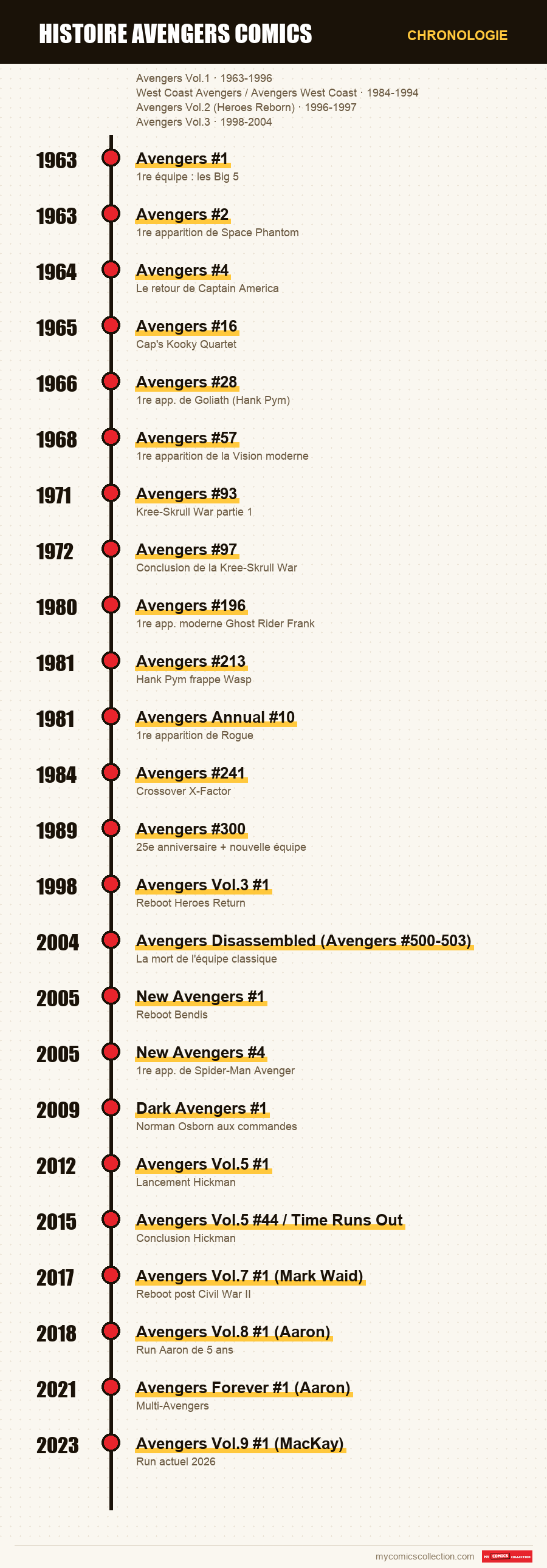
Voici les numéros les plus importants à connaître, dans l'ordre chronologique :
Avengers #1
Le numéro fondateur. 1re apparition de l'équipe (Iron Man, Thor, Hulk, Ant-Man, Wasp). Histoire intitulée « The Coming of the Avengers! » où Loki manipule Hulk pour réunir les héros. Top 10 des comics Silver Age les plus chers : un CGC 9.4 s'est vendu 274 850 $ en 2022, un CGC 9.6 dépasse les 500 000 $ sur les très rares ventes. Le Saint Graal de toute collection Avengers.
Avengers #2
1re apparition de Space Phantom, le premier antagoniste exclusif des Avengers. Plus important encore : Hulk quitte le groupe à la dernière page, ouvrant la voie à l'arrivée de Cap au #4. Un numéro pivot pour la formation d'origine.
Avengers #4
Le numéro le plus important historiquement après le #1. Captain America est retrouvé congelé dans la glace de l'Atlantique Nord par les Avengers, ranimé après 20 ans depuis 1945. C'est la 1re apparition Silver Age de Cap (sa dernière apparition Golden Age datait de 1954). Cap rejoint l'équipe et en devient le leader emblématique. CGC 9.0 estimé entre 80 000 $ et 130 000 $ lors des ventes 2022-2023. Top 5 des key issues Marvel les plus chers après Amazing Fantasy #15 et Hulk #1.
Avengers #16
Un tournant audacieux : Iron Man, Thor, Giant-Man et Wasp quittent tous l'équipe. Captain America reste seul leader et recrute trois anciens vilains repentis : Hawkeye, Quicksilver, Scarlet Witch. Ce reset choc montre que les Avengers sont une équipe en rotation, pas un casting figé. Le modèle de 60 ans de spin-offs et de reformations.
Avengers #28
Hank Pym change d'identité et adopte le nom de Goliath avec une nouvelle palette de costume. On y trouve aussi la 1re app. de The Collector (Tivan), futur acteur du MCU (Benicio del Toro). Un numéro double key.
Avengers #57
Première apparition de la Vision moderne, un androïde créé par Ultron (qui apparaît juste avant). Conçue pour détruire les Avengers, la Vision se rebelle et rejoint l'équipe. Un personnage central depuis 60 ans, popularisé dans le MCU par Paul Bettany (Avengers: Age of Ultron 2015 → WandaVision 2021). CGC 9.4 estimé à 4 000-6 000 $ en 2024.
Avengers #93
Début de la Kree-Skrull War, la première grande saga cosmique des Avengers. Roy Thomas et Neal Adams livrent ce qui reste un sommet du Bronze Age. La saga court jusqu'au #97, avec la Vision, Captain Marvel (Mar-Vell) et Rick Jones impliqués. Référence narrative réutilisée par les Russo / Markus dans Avengers: Endgame (Captain Marvel, Skrulls Secret Invasion 2023).
Avengers #97
Conclusion de la Kree-Skrull War. Un numéro spécial de 35 pages avec un back-up qui revisite les héros du Golden Age (Captain America, Sub-Mariner, le Human Torch original). Le modèle des sagas « event » 35 ans avant Civil War.
Avengers Annual #10
1re apparition de Rogue (Anna Marie), la mutante qui absorbe les pouvoirs. Bien que destinée à devenir une X-Man majeure, elle débute en attaquant Carol Danvers / Ms. Marvel dans un Avengers Annual. CGC 9.8 entre 1 200 et 2 000 $ en 2024. Très recherché.
Avengers #196
1re apparition d'un Ghost Rider qui sera réinterprété en version moderne. Solide valeur de collection Bronze Age, avec le run Michelinie/Byrne très recherché.
Avengers #213
L'un des numéros les plus controversés de l'histoire des Avengers. La scène (mal cadrée par Bob Hall, qui n'avait pas reçu toutes les notes de Shooter) montre Hank Pym frappant Janet Van Dyne. Le numéro a déclenché 40 ans de débats sur Hank Pym et son arc moral. Janet quitte Hank, le divorce devient officiel. Elle reviendra avec Hawkeye comme leader.
Avengers #241
Numéro pivot du run de Roger Stern, l'un des plus appréciés. Crossover avec la formation de X-Factor. Le run Stern (#227-285) reste, pour beaucoup, le sommet de fin de Bronze Age des Avengers : Under Siege (#270-277, Baron Zemo attaque l'Avengers Mansion) est l'arc culte de cette époque.
Avengers #300
Numéro du 25e anniversaire des Avengers. Reformation de l'équipe avec Cap, Thor, Mr. Fantastic, Invisible Woman, She-Hulk et Gilgamesh. Histoire en double feature avec un tie-in Inferno. Couvertures variantes très collectionnées.
Avengers Vol.3 #1
Lancement du Vol.3 sous Kurt Busiek et George Pérez. Heroes Return : les héros reviennent de Counter-Earth après Heroes Reborn. Considéré comme l'un des meilleurs Avengers #1 de tous les temps. Pérez s'occupe des 34 premiers numéros, dont Ultron Unlimited (#19-22) en 1999, l'arc le plus mémorable du run.
Avengers Disassembled (Avengers #500-503)
Retour à la numérotation legacy (#500 = #84 du Vol.3 + 416 du Vol.1 + premiers Annuals). Bendis déchire l'équipe : Scarlet Witch sombre dans la folie après avoir perdu ses enfants imaginaires. Hawkeye, la Vision et Ant-Man (Scott Lang) meurent tous. L'Avengers Mansion est détruit. Fin d'une ère, porte d'entrée vers New Avengers.
New Avengers #1
Lancement de l'ère Bendis, qui va définir les Avengers pendant 10 ans. Couvertures variantes très demandées. La formation New Avengers est le moule de l'équipe MCU de 2012 (Cap, Iron Man, Thor, Hulk, Hawkeye, Black Widow + Spider-Man et Wolverine).
New Avengers #4
La première fois que Spider-Man rejoint officiellement les Avengers en tant que membre régulier. Événement majeur : Spider-Man et Wolverine n'avaient jamais été Avengers en 40 ans de continuité. Très collectionné par les fans de Spider-Man.
Civil War #1-7 + tie-ins Avengers
L'événement Avengers le plus marquant du XXIe siècle. Cap contre Iron Man au sujet du Superhero Registration Act. Mort de Goliath (Bill Foster) dans le #4. Mort de Captain America (Steve Rogers) dans Captain America #25 quelques semaines plus tard. Adapté au MCU sous le titre Captain America: Civil War (2016).
Secret Invasion #1-8
Les Skrulls infiltrent la Terre et ont secrètement remplacé plusieurs Avengers pendant des années. Mort de Wasp (Janet) dans le #8. Norman Osborn devient le héros officiel des États-Unis (lançant Dark Reign). Adapté dans la série Disney+ Secret Invasion (2023).
Dark Avengers #1
Lancement de Dark Reign. Norman Osborn forme une équipe de vilains déguisés en héros : Bullseye en Hawkeye, Daken en Wolverine, Venom (Mac Gargan) en Spider-Man, Moonstone en Ms. Marvel, Iron Patriot (Osborn). 1re apparition de l'équipe Dark Avengers, popularisée dans Thunderbolts (2025) au MCU.
Avengers Vol.5 #1
Lancement du run Hickman. « We need to get bigger » : équipe élargie à 18 membres dont Hyperion, Captain Universe, Manifold, Smasher, Sunspot. Une saga cosmique de 3 ans qui mènera à Secret Wars 2015. Couvertures variantes ultra-collectionnées.
Avengers Vol.5 #44 / Time Runs Out
Conclusion du run Hickman. Saut temporel de 8 mois post-Time Runs Out, dernière incursion entre Earth-616 et Earth-1610. Le numéro mène directement à Secret Wars 2015 #1. Conclusion sublime, structurée, parfaitement résolue.
Avengers Vol.7 #1 (Mark Waid)
Lancement du Vol.7 par Mark Waid avec une équipe ressuscitée : Hercules, Wonder Man, Spider-Man (Peter), Falcon Cap, Vision, Wasp (Nadia van Dyne, la fille de Hank).
Avengers Vol.8 #1 (Aaron)
Lancement de l'ère Aaron post-No Surrender. Saga des origines préhistoriques Final Host (1 million av. J.-C., équipe d'Avengers néolithiques). 66 numéros vont suivre jusqu'en 2023. Couvertures variantes très collectionnées (la couverture dynamique de Cheung).
Avengers Forever #1 (Aaron)
Spin-off du run Aaron qui explore les Avengers de tous les univers (Tony Stark Cosmic Ghost Rider, Cap zombie, Black Panther of the Hour, Avenger Prime). Maxi-série en 15 numéros, avec une conclusion directement liée à Avengers Assemble Alpha/Omega 2023.
Avengers Vol.9 #1 (MacKay)
Lancement du run actuel. Captain Marvel forme une nouvelle équipe : Iron Man, Thor, Black Panther, Vision, Sam Wilson Cap, Scarlet Witch. Premier arc : Ashen Combine. Run en cours en 2026, avec des couvertures variantes très demandées par les collectionneurs modernes (variantes d'Alex Ross).
Vous collectionnez cette série ?
Suivez ce que vous possédez, ce qu'il vous manque et ce que vaut votre collection. Essai de 7 jours.
Commencer mon essai →Les grands arcs narratifs des Avengers dans l'ordre
Kree-Skrull War (1971-1972)
Roy Thomas / Neal Adams. Première grande saga cosmique. Référence MCU.
The Korvac Saga (1977-1978)
Jim Shooter. Korvac, le dieu omnipotent du futur. Un rare apogée émotionnel.
Under Siege (1986)
Roger Stern / John Buscema. Baron Zemo attaque l'Avengers Mansion.
The Crossing (1995)
Tournant controversé : Iron Man revient en vilain manipulé par Kang. Met en place Heroes Reborn.
Heroes Reborn (1996-1997)
Reset Image / Liefeld / Lee. Counter-Earth alternative. 13 numéros du Vol.2.
Avengers Forever (1998-1999)
Kurt Busiek / Carlos Pacheco. Maxi cosmique en 12 numéros, les Avengers de toutes les époques contre Immortus.
Ultron Unlimited (1999)
Busiek / Pérez. Ultron extermine la nation de Slorenia. Apogée du run Vol.3.
Avengers Disassembled (2004)
Bendis. Scarlet Witch détruit l'équipe. Mort de Hawkeye, de la Vision, d'Ant-Man (Scott).
House of M (2005)
Bendis / Coipel. Wanda réécrit la réalité. « No more mutants. » 8 numéros.
Civil War (2006-2007)
Mark Millar / McNiven. Cap contre Iron Man. Mort de Goliath, mort de Cap (Captain America #25).
Secret Invasion (2008)
Bendis / Yu. Les Skrulls infiltrent. Mort de Wasp. Lance Dark Reign.
Siege (2010)
Bendis / Coipel. Conclusion de Dark Reign. Asgard tombe. Norman Osborn vaincu.
Avengers vs X-Men (2012)
5 scénaristes (Bendis, Aaron, Brubaker, Hickman, Fraction). Le Phoenix Force divisé. 12 numéros.
Infinity (2013)
Hickman / Jim Cheung. Builders cosmiques + invasion de Thanos. 6 numéros + tie-ins.
Time Runs Out (2014-2015)
Hickman. Saut de 8 mois, Illuminati cachés. Conclusion qui mène à Secret Wars.
Secret Wars (2015)
Hickman / Esad Ribic. Battleworld, fin du Multivers, refondation. Maxi en 9 numéros.
Standoff (2016)
Pleasant Hill, mini-événement Cap-Avengers. Récupération du Cosmic Cube.
Civil War II (2016)
Bendis / Marquez. Iron Man contre Captain Marvel. 8 numéros. Mort de War Machine, mort de Hulk.
No Surrender (2018)
16 numéros hebdomadaires par Ewing/Waid/Zub. Pont vers le Vol.8 d'Aaron.
War of the Realms (2019)
Aaron / Russell Dauterman. Malekith attaque les 10 Royaumes. 6 numéros + tie-ins.
Empyre (2020)
Al Ewing / Slott / Schiti. Attaque des Cotati. Crossover FF + Avengers. 6 numéros.
Heroes Reborn (2021)
Aaron / McGuinness. Réalité de la Squadron Supreme. 7 numéros + tie-ins. Reset rétroactif.
World War She-Hulk (2022)
Aaron / Garrón. She-Hulk possédée par le Winter Hulk. Apogée du Vol.8.
Death Hunters (2022-2023)
Aaron / Garrón. Mephisto et les Multiversal Masters of Evil. Apogée du run Aaron.
Ashen Combine + Twilight Court (2023-2026)
Jed MacKay. Premier arc du Vol.9. Captain Marvel mène l'équipe. En cours.
Comment démarrer une collection Avengers en 2026
Se fixer un objectif clair
« Je veux tous les Avengers » est un mauvais objectif (700+ numéros legacy + 30+ spin-offs). « Je veux le run complet de Hickman (Vol.5 #1-44 + New Avengers Vol.3 #1-33 + Infinity + Secret Wars) » ou « le run New Avengers Vol.1 #1-64 de Bendis » sont d'excellents points de départ. Pour les numéros clés : Avengers #1, #4, #16, #57, Annual #10, #213, New Avengers #1, Vol.5 #1.
Importer le catalogue dans My Comics Collection
Avec My Comics Collection, importez Avengers Vol.1 à Vol.9, West Coast, New Avengers Vol.1-3, Mighty, Dark, Uncanny, Young, Secret, Academy et toutes les sous-séries. Chaque volume est identifié séparément, ce qui évite la confusion classique entre Avengers #1 (1963), Avengers Vol.2 #1 (1996), Avengers Vol.3 #1 (1998), Avengers Vol.4 #1 (2010), Avengers Vol.5 #1 (2012), Avengers Vol.6 #1 (2015), Avengers Vol.7 #1 (2017), Avengers Vol.8 #1 (2018) et Avengers Vol.9 #1 (2023).
Prioriser les numéros clés
Les 26 numéros clés listés représentent 80 % de la valeur historique. Consultez notre top 10 Avengers dédié pour un focus key issues + valeurs CGC actualisées.
Organiser par run plutôt que par numéro
Les Avengers se collectionnent le mieux par run (Lee/Kirby, Roy Thomas, Stern, Busiek, Bendis, Hickman, Aaron, MacKay) plutôt que dans l'ordre chronologique strict des numéros. Cela facilite la lecture et donne du sens à la franchise.
Suivre les estimations eBay
Avengers #1 est hors de portée (CGC 9.0+ > 100 000 $), mais de nombreux numéros clés se vendent en permanence (Annual #10 Rogue, #57 Vision, New Avengers #1, Dark Avengers #1). My Comics Collection met à jour les valeurs chaque jour à partir des annonces eBay en cours.
Pourquoi Avengers reste la franchise n°1 de Marvel en 2026
Avec Spider-Man et les X-Men, Avengers est la franchise Marvel la plus active en ventes mensuelles en 2026. Plusieurs raisons :
- L'effet MCU : la saga du Marvel Cinematic Universe 2008-2019 (Avengers, Avengers: Age of Ultron, Avengers: Infinity War, Avengers: Endgame) a généré plus de 7,7 milliards de dollars cumulés au box-office. Avengers: Endgame à lui seul a rapporté 2,8 milliards de dollars en 2019, brièvement le record absolu tous films confondus, désormais deuxième derrière Avatar 2. Avengers 5 (Doomsday, prévu pour 2026) et Avengers 6 (Secret Wars, prévu pour 2027) sont en post-production. Aucune franchise comics n'a un tel impact culturel et financier.
- La taille du roster : 200+ membres officiels recensés depuis 1963, permettant des configurations infinies. Aucune autre équipe Marvel n'offre autant de variations.
- Une continuité longue mais pas trop intimidante : 700+ numéros legacy contre 1 500+ pour Batman ou les X-Men, c'est gérable pour un collectionneur ambitieux. Les 9 volumes principaux balisent clairement les époques.
- Une présence multimédia : films MCU (5 films Avengers + des dizaines de tie-ins), série animée Earth's Mightiest Heroes (2010-2013), Avengers Assemble (2013-2019), série What If…? (2021+), spin-offs Disney+ (WandaVision 2021, Falcon and Winter Soldier 2021, Hawkeye 2021, Ms. Marvel 2022, She-Hulk 2022, Ironheart 2025), films Captain Marvel, Black Widow, Eternals, Shang-Chi.
- Une valeur de collection en hausse continue : Avengers #1 CGC 9.4 a franchi les 274 000 $ en 2022 (contre 150 000 $ en 2018) et la barre des 500 000 $ en CGC 9.6 en 2024. Croissance moyenne de 8 à 12 % par an depuis 2015 sur les grands key issues Silver Age.
Biographie de Équipe de super-héros fondée par Iron Man (Les Avengers (Vengeurs))
Les Avengers (Vengeurs) est créé par Stan Lee et Jack Kirby et publié par Marvel Comics. Sa première apparition se fait dans Avengers #1 en septembre 1963.
Fiche d'identité
- Nom complet : Équipe de super-héros fondée par Iron Man, Thor, Hulk, Ant-Man et Wasp
- Date de naissance : Septembre 1963 (création de l'équipe)
- Lieu de naissance : Manoir des Avengers (Avengers Mansion), New York, USA
- Première apparition : Avengers #1 (septembre 1963)
- Créateurs : Stan Lee (scénariste) et Jack Kirby (dessinateur)
- Éditeur : Marvel Comics
- Affiliations : S.H.I.E.L.D., X-Men (allié), Fantastic Four (allié), Illuminati
Origines
L'équipe est fondée dans Avengers #1 (septembre 1963) quand Loki, le frère adoptif de Thor, manipule Hulk dans un piège pour Thor. Iron Man, Ant-Man, Wasp et Thor unissent leurs forces pour combattre la menace, et Janet Van Dyne (Wasp) propose : "We need a name. Something colorful and dramatic, like... The Avengers!" Captain America rejoint l'équipe en #4 (1964), trouvé congelé dans l'Arctique depuis 1945. Plus de 100 héros ont depuis intégré l'équipe.
Pouvoirs et capacités
- Équipe regroupant les plus puissants héros Marvel
- Membres fondateurs : Iron Man (armure), Thor (foudre divine), Hulk (force gamma)
- Membres historiques : Captain America (sérum super-soldat), Black Widow (espionne)
- Quartier général : Avengers Mansion, puis Avengers Tower, Avengers Compound
- Autorisation gouvernementale et financement par Stark Industries
- Code des Avengers : règles d'admission et de conduite des membres
Costume et identité visuelle
Pas de costume unifié : chaque membre porte le sien. Symbole "A" stylisé sur badges et bâtiments. Couleurs équipe : rouge, bleu, or (rappel du drapeau américain).
Bâtissez votre collection Avengers avec méthode
Importez les 700+ numéros Avengers + West Coast + New Avengers + Mighty + Dark + Uncanny + Young + spin-offs en un clic, identifiez vos numéros clés manquants (Avengers #1, #4, #16, #57, Annual #10), suivez les valeurs eBay et les résultats d'enchères. Essai gratuit 7 jours.
🚀 Démarrez votre essai gratuit de 7 joursPour aller plus loin
FAQ, Histoire des Avengers
D'autres histoires de comics de personnages à découvrir
Notre série complète d'articles « Histoire des comics » couvre les 20 plus grandes franchises Marvel et DC. Chaque article suit le même format : naissance, chronologie complète des volumes, séries parallèles, numéros clés classés chronologiquement, arcs majeurs et méthode de collection.
→ Voir tous les articles « Histoire » du blog