
Deadpool (Wade Wilson) est né en février 1991 dans New Mutants #98, écrit par Fabian Nicieza et dessiné par Rob Liefeld. Conçu à l'origine comme un antagoniste secondaire mineur, le mercenaire est rapidement devenu l'un des personnages les plus populaires de Marvel. Sa première mini-série solo, Deadpool: The Circle Chase (1993, 4 numéros), était signée Nicieza et Joe Madureira. La première série régulière, Deadpool Vol.1 (1997-2002, 69 numéros), lancée par Joe Kelly, a verrouillé le ton du « Merc with a Mouth » qui allait devenir iconique. À ce jour, Deadpool compte 7 volumes principaux plus des dizaines de mini-séries et de team-ups (Cable & Deadpool, Spider-Man/Deadpool, Deadpool/Wolverine). Cet article couvre les origines, vous donne la chronologie complète des séries dans l'ordre et liste les numéros clés à connaître absolument.
Mercenaire défiguré à la langue bien pendue, briseur de quatrième mur, anti-héros culte des années 90 devenu icône pop mondiale grâce aux films de Ryan Reynolds (2016, 2018, 2024), Deadpool est l'un des personnages les plus singuliers du panthéon Marvel. Là où Spider-Man incarne la responsabilité et Wolverine porte une rage silencieuse, Wade Wilson assume sa folie, sa solitude et son humour méta : il sait qu'il est dans un comic, parle directement aux lecteurs, commente les couvertures et brise toutes les conventions narratives. Aucun autre personnage Marvel n'a transformé une idée de parodie de seconde zone (un décalque comique de Deathstroke, issu du rival DC) en une franchise pesant des milliards de dollars.
Ce guide va vous donner tout ce qu'il faut pour comprendre la naissance de Deadpool, suivre la liste complète des comics Deadpool dans l'ordre et identifier les numéros clés et arcs majeurs à prioriser. Nous allons parcourir plus de 35 ans du personnage, de New Mutants #98 (février 1991) au run actuel d'Alyssa Wong et au crossover phénoménal Deadpool/Wolverine (2024) qui a rapporté 1,3 milliard de dollars au box-office, en séparant les volumes principaux, les séries régulières parallèles et les nombreuses mini-séries cultes (Killustrated, Kills the Marvel Universe, Bad Blood, Dracula's Gauntlet…).
La naissance de Deadpool : Marvel en 1991
Pour comprendre comment Deadpool a vu le jour, il faut remonter au tournant des années 1990, une période d'explosion et de chaos pour Marvel. X-Men #1 (1991, dessiné par Jim Lee) venait de pulvériser tous les records de vente avec 8 millions d'exemplaires écoulés. Rob Liefeld, dessinateur prodige de 23 ans devenu star sur The New Mutants, cherchait à transformer la série young-adult de Chris Claremont en thriller paramilitaire dynamique. Il avait déjà introduit Cable dans New Mutants #87 (1990), un guerrier voyageur dans le temps doté d'un bras cybernétique. La machine était lancée.
En 1991, Liefeld imagine un nouveau personnage pour New Mutants : un mercenaire défiguré en costume rouge et noir, des épées dans le dos et un masque intégral. Le concept visuel s'inspirait ouvertement de Deathstroke / Slade Wilson (le personnage phare de The New Teen Titans chez DC, créé par Marv Wolfman et George Pérez en 1980). Le clin d'œil va même jusqu'au nom : Deathstroke s'appelle Slade Wilson, donc Deadpool s'appelle Wade Wilson. Fabian Nicieza, le scénariste chargé des dialogues sur New Mutants, a repéré la ressemblance dès la toute première page d'introduction et a lancé à Liefeld : « tu viens littéralement de créer Deathstroke. » Pour transformer le pastiche en personnage à part entière, Nicieza lui a injecté une voix : Deadpool serait bavard, blagueur, méta, là où Deathstroke est froid et taciturne. Ce basculement de ton a tout changé.
New Mutants #98 (février 1991)
Deadpool fait sa première apparition dans New Mutants #98 (daté en couverture de février 1991, en kiosque dès décembre 1990). Il est envoyé par Mister Tolliver pour assassiner Cable et son équipe. Le numéro contient un cocktail historique exceptionnel : 1re apparition de Deadpool, 1re apparition de Domino (techniquement une imposture, puisque la vraie Domino arrivera plus tard) et 1re apparition de Gideon. Trois premières dans un seul numéro dessiné par Liefeld, à une époque où les fans achetaient des couvertures façon Image à 1,50 $ dans les drugstores. Personne, à l'époque, ne soupçonnait que ce mercenaire de seconde zone deviendrait l'un des personnages les plus rentables de Marvel.
Le succès fut progressif. Deadpool revient dans X-Force #2 (septembre 1991) pour une deuxième apparition cruciale, puis fait des caméos dans plusieurs séries X-Men au début des années 90. Mais c'est en 1993 que Marvel lui confie sa première mini-série solo, Deadpool: The Circle Chase (4 numéros, août-novembre 1993), écrite par Fabian Nicieza et dessinée par un Joe Madureira encore très jeune. Cette mini-série pose les fondations du Deadpool moderne : ton parodique, action décomplexée, personnages secondaires (Slayback, Banshee, Black Tom Cassidy). Une deuxième mini-série, Deadpool: Sins of the Past (1994, 4 numéros par Mark Waid et Ian Churchill), confirme le buzz et ouvre la porte à une série régulière.
L'ironie historique : Rob Liefeld a co-créé Deadpool pour surfer sur la vague Cable / X-Force, sans imaginer une seule seconde que ce personnage secondaire éclipserait sa propre carrière. Liefeld a quitté Marvel en 1992 pour fonder Image Comics et n'a jamais touché le moindre centime de royalties significatif sur les milliards générés par les films Deadpool de 2016/2018/2024. Fabian Nicieza, lui, a été crédité comme co-créateur officiel et écrit encore des histoires de Deadpool en 2026. La leçon : un personnage de parodie peut devenir une franchise mondiale si on lui donne une voix.
Les volumes principaux de Deadpool dans l'ordre chronologique
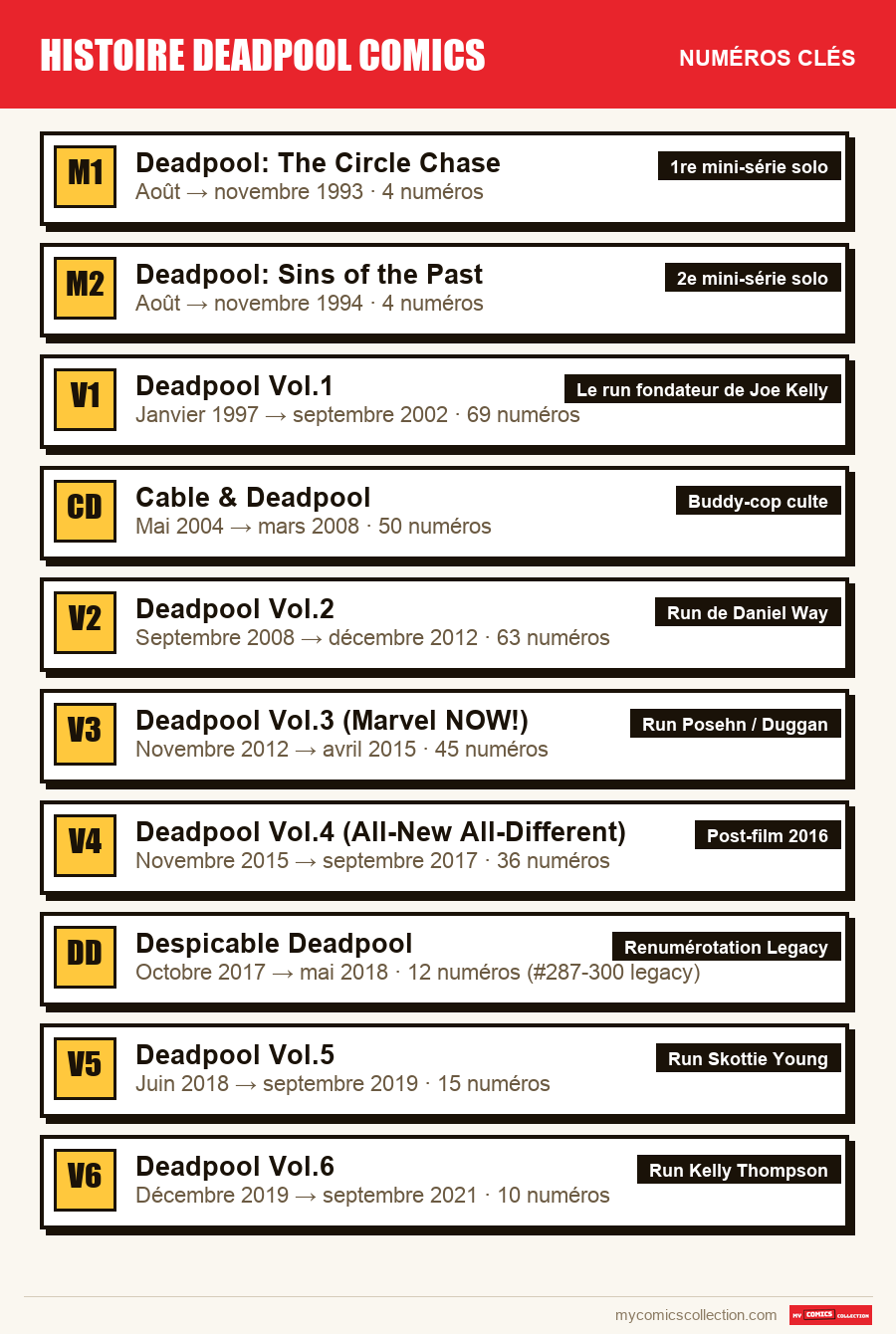
Deadpool compte 7 volumes principaux réguliers, plus deux mini-séries fondatrices. Voici la chronologie complète :
Deadpool: The Circle Chase
La mini-série fondatrice signée Fabian Nicieza et Joe Madureira. Wade Wilson traque l'héritage de son défunt ancien employeur, Mister Tolliver. Le ton est encore en construction (plus d'action que de comédie méta), mais les bases sont là : Deadpool est un mercenaire bavard, défiguré sous le masque, qui utilise l'humour pour masquer sa douleur. Le numéro #1 reste très recherché dans les hauts grades CGC, marquant le passage de Deadpool au statut de tête d'affiche.
Deadpool: Sins of the Past
Deuxième mini-série, écrite par Mark Waid avec Ian Churchill au dessin. Black Tom Cassidy, Juggernaut, Banshee. Mark Waid commence à creuser la psyché de Wade : le mercenaire qui se déteste, qui aime pour les mauvaises raisons, qui veut être sauvé sans oser l'admettre. Cette psychologie nourrira tout le run à venir de Joe Kelly. Une mini-série essentielle pour comprendre l'évolution narrative du personnage avant la série régulière.
Deadpool Vol.1
La première série régulière officielle, lancée en 1997 par le scénariste alors inconnu Joe Kelly et le dessinateur Ed McGuinness. Un run absolument fondateur : Joe Kelly a inventé le Deadpool que l'on connaît aujourd'hui : bris du quatrième mur systématique (le #11 reste l'épisode iconique), personnages secondaires cultes (Blind Al, Weasel, T-Ray), anti-héros qui veut devenir un vrai héros mais échoue sans cesse. Joe Kelly part au #33, suivi de Christopher Priest (#34-45), puis de Frank Tieri et Gail Simone jusqu'à la fin. 69 numéros qui constituent la pierre angulaire de tout collectionneur sérieux de Deadpool.
Cable & Deadpool
Après la fin du Vol.1, Marvel rappelle Fabian Nicieza aux commandes pour une série buddy-cop entre Wade et Cable, avec Patrick Zircher au dessin. 50 numéros d'une alchimie redoutable : le mercenaire bavard et le messie venu du futur. Considérée par beaucoup comme la meilleure série Deadpool après le run de Joe Kelly. Numéros clés : #1 (lancement), #15 (tie-in Civil War), #36 (One World Order), #50 (final). Un excellent point d'entrée pour les nouveaux lecteurs.
Deadpool Vol.2
Le deuxième volume principal, écrit entièrement par Daniel Way avec Paco Medina puis Carlo Barberi au dessin. Lancé en pleine vague de popularité de Deadpool (X-Men Origins: Wolverine 2009, premiers bruits autour du film solo). 63 numéros qui poussent la dimension comique au maximum : Wade entend des voix dans sa tête (les fameux encadrés narratifs jaunes et blancs), enchaîne les missions absurdes, devient une figure populaire auprès des ados. Un run très accessible, un peu décrié par les puristes de Joe Kelly, mais celui qui a fait exploser la fanbase. Numéros clés : #1, #13 (Suicide Kings), #27 (anniversaire), #50, #1000 (one-shot des 70 ans de Marvel).
Deadpool Vol.3 (Marvel NOW!)
Reboot sous l'initiative Marvel NOW! avec un duo de scénaristes inattendu : l'humoriste de stand-up Brian Posehn et le journaliste Gerry Duggan, avec un dessin de Tony Moore puis Mike Hawthorne. Un run plus mature, plus émotionnel : Wade combat les présidents américains zombies (#1-6), explore son passé, épouse Shiklah (#27, « The Wedding of Deadpool »). 45 numéros sur deux ans et demi. Un excellent point d'entrée moderne, surtout pour les fans du film de 2016.
Deadpool Vol.4 (All-New All-Different)
Lancé juste avant la sortie du film Deadpool de Tim Miller (février 2016), qui a écrasé le box-office (783 millions de dollars), ce volume a explosé en ventes grâce à l'effet Ryan Reynolds. Scénario solo de Gerry Duggan, dessin de Mike Hawthorne. Wade dirige sa propre équipe de mercenaires (les Mercs for Money), épouse officiellement Shiklah et gère sa célébrité toute neuve. 36 numéros qui basculent ensuite dans Despicable Deadpool dans le cadre de l'ère Legacy.
Despicable Deadpool
Suite directe du Vol.4 sous la numérotation legacy de Marvel. Le titre passe de Deadpool #36 à Despicable Deadpool #287 (décompte historique cumulé 1+1+1+1+…). Gerry Duggan conclut son arc avec un Wade redevenu pleinement vilain, lancé à la poursuite de Cable, et boucle une boucle narrative entamée 6 ans plus tôt. Le numéro #300 clôt l'arc de Duggan sur un climax émotionnel.
Deadpool Vol.5
Le scénariste Skottie Young (connu pour Rocket Raccoon et son run cartoonesque sur Strange Academy) reprend les commandes avec Nic Klein au dessin. Le ton le plus déjanté à ce jour, presque adult swim : Deadpool chasse des monstres pour le compte des dieux d'Asgard, devient roi des monstres, fonce tête baissée dans des situations absurdes. 15 numéros qui marquent le retour à un Deadpool 100 % comédie après l'ère plus émotionnelle de Duggan.
Deadpool Vol.6
Run de Kelly Thompson (scénariste acclamée sur Captain Marvel et Black Widow) avec Chris Bachalo et Gerardo Sandoval au dessin. Wade devient roi de Staten Island, règne sur une cité de monstres et redécouvre son côté héroïque sous un nouvel angle. 10 numéros denses et émotionnels, salués par la critique pour leur écriture des personnages féminins (Elsa Bloodstone en particulier). Court mais essentiel pour comprendre la transition vers l'ère Marvel post-2020.
Deadpool Vol.7
Run d'Alyssa Wong (Doctor Aphra, Iron Fist) avec Martin Coccolo au dessin. Wade affronte un nouvel ennemi, Eppu, hôte d'un parasite extraterrestre. Plus horreur que comédie, ce run explore le body horror inhérent à Deadpool (régénération constante, chair en lambeaux). Mise en place directe du crossover Deadpool/Wolverine (2024) à venir. 10 numéros qui resserrent la franchise avant la sortie du film.
Deadpool/Wolverine: WWIII
Crossover spécial lancé en mai 2024 pour accompagner la sortie du film Deadpool & Wolverine de Shawn Levy (juillet 2024, 1,3 milliard de dollars au box-office, le plus grand succès de l'histoire de Deadpool et le premier film MCU classé R). Histoire de Joe Kelly (de retour 22 ans après son run d'origine !), dessin d'Adam Kubert. Un tie-in incontournable pour les collectionneurs de la phase 6 du MCU.
Deadpool Vol.8
Lancement post-Deadpool & Wolverine pour capitaliser sur la vague de popularité du MCU. Histoire de Cody Ziglar (Miles Morales: Spider-Man), dessin de Rogê Antônio. Wade veille sur Princess (sa fille Eleanor) et affronte un nouvel ennemi cyborg, « Death Grip ». Run toujours en cours en 2026, avec des couvertures variantes très demandées. Probablement le run de référence pour les nouveaux lecteurs venus par les films.
Toutes les séries parallèles de Deadpool dans l'ordre chronologique
En parallèle des volumes principaux, Marvel a publié des dizaines de mini-séries et de team-ups Deadpool, parfois plus mémorables que les séries régulières elles-mêmes. Voici la chronologie des principaux titres :
- Deadpool Team-Up Vol.1 (1998, 1 numéro) : one-shot avec Widdle Wade.
- Agent X (2002-2004, 15 numéros) : spin-off direct du Vol.1 par Gail Simone, où Deadpool est apparemment mort et remplacé par Agent X.
- Cable & Deadpool (2004-2008, 50 numéros) : déjà cité dans les volumes principaux.
- Deadpool: Suicide Kings (2009, 5 numéros) : Tieri / Camuncoli, mini-série néo-noir.
- Deadpool Team-Up Vol.2 (2009-2010, 14 numéros, #899→#883 numérotation inversée !) : team-ups mensuels avec un héros différent à chaque fois.
- Deadpool: Merc with a Mouth (2009-2010, 13 numéros) : Lapham / Bong Dazo, version Headpool (tête zombie).
- Deadpool Pulp (2010-2011, 4 numéros) : version noir alternative.
- Deadpool MAX (2010-2012, 12 numéros) : version Hard-R par Kyle Baker, label adulte MAX.
- Deadpool: Wade Wilson's War (2010, 4 numéros) : flashback sur le Vietnam.
- Hit-Monkey / Deadpool (2010, 1 numéro) : one-shot.
- Deadpool Killustrated (2013, 4 numéros) : Cullen Bunn, Wade traque les héros de la littérature (Sherlock Holmes, Don Quichotte, Tom Sawyer). Mini-série culte.
- Deadpool Kills the Marvel Universe (2012, 4 numéros) : Cullen Bunn / Dalibor Talajic. Wade massacre tous les héros Marvel. Best-seller indépendant, suivi de Deadpool Killustrated et Deadpool Kills Deadpool (2013).
- Deadpool: Dracula's Gauntlet (2014, 7 numéros) : Posehn / Duggan, préquelle au Wedding of Deadpool.
- Mrs. Deadpool and the Howling Commandos (2015, 4 numéros) : tie-in Secret Wars, Shiklah dirige une équipe de monstres.
- Spider-Man/Deadpool (2016-2019, 50 numéros) : Joe Kelly + Ed McGuinness à nouveau réunis ! Buddy-comedy entre Spider-Man et Deadpool. L'une des meilleures séries de la décennie.
- Deadpool: Bad Blood (2017, OGN puis 4 numéros en 2022) : Rob Liefeld revient à Deadpool 26 ans après l'avoir co-créé !
- Deadpool: Last Days of Magic (2016, one-shot) : tie-in Doctor Strange.
- Deadpool the Duck (2017, 5 numéros) : crossover avec Howard the Duck.
- Deadpool & Cable: Split Second (2015, 3 numéros) : retour de Fabian Nicieza.
- Old Man Deadpool (2018, 5 numéros) : version alternative façon Old Man Logan.
- Deadpool 2099 (2019, 5 numéros) : version futuriste.
- Deadpool: Assassin (2018, 6 numéros) : retour de Cullen Bunn, Wade joue les James Bond.
- Deadpool: World's Greatest Hero / Worst Avenger (plusieurs one-shots) : tie-ins MCU.
- Deadpool: Black, White & Blood (2021, 4 numéros) : anthologie noir-blanc-rouge.
- Deadpool: Heir of Apocalypse (2024, 4 numéros) : tie-in Apocalypse Wars.
- Deadpool/Wolverine: WWIII (2024, 5 numéros + spécial) : déjà cité.
Les numéros clés de Deadpool dans l'ordre chronologique
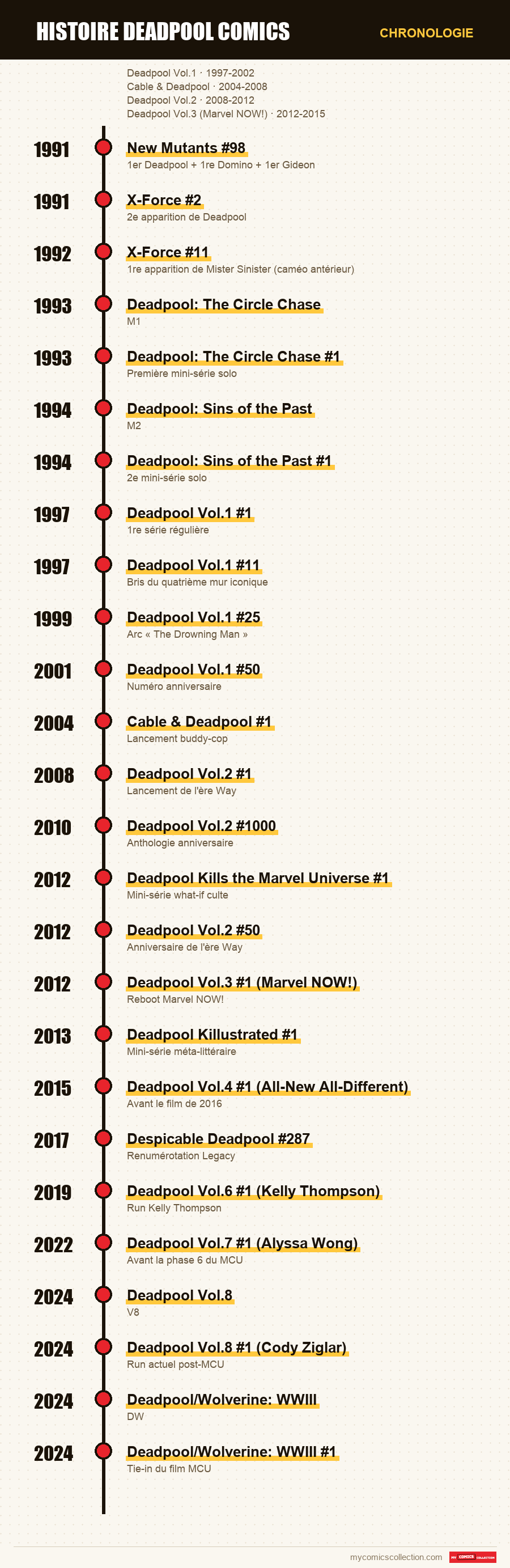
Voici les numéros les plus importants à connaître, dans l'ordre chronologique :
New Mutants #98
Le numéro fondateur. Wade Wilson alias Deadpool est envoyé par Mister Tolliver pour assassiner Cable. Triple première historique dans un seul numéro : Deadpool, Domino (techniquement Copycat qui se fait passer pour elle, mais comptée comme 1re app) et Gideon. Un exemplaire CGC 9.8 s'est vendu plus de 10 000 $ en 2024 après le succès de Deadpool & Wolverine. Pour la valorisation détaillée, consultez notre guide dédié à New Mutants #98.
X-Force #2
Deuxième apparition du mercenaire, dans la nouvelle série que Liefeld a lancée en spin-off de New Mutants. Deadpool affronte Cable et l'équipe X-Force. Un numéro souvent négligé, mais essentiel pour compléter une collection de numéros clés Deadpool. Bien plus abordable que New Mutants #98.
X-Force #11
Troisième apparition de Deadpool et une étape importante. Le numéro est aussi notable pour des raisons plus larges liées à l'écosystème Cable / X-Force. Un numéro recherché par les complétistes de l'ère Liefeld.
Deadpool: The Circle Chase #1
Premier numéro de la première mini-série solo de Deadpool. Couverture iconique de Liefeld. Le numéro inaugure le format de Wade Wilson en tête d'affiche de ses propres aventures, avec un Joe Madureira encore très jeune au dessin (avant son explosion sur Uncanny X-Men).
Deadpool: Sins of the Past #1
Premier numéro de la deuxième mini-série, écrite par Mark Waid. Une étape clé qui prépare la série régulière à venir : Waid commence à creuser la psychologie de Wade. Un numéro souvent oublié des collectionneurs grand public, mais important pour l'évolution narrative du personnage.
Deadpool Vol.1 #1
Lancement de la première série régulière de Deadpool. Joe Kelly arrive de Wildstorm/Image et signe pour ce qui deviendra le run qui a défini le personnage. Ed McGuinness, futur dessinateur star, fait ici ses débuts remarqués. 1re apparition de Blind Al, personnage secondaire culte.
Deadpool Vol.1 #11
Le numéro fondateur du bris du quatrième mur chez Deadpool. Wade et Blind Al voyagent à l'intérieur d'un comic Spider-Man de l'âge d'argent et pulvérisent toutes les conventions narratives. Joe Kelly invente ici, en plein cœur de la continuité Marvel, le ton qui définira tous les Deadpool à venir et inspirera directement les films de Ryan Reynolds.
Deadpool Vol.1 #25
Numéro central de l'arc The Drowning Man, où Wade affronte Mister Sinister dans une confrontation mémorable. Le run de Joe Kelly atteint ici un sommet émotionnel sur la psyché torturée de Wade. Un moment charnière du Vol.1.
Deadpool Vol.1 #50
Numéro anniversaire du Vol.1, format double page, contributions de plusieurs dessinateurs. Joe Kelly est parti depuis longtemps ; Frank Tieri est au scénario. Un numéro charnière avant la conclusion du Vol.1 au #69.
Cable & Deadpool #1
Lancement de la série buddy-cop Cable & Deadpool, écrite par le co-créateur Fabian Nicieza. 50 numéros d'une alchimie redoutable. Une référence absolue pour les fans de Cable comme de Deadpool. Un numéro très recherché en CGC 9.8.
Deadpool Vol.2 #1
Lancement du deuxième volume principal sous Daniel Way. Vague de popularité grand public, accessibilité maximale, ventes records. Pour beaucoup de fans arrivés vers 2010, c'est le Deadpool de référence. Beaucoup de couvertures variantes très demandées.
Deadpool Vol.2 #50
Numéro anniversaire du Vol.2, faisant partie de l'arc Dead. Mise en place de la fin du run de Daniel Way. Important pour compléter le run.
Deadpool Vol.2 #1000
One-shot anniversaire célébrant les 70 ans de Marvel à travers Deadpool. Anthologie de scénaristes, format jumbo. Un numéro rare qui combine plusieurs styles graphiques.
Deadpool Vol.3 #1 (Marvel NOW!)
Reboot Marvel NOW!. Wade combat les présidents américains zombies. Tony Moore (co-fondateur de The Walking Dead) au dessin. Couvertures variantes très collectionnées, notamment les pépites cachées de Skottie Young.
Deadpool Vol.4 #1 (All-New All-Different)
Lancement 3 mois avant la sortie du film Deadpool de Tim Miller (février 2016). Couverture iconique célébrant le statut d'Avenger de Wade. La demande a explosé après le succès du film (783 millions de dollars). Couvertures variantes Ryan Reynolds très demandées.
Deadpool Killustrated #1
Premier numéro de la mini-série culte où Wade traque les personnages de la littérature (Sherlock Holmes, Tom Sawyer, Don Quichotte) après les événements de Deadpool Kills the Marvel Universe. Concept brillant, exécution mémorable. Une mini-série de référence pour les amateurs de méta-fiction.
Deadpool Kills the Marvel Universe #1
Premier numéro de la mini-série hors continuité où Wade massacre tous les héros Marvel. Un best-seller indépendant qui a lancé toute une franchise (Killustrated, Kills Deadpool, Kills the Marvel Universe Again). Un numéro essentiel pour comprendre la dimension sombre de Deadpool.
Despicable Deadpool #287
Numéro de transition entre le Vol.4 et Despicable Deadpool, sous la numérotation legacy de Marvel. Le titre saute de Deadpool #36 à Despicable Deadpool #287 (décompte historique cumulé). Important pour les complétistes legacy.
Deadpool Vol.6 #1 (Kelly Thompson)
Lancement du run de Kelly Thompson. Wade devient roi de Staten Island. Un run court (10 numéros) mais très bien accueilli par la critique pour son écriture des relations.
Deadpool Vol.7 #1 (Alyssa Wong)
Run aux accents plus horrifiques signé Alyssa Wong. Mise en place directe du crossover Deadpool/Wolverine. Couvertures variantes très demandées dans l'attente du film.
Deadpool/Wolverine: WWIII #1
Lancement du tie-in du film phénoménal Deadpool & Wolverine (1,3 milliard de dollars). Le retour iconique de Joe Kelly à Deadpool 22 ans après son run d'origine. Adam Kubert au dessin. Un numéro indispensable pour la phase 6 du MCU.
Deadpool Vol.8 #1 (Cody Ziglar)
Lancement post-Deadpool & Wolverine pour capitaliser sur la vague MCU. Wade s'occupe de sa fille Eleanor. Run toujours en cours en 2026, avec des couvertures variantes très demandées parmi les nouveaux collectionneurs venus par les films.
Vous collectionnez cette série ?
Suivez ce que vous possédez, ce qu'il vous manque et ce que vaut votre collection. Essai de 7 jours.
Commencer mon essai →Les arcs narratifs majeurs de Deadpool dans l'ordre
The Circle Chase (1993)
Mini-série fondatrice. Wade traque l'héritage Tolliver.
Sins of the Past (1994)
Mini-série de Mark Waid. Black Tom et Juggernaut.
Saga complète de Joe Kelly (1997-1999)
Run fondateur du bris du quatrième mur et du Deadpool moderne.
The Drowning Man (1999)
Conflit psychologique central du run de Joe Kelly. Mister Sinister.
Ère Daniel Way (2008-2012)
63 numéros de pure comédie. Les voix dans la tête de Wade.
Dead (2010)
Arc de Daniel Way. Wade flirte avec la mort au sens littéral.
Marvel NOW! Posehn/Duggan (2012-2015)
Run phare des années 2010. Présidents zombies, mariage, règlement de comptes émotionnel.
Original Sin: Deadpool (2014)
Tie-in de l'événement Original Sin. Wade découvre une vérité enfouie sur sa famille.
The Wedding of Deadpool (2014)
Le mariage de Wade avec Shiklah, reine des monstres.
Deadpool Killustrated (2013)
Wade traque les héros de la littérature (Sherlock, Tom Sawyer, Don Quichotte).
Despicable Deadpool (2017-2018)
Conclusion du run de Duggan. Wade redevient pleinement vilain.
Deadpool 2099 (2019)
Mini-série futuriste. La fille de Wade hérite du costume.
Last Days of Magic (2016)
Tie-in Doctor Strange. Wade traque l'Imperator.
Heir of Apocalypse (2024)
Tie-in Apocalypse Wars. Wade finaliste pour devenir Apocalypse.
Deadpool: Bad Blood (2017)
Rob Liefeld revient à Deadpool 26 ans après l'avoir co-créé.
Comment démarrer une collection Deadpool en 2026
Fixez un objectif clair
« Je veux tout Deadpool » est un mauvais objectif (plus de 300 numéros canoniques + des dizaines de minis). « Je veux le run complet de Joe Kelly (Deadpool Vol.1 #1-33) » ou « tout Cable & Deadpool (50 numéros) » sont d'excellents points de départ. Idem pour « le run de Daniel Way (Vol.2 #1-63) » ou « Marvel NOW! Posehn/Duggan (Vol.3 #1-45) ».
Importez le catalogue dans My Comics Collection
Avec My Comics Collection, importez New Mutants, X-Force, Deadpool Vol.1-8, Cable & Deadpool, Spider-Man/Deadpool et toutes les mini-séries. Chaque numéro et chaque volume est identifié distinctement, pour ne pas confondre Deadpool Vol.2 #1 (2008) avec Deadpool Vol.4 #1 (2015).
Priorisez les numéros clés
New Mutants #98 est le Saint Graal. Au-delà, visez X-Force #2, Deadpool: Circle Chase #1, Deadpool Vol.1 #1, #11 (bris du quatrième mur), Cable & Deadpool #1, Deadpool Vol.2 #1, Deadpool Kills the Marvel Universe #1. Voir notre top 10 Deadpool dédié pour un focus sur les numéros clés + valeurs CGC.
Organisez par run plutôt que par numéro
Deadpool se collectionne par run (Joe Kelly, Daniel Way, Posehn/Duggan, Skottie Young, Kelly Thompson, Alyssa Wong, Cody Ziglar) plutôt que dans un ordre chronologique strict des numéros. Cela facilite la lecture et donne du sens à la collection. Chaque run a son propre ton.
Suivez les valorisations eBay post-film
Les numéros clés de Deadpool bougent fortement à chaque sortie de film de Ryan Reynolds. New Mutants #98 a explosé en 2016, à nouveau en 2018, et encore une fois en 2024 après Deadpool & Wolverine. My Comics Collection met à jour les valeurs chaque jour à partir des annonces eBay en cours.
Pourquoi Deadpool reste un personnage massivement collectionné en 2026
Aux côtés de Spider-Man et de Wolverine, Deadpool est l'un des personnages Marvel les plus actifs en ventes mensuelles en 2026. Quelques raisons :
- Les films de Ryan Reynolds : la trilogie Deadpool (2016, 2018, 2024) a généré plus de 2,7 milliards de dollars au box-office mondial. Deadpool & Wolverine (2024) a rapporté à lui seul 1,3 milliard de dollars, devenant le plus grand succès classé R de l'histoire et le premier film MCU classé R. Chaque sortie fait flamber la demande sur les numéros clés, en particulier New Mutants #98.
- Intégration à la phase 6 du MCU : Deadpool & Wolverine a officiellement fait entrer Deadpool dans le Marvel Cinematic Universe. Les prochains films de la phase 6 (Avengers: Doomsday, Avengers: Secret Wars) intégreront Wade Wilson, ce qui maintient la demande.
- New Mutants #98 explose en valeur : un exemplaire CGC 9.8 valait 200 $ en 2010, 1 500 $ en 2016, et plus de 10 000 $ en 2024. La trajectoire d'investissement la plus performante de tous les numéros clés des années 90.
- Favori des fans du monde entier : Wade Wilson franchit les barrières linguistiques et culturelles. Ses punchlines, son humour méta, sa fragilité sous le masque parlent à toutes les générations. Aucun autre anti-héros n'a cette universalité contemporaine.
- Polyvalence narrative : Deadpool peut être comique (run de Daniel Way), émotionnel (run Posehn/Duggan), horrifique (run d'Alyssa Wong), méta-littéraire (Killustrated, Kills the Marvel Universe) ou tie-in d'événement (Original Sin, Apocalypse Wars). Il s'adapte à tous les angles éditoriaux.
Biographie de Wade Winston Wilson (Deadpool)
Deadpool est un personnage de Marvel Comics créé par Fabian Nicieza et Rob Liefeld. Sa première apparition se fait dans New Mutants #98, publié en février 1991.
Fiche d'identité de Wade Winston Wilson
- Vrai nom : Wade Winston Wilson
- Date de naissance : Février 1991 (création)
- Lieu de naissance : Canada
- Première apparition : New Mutants #98 (février 1991)
- Créateurs : Fabian Nicieza (scénariste) et Rob Liefeld (dessinateur)
- Éditeur : Marvel Comics
- Affiliations : X-Force, Mercs for Money, Heroes for Hire, Avengers (occasionnel)
Origines du personnage
Wade Wilson, mercenaire atteint d'un cancer en phase terminale, accepte de participer au programme Weapon X qui lui donne le facteur de guérison de Wolverine. La procédure réussit mais le défigure et altère sa santé mentale. Devenu Deadpool, il combat tantôt en mercenaire, tantôt en anti-héros, avec un humour absurde et la conscience d'évoluer dans un comic book (briseur de quatrième mur).
Pouvoirs et capacités
- Facteur de guérison accéléré dérivé de celui de Wolverine (quasi-immortel)
- Capacité régénérative : peut survivre à la décapitation et au démembrement
- Maîtrise des armes à feu (pistolets, fusils d'assaut, snipers)
- Combat au katana (deux katanas signatures)
- Combat rapproché (arts martiaux, judo, boxe)
- Briseur de quatrième mur : conscient d'être un personnage de comics
- Santé mentale instable : multiples voix dans sa tête
Costume et identité visuelle
Combinaison rouge et noir intégrale avec masque à yeux blancs. Deux katanas dans le dos, ceintures d'armes, holsters de pistolets. Inspiré du costume de Deathstroke (DC Comics).
Construisez votre collection Deadpool avec méthode
Importez les 300+ numéros Deadpool + Cable & Deadpool + Spider-Man/Deadpool + mini-séries en un clic, identifiez vos numéros clés manquants, suivez la valeur eBay post-Deadpool & Wolverine. Essai gratuit 7 jours.
🚀 Démarrez votre essai gratuit de 7 joursPour aller plus loin
FAQ, Histoire de Deadpool
Autres histoires de personnages de comics à découvrir
Notre série complète d'articles « Histoire des comics » couvre les 20 plus grandes franchises Marvel et DC. Chaque article suit le même format : naissance, chronologie complète des volumes, séries parallèles, numéros clés classés chronologiquement, arcs majeurs et méthode de collection.
→ Voir tous les articles « Histoire » du blog