Algunos cómics se venden por unos pocos dólares. Otros, aparentemente idénticos (mismo editor, mismo formato, misma época) alcanzan miles, a veces millones de dólares en una subasta. ¿La diferencia? Una palabra: tema clave.
Algunos cómics se venden por unos pocos dólares. Otros, aparentemente idénticos (mismo editor, mismo formato, misma época) alcanzan miles, a veces millones de dólares en una subasta. ¿La diferencia? Una palabra: tema clave. Estos temas clave son el corazón del mercado de cómics coleccionables, y comprender qué son, por qué valen tanto y cuáles merecen un lugar en su colección es esencial para cualquier coleccionista serio.
Esta guía cubre los temas clave esenciales (Marvel, DC, Image e indies) y explica cómo identificarlos, evaluarlos e integrarlos inteligentemente en su colección.
¿Cuál es una cuestión clave? Definición y lógica de valores.
Un tema clave es un cómic cuya importancia narrativa, histórica o cultural le confiere un valor de mercado sensiblemente superior al de otros números de la misma serie. Fuera de estos números estratégicos, los cómics de la misma serie generalmente tienen un valor similar, a veces cercano a cero para temas comunes de las últimas décadas.
¿Por qué algunas emisiones valen 10, 100 o 1000 veces más que sus vecinas de caja larga? Se combinan varios factores:
- Importancia narrativa: primera aparición de un personaje importante, marcando la muerte, regreso espectacular, revelación del origen
- Rarity: tirada limitada, número difícil de encontrar en buen estado, edición especial mal distribuida
- Demanda cultural: adaptación cinematográfica o televisiva que genera una afluencia de nuevos coleccionistas para un personaje específico
- Condición de conservación: una edición clave casi perfecta puede valer entre 10 y 50 veces más que una copia en condiciones mediocres
Las cuestiones clave gobiernan: An Amazing Fantasy #15 en Fair (2.0) se vendió alrededor de $22 000 en 2023. La misma emisión con calificación CGC 9.6 alcanzó los $3,6 millones en 2021. Las condiciones de preservación amplifican exponencialmente el valor de una emisión clave.
Las 3 principales categorías de problemas clave
No todas las cuestiones clave son iguales. Generalmente existen tres familias principales, cada una con su propia lógica de valores:
1. Primeras Apariciones
La categoría reina de los temas clave. Un número que contiene la primera aparición de un personaje importante casi siempre es más valioso que cualquier otro número de la misma serie. La lógica es simple: sólo hay un problema en el que un personaje aparece por primera vez. La rareza es estructural. Las adaptaciones de Marvel Studios y DC Films han multiplicado la demanda de estos temas: tan pronto como se anuncia un personaje en una película o serie, su primera aparición se dispara.
2. Muertes y grandes retornos
La muerte de un personaje icónico en las páginas de cómics es un evento editorial. Estos temas son a menudo puntos de ruptura narrativa y se convierten en temas clave de segunda categoría. Los retornos espectaculares (como el Capitán América en Avengers #4) también son muy buscados. Estos temas cuentan una historia: marcan una época y suelen ser los más discutidos en la comunidad de coleccionistas.
3. Orígenes y arcos fundacionales
Algunas cuestiones definen a un personaje para siempre: revelan su origen, presentan a su principal enemigo o sientan las bases de su mitología. Estas cuestiones fundacionales tienen un valor cultural que va más allá de la simple especulación. A menudo son los favoritos de los verdaderos fanáticos, no sólo de los especuladores.
Temas clave imprescindibles de Marvel
El universo Marvel está lleno de cuestiones clave. Estos son los más importantes que todo coleccionista serio debería al menos conocer:
| Asunto | Importancia | Categoría |
|---|---|---|
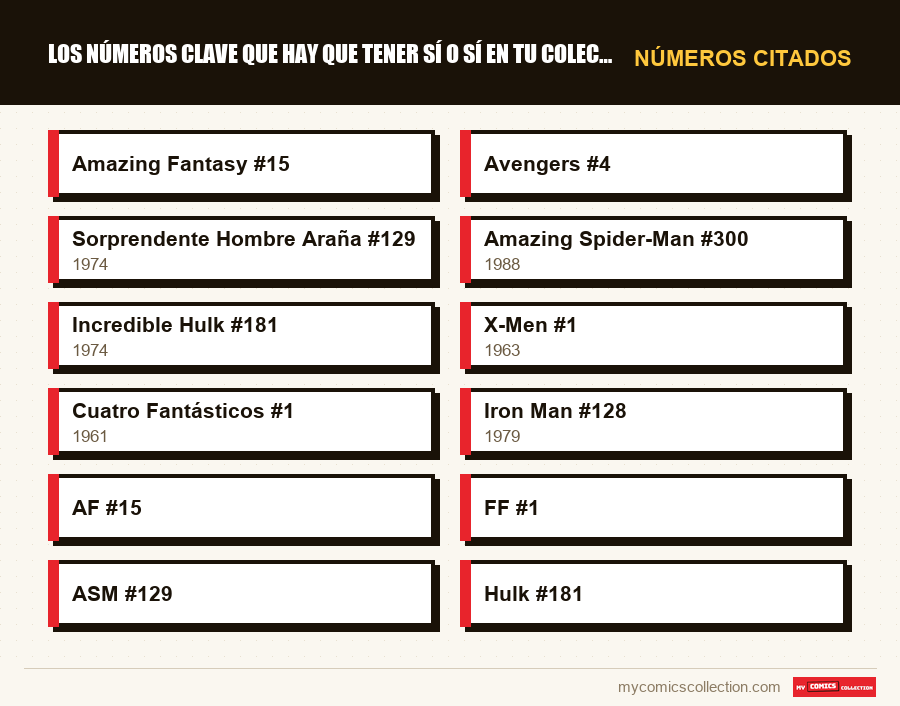
| Amazing Fantasy #15 (1962) | Primera aparición de Spider-Man | Primera aparición |
| El Sorprendente Hombre Araña #129 (1974) | Primera aparición de Punisher | Primera aparición |
| Amazing Spider-Man #300 (1988) | Primera aparición de Venom (completa) | Primera aparición |
| Incredible Hulk #181 (1974) | Primera aparición completa de Wolverine | Primera aparición |
| X-Men #1 (1963) | Primera aparición de todo el equipo X-Men | Primera aparición |
| Avengers #4 (1964) | El regreso del Capitán América (Edad de Plata) | Retorno importante |
| Cuatro Fantásticos #1 (1961) | Nacimiento del universo Marvel moderno | Fundación |
| Iron Man #128 (1979) | Demon in a Bottle, arco fundacional de Iron Man | Arco mayor |
Estos números representan la cima de la pirámide de Marvel. Algunos son inaccesibles para la mayoría de los presupuestos (AF #15, FF #1 en buenas condiciones), pero otros siguen siendo asequibles dependiendo de su condición, en particular ASM #129 o Hulk #181 en grado medio.
Cuestiones clave imprescindibles de DC
DC Comics tiene una historia aún más larga que Marvel, lo que significa problemas clave aún más raros y, a menudo, incluso más costosos para copias de calidad:
| Asunto | Importancia | Categoría |
|---|---|---|
| Action Comics #1 (1938) | Primera aparición de Superman, el cómic más caro del mundo | Primera aparición |
| Detective Comics #27 (1939) | Primera aparición de Batman | Primera aparición |
| Batman #1 (1940) | Primer Batman en solitario, primera aparición del Joker y Catwoman | Primera aparición |
| Superman #1 (1939) | Primer Superman en solitario | Fundación |
| Batman #232 (1971) | Primera aparición de Ra's Al Ghul | Primera aparición |
| Flash #123 (1961) | Flash of Two Worlds, introducción del multiverso DC | Arco mayor |
Los números clave de Golden Age DC (Action Comics #1, Detective Comics #27) se encuentran entre los cómics más valiosos que existen. Representan obras de museo más que objetos de colección accesibles. Sin embargo, números como Batman #232 se pueden encontrar a precios razonables dependiendo del estado.
¿Coleccionas esta serie?
Lleva el control de lo que tienes, lo que te falta y de lo que vale tu colección. Prueba de 7 días.
Empezar mi prueba →Cuestiones claves de imagen e indie
El mercado de cuestiones clave no se limita a Marvel y DC. La era de las editoriales independientes produjo cuestiones fundamentales que ahora forman parte de la historia del medio:
Spawn #1 (1992)
Primera aparición en Spawn de Todd McFarlane. El número fundacional de Image Comics, impreso en varios millones de copias, pero las copias Near Mint siguen siendo buscadas.
Muertos vivientes #1 (2003)
Primera aparición de Rick Grimes por parte de Robert Kirkman. Impreso en números iniciales muy pequeños, este número se ha vuelto extremadamente raro. Un CGC 9.8 suele superar los 5.500 dólares.
Saga #1 (2012)
Primera aparición de la serie de Brian K. Vaughan y Fiona Staples. El tema clave del indie moderno por excelencia, con varias ediciones difíciles de distinguir. La primera impresión sigue siendo la más valiosa.
Estos números ilustran una tendencia: los temas clave del mercado independiente pueden apreciarse muy rápidamente, especialmente cuando la serie se vuelve popular después de una adaptación o un premio literario. Suelen ser más baratos de comprar que sus equivalentes de Marvel/DC, lo que los convierte en inversiones interesantes.
Cómo identificar un tema clave antes de comprar
Antes de comprar un cómic que se presenta como tema clave, es fundamental verificar varios puntos para evitar sorpresas desagradables:
Consultar el censo del CGC
El censo CGC (Empresa de Garantía Certificada) registra todos los cómics certificados por su servicio de clasificación. Puede ver cuántas copias de un número determinado se han enviado y qué calificaciones se asignaron. Una edición con pocas copias de alta calidad en el censo es estructuralmente rara y, por lo tanto, potencialmente más valiosa.
Utilice la guía de precios de cómics de Overstreet
La Overstreet Guide ha sido la biblia anual para coleccionistas de cómics desde 1970. Enumera temas clave reconocidos y ofrece rangos de precios según el estado de conservación. Es la referencia básica, aunque los precios reales del mercado pueden diferir significativamente de los de Overstreet (en ambas direcciones).
Consultar ventas recientes en eBay
Los "listados completos" en eBay dan precios de venta recientes reales: no precios solicitados, sino precios realmente pagados. Son los datos más confiables para calibrar el valor actual de una cuestión clave. Para emisiones calificadas, GoCollect y Heritage Auctions ofrecen historiales de ventas aún más detallados.
Lista de verificación antes de comprar un tema clave
- Verificar la importancia del problema (primera aparición confirmada, arco reconocido)
- Consulte el censo del CGC para conocer la rareza de alto grado.
- Comparar con anuncios vendidos recientes de eBay
- Evalúe con precisión el estado de conservación de la copia.
- Verifique que sea la impresión correcta (algunos problemas clave tienen varias impresiones)
- Para cuestiones valiosas: considere la certificación CGC antes o después de la compra
Integrando sus temas clave en su colección
Poseer números clave cambia la naturaleza de su colección. Estas cuestiones merecen una atención especial: almacenamiento en fundas sin ácidos, tablero protector rígido y trazabilidad precisa en su inventario. Un tema clave que no está registrado en su colección digital es un activo invisible: imposible de asegurar adecuadamente, difícil de valorar y difícil de revender a un precio justo.
Para realizar un seguimiento de sus ediciones clave y su valor en tiempo real, consulte nuestra guía sobre las ediciones de cómics más valiosas y cómo gestionarlas con una aplicación dedicada. Valoración de colección es particularmente importante para temas clave, cuyo valor puede evolucionar rápidamente según las noticias de Marvel o DC.
Preguntas frecuentes: cuestiones clave
Gestiona tus problemas clave con My Comics Collection
Realice un seguimiento del valor de sus números clave en tiempo real, observe su estado de conservación y nunca más se pierda un tema clave de su serie favorita.
🚀 Prueba gratuita de 7 días, sin compromiso