
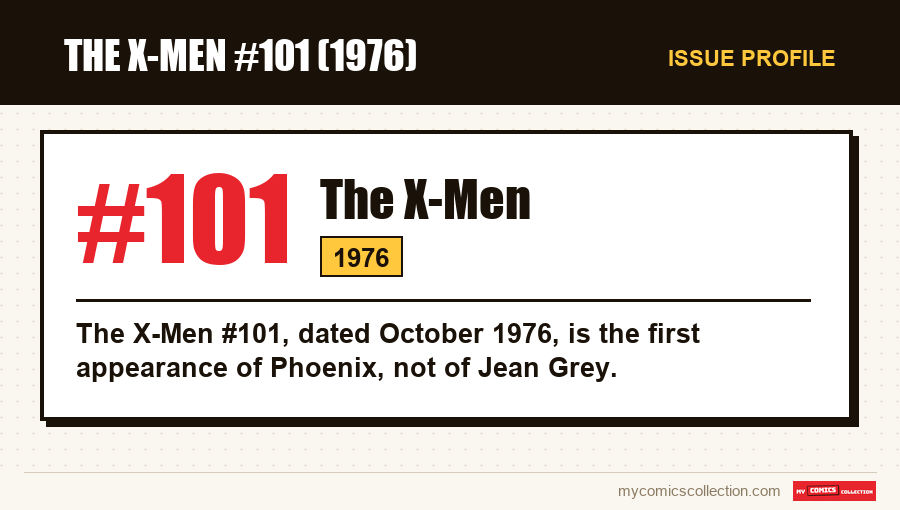
The X-Men #101, dated October 1976, is written by Chris Claremont and drawn by Dave Cockrum. Jean Grey rises from the waters of Jamaica Bay after the shuttle crash, in a new costume, and presents herself under the name Phoenix. This is not the birth of a new heroine: the character has existed since 1963 as Marvel Girl. The issue marks a change of name, costume and power scale. Collectors seek it as the first milestone of a trajectory whose next chapter came four years later.
Few issues sell as much on what happens to them afterward as on their own content. This one is no exception, and that is the whole problem when you buy it. You think you are paying for a first appearance in the full sense, that of a character who did not exist the day before, when in fact you are paying for a shift of identity: the same heroine, credited differently, endowed with a power register that no longer resembles her former one. Knowing exactly what the booklet contains changes how you judge an asking price, and above all how you read sales descriptions, which are often more generous than the facts.
As always in this guide, only verified information (creators, issue numbers, dates) is stated as fact. The analysis is ours, with no reproduction of panels or protected dialogue.
What The X-Men #101 actually contains
The booklet carries an October 1976 cover date. Chris Claremont writes the script, and Dave Cockrum draws it; Cockrum has been with the series since the team's relaunch. The story picks up directly from the previous issue: the team descends from orbit in a shuttle, Jean Grey holds the controls through atmospheric re-entry and endures an exposure that should have killed her. The craft comes down in the waters of Jamaica Bay, and it is from there that she emerges, standing, announcing her new name.
The rest of the issue does not linger on this transformation. The team heads quickly for Ireland, where the story sets up a confrontation that will occupy the following episodes. In other words, the scene everyone buys takes up a fraction of the booklet, and most of the pages go to a plot that has nothing to do with it. This is common in the key issues of this period, where character shifts happen in a few panels in the middle of an ongoing arc.
On the cover, the image featured is that of the transformation. It is what fixed the issue in collective memory, far more than the interior pages, and it largely explains why presentable copies trade above the rest of the 94 to 110 range.
Where the series stood in 1976
The title had only just restarted after years of reprints. The international team had been introduced in a giant-size issue in 1975, and the regular series had then returned to new stories from issue 94 onward. So in 1976 we are looking at a series under reconstruction, carried by a small but loyal audience, without the commercial stature it would reach at the end of the decade.
At that time, publication was not monthly: the episodes came out spaced apart, which explains both the compressed narrative rhythm of Claremont's writing and the fact that the series' print runs could not compete with those of the publisher's flagship titles. For a buyer, this detail matters more than any anecdote, because it limits the number of copies still in circulation in high grades.
The logo itself had not yet received the word that would stay associated with the series for thirty years; it arrived a little later in the numbering. In the catalogue, the series is therefore registered under its original title, The X-Men (1963), and the issues from this period belong to it, with no separate series to create.
What this issue does not contain
It does not contain Jean Grey's first appearance. That dates back to X-Men #1 in 1963, under the signature of Stan Lee and Jack Kirby, where the character was called Marvel Girl. Confusing the two means confusing a creation with a reworking. A seller who describes issue 101 as the character's first appearance is mistaken, or misleading you, and the difference is worth considerable amounts of money.
Nor does it contain the storyline that made Phoenix famous. The turn toward Dark Phoenix would be published four years later, in a run of 1980 episodes written by Claremont and drawn by John Byrne, whose outcome, the character's death, became one of the most discussed sequences in the medium. The issues concerned are different booklets, with their own price and their own scarcity in high grades.
Finally, it does not contain the mechanism as it is understood today. In 1976, the story presents a metamorphosis of the character herself. A decade later, an episode published in the pages of Fantastic Four would reinterpret the whole by separating the cosmic force from the young woman. Issue 101 is the first appearance of an identity, not of an entity.
Why it became a key
Three reasons add up. First, the name. Phoenix became one of the few Marvel aliases as well known as the character who carries it, and the market always values the first booklet that displays a name and a costume, even when the person beneath the mask already existed. Next, its position in the numbering: issue 101 opens the most sought-after stretch of the series, the one in which the team of Wolverine settles in for the long run.
The third reason is colder. Print runs in 1976 were modest, the booklets circulated on newsstands without protection, and the share of copies kept in very fine condition is small. When a title becomes retrospectively important although nobody was setting it aside at release, the gap between high-grade supply and demand widens mechanically. That is exactly the configuration of this issue.
By contrast, the key remains second-tier compared with the full first appearances of the same decade. A collector who builds a complete series around Jean Grey will consider it indispensable; an investor pure and simple will often prefer the 1980 issues. Both readings are defensible; they simply do not lead to the same budget.
What moves the price
Condition dominates everything else. On a 1976 booklet, the difference between a read copy and an almost intact one is measured in multiples, not percentages. The checkpoints are well known: how the spine holds, how flat the cover is, the color of the page edges, the presence of a vertical reading crease, and the sharpness of the corners, which blunt at the first storage in an ill-fitted carton.
Next comes the question of the local market. Copies of this period circulated in several versions depending on distribution territory, with different price markings printed on the cover. Depending on the copy in your hand, provenance can work in either direction, and there is no universal rule: it must be checked case by case, comparing the cover with what the catalogue describes for this issue.
Paper, finally, is an underestimated factor. The mid-1970s produced booklets whose pages yellow quickly and become brittle if they have lived in an attic. Two copies graded in the same neighborhood, one of which keeps clean white pages, do not sell at the same level, and the gap widens on the sought-after issues.
Do you collect this series?
Track what you own, what you are missing and what your collection is worth. 7-day trial.
Start my trial →
Recognizing the original edition
The first reflex is to read the indicia, the legal notice in small print on the first interior page. It carries the publication date and the volume number, and it is what settles the question when the cover leaves room for doubt. An identical cover with a later indicia signals a reprint, not a copy from 1976.
The episodes of this stretch of the series have been republished several times. A reprint collection launched in the mid-1980s ran through the story arc in order, with its own numbering and sometimes with added pages. To this are added the hardcover collections and the budget black and white volumes published since. None of these formats carries the value of the original booklet, and all are recognizable at once: format, pagination, paper quality, later copyright notices.
Be wary, on the other hand, of the reconstructed booklet: a correct cover married to the interior of another copy. Count the pages and look at the staples, whose oxidation must be consistent with the paper around them.
The pitfalls at purchase
The most common pitfall remains the description that mixes up the steps. It is regularly said that the issue contains the first appearance of Dark Phoenix, which is false: the character in that form arrives in 1980. It is also said to be Jean Grey's first appearance, which ignores thirteen years of publication. In both cases, the asking price follows the description, not the contents.
The second pitfall is undisclosed restoration. A consolidated spine, a mended tear, a color retouched along a crease can be spotted under raking light and by touch, but not always in a photograph. Request photos of the spine and the edges, not only a face-on view of the cover, and ask for a photo of the issue opened flat without forcing the binding.
The third pitfall is lots. The 94 to 110 sequence is often sold in bundles, and issue 101 serves as the commercial hook even though the other booklets in the lot are in poor condition. Do the arithmetic issue by issue before accepting an overall price: a lot is only interesting if the key is at least at the level of the rest, which is rarely the case.
The neighboring issues that matter
The giant-size issue of 1975 that introduces the international team remains the centerpiece of the period, and its price sits in another division. Issue 94 of the regular series, which opens the new stories with this new line-up, is its natural follow-on and the second key of the sequence.
On the later side, the 1980 episodes form a separate block. The one that opens the saga introduces two characters who would build careers, and the one that closes it contains the outcome of Phoenix's destiny. These two booklets are distinct targets, to be budgeted separately, and their availability in high grades is much better because they date from a time when readers already kept their purchases.
In between, the return of a historic adversary of the team in the episodes immediately following issue 101 is worth noting, if only for the coherence of a followed collection. The Storm hub helps place each character's arrival in this chronology, useful when you build the sequence in order rather than issue by issue.
What grading changes
Having a 1976 booklet graded has a real benefit as soon as the copy is beautiful: the sealed holder removes the discussion about condition and immediately widens the circle of buyers. On an average copy, however, the cost of the operation and the waiting time often exceed the gain, because the value of a reading copy depends little on a hundredth of a grade.
A single grade step in the upper ranges can shift value by a ratio that nothing else approaches: neither provenance, nor signature, nor the presentation of the listing. That is why you should buy the copy, not the grade. A flattering grade on a copy with dark pages resells worse than a lower grade with clean pages.
The mention of page quality is decisive for this band of years, and it cannot be corrected.
Tracking it in a collection, and what to keep in mind
Record the issue under the catalogue's series title, The X-Men (1963), with the cover year 1976. This is the condition for the 94 to 110 sequence to stay grouped and readable, and for avoiding a parallel record that would separate your copies of the same period. In the free-text field, note the exact nature of the appearance, first appearance under the Phoenix identity, rather than a shortcut: your future buyer, or your insurer, will read that line.
Then follow the value over time rather than at the moment of purchase. This issue reacts to adaptation announcements and to editorial reassessments of the character, with movements that subside afterward. A periodic check on your own copy, at its real grade, gives a far more accurate picture than the prices sellers display, which are always aligned with the highest grades available.
To sum up: The X-Men #101 of October 1976, by Claremont and Cockrum, contains the first appearance of Jean Grey under the name and costume of Phoenix, and nothing more. The character has thirteen years of history behind her, and the saga that would make her name lies four years ahead. Bought for what it is, in an honest condition, it is a solid key of the most sought-after sequence of the series. Bought on the strength of a loose description, it is an issue you end up paying for twice.
You own a copy of the 94 to 110 sequence, with or without a holder, and want to know where your issue 101 stands at its real grade.
Estimate my comic
Frequently asked questions
No. Jean Grey first appears in X-Men #1, in 1963, under the name Marvel Girl, created by Stan Lee and Jack Kirby. Issue 101 of October 1976 marks her first appearance under the Phoenix identity, name and costume. It is a reworking of the character, not a creation, and any listing that confuses the two overvalues the booklet.
No, and this is the most costly confusion about this booklet. The turn toward Dark Phoenix was published four years later, in 1980, in the run of episodes written by Chris Claremont and drawn by John Byrne. Issue 101 contains only the appearance of Phoenix in her initial form, without any of the consequences that made the character's reputation.
Under The X-Men (1963), the catalogue's series title, with the 1976 cover year. The word added to the logo a few issues later does not create a separate series for this period. Recording the booklet elsewhere breaks the continuity of your sequence and complicates any later tracking of the value across the whole relaunch.
By the indicia, the legal notice in small print on the first interior page: it carries the publication date and the volume number. The republications of the 1980s and later use their own numbering and later copyright notices. The format, the pagination and the paper quality are also enough to recognize them at first contact.
It depends on your goal. For a followed collection built around Jean Grey or the relaunch of the team, issue 101 is the logical milestone. For the most sought-after narrative sequence, the 1980 episodes carry more weight and are easier to find in high grades. The two targets do not call on the same budget.