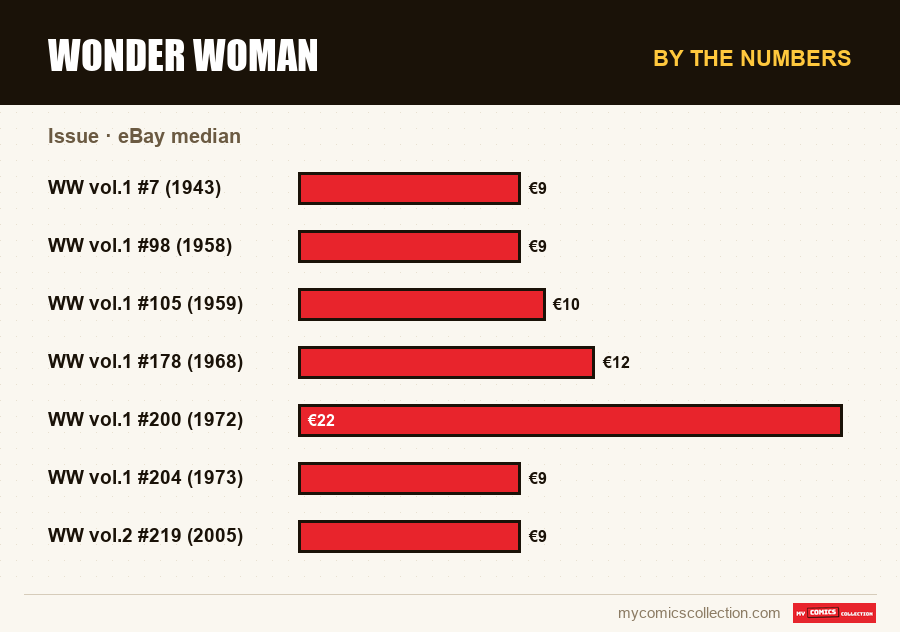
Several historically significant Wonder Woman issues (spanning the Silver Age, Bronze Age, and modern era) still trade below €15 at the all-grades eBay median, according to our estimator (eBay.fr + eBay.com, June 2026). The accessibility is real: dozens of active listings confirm a liquid market across titles that cover 80 years of the character's history.
Created by William Moulton Marston (writer) and Harry G. Peter (artist), Diana Prince made her debut in All Star Comics #8 in December 1941: a first appearance that reached $1.62 million for a CGC 9.4 copy at Heritage Auctions in June 2022. She received her first cover-feature series with Sensation Comics #1 in January 1942 (documented record: $399,100 for a CGC 9.6 in 2017), then her own solo title Wonder Woman vol.1 #1 the same year, with a CGC 9.0 realising $291,100 in 2016. These Golden Age grails are out of reach for most collectors, but they are far from the only entry point into the character.
This guide focuses on accessible and undervalued issues: comics with genuine historical significance that current eBay medians still place at reasonable entry prices. All figures come from our eBay estimator (real sales) or documented sources (Heritage Auctions, CGC News, GoCollect). Any issue returning fewer than 15 active listings is treated qualitatively rather than quoted as a precise median.
Undervalued issues by era (real eBay medians, June 2026)
eBay data, all grades combined. The low median reflects the majority of low-grade copies circulating on the market; CGC high-grade slabs trade in an entirely different bracket.
| Issue | Significance | eBay median | Active listings |
|---|---|---|---|
| WW vol.1 #7 (1943) | Ongoing series, accessible Golden Age | €9 | 96 |
| WW vol.1 #98 (1958) | Silver Age relaunch (Kanigher / Andru, new origin) | €9 | 63 |
| WW vol.1 #105 (1959) | Silver Age, consolidated Kanigher run | €10 | 52 |
| WW vol.1 #178 (1968) | Prelude to the "mod" Diana Prince era | €12 | 31 |
| WW vol.1 #200 (1972) | Anniversary issue, powers restoration in progress | €22 | 22 |
| WW vol.1 #204 (1973) | Powers fully restored, Amazon once again | €9 | 28 |
| WW vol.2 #219 (2005) | Greg Rucka era, strong story arc | €9 | 35 |
Sources: mycomicscollection.com eBay estimator (eBay.fr + eBay.com, June 2026).
Accessible Golden Age: Wonder Woman vol.1 #7
Published in 1943 during Marston and Peter's founding run, Wonder Woman vol.1 #7 is one of the few Golden Age issues to reach an eBay median of €9 across 96 active listings: a remarkably liquid market for a comic from this period. At that price, copies are inevitably very low grade; but owning a 1943 Diana Prince comic for under €15 is an opportunity that few Golden Age characters can match. The concentration of low-grade copies in the current market means that any better-preserved copy diverges sharply upward from that median: the grade spread here represents the real collecting opportunity.
Silver Age: Wonder Woman #98 and #105 (1958-1959)
In 1958, writer Robert Kanigher relaunched the series with artist Ross Andru and introduced a new origin for Diana: Wonder Woman #98 marks the official start of the character's Silver Age. Our estimator returns a median of €9 across 63 active listings . Wonder Woman #105 (1959), from the same run, similarly posts a median of €10 across 52 listings. Both issues follow the standard Silver Age pattern: the all-grades median is low because it incorporates many heavily worn copies, but their historical importance is intact. For a collector aiming to trace the full arc of the character's publication history without a major outlay, the Kanigher/Andru run remains consistently underpriced.
Bronze Age: the "mod" era and the return of powers
Between 1968 and 1973, the series underwent a radical transformation. Wonder Woman #179 (1968) opens the so-called "Diana Prince" era, in which Diana gives up her Amazonian powers to become a martial-arts spy: a controversial arc, often criticised, but a genuinely unique moment in the character's history. This issue returns only 14 active listings: just below the statistical reliability threshold, so no precise median is quoted. However, Wonder Woman #178 (the prelude to that era) posts a median of €12 across 31 listings , and Wonder Woman #204 (1973, full restoration of Diana's powers) shows a median of €9 across 28 listings . The anniversary issue Wonder Woman #200 (1972), at the heart of this transitional period, stands out with a median of €22 across 22 listings: the highest-priced issue in this selection, which remains modest for a round-number milestone of this significance.
Modern era: Wonder Woman vol.2 #219 (Greg Rucka)
Greg Rucka's run on Wonder Woman vol.2 (2003-2006) is widely regarded as one of the finest periods in the series' history. Wonder Woman #219 (2005), part of the "Sacrifice" arc that intersects with Infinite Crisis , trades at a median of €9 across 35 active listings. At that price, a key issue from the Rucka run with strong DC continuity ties represents genuine value for any collector following the character's modern evolution: the evolution that led directly to Patty Jenkins's 2017 film starring Gal Gadot, which grossed $824 million worldwide.
Why are these issues undervalued?
Wonder Woman suffers from a collector paradox: her absolute grails:All Star Comics #8 at $1.62M, Sensation Comics #1 at $399,100: dominate the media narrative and create the impression that the series as a whole is out of reach. In reality, nearly all of the vol.1 run (1942-1986, 329 issues) and the vol.2 series (1987-2006, launched by George Perez) circulate on eBay at medians between €9 and €25. The character's global recognition (a worldwide icon, an $824M film, 80 years of continuous continuity) is not yet priced into the run books. That asymmetry is precisely the opportunity for the attentive collector.
Do you own a Wonder Woman issue? Get a free valuation with our tool based on real eBay sales: low, median, and high estimates.
Frequently asked questions
The guide cites issues from several eras: Wonder Woman vol.1 #7 (1943), #98 (1958) and #105 (1959), #178, #200 and #204 (1968-1973), and Wonder Woman vol.2 #219 (2005). All have real historical significance and remain accessible.
In 1958, Robert Kanigher takes over the series with artist Ross Andru and introduces a new origin for Diana. This issue marks the official start of the character's Silver Age, and the Kanigher/Andru run remains largely underrated.
Between 1968 and 1973 the series transforms: Diana gives up her Amazon powers and becomes a martial arts spy, a controversial but unique arc. Wonder Woman #204 (1973) fully restores her powers, and #200 (1972) is the anniversary issue of the period.
It is unanimously praised by critics as one of the best periods of the series. Wonder Woman vol.2 #219 (2005) belongs to the "Sacrifice" arc, which crosses with Infinite Crisis, and is strongly anchored in DC continuity.
Because its absolute grails, such as All Star Comics #8 and Sensation Comics #1, overshadow the rest of the catalog in the media and give the impression of an out-of-reach series. In reality, nearly the whole vol.1 run (1942-1986) and the vol.2 series (1987-2006) circulate at modest prices: that is the savvy collector's opportunity.