With Wonder Woman, confusing originals and reprints can be costly. The most dangerous issue: Wonder Woman #1: which exists as two completely unrelated comics: vol.1 from 1942 (a Golden Age grail with a documented record of around $291,000 for a CGC 9.0) and vol.2 from 1987 (the George Pérez relaunch, widely available and inexpensive). Add to that the Famous First Edition (a 1975 oversized treasury reprint) and the newsstand/direct edition split on 1980s issues, and the landscape demands careful attention. This guide gives you the concrete markers to avoid every trap.
Wonder Woman spans eighty years of continuous publication: Golden Age (1941-1954), Silver Age (1956-1970), Bronze Age (1970-1985), and the Copper/Modern era (1986-present). One direct consequence: for several key issues there are multiple physically different objects that look deceptively similar. The most expensive misidentification on the current market involves the very first issue of the solo series: a "#1" that describes two comics separated by forty-five years.
This guide sticks to the verifiable: eBay data from our estimator (eBay.fr + eBay.com, June 2026) and records documented by Heritage Auctions, CGC News, and GoCollect. When a listing count falls below 15, no median is quoted as a headline figure: the signal is too thin. For Golden Age pieces, specialist auction results are the authoritative benchmark.
Trap number one: Wonder Woman #1 vol.1 (1942) vs vol.2 (1987)
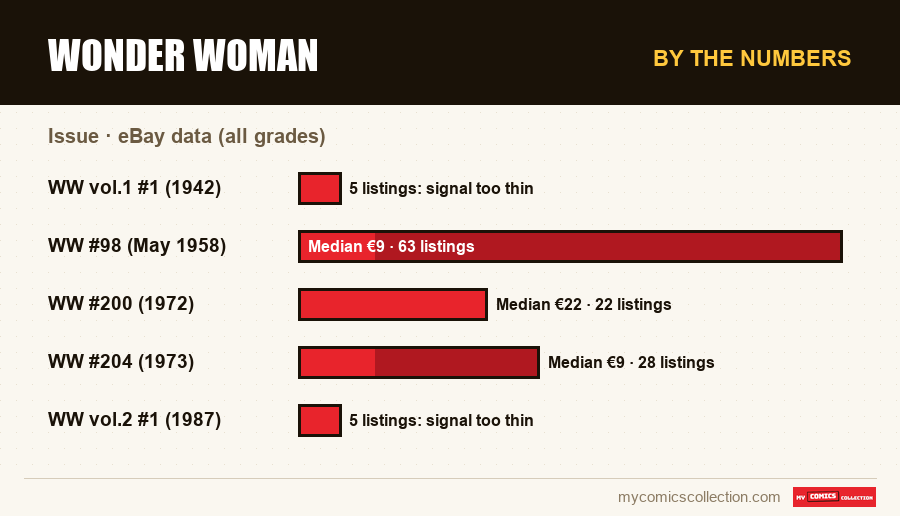
The eBay tool does not separate volumes: a query for "Wonder Woman #1" returns a blend of both series, with only 5 active listings: too thin for any reliable median. The two issues must be distinguished precisely:
| Issue | Publication date | Creators | Indicative value |
|---|---|---|---|
| WW vol.1 #1 (1942) | Summer 1942 · DC Golden Age | William Moulton Marston (writer) · H.G. Peter (artist) | Documented record: ~$291,000 (CGC 9.0) · eBay signal too thin |
| WW vol.2 #1 (1987) | February 1987 · DC Copper Age | George Pérez (co-plot + art) · Greg Potter (script) | Accessible; eBay median unreliable (< 15 listings) · raw copies often under €10 |
The vol.1 #1 of 1942 is the first issue of the solo series created by Marston and Peter: the same duo who had introduced the character in All Star Comics #8 (December 1941, Wonder Woman's absolute first appearance, record $1,620,000 for a CGC 9.4 at Heritage Auctions in June 2022) and then in Sensation Comics #1 (January 1942, first cover appearance, record $399,100 for a CGC 9.6 in 2017). The vol.2 #1 of 1987, by contrast, opens the post-Crisis on Infinite Earths relaunch by George Pérez: artistically acclaimed, but printed in modern quantities with no equivalent scarcity.
How to tell them apart physically: the vol.1 #1 is a Golden Age comic (slightly larger page size than modern comics, yellowed newsprint interior, imprecise colour registration, 10-cent cover price, no barcode). The vol.2 #1 is a standard Copper Age comic (modern format, glossy cover, 75-cent cover price, with or without a UPC barcode depending on edition: see newsstand section below). The date printed on the cover and/or title page is the first thing to check.
The Famous First Edition: the 1975 oversized treasury reprint
In 1975, DC Comics published a complete reprint of Wonder Woman #1 (1942) in its Famous First Edition collection, under the reference #F-6. The reprint itself is entirely legitimate, but it has been used in fraud attempts when the outer cardboard cover is removed.
- Tabloid format: the Famous First Edition measures approximately 10 × 13.5 inches (about 26 × 34 cm), noticeably larger than any original Golden Age comic. This is the most immediate identification criterion.
- External cardboard cover: the original edition came with an outer cardboard wrapper explicitly stating "Limited Collectors' Edition" and the F-6 reference. This wrapper has unfortunately disappeared from many copies over the decades.
- Modern printing: the print quality is that of 1975 (modern offset), not the 1940s (photogravure with less precise colour registration).
- Value: according to the Overstreet Price Guide, a Famous First Edition without its outer cover has "little or no value" on the collector market: it is not an original.
A simple rule: if a "1942 Wonder Woman #1" on the market is tabloid-sized, it is the Famous First Edition, not the original. If the format is standard (approximately 17 × 26 cm) with period-appropriate yellowed paper, you may be looking at an original, but CGC or CBCS authentication remains essential before any significant purchase.
The Millennium Edition (2001): the most recent Golden Age reprint
In 2000-2001, DC published the Millennium Edition series, reprinting classic Golden Age titles in standard comic book format. All-Star Comics #8 (Wonder Woman's first appearance) received this treatment in a one-shot published in February 2001. Key identifying features:
- Gold foil stamp on the cover reading "Millennium Edition."
- Modern offset printing quality, white non-yellowed paper stock.
- Editorial essay on the inside cover pages explaining the issue's historical significance.
- Modern barcode and year-2001 cover price.
Unlike the Famous First Edition, the Millennium Edition is standard-sized: it can therefore look more similar to an original to an untrained eye. The distinction remains straightforward: white non-yellowed paper + gold foil cover logo = 2001 reprint.
Newsstand vs Direct Edition on 1980s-1990s issues
DC Comics has simultaneously distributed two versions of each issue since 1980: the newsstand edition (general retail, newsstands) and the direct edition (specialist comic shops). For Wonder Woman vol.2 (1987-2006), the distinction applies to every single issue.
| Criterion | Newsstand Edition | Direct Edition |
|---|---|---|
| Cover barcode | Standard UPC barcode (14 digits) | DC bullet logo or blank box where barcode would be |
| Returnability | Returnable (unsold copies stripped) | Non-returnable (sold firm) |
| Estimated print run (1990s) | Minority, declining | Majority |
| Collector premium (2010-2017) | 5× to 20×+ over direct edition | Reference baseline |
For Wonder Woman vol.2 #1 (1987), CGC now explicitly distinguishes the two variants on its label. The newsstand version, scarcer in high grade (newsstands handled stock less carefully), can command a significant premium. Identification is done on the cover: standard UPC barcode = newsstand; DC bullet logo or blank box = direct edition.
Key issues: real values (June 2026)
| Issue | Significance | eBay data (all grades) | Documented benchmark |
|---|---|---|---|
| All Star Comics #8 (1941) | 1st appearance of Wonder Woman | Series "all-star-comics": not covered by estimator | $1,620,000 (CGC 9.4, Heritage June 2022) |
| Sensation Comics #1 (1942) | 1st Wonder Woman cover appearance | Series "sensation-comics": not covered by estimator | $399,100 (CGC 9.6, 2017) |
| WW vol.1 #1 (1942) | First solo issue | 5 listings: signal too thin | ~$291,000 (CGC 9.0) |
| WW #98 (May 1958) | 1st Silver Age origin (Kanigher/Andru) | Median €9 · 63 listings | Overstreet VF 8.0 ~$3,154 |
| WW #200 (1972) | Bronze Age anniversary issue | Median €22 · 22 listings | Not publicly documented |
| WW #204 (1973) | Diana Prince powers restored | Median €9 · 28 listings | Not publicly documented |
| WW vol.2 #1 (1987) | Pérez relaunch post-Crisis | 5 listings: signal too thin | Raw copies commonly under €15 |
Record sources: Heritage Auctions, CGC News, GoCollect, sellmycomicbooks.com.
Grade before you buy: why CGC changes everything
For any Golden Age Wonder Woman piece: vol.1 #1 (1942), All Star Comics #8 (1941), or Sensation Comics #1 (1942): CGC or CBCS encapsulation is the only authentication guarantee recognised by the market. A raw ungraded copy sold as an "original from 1942" without documented provenance deserves the greatest caution, particularly if the format or paper stock appears suspicious. For Bronze Age and Copper Age issues (WW #98, vol.2 #1), raw copies are common and the risk of reprint confusion is much lower: the date printed on the cover is generally sufficient identification.
Own a Wonder Woman issue and want to know what it is worth? Get a free valuation with our tool based on real eBay sales to find its low, median, and high value.
Frequently asked questions
Because it designates two unrelated comics, separated by forty-five years: vol.1 of summer 1942, a Golden Age grail created by William Moulton Marston and H. G. Peter, and vol.2 of February 1987, George Pérez's post-Crisis relaunch, very accessible. A search query mixes the two series, so they must be distinguished rigorously.
The 1942 vol.1 is a Golden Age comic: slightly larger format than modern comics, yellowed newsprint, imperfect color registration and no barcode. The 1987 vol.2 has a modern format and a glossy cover. The date printed on the cover or title page is the first reflex to have.
A complete reprint of Wonder Woman #1 (1942) published by DC in its Famous First Edition collection, under reference F-6. It is perfectly legitimate, but it measures about 26 by 34 cm, in tabloid format, and without its outer cardboard cover it has little or no value: if a "1942 #1" is in tabloid format, it is not the original.
This series reprints several Golden Age classics in standard format, including All-Star Comics #8 (February 2001). It is recognized by its embossed gold foil logo on the cover, its unyellowed white paper, its editorial essay on the inside cover pages and its modern barcode.
Since 1980, DC distributes two versions of each issue. The newsstand edition carries a standard UPC barcode, whereas the direct edition carries a DC bullet logo or an empty box in its place. The newsstand, rarer in high grade, can command a significant premium on issues from the 1980s and 1990s.