The key issue of Walking Dead remains #1 (Image Comics, October 2003), printed in only a few thousand copies before the phenomenon exploded: a CGC 9.8 copy sold for $24,200 at Heritage Auctions in March 2022. Right behind it come #19 (first appearance of Michonne), #27 (first Governor) and above all #100 (first appearance of Negan and Lucille, death of Glenn), which form the core of any serious collection of the series created by Robert Kirkman and Tony Moore.
Few contemporary comics embody as well the trajectory of a "small confidential print run" that became a pop culture monument as The Walking Dead has. Launched in 2003 at Image Comics without much promotion, Robert Kirkman's series took several years to find its audience before the AMC TV adaptation, which began in 2010, turned issues that had once been ordinary into collectibles fought over at auctions.
This guide lists the truly decisive issues of the original publication, from the first 24 issues drawn by Tony Moore and then Charlie Adlard up to the final issue #193 published in 2019. It relies on verifiable facts: publication dates, creators, known print runs, and values actually recorded in documented sales. No figure is put forward without a source. Where market data is not available, rarity and editorial context are described instead.
Editorial and historical context of the series
The Walking Dead #1 went on sale on October 8, 2003 at Image Comics, written by Robert Kirkman and drawn by Tony Moore, who co-created the universe visually with him. At the time, Image operated on a "creator-owned" model with no guaranteed mass distribution. Orders from North American comic shops through Diamond came to about 7,200 copies for this first issue, and estimates of the total print run (including extra copies printed to meet the initial demand) hover around 7,500 units according to specialist sources. That is a derisory figure compared with the print runs of Marvel or DC series of the same era, and it alone explains the comic's current scarcity.
The series changes artist from issue #7, dated April 2004. Tony Moore, prevented by deadline constraints, hands the pencils to Charlie Adlard, who remains the series' regular artist until its final issue fifteen years later: a rare case of such long artistic continuity in the history of the American comic book. Moore nevertheless went on signing covers up to issue #24, creating a transition period in which two different hands coexist on the same copy.
Critical success preceded commercial success. The series received several Eisner Award nominations in its launch year, but print demand truly exploded after the announcement, and then the broadcast from 2010, of the AMC TV adaptation. Issues published between 2003 and 2009, printed at a few thousand copies each, then became objects of active search for readers who discovered the comic after watching the show. It is this gap between a confidential original print run and a massive retroactive demand that today structures most of the secondary-market price.
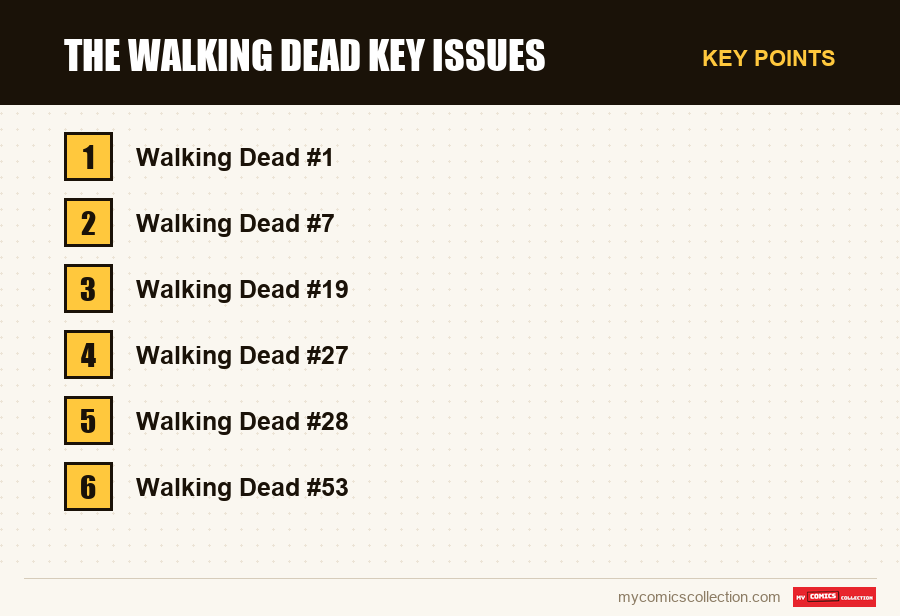
Walking Dead #1
The founding issue of the entire saga: we discover Rick Grimes waking from a coma in a hospital, in a world ravaged by the zombie apocalypse. Printed at roughly 7,200 to 7,500 copies in its first printing according to specialists' estimates, this issue received no particular promotional campaign on release: Image Comics was then betting on a niche readership for a creator-owned series with no pre-existing license. It is precisely this low initial print run, combined with the explosion of demand after the launch of the AMC series in 2010, that made this issue one of the most sought-after modern comics on the market.
Walking Dead #7
This issue marks a major editorial turning point: Charlie Adlard succeeds Tony Moore on art, an artist change that would nonetheless become the series' lasting visual identity, since Adlard would draw every issue up to #193 in 2019. On the storytelling side, the issue introduces Tyreese, his daughter Julie and Julie's boyfriend Chris, while revealing that Lori is pregnant: two narrative threads that will run through several major arcs of the series. Moore keeps the cover up to #24, creating a hybrid period that purists of the title's editorial history seek out.
Walking Dead #19
Michonne makes a spectacular entrance into the story: she appears crossing a field of walkers, katana in hand, dragging behind her two disarmed zombies with no jaws, used as olfactory camouflage. This character will become one of the pillars of the Walking Dead mythology, in the comic as well as in her television incarnation by Danai Gurira from season 3 of the AMC series. Demand for this issue remains strong on the secondary market, with graded copies regularly offered for sale. The original 2005 print run remains far more modest than that of the issues published after 2010, which keeps constant pressure on supply at the top grades.
Walking Dead #27
Opening of the series' second major antagonist arc with the appearance of the Governor, his right-hand man Martinez and the fortified town of Woodbury. This character will become one of the most striking villains in comic book history, adapted on screen by David Morrissey in the AMC series from season 3. The issue is actively sought by collectors building a complete "first appearances" collection, in the same way as the issues linked to Negan or the Governor in the original comic continuity, well before the novel prequels devoted to the character.
Walking Dead #28
One of the most violent and memorable scenes in the entire comic: the Governor slices off Rick Grimes' right hand with a knife. This pivotal moment, still one of the passages most debated by readers of the original series, had never been adapted on screen in the classic AMC series, until the spin-off The Walking Dead: The Ones Who Live (2024) finally picked it up right from its opening, eighteen years after the comic was published. This issue illustrates how interest in recent adaptations revives demand for issues published nearly two decades earlier.
Walking Dead #53
Three major characters of the series' middle period make their simultaneous debut: Eugene Porter, Abraham Ford and Rosita Espinosa, all three later adapted on screen and central to the storyline of the search for a cure for the infection. This issue remains a good example of an "accessible key": less spectacular than #1 or #100, it keeps a limited original print run while remaining affordable for collectors starting a character-based theme collection.
Walking Dead #100
The most commercially important issue in the series' history. Published at the height of the AMC adaptation's popularity, it was ordered at about 379,000 copies across all covers, making it the best-selling comic of the 2010s according to distribution data. It came with some twenty variant covers signed by artists such as Todd McFarlane, Bryan Hitch, Frank Quitely, Sean Phillips or Marc Silvestri, some printed in only 250 or 500 copies (the red foil "Lucille" edition, in particular). The issue marks the entrance of Negan and his barbed-wire-wrapped baseball bat, as well as the death of Glenn Rhee, one of the most discussed narrative shocks in the whole series.
Walking Dead #193
The conclusion of sixteen years of continuous publication, revealed without any prior announcement: Robert Kirkman deliberately kept the ending secret, going so far as to produce fake covers for the three following issues to preserve the surprise until the actual release in stores. The story takes place twenty-five years after the events of #192, the largest time jump in the entire saga, and it remains the only issue set in the future of the chronology. Published during a period of strong distribution (after the AMC boom), its print run is markedly higher than that of the very first issues of 2003-2006, which limits its relative scarcity despite its symbolic importance as a closing piece for a collection.
The impact of adaptations on the price
Few comics illustrate as clearly the mechanics of "retroactive demand" as The Walking Dead. AMC's TV series, broadcast from October 2010 to November 2022 over eleven seasons, multiplied the readership of the comic long after the founding issues were published. It created a lasting imbalance between a tiny original supply (a few thousand copies for the 2003-2008 issues) and a demand that formed ten years later on the basis of several million viewers.
This phenomenon can be observed issue by issue. Michonne, introduced in the comic as early as 2005 (#19), only appears on screen from season 3 in 2012, played by Danai Gurira. The Governor, present in the comic since 2006 (#27), becomes a major television antagonist the same season, played by David Morrissey. Negan, who appeared in the comic in 2012 (#100), makes his television debut only in 2016, at the season 6 finale, played by Jeffrey Dean Morgan: a cliffhanger that considerably revived interest in the original issue when it aired.
More recently, the scene of the Governor cutting off Rick's hand, published in the comic as early as 2006 (#28) but never adapted in the original series, was taken up in The Walking Dead: The Ones Who Live in 2024. This type of narrative "catch-up", characteristic of the expanded universe after 2022 (Dead City, Daryl Dixon, The Ones Who Live), periodically revives interest in older issues whose original print run remains permanently fixed. It is a mechanism to watch for any collector: each new spin-off release can reactivate demand for the comic issues that correspond to the arc adapted on screen, without the physical supply ever being able to adjust upward.
Conversely, issues published after 2010, at the height of the TV series' fame, benefit from much more generous print runs (the extreme case being #100 and its ≈379,000 copies). This explains why their relative scarcity, and therefore their price, remains structurally below that of the very first issues, despite sometimes greater narrative importance.
Do you collect this series?
Track what you own, what you are missing and what your collection is worth. 7-day trial.
Start my trial →
Buying guide
- Tell the printings of #1 apart. The first issue went through several reprints over the years (second, third and fourth printings, and special convention editions such as the Wizard World Chicago variant). Only the very first 2003 printing carries the maximum collector value. Systematically check the indicia code and, ideally, have the authenticity confirmed by a professional before any high-priced purchase.
- Spot the Moore / Adlard transition. Issues #1 to #6 are entirely drawn by Tony Moore. From #7, Charlie Adlard takes over the interior art while Moore keeps the covers up to #24. This hybrid period has particular documentary value for collections centered on the title's artistic history.
- Favor white pages in CGC grading. As the series is printed in black and white, paper quality and the absence of yellowing are criteria that graders scrutinize closely. On early issues (2003-2008), a copy with white pages always trades above a copy with cream pages.
- Do not confuse original editions with colorized reprints. Since October 2020, Image Comics has published The Walking Dead Deluxe, a full reissue entirely colored by Dave McCaig, accompanied by unreleased bonuses ("Cutting Room Floor"). This collection, rich and sought after in its own right for its variant covers, nevertheless does not have the same collector value as the original black and white issues: the two markets must be considered separately.
- Focus on low original print runs rather than only on narrative peaks. A high-impact story issue published after 2010-2012 (such as #193) was often printed in far larger quantities than an appearance issue published in 2004-2008. The original print run remains the number one factor of scarcity, even ahead of the importance of the plot.
- Check the variant covers of #100. This issue came in some twenty different covers, some printed in only 250 or 500 copies (such as the red foil "Lucille" edition or the ComiXology variant signed by Kirkman and Adlard). Identify precisely the version offered before evaluating its interest, as the scarcity gap between the standard cover and a limited variant can be considerable.
- Systematically document provenance. For the most sought-after issues (#1, #19, #27, #100), always request the CGC/CBCS grading history and, if possible, photos of the spine and back before buying. These are black and white comics, where micro-defects on the spine are particularly visible and strongly affect the final grade.
To track the evolution of your Walking Dead collection issue by issue (key appearances, print runs and condition of your copies), the collection management app lets you centralize this information and follow the estimated value of each piece over time.