A copy whose cover has disappeared is not a bad copy: it is a copy of another category. On the advertisement survey carried out on August 30, 2026 around the 1968 issue where Vision appears, a copy described as lacking a cover was offered at $54.99: more than four complete objects appearing in the same list, two of which are not even the issue sought. These amounts are what sellers were asking for that day, not completed transactions, and a statement taken on a single date says nothing about a trend.
In the current vocabulary of collectors there is a catch-all category, that of the copy “good for the trash”: cover torn off, staples removed, notebooks separated. Custom dictates that we exclude it from the count, that we do not note it anywhere, that we do not talk about it. The survey conducted on August 30, 2026 on a general auction site in the American market, around the query “Vision Avengers 57 1968”, contradicts this habit on a precise and verifiable point: a copy without a cover appeared there, with an asking price, and this price was not the lowest on the list. Four other items were claimed for less than him.
This observation deserves attention, because it touches on the very way in which a collection is held. If an object deemed worthless is assigned a higher amount than several complete objects, then the line that separates “collectible” from “junk” is not where we spontaneously place it. It does not pass between the intact copy and the damaged copy: it passes between the desired copy and the copy which is not. An old mutilated booklet remains an old booklet. A new derivative object, however clear it may be, is not the old booklet.
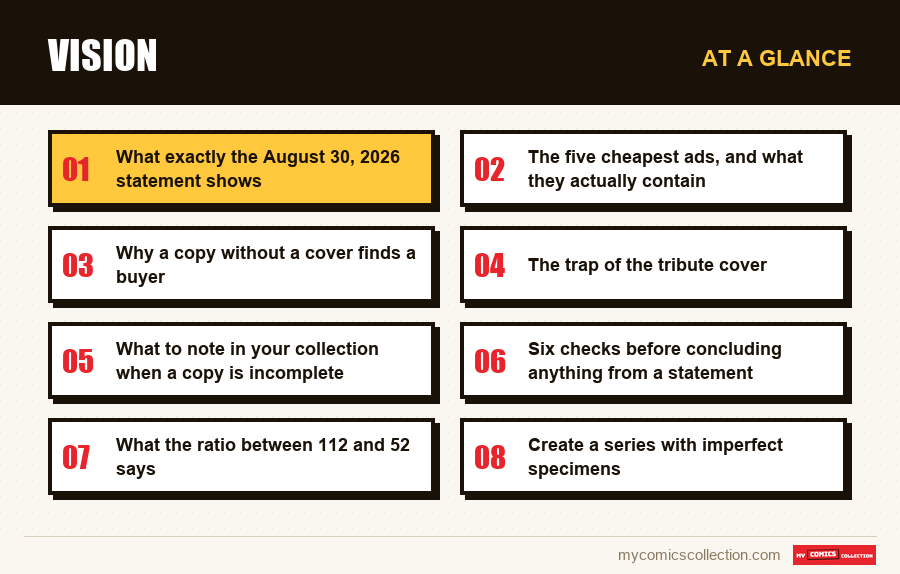
What exactly the August 30, 2026 statement shows
The report concerns the announcements in progress that day, on a general market place oriented towards the American public. At no time are these sales concluded: each figure cited is an amount that a seller displayed, hoping to get it. No one has paid these amounts at the time the statement was taken, and there is no indication that anyone will pay them. This distinction is not a stylistic precaution, it changes the reading: an announcement is a proposal, a sale is an agreement.
The request produced 52 ordinary advertisements, that is to say relating to copies not passed by a verification body. The minimum claimed there was $4.00, the median $325.84, the maximum $1,353.80. Separately, counted separately, 112 verified copies were offered: minimum $59.90, median $577.50, maximum $14,999.99. These two sets do not mix and do not compare feature for feature, since they do not relate to the same commercial object: in one case a fascicle as is, in the other a fascicle accompanied by an external assessment of its condition.
The $14,999.99 maximum should only be read for what it is: the amount a single seller listed in their listing. An isolated extreme expresses an individual hope, never a market level. The same goes for $1,353.80 on the regular ads side. The medians are more resistant to this type of accident, because they are located in the middle of the workforce and do not move when a single ad flies away.
Finally, it is necessary to repeat what a single measure does not allow. A statement dated August 30, 2026 provides a photograph. It provides no slope, no direction, no speed. To write that the market “rises” or “falls” from this single snapshot would be pure invention: there is no previous point of comparison in this data, therefore no observable movement. Everything we can say, we say in the present tense, about that day.
The five cheapest ads, and what they actually contain
$4.00: a 2023 tribute cover
The cheapest ad is for “AVENGERS FOREVER 13 CLASSIC VARIANT NM 57 HOMAGE 1968”. It is a recent booklet whose cover illustration repeats the composition of that of 1968. The date appears in the title of the advertisement, but as a reference to the original, not as the publication date of the item sold.
$10.00: an item that is not a comic
Next comes “Funko Pop!” Comic Covers: Vision Vinyl Collectible. The request related to a booklet; the result returns a collectible figurine. The object is legitimate in itself, it simply has nothing to do in a price statement for booklets, and its amount pulls the lower limit down without describing anything.
$35.00: a foreign edition
“Avengers #57 (1968): Brazilian Foreign key Brazil” designates an issue published outside the American market. It is indeed the same story, it is not the same editorial object: the question of knowing what we are collecting, a content or a precise impression, arises here directly.
$49.99 then $54.99: the recent variant, then the no-cover
“2024 Rare HTF Avengers 57 NM MX Foil 1000 1st App Vision 1968 Foreign Variant” is a modern variant. Just above, at $54.99, the “Avengers 57 Coverless” ad offers the period copy without its cover. It is he who is claimed to be the most expensive of the five.
The lesson can be summed up in one sentence: of these five advertisements, two do not relate to the issue sought, two relate to printings distinct from the original, and the fifth is an incomplete period copy. In other words, the lower limit of a reading is almost never the floor price of the object; it is the price of the most economical misunderstanding that the search engine was willing to reveal.
A text query does not sort: it collects everything that contains the right words. The vintage “1968” appears both in the title of a tribute reissue and in that of a period copy, and the name of a character appears both on a booklet and on a figurine.
A statement is therefore not uniform by default. It becomes so if, and only if, we open it ad by ad to check what each line actually describes. Without this inspection, the calculated statistics measure a mixture, not an object.
Why a copy without a cover finds a buyer
The very existence of an asking price for a mutilated copy presupposes that a buyer may be interested in it. At least three profiles make it understandable, and none of them need to be a naive buyer. The first wants to read: the interior pages are there, the story is complete or almost complete, and the object costs a fraction of what a complete copy costs. The second wants to hold in hand a period print, with its paper, its grain, its layout, without paying the premium attached to the integrity of the object. The third constitutes a waiting place: it occupies the box in its series and will replace it later, when the opportunity arises, with a complete copy.
These three uses have one thing in common: they are not intended for resale. They are about access. This is precisely what distinguishes the no-coverage segment from the rest of the market: it doesn't play on the same promise, so it doesn't compare to the same prices. Bringing it closer to the medians noted would amount to comparing two different proposals that only share a title.
The fact remains that the cover concentrates a significant part of the value of an old issue. It is she who bears the identifying image, the publisher's mark, the period price, the date notices; she is the one we look at first and she is the one who suffers first. We do not have any measurement of this part here, and it would be dishonest to put forward one: the survey data does not include paired copies which would allow a difference to be calculated. What we can say without forcing is that the amount requested for the copy without cover is in an order of magnitude significantly lower than the medians observed, both for ordinary advertisements and for verified copies.
This reasoning applies beyond a particular title. It applies to any old and sought-after issue, and we find the same mechanics on other series from the same period: see for example the references collected on the key issues of the Avengers or on the key numbers of Thor. The higher the demand for a given issue, the more degraded copies cease to be unsaleable and become an accepted entry-level item.
The trap of the tribute cover
The first announcement in the ranking deserves its own development, because it represents the most frequent confusion in this type of research. A tribute cover is a new cover which reproduces, quotes or diverts the composition of an old cover. It is an ordinary and perfectly assumed editorial exercise: the editor indicates a connection, the reader recognizes an image, the illustration functions as a visual quotation.
The problem only appears at the time of classification. A reduced thumbnail shows the same silhouette, the same layout, sometimes the same palette. The title of the ad contains the year of the original. A quick eye therefore sees "the" 1968 cover and a ridiculous price, and draws the conclusion that the old booklet is exchanged for a few dollars. The conclusion is false, and the error is entirely avoidable: the actual publication date is on the subject, and you just have to look at it. A tribute only deceives the one who does not verify the vintage.
The same vigilance applies to recent variants in special editions, which also include an old issue in their title. The numbering displayed refers to the original; the object is new. Distinguishing the two does not require any expertise: it requires a habit, that of reading the year of publication before the title.
What to note in your collection when a copy is incomplete
Note the defect noted, not the letter taken from the ad.“Coverage absent” is information. A status letter copied from a seller is not one: it summarizes an assessment whose criteria are unknown and which never says what is missing. A copy without a cover and a copy with a detached but present cover can receive the same summary rating; However, they are not the same objects, neither for reading nor for future replacement.
Detail the nature of the shortage, element by element. Missing cover, missing staples, cut pages, loose notebook, detached coupon: each of these defects can be noted separately and noted separately. A complete but unstapled copy has nothing to do with a copy without its central pages. A description that lists what is missing remains readable in ten years; a single letter, no.
Explicitly mark the copy as waiting. If you buy something without coverage while waiting for something better, write it in the form. Without this mention, the box appears filled, the series appears complete, and the search stops. With it, the copy counts as present while remaining marked as provisional: which is exactly its status.
Separate the original edition from its reissues and variants. A foreign copy, a modern variant and a period issue share a number and a story, not an identity. Save them as separate lines, with their actual year of publication. This is the only way to avoid that an internal search later mixes what the market already mixes.
Record the source and date of any amount you enter. A price noted without its date loses its meaning in a few months, and a price noted without its origin no longer allows us to know whether it was a request or a transaction. The two mentions take just a few characters and transform an isolated value into a dated, reusable and honest observation.
Collecting this series?
Track what you own, what you are missing and what your collection is worth. 7 day trial.
Start my trial →Six checks before concluding anything from a statement
Open extreme ads
The lower limit and the upper limit of a reading are the two lines most likely to describe something other than the object sought. These are therefore the first two to inspect, before any calculation.
Read the year of publication
An ad title may contain an old vintage to designate a new item. The year that counts is that of the proposed printing, not the year referenced.
Distinguish requested and concluded
An amount displayed in a current advertisement is only binding on the seller. A conclusion on a price level assumes completed transactions, which this type of statement does not provide.
Discard what is not a booklet
Figurines, posters, derived objects: a textual query brings them up as soon as they have the right name. Leaving them in the sample distorts the lower limit and the number.
Look at the headcount before the median
A median calculated on less than ten ads does not describe anything stable. With such a small number, the only honest answer is to note that we cannot conclude.
Count the verified separately
Copies passed by a verification body form a separate submarket. Here, they are more than twice as numerous as ordinary announcements: 112 against 52.
What the ratio between 112 and 52 says
The imbalance between the two sets is one of the clearest facts of the survey, and it is too often treated as a detail of method. On this issue, on this day, the copies accompanied by external verification were more than twice as numerous as the copies offered as is. The visible booklet market is therefore mainly a market for verified copies, and the raw supply occupies a minority position.
This proportion has a direct consequence on the reading of prices. If we add the two sets to calculate a single average, the result is driven upwards by the composition of the sample, not by an increase in prices: we then measure the proportion of verified people much more than we measure the value of the number. Separating the two populations is not a statistical vanity, it is the condition for the figures to relate to something.
It also sheds light on the position of those without coverage. In a set dominated by copies whose condition has been assessed and sealed, the mutilated copy occupies the exact opposite of the spectrum: it is the one whose state does not need to be assessed, since it is visible and definitive. Lack is the descriptor. No evaluation will qualify it, and none will challenge it either.
Finally, we must be careful not to extend this report to other numbers. Nothing in this statement says that a neighboring issue would present the same distribution: the proportion of verified copies depends on the perceived value of the issue, its age, the fragility of its paper. What we hold, we hold for this number, on this date, in this marketplace.
Create a series with imperfect specimens
Many collections stop short in front of a number that is too expensive. The series remains open, the research is put on hold, and the whole loses its coherence for a single lack. The degraded copy offers another way out: it closes the box without pretending to close it definitively. The series becomes readable again, reading becomes possible again, and replacement remains on the program.
This strategy, however, only works on one condition: that the provisional status is registered somewhere. A headwear collection forgets this kind of nuance in a few months. A collection held in a tool that accepts a free state description keeps it indefinitely, and allows you to find all the boxes to improve at a glance. For reading cues that help decide where to start a series, the reading guide dedicated to Vision and the panorama of the editorial history of the Avengers provide the necessary context.
You must also accept that the replacement copy will not be available on order. A sought-after back issue appears when it appears, in the condition it appears, and at the price its seller decides. Giving yourself the means to wait (that is, already having a readable version of the number) removes the urgency of research, and urgency is what makes you pay too much.
Finally, there remains the case of the degraded copy that we keep even after replacement. There is no obligation to resell it, and a collection can perfectly accommodate two copies of the same issue in two different titles: one for condition, the other for use. Here again, everything is played out in the form: two distinct lines, two distinct state descriptions, and the whole thing remains understandable.
Frequently asked questions
Can a copy without a cover be resold? The survey shows that it is offered, with an asking price higher than that of four other items on the same list. It does not show that it is selling, since it only covers current ads.
Because it does not relate to the 1968 issue. It is a recent issue whose cover pays homage to that of the time. The vintage cited in the title of the ad designates the original illustration, not the date of printing of the item offered. This is the most common case of false floor in this type of research.
No, and for one definitive reason: there is only one date. A measurement taken on August 30, 2026 cannot be compared to anything within this data. Any statement about a movement, up or down, would be added by the commentator, not taken from the reading.
Better not to do it. The two sets describe different commercial propositions: in one case a booklet sold as is, in the other a booklet accompanied by an external assessment of its condition. Merging them produces a statistic that primarily measures the composition of the sample.
By describing the defects observed one by one: missing cover, missing staples, cut pages, loose notebook. A single letter taken from an advert does not say what is missing and becomes illegible over time. The free description remains accurate and allows you to find the copies to be replaced.
No. An isolated maximum corresponds to the price that a single seller has decided to display, without any buyer having validated it. The medians noted: $325.84 on the ordinary ads side, $577.50 on the verified side: describe the center of the offer much better, while also remaining the amounts requested.
Describe actual condition, not a rough letter
My Comics Collection lets you record what's really missing on each copy, distinguish an original edition from its variants and reissues, and spot at a glance the boxes you plan to replace. Your price observations remain dated and assigned, therefore reusable.