The booklet where Vision reappears in a completely redesigned form has a motif name of its own, distinct from the first appearance, the return and the entry into the team: the first "white" version of the character. As of August 30, 2026, on a general American auction site, 146 current advertisements were asking from $13.63 to $800.00 for West Coast Avengers #45, with a median amount requested of $34.37; verified copies, counted separately, formed a set of 48 listings ranging from $45.00 to $999.99 for a median of $105.00. The five cheapest ads are all the right issue and fall within a range of less than four dollars. None of these values is a transaction: they are sums requested, stopped at a single moment.
A collector who puts away his purchases always ends up stumbling over a question of vocabulary. A character changes appearance, and it is necessary to decide whether the issue concerned deserves special mention or whether it joins the mass of ordinary episodes. The answer is rarely a matter of taste: it can be seen in the way the market writes its advertisements. When several unrelated sellers spontaneously use the same formula to designate the same event, it is because the motive exists independently of them. It has a name, it circulates, and it directs the buyer's search.
The case of Vision in West Coast Avengers #45 illustrates this mechanism with rare clarity. It is neither a creation of a character, nor a return after absence, nor a simple change of costume as occurs with each editorial relaunch. It is an already established character which returns in a radically different form, to the point that the market gives it its own designation. This article examines what the August 30, 2026 statement allows us to establish, what it does not allow us to conclude, and how to translate all of this into usable inventory lines.
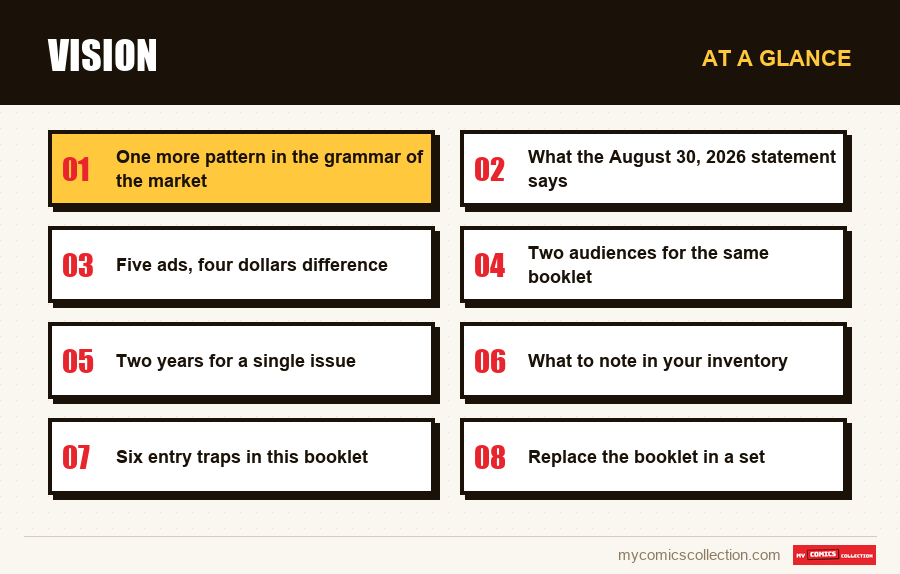
One more pattern in the grammar of the market
The reasons why an issue sells above its serial neighbors are a shorter list than one might think. The first appearance of a character occupies the peak. Then comes the first clash between two major figures, the entry into a team, the first time that a solo title is entrusted to someone, the taking over of a role by another bearer. Each of these reasons answers a simple question that the buyer asks himself before paying: what happened here that has never happened elsewhere?
The new version of an existing character answers this question in a way that the other designs don't cover. The character does not appear for the first time, since he has existed for a long time. He is not returning from an absence, since he had not left. He does not join a team, since he is already there. What changes is its very form: its appearance, and with it its way of existing on the pages. The market needed a word for it, and it found it: it designated this release as the first appearance of a distinct version, namely the white version.
The proof that this pattern is stabilized lies in the repetition. Of the five least expensive advertisements in the survey, four explicitly name the specification sought and three name the pattern in the same terms. “1st White Vision”, “1st Appearance of White Vision”: the formula varies in its length, never in its content. Sellers who do not consult together converge on the same designation because it is the one that their buyers type in a search bar. A named pattern is a findable pattern, and a findable pattern is a pattern that meets its request.
This practical consequence is worth emphasizing, because it works both ways. For the buyer, the booklet can be located in a few seconds: the query is successful, the results are relevant, the comparison between offers is immediate. For the seller, the same transparency closes the door to any profit from obscurity. No one can hope to take advantage of a poorly informed buyer on a booklet that three out of five ads describe correctly. What the motif gains in visibility, it loses in margin.
What the August 30, 2026 statement says
146 unverified ads
The request for this booklet shows 146 current offers for copies without certification, from $13.63 to $800.00. The number is comfortable: it allows us to speak of a general trend rather than an isolated case. The asking midpoint stands at $34.37.
48 verified ads separately
The copies passed by a verification agency form a distinct set of 48 offers, from $45.00 to $999.99, with a median asking of $105.00. These two populations do not mix: a sealed and graded copy cannot be compared to a raw copy.
Around fifteen dollars at the entrance
The actual entry point for the booklet is around fifteen dollars. The five cheapest deals range from $13.63 to $17.50: less than four dollars separate the first from the fifth, while the stated states differ from listing to listing.
A maximum without scope
The top $800.00 of the unverified range, like the top $999.99 of the verified range, measures a seller's ambition and nothing else. An amount demanded is not an amount obtained, and an extreme point never describes a deal.
We must be explicit about the nature of these numbers, because everything else depends on them. These are sums that sellers requested on August 30, 2026, for copies still on display, on a general auction site on the American market. None have been cashed to my knowledge. A asking price expresses what a seller hopes for; a concluded price expresses what a buyer has agreed to. Confusing the two amounts to mistaking an intention for a fact.
We must be just as explicit about the temporal dimension. This reading was taken only once, on a single date. A snapshot contains no direction: it does not learn that the issue is going up, down, or stagnating. To say anything about a movement, you would need at least two spaced measurements, taken under the same conditions and on the same perimeter. This page therefore only claims to describe a state, not a trajectory.
The separation between verified copies and raw copies is not a nuance of presentation. The floor of verified bids, $45.00, sits above the midpoint of raw bids, $34.37: the two sets barely overlap. Merging the two populations would produce an average that would not describe any real specimen.
What the buyer of a verified copy pays for is not just the object. It also pays for a third-party opinion on the condition, and the certainty that this opinion was given before the purchase rather than after. It's a service, it has a cost, and this cost is automatically reflected in the amount displayed.
Five ads, four dollars difference
The most instructive detail of the reading is not the top of the range but its bottom. The five cheapest offers are as follows: $13.63, $15.99, $16.50, $16.99, $17.50. They all relate to the specification you are looking for: no serial errors, no number confusion, no mislabeled batches. And the total gap between first and last is less than four dollars.
This tightening says something specific about the state of the market. Five independent sellers, who do not consult each other, describing examples whose declared conditions differ, arrive at the same order of magnitude. This only happens when a reference amount circulates and imposes itself on everyone. None of these sellers try to get more, because none think they can; no one breaks the price, because no one needs to sell off to find a buyer.
A tight market doesn’t look like that. When demand exceeds the available supply, the asking prices spread out: those who want to sell quickly stay low, those who bet on scarcity go high, and the range opens. Here the fan is closed. The supply is abundant - 146 advertisements for a single issue leave little doubt, and this abundance is enough to explain the price discipline. A buyer in a hurry has no reason to pay more: he will find another tomorrow.
A reservation, however, on what this tightening allows us to conclude. It concerns five advertisements, taken from the bottom of a set of 146. Five observations are never enough to establish a price level for an entire market; they describe a front door, which is already useful, but nothing more. The median amount asked, $34.37, is twice that entry point, and it remains the best description of the whole thing.
Two audiences for the same booklet
One in five ads, at the bottom of the range, do not mention the reason at all. It highlights the author, John Byrne, and the character, without a word about the transformation. The seller is asking $17.50, the highest of the five, and he's actually selling something other than his four shelf neighbors.
This announcement is aimed at a reader who is following a signature. This player is not looking for an event, he is looking for a hand. He does not compare this booklet to other key issues of the character but to other works by the same author, and he will perhaps buy several titles with no narrative link between them just because they share a name in the credits. His purchasing logic is vertical where that of the pattern hunter is horizontal.
The same booklet can therefore be sold according to two distinct arguments, to two distinct audiences, on the same site and the same day. This is a fairly general property of booklets which combine a narrative event and a recognized signature: the content attracts one audience, the execution attracts another, and the object is found at the intersection. This double membership partly explains the abundance of the offer: the booklet interests more people than a simple episode of a series, so it has been kept by more people, so it appears in greater numbers.
For the collector who keeps an inventory, the lesson is direct. If you only note one reason for purchasing a booklet, you will lose the other. A copy acquired for the signature cannot be replaced by a copy acquired for the event, even if it is the same number: the question we will ask ourselves in two years will not be the same. The personal notes field does exactly that: recording the reason for purchase, not just the item purchased. The same reasoning also applies to all of the key Avengers issues, where several motifs regularly overlap on the same booklet.
Two years for a single issue
Two of the five advertisements bear the year 1989. A third bears 1985. The gap is four years, and there is nothing accidental about it: 1985 is the year of launch of the series, the year when the title began its numbering. The seller did not get the issue wrong, he used the year associated with the title rather than that associated with the number.
This substitution is a wording convention, not an attempt to deceive. On many files and sales databases, the year attached to a series is that of its first issue; a seller who mechanically copies this sheet to describe his booklet reports the year of the title. The error is clear, visible, and has no impact on identification: the number and title are sufficient to remove the ambiguity.
It does, however, have an impact on research. A buyer who filters their results by year of publication will not see this ad: the third cheapest in the survey. An overconfident filter excludes perfectly valid offers. On a booklet where four dollars separate the five best offers, rejecting one ad in five amounts to depriving oneself of a significant part of the available choice.
The counterpart of this general imprecision is that a personal inventory must decide. A collection which inherits the year of the title for certain issues and the year of the number for others becomes incapable of sorting itself chronologically. Sorting by date then returns absurd results, and only the person who entered the data knows why. It's the kind of debt that isn't visible at the time of foreclosure and is expensive three years later.
Collecting this series?
Track what you own, what you are missing and what your collection is worth. 7 day trial.
Start my trial →What to note in your inventory
The exact version of the character. Simply writing the name of the character is no longer enough once the market distinguishes between several forms. The line should specify which version it is, because it is the version that carries the design and not the character in general. Two copies of the same character in two different forms are not placed on the same line: they are two separate entries, with two reasons for purchase that have nothing to do with each other.
The year of publication, distinct from the year the series was launched. Since one in five ads confuses the two, inventory must choose its own and stick to it without exception. The most robust rule is to note the year of the number owned, and to mention the year of the title in a separate field if it serves a purpose. Any hesitation between the two is paid for at the time of chronological sorting.
The distribution channel when the ad indicates it. One of the five advertisements specifies that its copy is for newsstand distribution rather than the specialized circuit. It is a physical characteristic of the object, not an advertising argument, and it cannot be deduced from any other data on the sheet. If it appeared in the ad at the time of purchase, it must appear in the inventory line, otherwise the information is permanently lost.
The author, when he is the one who motivated the purchase. The booklet attracts two audiences; the inventory must remember which one was recorded that day. A copy purchased for signing is noted as such, with the name, because this note conditions future decisions: which other titles to look for, which to resell first, which to never separate from the rest. Without it, all that remains is a serial number with no intention.
The price paid, shipping included. The amount that counts is not the amount on the label but the amount that left the bank account. On a booklet costing around fifteen dollars, shipping costs represent a considerable fraction of the total, and ignoring them distorts any subsequent comparison with the amounts displayed. Noting the all-inclusive price, along with the date of purchase, is the only way to ever know what the collection really cost.
Six entry traps in this booklet
Find the character without the version
A query relating to the name of the character alone goes back hundreds of unrelated booklets. This is the version that usefully narrows the search, because it is what sellers name in their ad titles.
Filter by year of publication
A filter on the year excludes advertisements which bear the year of launch of the series. In this report, that represents one in five of the cheapest deals, including a perfectly legitimate copy at $16.50.
Compare verified and raw
The verified bid floor exceeds the raw bid median. Placing the two in the same table produces an irrelevant comparison: these are not two prices for the same object, but two different objects.
Forget shipping costs
At around fifteen dollars, shipping is heavy. An inventory line that only records the displayed price systematically underestimates the true cost, and the discrepancy accumulates over purchases.
Take the maximum for a value
The top $800.00 has never been paid by anyone to my knowledge: it is a requested amount. Building a collection estimate on an extreme point amounts to adding up the hopes of sellers.
Merge two versions on one line
An inventory that places all forms of a character under a single entry loses the distinction that the market maintains. Two shapes, two lines: it's the only way to find one without the other.
Replace the booklet in a set
A single key number has little meaning. It takes its use value in a set: what precedes it explains why the transformation matters, what follows it shows whether it lasted. A collector who only acquires issues marked as important finds himself with a series of points without a line: each object costs him the price of the motif, without any telling him anything.
The solution rarely lies in purchasing all the intermediate numbers. It comes from reading, which costs much less than owning it, then from the targeted purchase of what you want to keep after reading. A organized reading route around the character fulfills exactly this function: it gives the transformation its before and after, and it allows you to decide which issues deserve an inventory line rather than a simple reading.
This approach has a pleasant budgetary consequence. On a booklet whose entry price is around fifteen dollars and whose offer reaches 146 simultaneous advertisements, there is no urgency. Rarity does not pressure the buyer; abundance gives him time to read first and then buy. This is not true of all reasons, but it is true of this one, and the record shows it unambiguously.
Finally, a pattern is better understood by comparison. The new version of an existing character is not a singularity of a single hero's universe: it is found wherever a character has lasted long enough to be redesigned. Observing how the same mechanism manifests itself elsewhere (in other ancient figures, in other team series) helps recognize the pattern before the market has fully named it. This is the kind of transversal reading that the recaps by character allow, on the side of key issues of Thor like elsewhere.
What this statement does not say
It is also important to list what these figures do not cover. They say nothing about the number of copies originally printed, a data which does not appear anywhere in the statement. They say nothing about the proportion of surviving examples in good condition. They say nothing about the rate at which advertisements find takers, since all the offers observed were still in progress at the time of the measurement.
Above all, they say nothing about management. A single measurement has no slope. To assert that this issue “goes up” or “goes down” on the basis of August 30, 2026 would be a pure invention, and the fact that such an assertion is frequent does not make it any more justified. A reader who wishes to think about trends must repeat the same query, with the same filters, a few months apart, and then compare the two medians rather than the extremes.
They also say nothing about what a specific copy is worth. Conditions stated in listings are sellers' statements, not independent assessments, and the relationship between advertised condition and asking price is noticeably loose since five different conditions result in the same order of magnitude. A personal copy is not valued by analogy with an advertisement whose description cannot be verified.
Finally, they say nothing about the future of the pattern itself. A market reason is a collective agreement; conventions shift. The fact that the white version of the character is named in three out of five ads today is an observation of the present, not a guarantee of permanence. The only thing an inventory can do in the face of this uncertainty is record precisely what was purchased and why, so that the line remains readable even if the market vocabulary changes. Replace the publication in the long history of the Avengers in comics also gives a fairly fair idea of the speed at which this vocabulary is renewed.
A costume change leaves the character identical in another outfit; it occurs frequently and the market rarely names it. A new version changes the shape of the character itself, to the point where sellers give it a separate designation in their listings. The practical test is simple: if independent sellers spontaneously use the same name to designate this form, the pattern exists.
Because these are two markets that barely overlap. In this statement, the floor of the 48 verified offers, $45.00, exceeds the median of the 146 raw offers, $34.37. A verified copy incorporates the cost of third-party evaluation and the guarantee that this evaluation was done before purchase. Mixing the two populations would produce an average that would not correspond to any actual specimen.
This statement does not provide an answer. It was taken on August 30, 2026, only once, and a single measurement contains no direction. To talk about movement, we would need two measurements spaced over time, carried out with the same query and the same perimeter, then compare the medians. All this page establishes is a state on a date.
No. This amount is claimed by a seller, not paid by a buyer, and there is no indication that he has found a buyer. An extreme point expresses individual ambition and never describes the state of a market. The median requested, $34.37 for raw copies, is an infinitely more faithful description of what is practiced.
By not filtering by year. Two advertisements in the survey bear 1989 and one bears 1985, which is the year of launch of the series; the seller used the year of the title instead of that of the number. A filter by year would rule out this offer, although it is valid. Better to filter on the title and number, then read the descriptions.
Keep the version, date and reason for purchase on the same line
A booklet which exists in several forms, which circulates in two different years and which is sold to two distinct audiences requires a precise inventory. My Comics Collection allows you to record the exact version, the year of publication, the distribution channel, the reason for purchase and the price paid including shipping, then find everything in one search.