At Vision, the booklet which tells the origin of the character is not the one which shows him for the first time: they are two consecutive issues of Avengers, and both mentions are correct. On August 30, 2026, a report of current advertisements on an American general auction site placed the original number, Avengers #58 from 1968, at a median of $89.99 claimed on 52 unverified bids, when a statement from the same day on the issue immediately preceding it gave a median of $325.84 for regular copies. These are amounts requested by sellers, not completed transactions, and a measurement taken on a single day does not indicate any developments. The practical consequence can be summed up in one sentence: before buying, you need to know which of the two labels you are paying for.
An old comic book ad is one line, and that line is almost always flattering. “Origin of Vision”, “key to the Silver Age”, “major number”: these formulas are often true, and yet they are never enough to identify what we are looking at. A character may appear in one episode, then have their past told in the next. Two separate booklets then each bear a perfectly defensible mention, and a buyer in a hurry can acquire one while believing they have the other. No one will have deceived him. The seller will have written the truth; This is the question that was missing.
The case of Vision is a textbook case, because the gap between the two issues is reduced to a single numbering notch in the same series. Nothing on a cover indicates that one tells of the origin and the other of the first appearance. Both date from the same year, belong to the same collection, look similar on the shelves. Only the nomenclature separates them, and the nomenclature, in a collection, is what determines the price.
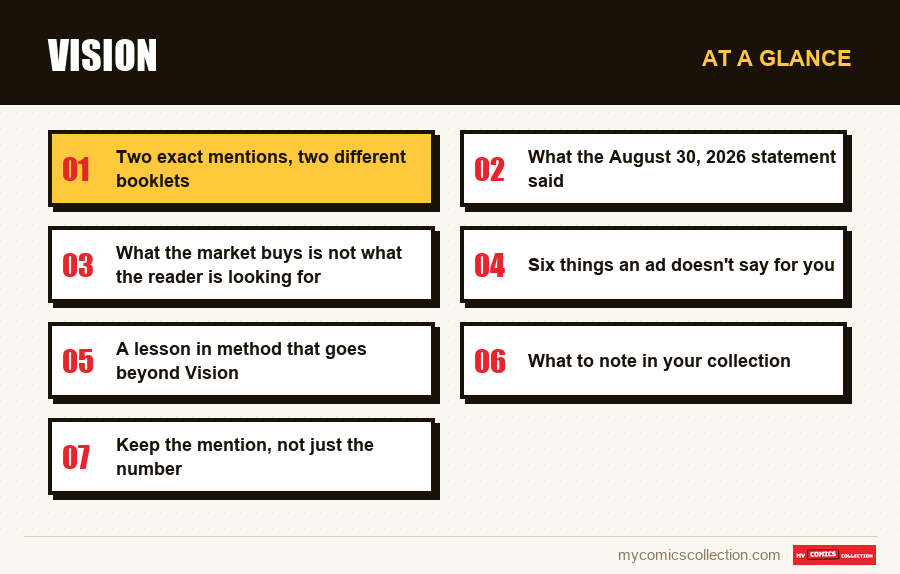
Two exact mentions, two different booklets
Let's start by establishing the distinction, because it is simple and it is almost always overlooked. There first appearance designates the issue where the character appears for the first time in the pages of a comic book. L'origin designates the booklet where his story is told: where he comes from, who made him or gave birth to him, why he acts the way he does. Nothing obliges these two events to coexist. A writer can introduce a menacing figure, then wait until the next episode, or ten episodes, to explain what she is.
For Vision, the explanation comes in Avengers #58, dated November 1968. The statement of August 30, 2026 confirms this by the very wording of the sellers: of the five least expensive advertisements, two explicitly qualify this number as second appearance in addition to being the origin. In other words, it is the sellers themselves who indicate that the first appearance is elsewhere. The information is available, written in black and white, in the text of the offer. It is simply drowned in the middle of a title which begins with “Iconic Origin of the Vision”.
This coexistence in the same ad title deserves attention. “Origin of Vision, Second Appearance” is not a contradiction, it is a complete description. The booklet is indeed the origin, it is indeed the second appearance, and the two statements describe the same object. The reader who skims picks up the first strong word, “origin”, and assumes the rest. The reader who reads to the end understands that there is another number, and that this number is not in their basket.
A third mention also circulates in the same announcements: “joins the Avengers”. It appears in several of the offers noted, attached to the origin. Three formulations, therefore, two of which fall here on the same issue and one on another. None are false. None, taken alone, is enough to identify a number.
What the August 30, 2026 statement said
52 unverified ads
For the original number query, fifty-two bids without independent certification were pending that day. The lowest amount claimed was $32.99, the median was $89.99, the highest was $300.00. A workforce of this size makes the median readable: it is not based on a handful of isolated offers.
22 verified ads, counted separately
The copies passed through a verification agency formed a second set of twenty-two offerings, with a low of $90.00, a midpoint of $266.40, and a high of $1,999.99. Mixing the two sets would make no sense: they do not describe the same product, since verification adds an attested state and a box.
The five cheapest offers are aimed at this number
This is the point which reassures about the cleanliness of the statement. The five entry-level advertisements all relate to the booklet sought: $32.99, $38.83, $47.85, $49.99 and $50.00. No mismatched batches, no disguised reprints, no derivative objects artificially inflating the bottom of the range.
The previous number, measured on the same day
A statement conducted under the same conditions on the immediately preceding booklet gave, for ordinary copies, a median of $325.84 claimed. The difference between the two medians is clear, and it is due to the mention that each issue bears, not to a difference in rarity or printing quality.
These figures call for a precaution that I prefer to write twice rather than once. These are sums requested by sellers on August 30, 2026, on announcements then in progress. None are completed transactions. A seller can display whatever he wants; what a buyer actually agrees to pay is another piece of data, which this statement does not contain. The maximum of $1,999.99 noted on the verified side perfectly illustrates the limit: it reflects the ambition of a person, not a market level.
A measurement taken on a single date shows no movement. Nothing in these readings says that the original number is rising, falling or stagnating: to talk about evolution, there would need to be at least two readings spaced over time, conducted with the same query and the same counting method. What is described here is a photograph, and a photograph does not tell of a movement.
Second precaution, methodological: verified copies and ordinary copies are counted separately, and must remain so. Merging the two populations would produce a hybrid median which would not correspond to any real object, neither to the raw copy found in conventions, nor to the sealed copy purchased by description.
What the market buys is not what the reader is looking for
There is, in this difference in medians, an irony which deserves to be noted without being transformed into purchasing advice. The cheaper of the two issues that day is the one that contains the story. It is in the original issue that the character is explained: what he is, how he was made, what drives him. A reader who wants to understand Vision opens this issue. The previous issue simply shows it.
The market does not remunerate narrative value. It pays for prior rights. “First appearance” is a mention that can never be shared: there is only one, it is definitive, and this uniqueness creates the symbolic rarity on which the prices are nourished. “Origin” is a richer term for those who read, but less sharp for those who classify. The same character can also see its origin taken up, completed or rewritten later, which further weakens the exclusivity of the label.
This dissociation is liberating if we take it seriously. A collector who buys to read has no reason to be guided by the price hierarchy: he can prioritize issues where something is happening, even if it means finding them at the bottom of the range. A collector who buys to constitute a set of cardinal mentions will follow another logic, more expensive and more constrained. Both approaches are legitimate; they just don't produce the same shopping list.
The trap is to believe that you can follow both at the same time without formulating it. This is where regretted purchases are born: we pay the price of heritage logic for an object chosen according to reading logic, or the opposite. Writing down your reason before buying costs thirty seconds and avoids this kind of collision. To place a number in a reading continuity rather than in a scale, a reading guide dedicated to Vision answers a different question than a list of key numbers asks, and that's why both exist.
Collecting this series?
Track what you own, what you are missing and what your collection is worth. 7 day trial.
Start my trial →Six things an ad doesn't say for you
What is the number?
An ad title stacks arguments without hierarchizing them. “Origin”, “second appearance” and “joins the team” can coexist in the same line, and two of these three mentions can designate another booklet. Read the entire line, not the first three words.
When was the price observed?
An ad displays an amount without a timestamp that is useful for the buyer. A statement must always bear its date. The one in question here was made on August 30, 2026; it says nothing about the day before and nothing about the next day, and should not be cited as a permanent value.
If the price is requested or obtained
A current offer is an intention to sell. It can stay online for months without finding a buyer. Confusing the amount displayed with a market price is like confusing a classified real estate ad with a notarial deed.
The condition of the interior pages
One of the advertisements noted indicates a detached first page. No cover photo, no matter how clear, could reveal this defect. The condition of an old issue is as much at stake inside as outside, and the only solution is to ask for views of the pages.
On which population the price compares
Twenty-two verified offers and fifty-two ordinary offers do not compare. Verification by an independent organization changes the nature of the item sold. Any median cited must specify which set it comes from, otherwise it will be a figure without a referent.
What you want from this number
No ad asks the buyer why they are buying. Reading the origin, aligning a rare mention, completing a series: these three reasons lead to three different arbitrations on the same shelf. The pattern is decided before the search tab, not during it.
A lesson in method that goes beyond Vision
What we observe here is not specific to a character. The separation between appearance and origin is a common editorial motif of the Silver Age: introduce first, explain later. Each time this pattern occurs, it mechanically produces two issues with similar labels and distinct valuations. The number of numbers separating them varies; the mechanism repeats itself.
This is why the good habit is not to memorize a case but to install a reflex: faced with any booklet presented as important, ask important for what. The answer is in one word (origin, first appearance, first coverage, joining a team, first confrontation) and this word is enough to know if the number we are looking at is the one we think it is. A well-kept set of key numbers, which he carries on a character from the same era or on the one that concerns you, is constructed exactly this way: one line per issue, one explicit mention per line.
The collective series in which the episode plays out adds a layer of complexity, because a team title accumulates individual events. The same number can mark the arrival of a member, the departure of another and the beginning of an arc, which multiplies the candidate mentions and the opportunities for confusion. To understand the editorial trajectory of this collective series allows each mention to be placed in context rather than treating it as a floating label.
One last point deserves to be said frankly: this rigor costs almost nothing and is paid for immediately. Thirty seconds of verification before a purchase avoids, in the best case, disappointment, and in the worst case, a three-figure expense for an item that was not what we were aiming for. No shortcut replaces reading the ad title and description in full.
What to note in your collection
Write the pattern, not just the number. «Avengers #58” says nothing in six months. “Avengers #58: Origin of Vision, Second Appearance” says it all, including what you didn't buy. The mention is the only field that will allow you to know, later, whether your copy answers the question you asked yourself at the time of acquisition, or another one.
Note that three mentions can designate three fascicles. Origin, first appearance, entry into the team: in this case, two of them fall on the same number and one on its immediate neighbor. There is no guarantee that this is the case elsewhere. Recording the three separately, indicating the fascicle concerned for each, avoids having to reconstruct this information each time.
Date each price record you keep. An amount without a date is an orphan figure. If you note the median of $89.99 observed on regular offers, write next to it "August 30, 2026, current announcements, amounts claimed." Without this mention, in a year you will reread a number of which you will no longer know whether it described a request or a sale.
Separate the verified line from the regular line. Your listing should indicate whether or not the copy you own has passed through a verification agency, because the two populations don't compare: 22 offers on one side, 52 on the other, with floors at $90.00 and $32.99 respectively. A collection that mixes the two loses all ability to self-evaluate.
Record any internal defects found. If the ad mentioned a detached page, or if you discover one upon receipt, this information must be added to the file immediately. It will never reappear on a cover photo, nor in your memory three years later, and yet it conditions any subsequent judgment on the copy.
No, the two sometimes coincide: certain characters are introduced and explained in the same episode. But nothing imposes it, and dissociation is frequent in the silver age. The practical rule is to never assume coincidence: you must check case by case, character by character.
The August 30, 2026 statement notes the difference: median of $89.99 compared to $325.84 on ordinary copies: without explaining it. The most sober interpretation is that the market values anteriority, that is to say the mention of first appearance, more than the narrative content. This is a dated observation, not a rule that can be transposed to other characters.
As market information, very little. An isolated maximum expresses the hope of a single seller on a current advertisement; it does not prove that a buyer accepted this amount. In a set of twenty-two bids, the central value of $266.40 is a significantly more honest benchmark than its peak.
By systematically requesting views of the interior pages before purchasing an old booklet, and in particular of the first and last pages as well as the center of the booklet. One of the advertisements noted pointed out a detached first page. A serious seller provides these views without difficulty; a refusal is in itself information.
No. All the values cited come from a single reading carried out on August 30, 2026. A one-off observation describes a state, never a movement. To talk about an increase or a decrease, it would be necessary to compare at least two readings taken on different dates with an identical method.
Keep the mention, not just the number
A properly maintained collection records for each issue what it represents: origin, first appearance, entry into a team. My Comics Collection lets you record these reasons, the condition found and the date of your statements, so that you always know what you own and why you bought it.