
A pedigree comic is a copy from a named, historically identified collection preserved intact for 40 to 80 years under exceptional conditions (white pages, tight covers, vibrant inks), authenticated and labeled by CGC. The ten benchmark collections (Mile High, Pacific Coast, Allentown, Promise, Boston, Gaines File, Curator, San Francisco, Larson, Cosmic Aeroplane) command a market premium of 20 to 50% over standard guide value. A Captain America Comics #1 Mile High in CGC 9.4 sold for $915,000 in March 2022.
The Golden Age and Silver Age comics market rests on a stark reality: 99.9% of all copies printed between 1938 and 1970 have vanished: thrown in the trash, chewed by rodents, browned by the acidity of the newsprint paper of the era. The rare complete collections that survived the decades in extraordinary preservation condition form a category all their own, identified by name by CGC since 2001: pedigree collections. Understanding the concept of pedigree means understanding why the same Action Comics #1 can be worth $3 million or $6 million depending on its provenance, and why an additional label on a CGC slab mechanically adds 20 to 50% to resale value. This guide covers the technical definition, the ten major pedigrees, how the premium works, and how to verify a copy before buying.
What exactly is a pedigree comic?
The word pedigree, borrowed from dog breeding and equestrian terminology, means in the context of numismatics and comic book collecting a documented and certified provenance. In comics, a pedigree is not an abstract quality mark: it is the verified membership of a copy in a named, historically identified collection, dispersed on a specific date, whose name CGC has agreed to print on the slab's label.
Four cumulative technical criteria define a collection eligible for pedigree status. First criterion: age and purchase at publication. Pedigree collections almost exclusively involve comics bought new between 1938 and 1965, stored without intensive reading, without repeated reading creases. Second criterion: completeness or near-completeness. A pedigree collection typically contains several thousand issues from the same era, sometimes 20,000 or 30,000 copies, assembled methodically by a single collector. Third criterion: preservation quality well above the market average. Pedigrees produce average CGC grades in the 8.5 to 9.6 range, whereas standard Golden Age copies often top out at 4.0 or 5.0. Fourth criterion: white pages. The acidity of newsprint naturally yellows pages over the decades. Pedigree collections, stored under exceptional conditions (stable temperature, controlled humidity, no light exposure), retain off-white or white pages: a crucial notation that adds 30 to 60% to value.
CGC formalized its list of accepted pedigrees starting in 2001. For a copy to receive a pedigree label on its slab, two conditions must be met: provenance verified through a chain of ownership (original purchase invoice for the collection, testimonies, comparison of handwritten marks), and CGC must have formally accepted that collection as a pedigree. A collector cannot self-declare their lot a pedigree.
Identification is often made through physical clues: a distributor's arrival stamp, a pencil mark from the owner in the cover margin, a handwritten date, a signature or initial. For the Mile High collection, copies frequently carry a small pencil mark in the upper-right corner of the cover, written by Edgar Church himself. This physical traceability is used by CGC alongside the documentary chain of ownership to validate authenticity before awarding the label.
Mile High Collection: the gold standard
The Mile High Collection , also known as the Edgar Church Collection, holds a unique place in pedigree mythology. Edgar Church was a commercial illustrator from Denver, Colorado, born in 1888 and died in 1978. From 1937 to 1953, he systematically bought nearly every new comic that came out, primarily to study cover illustration techniques for his own work. He stored these comics in carefully organized stacks in his basement, never truly reading them and never reselling them.
In 1977, dealer Chuck Rozanski (future founder of Mile High Comics) received a phone call from the Church family: the basement contained comics. Rozanski expected an ordinary lot. Instead, he discovered 18,000 Golden Age copies in near-perfect condition, including duplicates and triplicates of hundreds of major comics. The lot included the entirety of the major Timely (pre-1961 Marvel), DC, Fawcett, Quality, Fox, and Centaur titles from 1938 to 1953. Rozanski paid $1.8 million for the whole collection: roughly $100 per comic on average, an astronomical sum at the time. Today, the combined value of those 18,000 copies exceeds several hundred million dollars.
The Mile High's technical edge comes down to altitude. Denver, situated 5,280 feet above sea level (Mile High City), benefits from dry air and moderate temperature swings. These conditions preserved the comics in a state that collections from more humid cities like New York or Chicago simply could not match. The average CGC grade for Mile High copies runs around 9.0 to 9.4, with a high percentage of 9.6 and 9.8: figures unattainable for non-pedigree Golden Age.
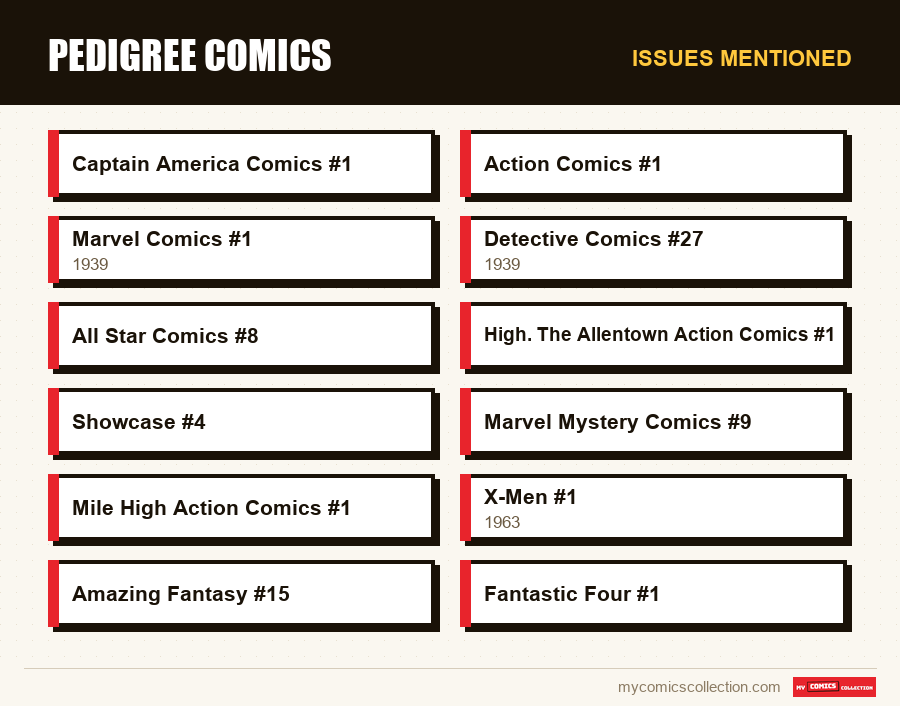
Record sales include: Captain America Comics #1 (March 1941) in CGC 9.4 Mile High sold for $915,000 in March 2022; Marvel Comics #1 (October 1939) in CGC 9.4 Mile High sold for $1.26 million in November 2019; Detective Comics #27 (May 1939, first appearance of Batman) in CGC 7.0 Mile High sold for $1.07 million. The Mile High pedigree premium consistently runs 30 to 70% above the standard guide value for the same grade. To build a well-tracked collection, the Comics Manager complete guide details the tracking tools you need.
Pacific Coast, Allentown, Boston: the historic pedigrees
The Pacific Coast Collection was discovered in 1983 by dealer Bob Storms in California. Assembled by a California collector in the 1940s (the exact identity remains unclear; the name Brian Hughes is sometimes mentioned), it contains roughly 1,800 Golden Age copies, mainly Timely and DC. The average grade runs around 9.2 to 9.6, slightly higher on average than Mile High on certain titles. The edge comes from the dry California coastal climate and sealed-box storage. An All Star Comics #8 (first appearance of Wonder Woman) Pacific Coast in CGC 9.4 sold for $936,000 in 2017.
The Allentown Collection, discovered in 1987 in Pennsylvania, contains roughly 135 Golden Age copies of exceptional technical quality. Assembled by an anonymous collector between 1940 and 1942, it includes Marvel Comics #1, Action Comics #1, and Detective Comics #27 in record grades. The average Allentown grade approaches 9.5 to 9.8, the highest of all pedigrees, but across a far smaller number of copies than Mile High. The Allentown Action Comics #1 in CGC 8.5 long held the record for the highest known grade for that title.
The Boston Collection, dispersed starting in 1991, contains roughly 5,000 Golden Age and early Silver Age copies assembled by a New England collector. Notable feature: a strong focus on DC titles and humor comics. Average grade between 8.5 and 9.2. Boston copies often carry a small identifying pencil mark, which makes authentication straightforward. For historical context on this era, the article pre-code comics 1938-1954 covers the Golden Age in depth.
The Gaines File Copies, named for William Gaines (founder of EC Comics), are a special case. These are archival copies kept by the publisher itself for its internal files, primarily EC Comics horror, crime, and science fiction titles from 1947 to 1955. Dispersed starting in the 1990s, they feature an exceptional average grade (9.4 to 9.8) and command a massive premium: EC collectors regularly pay 100% above guide value for a Gaines File copy. The article EC Comics horror crime pre-code puts this pedigree in context.
Characteristic physical markers: Mile High comics often carry a pencil initial "C" or "EC" in the upper cover margin: Edgar Church's mark. Pacific Coast copies have perfectly flat covers with no trace of creasing, a sign of flat storage (rather than vertical box storage). Boston copies carry a small handwritten numerical annotation near the logo. These clues, cross-referenced against the documentary chain of ownership, validate authenticity before CGC grading.
Curator, San Francisco, Larson, Cosmic Aeroplane, and the rest
The Curator Collection, dispersed in 2003, consists of roughly 4,500 Golden Age copies preserved by a private museum (hence the name). What sets it apart: humidity-controlled storage from the very beginning, which produces brilliantly white pages. Average grade 9.0 to 9.6. Strong concentration of Fawcett (Captain Marvel) and Quality (Plastic Man) titles, making it the reference pedigree for both publishers: now owned by DC.
The San Francisco Collection, which hit the market in 1991, groups roughly 2,500 Golden Age and early Silver Age copies. A mid-tier pedigree in the marketplace, with an average grade between 8.5 and 9.2. Copies often carry an identifiable California newsstand distributor stamp.
The Larson Collection, dispersed in the late 1990s, contains roughly 1,500 Silver Age copies (1956-1965) with a focus on DC and Marvel. Noteworthy: it is one of the few pedigrees covering primarily the Silver Age. Average grade 9.2 to 9.6. A Showcase #4 (first Silver Age Flash) Larson in CGC 9.4 sold for $750,000 in 2024.
The Cosmic Aeroplane Collection, named for a Salt Lake City bookstore that acquired the lot in the 1970s, contains roughly 8,000 Golden Age copies. What makes it unique: a mix of mainstream titles and rare funny animal comics (Pogo, early Uncle Scrooge, etc.). Average grade 8.5 to 9.4.
About a dozen additional minor pedigrees exist: Lost Valley (Missouri), Vancouver , Crowley , Chicago Boys , White Mountain , Davis Crippen "D" Copies , Bethlehem , Big Apple , Northland, each with its own publisher focus and average grade profile. In total, CGC officially recognizes roughly 50 pedigree collections as of late 2025, of which 10 to 12 command a significant premium on the secondary market.
Promise Collection: the contemporary pedigree (2021-2026)
The Promise Collection deserves its own section because it emerged recently, in 2021, and redefined what a pedigree can look like in the modern era. The story: Steve Borock, former CGC president and founder of CBCS, was contacted in 2020 by a Texas family holding the collection of a recently deceased relative. The deceased had methodically bought nearly every comic published each week from 1939 to 1952, stored in dry boxes for 70 years.
The total: roughly 5,000 Golden Age copies in exceptional condition, with 60% grading 9.0 and above. What sets Promise apart technically: every copy has off-white or white pages and covers with unfaded, vivid colors. The focus covers Timely (Marvel), DC, Fawcett, MLJ (Archie), and Fox, with remarkable completeness for the early Captain America, Sub-Mariner, and Human Torch runs.
The collection is being dispersed gradually through Heritage Auctions starting in 2021, spread over several years to avoid flooding the market. Opening sales broke records: Captain America Comics #1 (March 1941) Promise in CGC 9.4 sold for $3.12 million in April 2022, an all-time record for the title. Marvel Mystery Comics #9 Promise in CGC 9.6 sold for $504,000. From its very first year of dispersal, Promise matched Mile High in terms of market premium: 40 to 70% above the equivalent non-pedigree. The article 2025 comics market recap quantifies the impact of Promise sales on the year.
The late emergence of Promise illustrates an essential point: pedigrees are not a closed category. As long as collections remain hidden in basements or attics, CGC can continue adding new ones to its official list: provided the four criteria (age, completeness, quality, traceability) are met.
How the pedigree premium works: +20 to +50% on average
The pedigree premium is the additional price a buyer pays for a pedigree copy versus an identical non-pedigree copy at the same CGC grade with the same pages. It rests on four cumulative factors.
First factor: provenance guarantee. A standard Action Comics #1 can raise questions (was it restored? Pressed? Color-touched?) that modern detection techniques don't always catch. A Mile High Action Comics #1 comes from a sealed basement for 40 years; its physical integrity is documented and beyond dispute.
Second factor: scarcity at high grades. For any given Golden Age issue, the number of known copies in CGC 9.0 and above can often be counted on one hand. Pedigrees account for a disproportionate share of those top grades. Buying a pedigree copy is statistically buying one of the best copies in the world.
Third factor: collector prestige. Owning a Mile High or a Promise places a collector in a recognized, elite circle within the community. The emotional and status value fuels demand.
Fourth factor: resale liquidity. A pedigree copy sells faster than an equivalent non-pedigree. Heritage and ComicConnect auctions consistently draw more bidders on pedigrees, pushing hammer prices beyond estimates.
Empirically, the premium breaks down as follows (2024-2026 data): Allentown +50 to +80%, Mile High +35 to +60%, Promise +40 to +65%, Pacific Coast +30 to +50%, Gaines File +60 to +100% (on EC titles), Curator +25 to +45%, Boston and other top-10 pedigrees between +20 and +35%. To estimate potential resale value, the free valuation tool factors the pedigree premium into its calculation.
Watch out for fake pedigree claims: a copy described as "ex-Mile High" in an eBay listing or on a forum, without a CGC label explicitly mentioning the pedigree, has no added legal value whatsoever. Only the official CGC label: with "Mile High Collection," "Pacific Coast Collection," etc. printed on the slab's band: confers the market premium. Any other claim is pure marketing with no legal standing.
Track the value of your comics: pedigree or not
Whether you own 50 modern issues or a CGC-graded pedigree copy, My Comics Collection calculates the live value of each issue, integrates the pedigree label into pricing, and syncs your collection across iPhone, iPad, and web browser. 7-day free trial, then a monthly or annual subscription, priced for your country.
How to verify a pedigree before buying
Buying a pedigree comic (given the sums involved (from $5,000 to several million depending on the title)) requires rigorous verification. Four steps structure the process.
Step 1: verify the physical CGC label. The CGC slab's label must explicitly state the pedigree name, printed in the upper section of the yellow or blue band. Without that printed notation, the copy is not recognized as a pedigree by CGC, regardless of what the seller claims. Always request a high-resolution photo of the label before buying.
Step 2: verify the CGC certification number. Every slab carries a 10-digit number you can look up on cgccomics.com. This check confirms the grade, page quality, label, and certificate authenticity. A slab whose number returns an error on the CGC site is suspect.
Step 3: cross-reference with the CGC Census. The CGC Census lists, for each issue, the number of graded copies at each grade level, including pedigrees. For any given Mile High copy, the Census confirms that the copy exists in CGC's database. A pedigree not in the Census does not exist.
Step 4: verify the documentary chain of ownership. For sales above $100,000, request the previous ownership history and prior Heritage, ComicConnect, or ComicLink invoices. Major pedigrees have a documented sales history that auction houses verify before listing. The article buying and selling comics guide covers best practices for European collectors.
What this means for collectors outside the US in 2026
Collectors outside the United States who want to acquire a pedigree copy face three specific constraints. First constraint: the pedigree market is almost exclusively American. Heritage, ComicConnect, and ComicLink sales take place in Dallas, New York, and Beverly Hills. No non-US auction house currently handles comparable volume in the pedigree segment. This means shipping costs (typically $80 to $200 per insured slab), import duties and VAT (the duty-free threshold is exceeded the moment a slab is worth more than roughly €150), and currency conversion fees.
Second constraint: taxes. The tax treatment of a comic bought for €100,000 and sold for €150,000 varies by jurisdiction, and international collectors should consult a tax advisor familiar with collectibles in their country before acquiring pedigree-level assets.
Third constraint: insurance. A collection containing one or more pedigrees must be declared separately from standard homeowner's or renter's insurance. Specialized fine art and collectibles policies (such as those offered by Hiscox or AXA Art) cover CGC-graded comics at their appraised value, typically reassessed annually. Average cost: 0.3 to 0.8% of the insured value per year. For a strategic investment analysis, see the comics investing guide and comics: passion vs. investment.
Beyond the Golden Age pedigrees that are out of reach for most budgets, Silver Age pedigrees (Larson, Twin Cities, select Boston copies) remain attainable. An X-Men #1 (September 1963) Larson in CGC 9.0 trades around $50,000 to $70,000: a serious sum, but one that represents one of the world's finest copies of a Silver Age key. For buyers looking for more accessible targets, the article undervalued comics 2026 lists opportunities without a pedigree label.
FAQ
How many pedigree comics exist in total?
CGC recognizes roughly 50 official pedigree collections as of late 2025. Ten to twelve of them generate a significant premium on the secondary market (Mile High, Pacific Coast, Allentown, Promise, Boston, Gaines File, Curator, San Francisco, Larson, Cosmic Aeroplane). The total number of pedigree copies graded by CGC across all grades exceeds 100,000, but remains a tiny fraction of all graded comics.
Does the pedigree label always increase value?
Yes, in 95% of cases. The premium ranges from 20 to 80% depending on the pedigree, the title, and the grade. For lesser-known minor pedigrees with limited commercial recognition, the premium can drop to 10 or 15%, but it remains positive. The only theoretical exception involves modern comics (post-1980), for which the pedigree concept is not applied.
How can I tell if my comic comes from a pedigree?
Three clues: the presence of a characteristic handwritten mark (pencil notation, stamp), exceptional quality for a Golden Age copy (CGC 9.0+), and documented provenance (purchased from a dealer who advertised the pedigree). For official validation, submit the copy to CGC and check "pedigree review" when filling out the submission form: expect an additional fee of roughly $50 to $100.
Can a new pedigree be created today?
Yes, as the Promise Collection that appeared in 2021 demonstrates. The requirements: an old collection (ideally pre-1965), complete or very extensive (minimum several thousand copies), with exceptional preservation quality, and a documentable chain of ownership. CGC evaluates each application on a case-by-case basis. The average time between submission and acceptance is 12 to 24 months.
Which pedigree has the highest average price per copy?
The Allentown Collection has the highest average grade (close to 9.5), and therefore the highest average price per copy. But in total dispersal value, Mile High dominates by a wide margin with its 18,000 copies, followed by Promise (5,000 copies) and Curator (4,500 copies). Absolute record sales almost always involve Mile High or Promise copies.
Do European comics have pedigrees?
No, not in the CGC sense of the term. European comics (Tintin, Asterix, Spirou, Lucky Luke) use print-run classifications (original editions, first printings, reprints) but have no identified named-collection label system. A few celebrated private collections (Hergé's personal collection, collections belonging to historical dealers) are recognized without formal commercial codification. For managing a mixed BD/manga/comics collection, see managing BD, manga, and comics in all formats.
Can a restored comic be a pedigree?
Theoretically, no. The logic of pedigree rests on physical integrity preserved from the original. A restored comic (added color, replaced page, tear seal) is technically disqualified. CGC assigns a red "Restored" label in such cases, which is incompatible with a yellow or blue pedigree band. A few rare historical exceptions exist for collections identified before modern CGC standards were in place.
What's the minimum budget to enter the pedigree segment?
Realistic minimum: $3,000 to $5,000 to acquire a second-tier pedigree (Boston, San Francisco, Larson) on a non-key Silver Age title. For a Mile High or Promise copy of a Marvel Silver Age key (Amazing Fantasy #15, Fantastic Four #1, X-Men #1), budget $25,000 to $100,000 at minimum. Golden Age pedigrees start around $10,000 for minor titles in mid-range grades.