War Machine has two first appearances, separated by a decade and over a hundred issues. The man first arrived in 1978, without a costume, as an employee of the main hero of the series; the identity that bears his name today was not formalized until much later. No rule requires a seller to specify which issue he is talking about when he writes “first appearance”. The August 29, 2026 statement also shows two very different populations of advertisements: 78 unverified lots claimed between $8.99 and $400.00 (median $39.99), compared to 31 verified copies claimed between $68.31 and $599.99 (median $135.00). Before buying, you must therefore identify the booklet, not the character.
Most superhero characters are born all at once: the man and the mask enter the scene in the same panel, often in the same opening vignette. War Machine belongs to the much narrower family of characters built in two stages. An ordinary man first appears, without power, without costume and without announced destiny, in a supporting role to the main hero. He works for him. It occupies a few pages, then a few episodes, then settles permanently into the series without anything in its introduction suggesting that it will one day have its own code name. And it was only a decade later, a considerable distance in the numbering, that the costumed identity was made official.
This two-step construction has a direct and very concrete consequence for the buyer: there are two issues that the market legitimately calls "the first appearance", and they have neither the same nature, nor the same rarity, nor the same asking price. The first introduces a person. The second introduces an identity. A seller who writes “first appearance” without further clarification is not necessarily lying: he is simply letting the ambiguity work for him. The buyer has no recourse after the fact: he will have paid for what he understood, not for what was written.
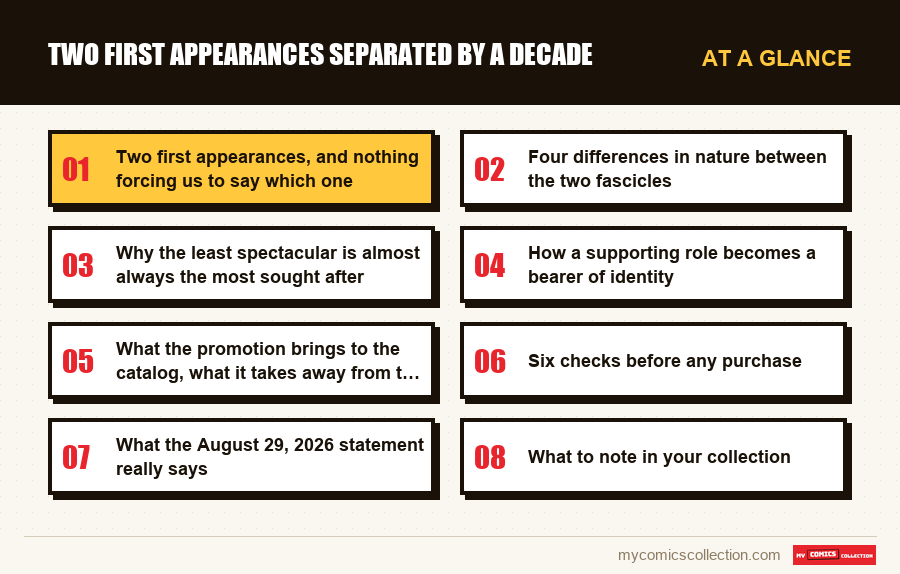
Two first appearances, and nothing forcing us to say which one
The phrase "first appearance" implicitly assumes that a character has only one point of entry. For a character with delayed construction, this assumption falls away. The first issue contains the man without the costume: when it was published in 1978, he was a supporting role among others, an employee of the main hero, and his introduction was not given any special treatment. The second contains the costume worn by this man: when it is published, the identity is expected, announced, possibly highlighted on the cover. Both statements "this is where he first appears" and "this is where War Machine first appears" are true simultaneously, and they do not refer to the same object. An ad that only contains half of it remains defensible for its author and misleading for its reader.
The problem is not moral, it is structural. The input fields of an online ad do not include a “what first appearance are you talking about” box. The title is short, space is limited, the search algorithm rewards short phrases. A seller in a hurry will therefore write the formula that attracts the most clicks, and a seller in good faith who does not know the editorial history of the character will write exactly the same thing. You can't tell the two apart when reading. This is why the verification must relate to the identified issue (series, number, date) and never to the promise made in the title.
Four differences in nature between the two fascicles
An unsignalized entry versus an announced entry
The 1978 issue introduces a secondary character that no one at the time could identify as important. Nothing on the cover, nothing in the title of the episode, nothing in the promotional pages designates it. The booklet which formalizes the costumed identity does exactly the opposite: the event is prepared, it is visible, and the cover sells it. This asymmetry explains almost everything else, starting with the quantities conserved.
An opposite state of conservation
We don't put aside a number whose importance we don't know. The 1978 issue was read, folded, resold, stacked like an ordinary episode of a monthly series. Whoever installs the costumed identity has arrived in an already speculative market, often purchased in duplicate and immediately put away. Upon arrival, the first is more difficult to find in good condition, even though it is mechanically older and therefore more damaged in principle.
A different narrative scope
The first booklet opens a relationship: it installs a man in the hero's entourage and makes everything that follows possible. The second closes an already written trajectory: it gives a name to what the reader sensed. Collectors who think in terms of starting point choose the first; those who think in terms of an iconic moment choose the second. These are two purchasing logics, not a hierarchy.
Unequal exposure to doubt
No one disputes that costumed identity begins where it begins: the cover says so. On the other hand, the person's entry date is debatable: background appearance, attributed dialogue, full page. The most sought-after booklet is therefore also the one whose definition is the most fragile, which multiplies the approximate announcements around it.
These four differences combine instead of canceling each other out. An old booklet, not reported at the time, poorly preserved, considered to be the true starting point and also defined in a questionable manner: this is exactly the profile of a number on which the advertisements diverge greatly, and this is what the statement at the end of August 2026 shows with 78 unverified lots claimed between $8.99 and $400.00. A gap of this magnitude within the same population cannot be understood without admitting that the sellers are not all talking about the same object.
The amounts quoted here are those that sellers requested on August 29, 2026, at a single time. These are not concluded transactions: no one guarantees that a single one of these lots has found a buyer at the price displayed. The 78 announcements without certification and the 31 copies passed by a verification body are counted separately, because mixing them would amount to comparing a promise and a statement.
A single reading says nothing about a trend. To affirm that a price is rising or falling, it would take at least two measurements spaced over time, constructed in the same way; we only have one. Likewise, the maximum of $599.99 observed on the verified side reflects the hope of a seller and not a market level: it is the median of $135.00 which describes the center of this population, and the median of $39.99 which describes that of the unverified advertisements.
Why the least spectacular is almost always the most sought after
There is an apparent paradox here. The booklet that shows the armor, the name, the posture, the one you could hang on the wall, is not the one that serious buyers pursue first. They are looking for an episode where we see a man in civilian clothes talking to his employer. The explanation can be summed up in one sentence: the old comic market pays for prior art, not aesthetics. When two issues claim the same character, the one that arrives first absorbs the request, because it is the only one that cannot be said to come after something.
Added to this is a rarity effect which is not intuitive. An innocuous issue from 1978 was put aside by no one, while an issue announced as an event was purchased in multiple copies by people who knew exactly what they were doing. A decade separates these two purchasing behaviors, and that decade was enough for the culture of speculation to completely change. The booklet that sells the most visually is therefore also the one that sleeps in the greatest number in tidy boxes.
Finally, the original booklet benefits from a narrative effect. It allows us to tell the story of owning the moment when no one knew. This narrative value is real for a collector, and it is not transferable to any other copy. The costumed identity booklet tells a confirmation: a less powerful story to tell, because the reader already knew the ending.
The practical result is that a seller can offer a spectacular copy, in excellent condition, with an immediately identifiable cover, only to have it stagnate in the face of a dull issue whose cover shows nothing special. This is not a market anomaly: it is the rule, and it applies to all characters built in two stages.
How a supporting role becomes a bearer of identity
The promotion of a supporting character is not a script accident. It obeys a precise narrative constraint: for a supporting role to be able to take on a costumed identity without the reader crying out for artifice, it must have been in place long enough for the promotion to seem deserved. A character introduced six months earlier and immediately promoted would come across as a tool. A character who has been around for years, whose competence, loyalty and disagreements we have seen, makes the promotion credible: it feels like a conclusion rather than an office decision.
This is precisely what explains the delay. The distance between the two booklets is not a coincidence of timing, it is the necessary installation time. The reader must have accumulated enough memories of the character to feel something when he changes status. A decade and more than a hundred issues represent a considerable duration of exposure: at the time of promotion, the character is no longer a novelty to sell, it is a familiar figure that is rewarded.
This mechanism can be recognized by a few constant signs. The supporting character begins with a clear job role, which legitimately places him near the hero without competing with him. He then gains his own scenes, where the hero is absent. He expresses disagreements, which gives him an independent point of view. Then he takes over a temporary role, generally due to the hero's unavailability. Final promotion only occurs after this narrative trial period, and it is this interim period, often, which constitutes the real change of character, regardless of the issue where the code name is finally pronounced.
What the promotion brings to the catalog, what it takes away from the original series
From a publisher's perspective, promoting a supporting character is the most economical operation possible. The cost of creation is zero: the character already exists, he has a name, a biography, a network of relationships and above all a base of readers who recognize him. Where an entirely new character must be presented, justified and imposed over several dozen episodes before bearing a title of his own, a promoted supporting role arrives with his capital of familiarity already established. The catalog gains a figure that can be used immediately, without a priming period.
The winning doesn't stop there. A costumed identity worn by an installed character mechanically inherits the history of the original series: readers who followed this series have a reason to buy the new one, and old episodes become retroactively relevant. The publisher thus transforms an existing collection into an active catalog, which results in collections, reissues and cross-references whose content has already been paid for for a long time.
But the operation has a cost, and it is borne by the original series. She loses a supporting role without gaining another. The place left empty is not a neutral place: it was the function which allowed the hero to have an interlocutor, someone to talk to when he was not in action, someone whose external gaze made the hero readable. A hero deprived of his entourage becomes a character who monologues, and the series must then either create a replacement, which brings back the cost of creation that we had just avoided, or do without this function and become poorer.
There is a second, more discreet effect. The promotion consumes the character's potential in the original series. As long as he was a supporting role, anything remained possible; once he wears a costume and a title, his trajectory is set and he cannot return to his previous role without this return feeling like a regression. The original series therefore not only loses a character: it loses all the stories that it could have written with him. For the collector, this means that the episodes from the supporting period form a closed set, which can be toured, and that the documentary value of these issues is independent of what the costumed identity does next.
Collecting this series?
Track what you own, what you are missing and what your collection is worth. 7 day trial.
Start my trial →Six checks before any purchase
Identify the booklet, not the formula
Never buy based on the words "first appearance". Ask for the series, number and date, then compare these three elements with the catalog before deciding. If the seller only gives the promotional formula and refuses to specify, the advertisement does not relate to an identifiable object.
Check which decade we are talking about
The two issues are separated by an entire decade. A publication date is therefore sufficient to immediately decide between the entry of the person and the officialization of the identity. It is the quickest and most reliable test available to a busy buyer.
Separate verified ads from others
The 31 copies passed by a verification body and the 78 batches without certification form two distinct populations, with claimed medians of $135.00 and $39.99. Comparing a raw batch to a verified copy automatically leads to the conclusion that we are getting a deal, even though we are not comparing the same thing.
Beware of bundled batches
A set of several issues sold in bulk around the desired issue deserves a line-by-line examination. The announced number sometimes appears in a much lower condition than the rest of the lot, or does not appear at all, the seller having described a numbering range rather than content.
View reprints and collections
Content republished in a later volume remains the same story, but it is not the original booklet. The point is particularly sensitive for an old and unspectacular episode, often reprinted precisely because it has become a landmark.
Distinguish between interim and formalization
The moment when the character temporarily takes on the role of hero and the moment when he receives his own code name are two different stages, and some announcements confuse them. Ask which one is concerned before comparing two offers that seem to relate to the same event.
What the August 29, 2026 statement really says
The two populations noted do not tell the same story. On the unverified side, 78 listings range from $8.99 to $400.00 for a median of $39.99: half of the sellers are asking less than forty dollars, which indicates that the majority of these lots are not presented as rare pieces. The amplitude nevertheless remains considerable, and a difference of one to more than forty within the same population usually signals confusion about the object described rather than a hierarchy of states.
On the verified side, 31 listings range from $68.31 to $599.99 for a median of $135.00. The number is sufficient for the median to have meaning, but it remains modest: thirty-one copies do not describe a market, they describe what was visible at a given moment. The minimum of $68.31 deserves as much attention as the maximum, because it shows that a certified copy can be claimed at a price lower than the high end of the raw lot range. Certification moves the median, it does not create a floor.
What these numbers do not say needs to be stated just as clearly. They don't say whether prices are going up or down, since they come from a single measurement. They also do not say how many of these announcements concern the entry of the person and how many concern the formalization of identity, since it is precisely this distinction that the announcement titles omit. A buyer who uses these medians as a reference without first identifying the specification would apply an average price to an undetermined item.
What to note in your collection
Save the booklet, never the label. In your inventory, the line must have the series, number and year, and the words "first appearance" must live in a separate comment field, with the precision of what it covers. An inventory that notes "First appearance of War Machine" without a number reference will be unreadable in two years, including to you.
Note which of the two entries you have. If your collection contains the person's entry in 1978, the formalization of the identity, or both, this information changes how you complete the series. Many collectors believe they have the starting point and in reality have the outcome, or vice versa, due to not having recorded it at the time of purchase.
Record the verification status and its date. A verified copy and a raw copy do not belong to the same price population, as shown by the difference between the two medians noted. Note whether the copy has passed through a verification body, and on what date, because a condition assessed several years ago does not have the same scope as a condition noted recently.
Keep track of support period numbers. The episodes where the character appears in civilian clothes, without costume, form a closed and delimited whole, located between the two key issues. Rating them as a group lets you know what you're missing from that specific time period, which is also the one the ads talk about the least.
Enter the date of your own price statement. If you note an estimated value, systematically date it and specify that it is an amount requested and not a concluded sale. Without this double precision, a note taken today will be reread in a year as a real sale, and you will make a decision to buy or sell on a false basis.
Questions fréquentes
Not necessarily. The two fascicles can be described thus without the statement being false, since one contains the first appearance of the person and the other the first appearance of the costumed identity. The ambiguity is real but it is also often unintentional: many sellers are unaware that the character was constructed in two stages. The practical consequence is the same in both cases: it is up to the buyer to identify the number before paying.
Because the promotion must seem deserved. A newly introduced and immediately promoted character feels made for the occasion, which defeats the intended effect. The reader must have seen the character work, disapprove, sometimes fail, over a sufficient period of time so that the accession to his own identity seems like a consequence. This narrative requirement explains the gap of a decade and more than a hundred issues between the two issues.
No, and this is an absolute limit of this type of survey. A measurement taken on a single date describes a state, not a movement. To talk about evolution, we would need at least two surveys constructed using the same method and separated in time. Furthermore, these amounts are demanded by sellers and not paid by buyers: they indicate what the market hopes for, not what it gets.
It depends on the logic of the collection. A collector who builds around starting points will choose the 1978 issue, older, less preserved and considered by the majority of the market to be the true beginning. A collector who builds around striking images will choose the booklet which shows the costumed identity, which is more visually readable and easier to display. Neither approach is fairer than the other, but they do not cost the same and it is better to have decided before looking.
She finds herself with an empty place that she does not automatically fill. The function of the supporting role was not decorative: it gave the hero an interlocutor and an outside perspective. Without a replacement, the series loses a source of dialogue; with a replacement, she must repay the cost of creation that the promotion had precisely avoided. For the collector, this means that the episodes from the period where the two characters coexist constitute a closed set, which no subsequent issue will extend.
Keep track of the right booklet, not the right formula
Note for each issue the series, the year and what exactly the “first appearance” term means, and find the information when you need it: in front of an ad, not three days after purchase.