
On August 29, 2026, Black Canary's first solo title-a miniseries from the early 1990s-was only offered through two listings, at $3.00 and $10.00, with no verified copies for sale. On the same day, under the same statement conditions, its appearances in the historic team title lined up 173 unverified listings from $0.99 to $199.99, median $7.98, plus 5 verified copies from $22.00 to $99.99. Two advertisements do not allow any price calculation: what they measure is the number of sellers, and this number speaks of indifference, not scarcity.
A character born in 1947 goes through almost eighty years of publication, changes identities, generations, and internal editors, survives complete continuity overhauls, and eventually gets his own title. This title exists: it is a mini-series from the early 1990s. On the second-hand market as it stood on August 29, 2026, this editorial milestone came down to two sales proposals. Not two hundred, not twenty: two. There was no announcement of a verified copy at the same time. A collector who opens a search that day sees practically nothing, and the absence is so total that it seems at first like good news.
The reflex is almost automatic: little supply, therefore part difficult to find, therefore part worth something. This reasoning is false in the vast majority of cases, and it is particularly false here. An almost absent supply is not a signal of scarcity, it is a signal of indifference. On a booklet printed in large quantities around thirty years ago, if no one is selling, the most economical conclusion is that no one is asking. The copies have not vanished into thin air: they are lying dormant by the thousands in boxes that their owners have no reason to open, because no market signal invites them to do so. This article dismantles the shortcut, separates the three possible causes of a low offer, and gives the criteria which allow us to decide between them.
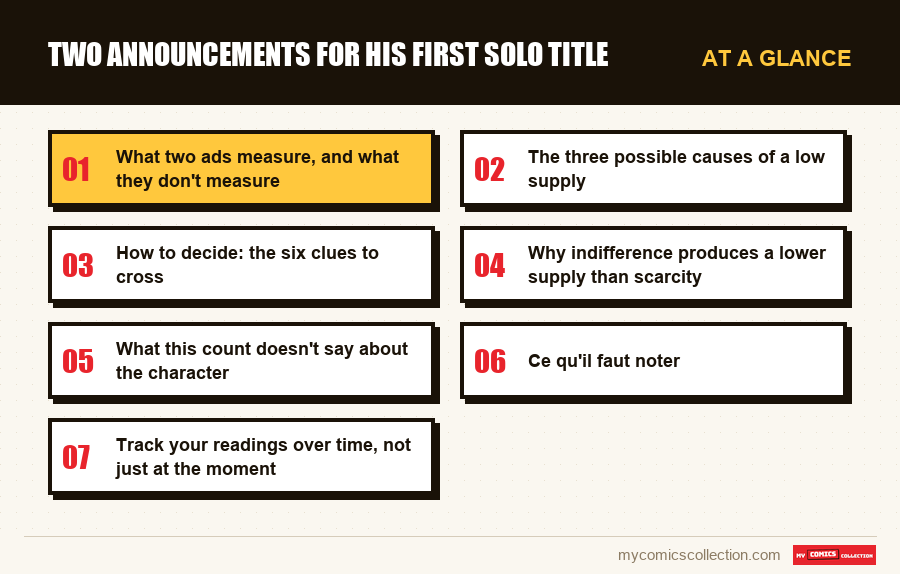
What two ads measure, and what they don't measure
We must pose the methodological warning before any interpretation, and pose it without attenuating it. Across two listings, no median, no average, no spread, no price level means anything. A median calculated on two points is not a statistic, it is a decoration. The amounts noted: $3.00 and $10.00: are sums claimed by two sellers on August 29, 2026, not recorded transactions. Nothing says that a buyer has accepted one or the other, nothing says that these two advertisements will find a buyer, and nothing prevents them from remaining online for months. The only solid and usable fact from this statement is a counting fact: there were two proposals, and zero proposals for a verified copy.
Everything that follows is based on this count, never on the amounts. It's a strong constraint, but it's also what makes the reading honest. The number of listings is a robust measure: it does not depend on a seller's mood, nor on their pricing ambition, nor on their lack of knowledge of the market. It depends on just one thing, the decision of a certain number of people to put an item up for sale at a given time. When this number drops to two for a widely distributed booklet, it is this decision that must be questioned, not the price displayed.
Second precaution, also important: this reading was taken only once, on August 29, 2026. A one-off measurement shows no movement. It does not say whether supply has decreased, increased or stagnated, it does not say whether the level of demand is rising or falling. Any sentence that asserts a trend based on this photograph would be an invention. The photograph describes a state, on a date, and nothing else. To speak of evolution, we would need at least two surveys separated in time, carried out under identical conditions: this is exactly the type of monitoring that a well-kept personal inventory allows us to construct, and it is one of the most underestimated uses of a collection management tool.
The point of comparison is much more comprehensive, and it was noted on the same day under the same conditions. The character's appearances in the historic team title yielded 173 unverified listings, ranging from $0.99 to $199.99, with a median of $7.98, plus 5 verified copies asking between $22.00 and $99.99. There, the numbers begin to weigh something: out of 173 propositions, a median becomes interpretable, an amplitude becomes readable, and the existence of a verified segment becomes a signal in itself. The comparison between these two sets does not oppose two levels of value, it opposes two levels of attention.
The three possible causes of a low supply
La rareté réelle
Few copies still exist. Either the original printing was limited, or time, paper fragility, distribution, or accidents destroyed most of the print run. Real scarcity is a physical constraint: even if all the holders wanted to sell at the same time, the supply would remain low because there is physically not much to sell. This is the only one of the three causes that justifies a high price, and it is the rarest of the three.
La rétention
The copies exist, their owners know them, and they choose not to sell. They expect better, or consider that the moment is bad, or consider the coin as an asset. Retention is a behavior, not a constraint: the offer is low by collective decision. It can be recognized by a decisive detail, the presence of a small number of advertisements at ambitious levels, placed by sellers who post a high price and agree to wait.
L'indifférence
Copies exist in abundance, but no one thinks of putting them on sale because no one is looking for them. There is no physical constraint or waiting strategy: there is simply an absence of reason to act. A seller does not list an item that he or she does not imagine would be of interest to anyone. Low supply here is a by-product of low demand, and the price of the few existing listings remains at the floor of what the listing itself costs in time.
Le cas observé
Two advertisements, at $3.00 and $10.00, no verified copies, on a booklet printed in large quantities around thirty years ago. No plausible physical constraint, no sign of strategic expectation, requested amounts which express no ambition. The three clues converge towards the third cause. It is a dormant market, not a tense market, and this distinction changes everything in the way of buying as well as in the way of hoping.
The confusion between these three causes is the most costly error of interpretation in collecting. It is costly in both directions: it pushes you to overpay for a common piece that you think cannot be found, and it pushes you to neglect a truly rare piece because it does not appear anywhere when you look for it. In both cases, the fault is the same: reading the number of announcements as a measure of availability when it primarily measures activity. The number of listings tells how many people wanted to sell, not how many copies exist.
Low supply is a symptom, never a diagnosis. The same symptom, two announcements, can cover a booklet of which there are only a handful of copies left in the world and a booklet of which there are tens of thousands left. Nothing in the counting itself allows us to distinguish them: we must look for clues elsewhere, in the time of printing, in the level of the amounts requested, and in the existence or not of a verified segment.
The shortcut “little supply therefore rare therefore expensive” skips two stages of reasoning at once. It transforms an observation about the behavior of sellers into a statement about the population of objects, then this statement into a price prediction. Neither transformation is valid without additional proof.
How to decide: the six clues to cross
The level of amounts requested
A seller who holds a rare piece displays a price that expresses this conviction: he aims high and waits. A seller who sells a booklet for which he expects nothing displays a symbolic amount to get rid of it. On the two announcements observed on August 29, 2026, the amounts claimed are low. This is not proof of value, but it is an indicator of the sellers' state of mind: no one is waiting for a surge, no one is playing for time.
L'époque d'impression
This is the most discriminating criterion, and it is almost always neglected. The prints from the early 1990s come out of a period of massive production, in a context where booklets were largely purchased for preservation. Copies have survived, often in good condition, often in several copies per buyer. Postulating physical scarcity on a title from this era amounts to betting against industrial evidence.
The presence of a verified segment
When a coin counts, someone eventually gets it certified, and these verified examples appear for sale separately, at distinct levels. On the historic team title, 5 verified copies were offered from $22.00 to $99.99. On the first solo title, this segment did not exist at all: no verified announcement. A total absence of certification offered for sale is an indicator of zero attention, independent of any reasoning on prices.
The volume compared on the same character
Comparing a booklet to other booklets of the same character, taken on the same day under the same conditions, neutralizes most of the biases. Two announcements on one side, 173 on the other: the discrepancy factor is too massive to come from the chance of a reading. He does not say that one is worth more than the other, he says that one circulates and the other does not. Circulation is a property of the market, not of the object.
Consistency between supply and amplitude
In an active market, asking prices range widely: the team title reading ranges from $0.99 to $199.99, because 173 sellers apply 173 different strategies, on different states and numbers. In a dormant market, there is no amplitude because there are not enough sellers to produce it. The absence of sprawl is not a sign of price stability: it is a sign of the absence of a market.
What the ad titles say
The two titles observed specify that it is a mini-series and the character's first solo title. The sellers therefore know the editorial argument and put it forward. There is nothing confidential about the information, it simply has no effect: it is displayed, and it produces neither competition between sellers, nor verified segments, nor ambitious amounts. A known argument that doesn't trigger anything is an argument that the market doesn't buy.
Collecting this series?
Track what you own, what you are missing and what your collection is worth. 7 day trial.
Start my trial →Why indifference produces a lower supply than scarcity
The mechanism is worth explaining, because it is counterintuitive. We spontaneously imagine that scarcity produces the lowest possible offer, since this is the extreme case: if there is nothing left, nothing can be sold. In practice, scarcity often does the opposite. A piece recognized as rare attracts opportunistic sellers, because everyone knows that a buyer is actively looking and that an auction will be seen. Rarity produces few available copies, but it also produces visibility, speculation and sustained circulation. It even generates advertisements at deliberately unrealistic levels, placed by holders who expect nothing but lose nothing by trying.
Indifference cuts the mechanism at the root. No one puts an item up for sale that no one talks about. Putting it up for sale costs time: you have to take out the booklet, examine it, photograph it, write it, package it, ship it. This cost is fixed, and it does not depend on the price of the item. Faced with an expected amount of a few dollars, this fixed cost becomes prohibitive. The holder does not calculate value, he calculates effort, and he concludes that it is not worth it. This reasoning, repeated by thousands of holders simultaneously, produces exactly what we observe: two advertisements on a mass-printed title.
This results in an important property. A zero offer due to indifference is unstable. It holds as long as nothing changes, and it suddenly turns around as soon as a signal appears: an adaptation, a reissue, an editorial re-promotion, a significant sale widely commented on. The dormant stock is immense, and it is just waiting for a reason to wake up. This is why a lack of supply does not protect against a subsequent influx: the boxes are not empty, they are closed. A low supply due to real scarcity, on the contrary, cannot turn around in this way, because no dormant stock exists to supply it.
This asymmetry is why you should never treat a weak offer as an opportunity to seize before it disappears. In a dormant market, urgency is an illusion: what is not available today will be available tomorrow, as soon as someone has a reason to take out a box. Emergency only exists where the constraint is physical. Distinguishing the two situations is exactly the purpose of the six preceding indices, and it is also what separates a stratégie de collection raisonnée d'une suite d'impulsions.
What this count doesn't say about the character
It would be absurd to conclude from this statement that Black Canary interests no one. On the same day, under the same conditions, his appearances in the historic team title produced 173 announcements and a verified segment of 5 copies. The character circulates, it is sought after, it is the subject of numerous sales and certifications. What is not circulating is a specific editorial object: his first series in his name alone, published in the early 1990s.
The distinction is essential and often poorly made. The market's attention is not focused on characters, it is focused on objects. A character can be extremely present in research while having entire sections of their bibliography completely inert. The second-hand market is not a barometer of popularity: it is a record of what people think about buying and selling, which is much narrower and much more arbitrary.
A second reading is required. The historic team title benefits from a ripple effect that the solo title does not have: it concentrates several characters, several current collections, several reasons for purchase. Each issue is sought after by collectors who were not initially looking for Black Canary. The solo title is only sought by those who explicitly seek it, and by no one else. This difference in capture explains part of the difference in volume without any value judgment having to be made.
Finally, we must resist the temptation to convert this observation into a prediction. Nothing in a single statement allows us to announce that the situation will last, nor that it will be reversed. What is documented is a state as of August 29, 2026: two proposals, no verified copies for sale, on an editorial milestone identified as such by the sellers themselves. It is useful and sufficient information in itself, provided you do not make it say more than it contains. To situate this title among the periods that really matter to the character, reading the runs de référence provides the editorial context that counting alone does not provide.
Ce qu'il faut noter
Two listings document a number, not a price. The amounts of $3.00 and $10.00 recorded on August 29, 2026 are sums claimed by two sellers, on a sample too small to support any statistics. No median, no average, no order of magnitude can be drawn from two points. The thing to remember, and the only thing to remember, is that there were two proposals and zero verified copy proposals.
The time of printing decides the question of rarity before any other consideration. A mini-series from the early 1990s comes out of a period of abundant production, where booklets were massively purchased and kept. To postulate that few copies have survived of a title from this era is to bet against the industrial logic of the period. On a booklet from the character's beginnings, in 1947, the reasoning would be exactly the opposite: there, a low offer could actually reflect limited survival.
The complete absence of a verified segment is a signal in its own right. On the historic team title, 5 verified copies were offered on the same day, from $22.00 to $99.99. On the first solo track, none. When no one has deemed it useful to have a booklet certified and to offer it in this way, it is because no one anticipates a buyer ready to pay for this guarantee. This absence can be read without making any assumptions about prices.
The sellers know the editorial argument, and it produces nothing. The two titles observed specify that it is a mini-series and the character's first solo title. The information is therefore displayed, available, highlighted, and it generates neither competition between sellers, nor ambitious amounts, nor certification. A known collection argument that triggers no reaction is an argument that the market, at that date, does not buy.
An offer absent due to indifference may be returned without notice. The copies exist in large numbers, they are simply immobile. All it takes is one reason for attention (an editorial re-promotion, an adaptation, a commented sale) for several thousand owners to remember that they own this booklet. A low offer due to real scarcity does not have this dormant stock. This is why we should never read the apparent scarcity of today as a guarantee of scarcity tomorrow, and why a measurement taken on a single date shows absolutely no movement.
No, and it is precisely the inversion that must be avoided. Ad counts measure how many people have decided to sell on a given date, not how many copies exist. On a title printed in large quantities in the early 1990s, the hypothesis of limited survival is very implausible. The two listings noted on August 29, 2026, at $3.00 and $10.00, with zero verified copies for sale, describe a market with no activity, not an exhausted stock.
By the level of the amounts requested and by the presence of a verified segment. A holder who holds back because he expects better displays an ambitious price and lets the ad live: there are few offers, but they are expensive and often certified. An indifferent holder does not list anything at all, and the rare existing announcements come from sellers who sell, at symbolic amounts. In the statement of August 29, 2026, no verified copy was offered and the two amounts claimed were low: both indicators point to indifference.
Because the comparison was made on the same day, under the same conditions, on the same character: it neutralizes method and calendar bias. It gives 173 unverified listings from $0.99 to $199.99, median $7.98, and 5 verified copies from $22.00 to $99.99. Faced with two announcements, the difference in volume is too massive to be a coincidence. It does not measure a difference in value, it measures a difference in circulation.
No, in no way. This is a single observation, taken on August 29, 2026. A photograph from a single date describes a state, not a trajectory: it can neither confirm nor deny a movement, in one direction or the other. Any statement of trend based on this reading alone would be an unsupported extrapolation. It would take at least two spaced surveys, conducted according to an identical protocol, to start talking about evolution.
The supposed emergency has no place here. In a dormant market, today's unavailability says nothing about tomorrow's availability: the stock exists, it is simply immobile, and it can return to circulation as soon as a reason for attention appears. Urgency is only justified when the constraint is physical, that is to say when the copies are really lacking. The six indices explained above (time of printing, level of amounts, verified segment, compared volume, amplitude, content of titles) are used exactly to know which of the two situations we find ourselves in.
Track your readings over time, not just at the moment
An isolated count describes a state; two counts spaced apart begin to describe a market. Record your observations, your reports, your measurement dates and your specimens in a structured inventory, and you will finally be able to distinguish what is moving from what is sleeping.