In the 2000s, a publisher brought a killer deemed irredeemable into officially heroic teams, under an assumed identity. The process is not a whim: a figure already installed brings immediate, free, permanent tension. But it rests on a balance that is impossible to maintain for long: the character must never reform, otherwise the spring falls, and he must never betray for good, otherwise the story ends. On the second-hand market, these series leave a weak trace: as of August 29, 2026, out of one hundred and seventy-eight advertisements noted, only seven carried a verified copy.
There's an editorial maneuver that superhero readers recognize at first glance and rarely comment on for what it is: taking an antagonist whose entire reputation rests on killing, giving him a mask, a neutral code name, and an official place on a team that presents itself as heroic. The reader knows who is under the costume. The other members of the team, no, or only partially. This information gap is the engine of the device, and it works from the first panel, without any line of dialogue needing to explain it.
It is not an isolated find but a family of stories, and it is for this reason that it must be looked at. It can be described as a mechanism: its operating conditions, its breaking points, its useful life. We can also measure what it leaves behind on the second-hand market, where highly commented periods do not necessarily produce objects that someone deems worthy of being preserved under protection.
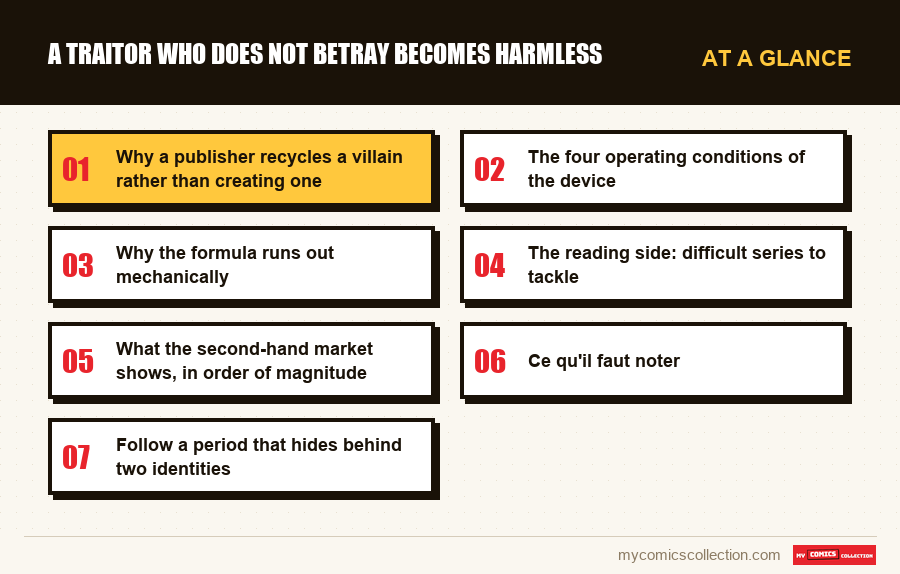
Why a publisher recycles a villain rather than creating one
Creating a new character costs pages. You have to give it an origin, a recognizable silhouette, a reason for being there, and above all you have to convince the reader that it matters. An already established antagonist arrives with all that already paid for by years of previous stories. Placing him in a heroic team is to import in a single gesture a dramatic charge that nothing else would provide so quickly. The first time he stands in the middle of the group, the scene is already tense, and the editor didn't have to spend anything on it.
The second reason is structural. A team of superheroes works by internal friction: an idealist against a cynic, a veteran against a beginner. These frictions wear out, because the characters end up knowing and accepting each other. An undercover killer produces a friction that does not wear away through familiarity, since it is based on a fact that cannot be digested: he did what he did, and no successful joint mission will erase it. The voltage is renewable without additional writing.
The third reason is the most powerful and dangerous: the promise of betrayal. As long as the character is in place, the reader reads each scene wondering if this is the one where he will change. This expectation is an extraordinary narrative resource, because it transforms mundane sequences-a team meeting, a transport, a night shift-into charged scenes. No other configuration gives as much value to pages which, without it, would be transitional.
The four operating conditions of the device
The reader must know what the characters don't know
The entire system is based on an information gap. If the team knows exactly who they are dealing with and fully accepts it, there are no more secrets, and therefore no more latent threat. The editor must maintain a gray area: some know, others suspect, others not at all. This uneven distribution is what makes the dialogues readable on two levels.
The character must never truly reform
Redemption is the enemy of the process. A killer who sincerely becomes a hero is just another team member, with a dark past and no particular function. Writing must therefore periodically remind, through a gesture or a reply, that nothing has fundamentally changed: without ever going so far as to break.
The assumed identity must remain porous
The mask and the code name serve to make the situation officially tenable: the public internal to the fiction sees a legitimate operator. But if the disguise is perfect, the reader stops seeing the villain. The old identity must therefore surface regularly, in a posture, a method, a poorly concealed pleasure in violence.
The authority that recruited him must be questionable
Placing a killer on a heroic team requires someone to decide it. If this authority is irreproachable, recruitment becomes incomprehensible; if it is frankly criminal, the team is no longer heroic and the ambiguity disappears. The system requires an intermediary authority, legitimate on the surface and doubtful on the bottom.
These four conditions must hold simultaneously. This is what makes these stories difficult to write over time: each pulls in a different direction, and satisfying one often undermines the other. Making the character more human brings him closer to redemption. Making it more threatening forces the other members to react, and therefore to discover. Each number consumes a little of the available margin.
A remark that often comes up among readers: it's not the villain who is interesting in these series, it's the others. The device works as a developer. What we really observe is the way in which characters presented as upright accept, tolerate or justify a presence that they know is unacceptable.
This is also why the formula ages poorly when repeated. Once the reader sees the revealer working, they know the answer before the question is asked, and the scene loses interest.
Why the formula runs out mechanically
The problem is arithmetic before being literary. A traitor who never betrays ceases to be a traitor: after a certain number of missed opportunities, the reader understands that nothing will happen, and the threat deflates into a backdrop. A traitor who betrays ends the story: the revelation resolves the tension, the team reassembles, and the device is consummated. In between, there is a narrow zone where the narrative can live, and this zone shrinks with each episode.
The publishers tried several maneuvers to expand it. Make the character betray on a minor point to preserve the big secret. Multiply false starts, where we believe the revelation is imminent before it is postponed. Add other questionable members to dilute the focus. All these maneuvers buy time and cost credibility: the reader learns that he will not be given what is promised to him, and he ceases to desire it.
It should be added that the ending of this type of arc is almost always disappointing, regardless of its quality. A promise maintained over dozens of numbers cannot be paid for with a single scene. The reader has constructed in his head a betrayal that exceeds anything that can be represented, and the execution, however careful it may be, falls short. It's a design flaw, not a writing one.
Finally, returning to the previous state is mandatory. A profitable antagonist figure cannot stay on a heroic team indefinitely, because he loses his opponent value elsewhere. The device is therefore, from its installation, a loan: the character is loaned to the heroes' camp for a time, and everyone knows that it will be returned. This certainty limits the issue.
The reading side: difficult series to tackle
These stories pose a problem of access that is rarely formulated. Their main interest is not in what is shown, but in what the reader already knows about the character before opening the booklet. A scene where he just sits silently in the back of a room only carries weight for someone who knows his past. For a newcomer, he's just another taciturn team member, and half the text escapes him without him noticing.
Subtext is invisible without precedence
The best scenes in these series are based on something unsaid. Without prior knowledge of the character, they read like flat transitions. The story almost never provides the necessary reminder, because providing it would kill the effect for other readers.
The ancient reader sees the reversals coming
Symmetrically, the person who knows the character anticipates each switch several numbers in advance. He reads a mechanism that he understands how it works and waits for a resolution that he knows will be postponed. The series is therefore opaque for some and predictable for others.
L'identité d'emprunt brouille l'identification
A neutral code name carried by a character for whom another name is known makes it difficult to find, sort, and converse. The catalog records the publications, not the equivalence between two identities carried by the same person at different periods.
Reading is dispersed between several titles
A team period is rarely told in a single series. The thread moves to neighboring titles, returns, is interrupted. Reconstructing the whole requires identification work that the reader must do himself, without reliable internal indication.
Research is porous
Searching for this period by keyword brings up issues from different series and unrelated recent publications. Each batch must be verified, which discourages methodical assembly and explains part of the low circulation of well-identified copies.
Aucune porte d'entrée évidente
There is no starting point that provides both the prior context and the beginning of the device. Begin to install private from the past; going back to the past requires a long detour before reaching what we were looking for.
Collecting this series?
Track what you own, what you are missing and what your collection is worth. 7 day trial.
Start my trial →What the second-hand market shows, in order of magnitude
These figures are requested amounts, not closed sales. A survey of announcements carried out on August 29, 2026 on the team series concerned gave one hundred and seventy-eight proposals without certification, ranging between ninety-nine cents and one hundred and twenty-five dollars, with an average distribution around ten dollars and eighty. Opposite, only seven advertisements carried a verified copy, between sixty-nine and two hundred and eighty dollars approximately, with a distribution average close to one hundred and eight dollars.
The exploitable fact is not any of these amounts taken in isolation: it is the relationship between the two populations. Seven copies treated as objects to be protected out of around one hundred and eighty advertisements, this describes a period which is talked about a lot and which almost no one considers worthy of being put under cover. A critical reputation and an item value are two different things, and this gap shows it well.
Two reservations are necessary. First of all, the research is porous: it brings back booklets belonging to several distinct series and even recent publications unrelated to the period, which prohibits any detailed reading and requires reasoning in orders of magnitude. Then, an isolated maximum says nothing about the market: it is the hope of a seller, displayed on a given day, and there is no guarantee that a buyer has ever validated it. The upper limit and the lower limit govern expectations, not transactions.
I refrain from drawing a trend from it. A single day's reading says nothing of what comes before or what follows; he photographs what sellers hoped to obtain at that moment. For a reader who wants to piece together this period, the only useful conclusion is practical: the bulk is found in the uncertified population, at modest levels, and we must agree to sort.
Ce qu'il faut noter
The device is judged by what it does to the other characters. If you approach this period, do not expect the killer to evolve: he will not have one, by construction. The real interest is in the reactions of the group, in the silences of members who know and in the justifications of those who prefer not to know. Read like this, the series becomes much richer than if we watch for the announced betrayal.
Apparent redemption is always an illusion. Each time the story suggests that the character changes, it prepares the opposite demonstration. This is not bad faith writing: it is the rule of the game, since an authentic reform would extinguish the system. Anticipating this avoids disappointment and turns false redemption signals into style cues rather than broken promises.
The assumed identity complicates any classification. The same character appears under two names depending on the period, and nothing in the publication data automatically links the two. If you follow this period, note the equivalence somewhere explicitly, otherwise your team papers will end up filed apart from everything else and will cease to be findable together.
Research porosity is a problem of identification, not of rarity. The results mix different series and unrelated publications. Before purchasing anything, check the exact series and period rather than the name shown in the ad; this is where most duplicate or off-topic acquisitions on this type of material occur.
The low proportion of verified copies has a direct consequence. Seven out of one hundred and seventy-eight as of August 29, 2026, this means that there is practically no stable reference to compare one state to another. On such a matter, your judgment on the state of the issue is worth more than any amount displayed, and the room for negotiation is wider than elsewhere.
Because an already established figure arrives with his reputation paid for. A new ambiguous character would take dozens of pages before the reader believed in his dangerousness. The known antagonist produces the same tension from his first appearance in the group, without a line of explanation.
No, and he can't. A sincere redemption would remove the reason for the system: all that would remain is a team member with a charged past. The story therefore multiplies the signs of change without ever validating them, which is consistent with the mechanics even if it can be frustrating.
Largely yes. Most of the subtext relies on what the reader knows before opening the booklet. Without this precedence, many scenes read like neutral transitions and we miss what makes the series interesting.
The announcement statement from August 29, 2026 showed a very majority uncertified population, with requests ranging from less than one dollar to one hundred and twenty-five dollars and a distribution environment around ten dollars and eighty. These are amounts claimed by sellers, not prices observed during sales.
Because critical notoriety and the status of an object to be preserved do not go together. Seven verified copies identified on August 29, 2026 compared to one hundred and seventy-eight ordinary announcements describe a period discussed but rarely treated as lasting. The porosity of the research adds vagueness to this count.
Follow a period that hides behind two identities
When the same character circulates under two names depending on the era, memory is no longer enough: you need a place where the equivalence is written in black and white and where the team documents remain attached to the rest. My Comics Collection allows you to maintain this inventory, identify shortages and avoid duplicate purchases on series that are confused by searches.