
Tracking your comic collection's value in real time transforms collecting from a guessing game into a data-driven investment practice. Modern collection management apps pull market data from recent sales, automatically update estimated values, and show portfolio trends over time: giving you the same visibility into your comics that stock investors have into their portfolios.
Most comic collectors have no idea what their collection is actually worth at any given moment. They bought books over years or decades, vaguely remember what they paid, and occasionally check eBay when curiosity strikes. This approach leaves money on the table. Without systematic value tracking, you miss optimal selling windows, fail to identify underperformers, and cannot make informed decisions about where to allocate your next dollar. Real-time collection tracking is the difference between collecting and investing.
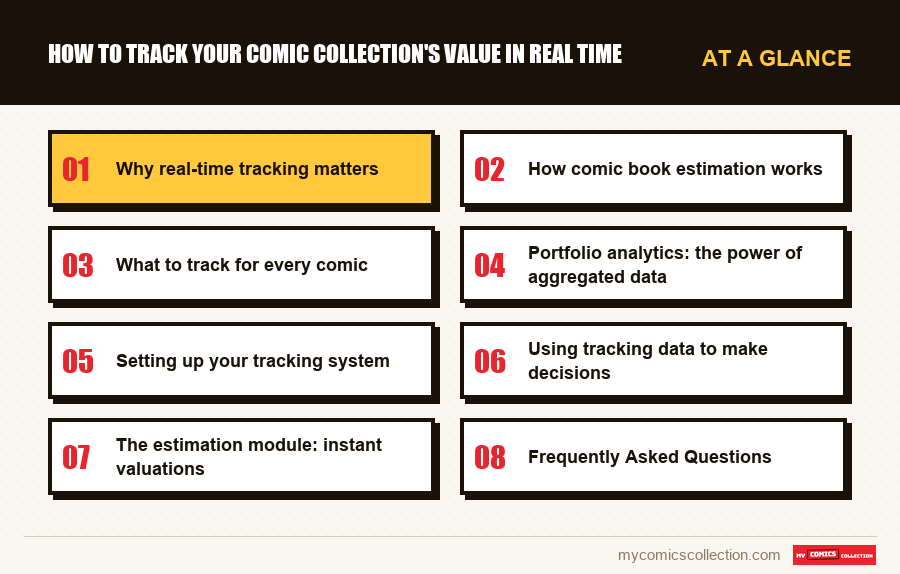
Why real-time tracking matters
The comic book market moves fast. Movie announcements, casting news, creator deaths, and market corrections can shift individual book values by 20-50% in a single week. Without a system that tracks these movements, you are flying blind.
What tracking enables you to do
- Identify sell signals: When a comic in your collection spikes 200% on a movie announcement, you need to know immediately: not three months later when prices have already corrected.
- Spot buying opportunities: Market corrections create temporary dips in otherwise strong books. A tracker alerts you when your watchlist books hit target prices.
- Calculate actual returns: Knowing your purchase price versus current value tells you your real portfolio performance, net of all costs.
- Plan insurance coverage: Accurate, up-to-date valuations ensure your collection is properly insured.
- Make informed rebalancing decisions: When one book has grown to represent 40% of your portfolio value, a tracker makes that concentration visible.
How comic book estimation works
Modern comic valuation tools pull data from multiple sources to generate accurate price estimates. Understanding how these estimates are calculated helps you use them effectively.
Data sources for comic valuation
- eBay sold listings: The largest dataset of actual comic transactions. Estimates based on recent sold prices reflect true market value better than asking prices or price guide values.
- Auction house results: Heritage, ComicConnect, and ComicLink provide verified sales data for higher-value books.
- Grade-adjusted pricing: The same issue in CGC 9.8 might be worth 5-10x more than in CGC 6.0. Accurate tracking requires grade-specific valuations.
- Market trend analysis: Algorithms detect whether a book is trending up, stable, or declining based on recent transaction patterns.
Limitations to understand
- Estimates are not guarantees: A valuation tool tells you what a comic has sold for recently, not what it will sell for tomorrow.
- Low-volume books have wider ranges: If a comic has only sold 2-3 times in the past year, the estimate is less reliable than one based on 50 recent sales.
- Condition nuances: Two CGC 9.8 copies of the same book can sell for different prices based on label notes, page quality (white vs. off-white), and presence/absence of the newsstand mark.
What to track for every comic
A complete tracking system captures the following data points for each book in your collection:
Essential data fields
- Title, issue number, and year: The basic identification.
- Condition/grade: CGC/CBCS grade if slabbed; your estimated raw grade if ungraded.
- Purchase date: When you acquired the comic.
- Purchase price: What you paid, including shipping and buyer's premiums.
- Current estimated value: Updated automatically or manually from market data.
- Edition type: Direct edition, newsstand, variant cover, or price variant.
- Storage location: Where the comic is physically stored for retrieval.
Advanced tracking data
- CGC certification number: For graded comics, links to the CGC verification page.
- Key issue significance: First appearance, first cover, origin story, etc.
- Target sell price: Your profit target for eventual sale.
- Notes: Any relevant information about the specific copy (pedigree, provenance, defects).
Portfolio analytics: the power of aggregated data
Individual comic tracking is useful, but the real power comes from analyzing your collection as a whole.
Key portfolio metrics
- Total portfolio value: The sum of all estimated values. Track this monthly to see overall trends.
- Total cost basis: What you have actually spent. The difference between total value and total cost is your unrealized gain (or loss).
- Portfolio return %: (Total value: Total cost) / Total cost. This tells you your overall investment performance.
- Concentration risk: What percentage of your portfolio is tied up in your single most valuable book? If it is above 30%, consider diversifying.
- Performance by era: Are your Silver Age books outperforming your Modern Age books? This informs future purchasing decisions.
Trend analysis
A good tracking system lets you view value changes over time. Monthly or quarterly snapshots reveal:
- Which books are appreciating fastest (potential hold candidates)
- Which books are flat or declining (potential sell candidates)
- How your portfolio correlates with broader market movements
- Seasonal patterns (many comics peak in value during spring convention season)
Setting up your tracking system
Step 1: Inventory your collection
Before you can track values, you need a complete inventory. This is the most time-consuming step, but it only needs to be done once. Work through your collection systematically, box by box.
Step 2: Record purchase data
For each comic, log what you paid and when. If you do not remember exact prices for older purchases, estimate based on market conditions at the time of purchase. Even approximate cost data is better than none.
Step 3: Establish baseline values
Use a comic estimation tool to get current market values for each book. This establishes your starting point for tracking appreciation or decline going forward.
Step 4: Set up regular reviews
Schedule monthly or quarterly portfolio reviews where you update values, check for significant movements, and make buy/sell decisions based on the data.
Using tracking data to make decisions
When tracking tells you to sell
- A book has hit your target return: Lock in profits when a comic reaches the price you set as your sell target.
- A spike is detected: If a comic jumps 100%+ in a short period (typically movie/TV news), consider selling before the correction.
- Consistent decline: If a comic has lost value for 12+ consecutive months with no catalyst for recovery, cutting your loss may be wise.
When tracking tells you to buy
- A watchlist book hits your target price: When a comic you want dips to your preset buy price, act quickly.
- Broad market correction: If your entire portfolio drops 10-20% and the decline is market-wide (not specific to your books), it may be a buying opportunity for blue-chip keys.
The estimation module: instant valuations
Our free comic estimation tool provides instant price ranges based on recent eBay sales data. Simply select the series, issue number, and condition, and receive a low-mid-high price range within seconds. No account creation required. This is the fastest way to check a single book's value or begin building your tracking database.
- Series selection: Browse or search from thousands of comic titles across all publishers and eras.
- Issue number: Specify the exact issue for precise pricing.
- Condition input: Select from CGC grade equivalents for accurate condition-based pricing.
- Price range output: Receive low, median, and high recent sale prices based on actual market data.
Pro tip: Use the estimation tool quarterly for your entire collection. Log the results in a spreadsheet or collection management app. Over time, this creates a historical value record that reveals which books are appreciating and which are stagnant: invaluable data for portfolio management.
Frequently Asked Questions
Valuations based on recent eBay sold data are generally accurate within 10-20% for commonly traded books. Accuracy decreases for rare books with few recent sales. Always treat estimates as ranges rather than exact prices. The most accurate valuations come from averaging multiple recent sales of the same issue, grade, and edition type.
For active investors, monthly updates on key holdings are ideal. For casual collectors, quarterly reviews suffice. If you receive alerts about significant market movements (movie announcements, creator news), check affected books immediately. Automated tracking tools that pull data continuously eliminate the need for manual updates.
For large collections, a dedicated comic collection management app is essential. Manual tracking via spreadsheets becomes unmanageable above 100-200 books. Look for apps that offer barcode scanning for quick data entry, automatic value updates, and portfolio-level analytics. The initial setup takes time, but the ongoing management is minimal.
At minimum, track every comic worth $50 or more. For a complete picture, track everything: even dollar-bin comics can occasionally spike in value on unexpected news. A comprehensive inventory also simplifies insurance claims and estate planning. Modern tracking tools make it easy to log even low-value books quickly.
Yes. A documented inventory with purchase prices, current valuations, photographs, and CGC certification numbers is exactly what insurance companies want for scheduled personal property coverage. Update your documentation annually and keep a copy off-site (cloud storage or a safety deposit box). Many insurers accept collection management app exports as proof of value.