The 12 covers of Watchmen (DC, 1986-87) form a coherent visual sequence designed by Dave Gibbons: vertical title, a doomsday clock approaching midnight, and each cover serving as the first panel of its chapter. The absolute grail is issue #1 in high-grade CGC: the original cover artwork sold for $228,000 at Heritage Auctions in 2019. The raw single-issue market is structurally thin (fewer than 10 active eBay listings per issue, often zero), making any precise raw price unreliable: real value is in high-grade CGC copies.
Watchmen launched in 1986 as a 12-issue DC Comics maxiseries (September 1986: October 1987). Alan Moore wrote it, Dave Gibbons drew it, John Higgins colored it. It is a Copper Age series: no earlier issues of this title exist. The series won the 1988 Hugo Award in the one-shot "Other Forms" category (the first graphic work ever to receive that distinction) and remains one of the best-selling graphic novels of all time.
This guide focuses on what makes Watchmen visually distinctive, Gibbons' cover system, and on the real collector value of individual issues. eBay figures are given for reference only; volume is too thin to treat them as precise prices.
Gibbons' cover design system: what made it revolutionary
Before discussing values, it's worth understanding why these covers are unique in comic history. Dave Gibbons broke with every convention of the era:
- Vertical title. The Watchmen logo runs down the left edge in Futura Condensed Extra-Black. By 1986, comic shops had moved to horizontal shelf display, so there was no longer a need for the title at the top to stay visible in a spinner rack. Gibbons reclaimed that space for the artwork.
- The doomsday clock. Each cover carries a small clock at the bottom left, its hands advancing issue by issue from eleven minutes to midnight all the way to midnight: a visual countdown mirroring the narrative's march toward catastrophe.
- The cover is the first panel. Every cover image is literally the opening panel of that chapter. This had never been done before in mainstream comics, and rarely has been since.
- No blurbs, no captions. While most 1986 comics packed covers with promotional text, Watchmen let the image speak alone.
The blood-stained smiley: issue #1
Issue #1 (September 1986) opens, and closes, on a yellow smiley-face badge splashed with a single drop of red blood. The badge belongs to the Comedian, found dead at the foot of a high-rise. Gibbons added the smiley almost as an afterthought, to break up the character's dark silhouette; when Alan Moore saw it, he rewrote the script's opening around it. The blood splatter is positioned at exactly five minutes to midnight: aligned with the hands of the doomsday clock that runs through the entire series.
That image is now one of the most recognized in the history of comics. The original cover artwork sold for $228,000 at Heritage Auctions in February 2019: it had previously sold at Heritage in 2013 for $155,350. More than thirty bidders competed for the lot.
Notable covers across the run
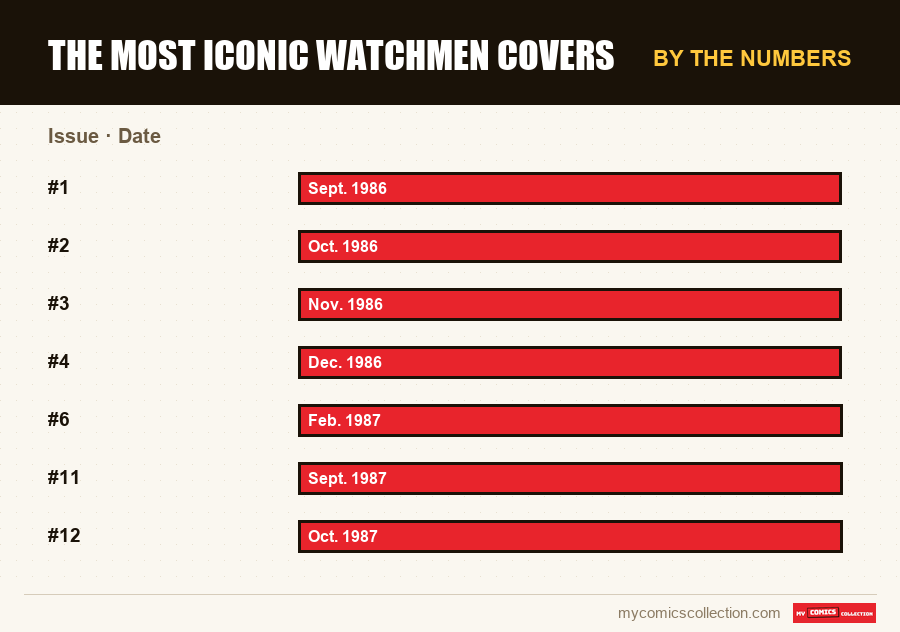
| Issue | Date | Cover image | Narrative significance |
|---|---|---|---|
| #1 | Sept. 1986 | Yellow smiley badge with blood drop | First appearances: Rorschach, Dr. Manhattan, Nite Owl, Silk Spectre, Ozymandias, the Comedian |
| #2 | Oct. 1986 | Rainy cemetery, hero statue | The Comedian's funeral; Vietnam flashbacks |
| #3 | Nov. 1986 | Smoke subtly forming a skeleton | The looming nuclear threat made visual |
| #4 | Dec. 1986 | Martian landscape, blue silhouette of Dr. Manhattan | Origin of Dr. Manhattan (John Osterman) |
| #6 | Feb. 1987 | Close-up of a black-and-white inkblot mask | Rorschach's origin: the second most-sought issue after #1 |
| #11 | Sept. 1987 | Ozymandias, grand setting | Revelation of Ozymandias's plot |
| #12 | Oct. 1987 | Clock at midnight, face drenched in blood | Conclusion; death of Rorschach |
Issues #5, #9 and #10 returned no active eBay listings at the time of writing (June 2026): volume is too thin for any estimate.
What the issues are actually worth
Watchmen presents a collector's paradox: it's one of the most important series in comic history, yet raw single issues trade modestly because the graphic novel (trade paperback) has been printed in the millions and remains trivially available. Value concentrates in high-grade CGC first-print copies.
- Watchmen #1 raw: our estimator finds 9 active eBay listings (indicative median €37, June 2026). Volume is too thin for a reliable price: treat as directional only.
- Watchmen #1 in CGC 9.8: the CGC census counts roughly 631 copies at 9.8 (the highest grade recorded). CGC 9.8 copies sold at around $600-630 at Heritage Auctions in 2022.
- Watchmen #4: 4 eBay listings, indicative median €19. A key issue for Dr. Manhattan's origin, but real value is in high grade.
- Watchmen #6: only 1 active listing. A sought-after issue for Rorschach's origin story.
- Newsstand editions: in 1986-87, newsstand copies (with UPC barcode) are rarer than direct editions. In high grade, newsstand copies command a meaningful premium: CGC now distinguishes them on their labels.
Spin-offs and adaptations
For collectors looking beyond the original 12 issues:
- Before Watchmen (2012, DC): multiple miniseries devoted to each character (Comedian, Rorschach, Nite Owl, Dr. Manhattan, Silk Spectre, Ozymandias, Minutemen). Many issues with top-tier artists: not currently speculative, but attractive as a complete NM set.
- Doomsday Clock (2017-2019, Geoff Johns & Gary Frank): the official sequel, crossing the Watchmen characters into the DC universe. Still accessible on the secondary market.
- Rorschach (2020, Tom King): a 12-issue miniseries illustrated by Jorge Fornés.
- Adaptations: Zack Snyder's film (2009) and Damon Lindelof's HBO series (2019) renewed interest in the original run without creating a lasting price surge on raw copies.
Collector strategy
- The centerpiece: #1 in high-grade CGC. That's where value and liquidity concentrate. A raw NM copy remains affordable as a reading copy or entry-level collectible.
- Complete raw set: all 12 issues in NM raw can still be assembled at a reasonable price: a rewarding way to own the original serialized run.
- Do not confuse eras. There is no Silver or Bronze Age Watchmen: the series begins in 1986. The characters were inspired by DC's Charlton heroes, but no earlier issue of THIS series exists.
- Check for first prints. The series was reprinted many times: for investment purposes, only the 1986-87 first prints count.
Own a Watchmen issue? Get a free valuation with our tool based on real eBay sales to find its low, median and high value.
Frequently asked questions
Dave Gibbons broke the conventions: a vertical title along the left edge, a clock advancing from eleven minutes before midnight to midnight, a cover that is exactly the first panel of the chapter, and no promotional text. The 12 covers form a coherent visual sequence.
Issue #1 (September 1986) opens and closes on a yellow smiley badge splashed with a drop of red blood. The badge belongs to the Comedian, found dead at the foot of a building. Gibbons added it almost by accident to the costume; Alan Moore then rewrote the opening of the script around it.
Because the graphic novel is printed in the millions and remains easy to find. The value is concentrated in high-grade CGC copies of the first printing: the CGC census lists about 631 copies of #1 at grade 9.8, the highest that exists.
#6 (February 1987), which tells Rorschach's origin, is the most in demand after #1. #4 (December 1986), Dr. Manhattan's origin, is the other key issue, but its real value lies in high grade. #12 (October 1987) shows the clock at midnight and the ending.
Check the first printing (1986-1987), since the series has been reprinted many times, and the newsstand mention, rarer in high grade. Around the 12 issues: Before Watchmen (2012), Doomsday Clock (2017-2019) by Geoff Johns and Gary Frank, and Rorschach (2020) by Tom King and Jorge Fornés.