The most iconic Spawn cover remains #1 (May 1992) by Todd McFarlane: an issue that sold roughly 1.7 million copies, making it the best-selling creator-owned single issue of all time. Yet its eBay median stays accessible (€15 across all editions, 102 listings, June 2026), because that colossal print run made it abundant. The title's most sought-after covers then cluster around the Angela era (#8/#9) and the #100 and #300 milestones.
Spawn debuted in 1992, so it's a purely Modern / Image-age title. There is no "Silver Age" or "Bronze Age" cover of the character: those eras ended back in 1970 and the mid-1980s. The title's cult covers are therefore all from the 1990s onward.
This guide sticks to the verifiable: real-time eBay medians (via our estimator) and documented facts about the covers, artists and print runs. When a precise value can't be trusted, we state it qualitatively rather than inventing it.
The iconic Spawn covers ranking (real values, June 2026)
Values = median of active eBay listings, all editions and grades combined (our estimator, eBay.fr + eBay.com). The cover matters as much as the issue number: one comic can exist in several covers, and some pull the value upward.
| Issue | Cover / significance | eBay median |
|---|---|---|
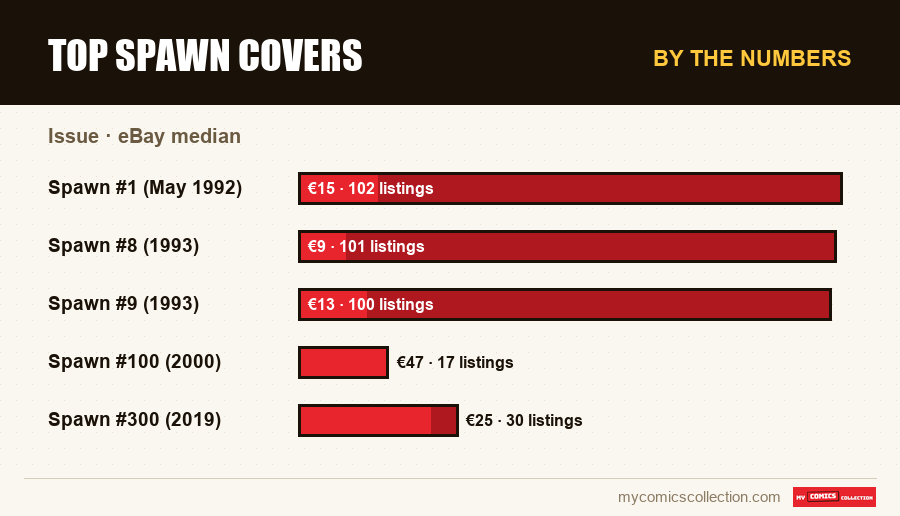
| Spawn #1 (May 1992) | McFarlane cover, first Spawn appearance | €15 · 102 listings |
| Spawn #8 (1993) | Pre-Angela era, McFarlane cover | €9 · 101 listings |
| Spawn #9 (1993) | First appearance of Angela (Neil Gaiman) | €13 · 100 listings |
| Spawn #100 (2000) | Milestone, 6 alternate covers | €47 · 17 listings |
| Spawn #300 (2019) | Milestone, multiple variant covers | €25 · 30 listings |
The #100 (17 listings) and #300 (30 listings) medians rest on thinner samples than the early issues: read them as a ballpark, not a to-the-cent price.
Spawn #1: the foundational cover
The #1 cover, drawn by Todd McFarlane, is the character's founding image and one of the most recognizable covers of the 1990s. Two reasons explain why it stays affordable despite that status:
- The record print run. Roughly 1.7 million copies sold at launch: the best-selling creator-owned single issue in history (sources: Wikipedia, GoCollect, ComicYears). That abundance keeps the raw median around €15.
- The grade spread. The "all grades combined" median is pulled down by raw copies; high-grade slabs (and especially the black-and-white edition / signed variants) trade well above it. Here it's the grade and edition, not the issue number alone, that drive value.
The #8/#9 era: the Angela cover
The real collector key of the early run isn't a spectacular cover but a piece of history: Spawn #9 (1993), written by Neil Gaiman, marks the first appearance of Angela. The issue became famous for the rights dispute between Gaiman and McFarlane that followed: Angela ultimately moved to Marvel in 2013 (source: Wikipedia). On rarity, the CGC census many copies in 9.8 (source: Bleeding Cool), making the high grade far more coveted than its raw €13 median suggests. The preceding #8 stays an accessible McFarlane-era issue (€9 median).
The Greg Capullo run: the golden age of covers
Many collectors regard the Greg Capullo era as the title's visual peak. Capullo first contributed on #16 and became the regular penciller from #26, on into the hundreds (source: Wikipedia). His dense, anatomically muscular covers define the "classic" 1990s Spawn. It's a run to chase issue by issue: few single issues exceed €10 at median, making it an ideal field for building a long complete run without breaking the bank.
The milestones: #100 and #300
- Spawn #100 (2000): the first Image comic to reach issue 100, with six alternate covers by McFarlane, Capullo, Frank Miller, Mike Mignola, Alex Ross and Ashley Wood (sources: mcfarlane.com, comics.org). The wealth of covers makes it a multi-edition issue: its €47 median (across 17 listings) ranks it among the title's highest-valued modern issues, but value depends heavily on the exact cover.
- Spawn #300 (2019): shipped with numerous variant covers (McFarlane, Capullo, J. Scott Campbell, Jerome Opeña, Jason Shawn Alexander…). With #301, the title earned the Guinness World Record for the longest-running creator-owned superhero comic (source: Guinness World Records). €25 median across 30 listings: a recent, liquid milestone.
Collector strategy (grounded in real data)
- #1 = the symbolic piece. Accessible raw, but target a high grade or a variant edition if you want rarity: the base issue is abundant.
- #9 = the true key issue. First Angela appearance, a one-of-a-kind rights saga: a CGC 9.8 high grade is the heritage target.
- The exact cover is everything. On #100 and #300 alike, the gap between editions runs into tens of euros. Always check the variant and condition live before buying: the medians above are from June 2026 and they move.
Own a Spawn issue? Get a free valuation with our tool based on real eBay sales to find its low, median and high value.
Frequently asked questions
The one on #1 (May 1992), drawn by Todd McFarlane, the character's founding image and one of the most recognizable covers of the 1990s. The issue sold about 1.7 million copies, the best-selling creator-owned single issue in history.
Because of that colossal print run, which makes it abundant, and a grade gap: raw copies pull the median down, while high-grade copies and variant editions trade well above it.
Spawn #9 (1993), written by Neil Gaiman, the first appearance of Angela. The rights dispute between Gaiman and McFarlane made it famous, and Angela eventually joined Marvel in 2013.
Greg Capullo, whom many consider the visual peak of the title: first contribution on #16, regular penciller from #26. It is a run to chase issue by issue to build a long series without breaking the bank.
#100 (2000) is the first Image comic to reach its hundredth issue, with six alternating covers by McFarlane, Capullo, Frank Miller, Mike Mignola, Alex Ross and Ashley Wood. #300 (2019) earned the title, together with #301, the Guinness record for the longest-running creator-owned superhero series.