The cover of Showcase #4 (October 1956), drawn by Carmine Infantino, is the most valuable in Flash history: a CGC 9.6 copy realised $900,000 at Heritage Auctions in January 2024: an all-time record for a Silver Age DC comic. It launched the Silver Age of American comics and set the visual identity of the character for generations. Close behind are Flash Comics #1 (1940, Golden Age) and The Flash #123 (1961, "Flash of Two Worlds"), two covers that have become landmarks in the history of the medium.
The Flash is the superhero whose visual identity spans more distinct eras than almost any other. Jay Garrick, the Golden Age Flash, debuted in Flash Comics #1 in January 1940 (Gardner Fox and Harry Lampert). Sixteen years later, Barry Allen, the Silver Age Flash, burst onto the scene in Showcase #4 (October 1956), pencilled by Carmine Infantino in a scarlet costume that redefined superhero aesthetics. From 1959 onwards, the The Flash ongoing series (resuming the numbering of the Golden Age title from issue #105) produced a succession of memorable Infantino covers: graphic compositions as recognisable today as the comics themselves.
This guide sticks to the verifiable: sale records documented by Heritage Auctions, CGC News, GoCollect, and QualityComix, and eBay medians from our estimator (eBay.fr + eBay.com, June 2026). Important caveat: the Silver Age Flash keys are very poorly represented on eBay:Flash #105, #110, #123, and #139 return zero or one result in our tool, and the Showcase series is not indexed. These issues will therefore not be cited with an eBay median; auction records are the authoritative reference.
Flash key cover ranking (real values, June 2026)
For Golden Age and Silver Age issues, auction records are the authoritative benchmark: these comics are too scarce on eBay to produce a reliable median. The Flash Comics and Showcase series are not indexed in our tool.
| Issue | Cover significance | eBay data (all grades) | Documented record |
|---|---|---|---|
| Flash Comics #1 (Jan. 1940) | 1st Jay Garrick appearance · 1st Flash cover ever | Not available (different series) | $450,000 (CGC 9.6 Mile High, Heritage 2010) |
| Showcase #4 (Oct. 1956) | 1st Barry Allen · Silver Age launch cover | Not available (different series) | $900,000 (CGC 9.6, Heritage Jan. 2024) |
| The Flash #105 (Feb. Mar. 1959) | 1st Silver Age series issue · 1st Mirror Master | 1 listing: signal too thin | ~$40,000 (CGC 9.2-9.4, Heritage 2011) |
| The Flash #110 (Dec. 1959-Jan. 1960) | 1st Kid Flash (Wally West) · 1st Weather Wizard | No eBay results | ~$9,750 (CGC 9.6, Heritage 2010) |
| The Flash #123 (Sept. 1961) | "Flash of Two Worlds" · 1st DC multiverse | No eBay results | ~$23,000 (CGC 9.4, Heritage 2004) |
| The Flash #139 (Sept. 1963) | 1st Professor Zoom / Reverse-Flash | No eBay results | ~$8,365 (CGC 9.6, Heritage 2006) |
Record sources: Heritage Auctions, CGC News, QualityComix, GoCollect, Bleeding Cool.
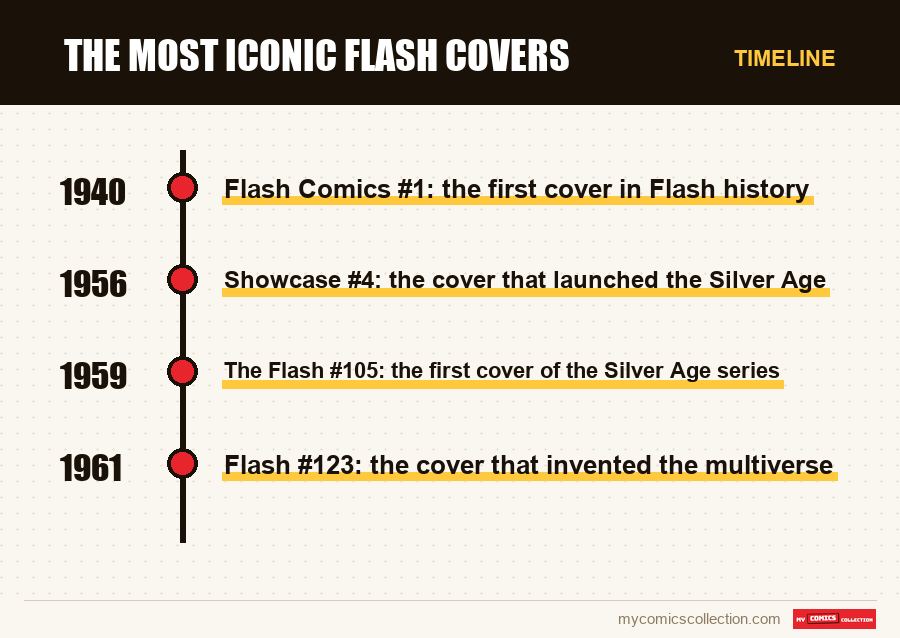
Flash Comics #1 (1940): the first cover in Flash history
Published in January 1940, Flash Comics #1 introduces Jay Garrick, the Golden Age Flash, in a story written by Gardner Fox and illustrated by Harry Lampert. The cover, Jay Garrick in a blue tunic and winged helmet streaking at full speed, is the first visual representation of the character in DC Comics history. The issue ranks in the top 15 Golden Age comics according to the Overstreet Price Guide. The unique CGC 9.6 copy, from the prestigious Mile High collection (Edgar Church), sold for $450,000 at Heritage Auctions in 2010: after previously selling for $273,125 in 2006. eBay prices are not available for this series, which falls outside our tool's index.
Showcase #4 (1956): the cover that launched the Silver Age
This is the most valuable and most influential cover in all of Flash history. Pencilled by Carmine Infantino and inked by Joe Kubert, it shows Barry Allen, a police scientist, in a scarlet costume leaping free from a black-and-white film strip: a bold visual declaration that superheroes had entered a new, more modern, more colourful era. The issue contains two stories: the first scripted by Robert Kanigher (who co-created the new Flash concept with Infantino), the second by John Broome, both drawn by Infantino.
The sole CGC NM+ 9.6 copy, the highest grade ever awarded to this issue by the CGC census, was sold for $900,000 at the Heritage Auctions sale of 11-14 January 2024, setting an all-time record for a Silver Age DC comic. That same copy had previously sold for $179,250 in 2009: a fivefold increase in fifteen years. In total, CGC has graded only a handful of copies at 9.0 or above, making this one of the most extreme rarities in all of Silver Age comics.
The Flash #105 (1959): the first cover of the Silver Age series
The Flash #105 (February-March 1959) is technically the first issue of the Silver Age series: DC resumed the numbering of the old Flash Comics title, which had ended in 1949 at issue #104, rather than starting fresh at #1. The Infantino cover introduces Mirror Master (Sam Scudder), the first major Silver Age villain to join what would become Barry Allen's Rogues Gallery. The script is by John Broome. No CGC copy graded 9.6 or higher has ever been confirmed; a copy graded CGC 9.2-9.4 reached approximately $40,000 at auction. Our eBay estimator returns only one active listing for this issue: the volume is insufficient for a reliable median.
Flash #123 (1961): the cover that invented the multiverse
Issue #123 of The Flash (September 1961), scripted by Gardner Fox and drawn by Carmine Infantino (cover inked by Murphy Anderson, interiors by Joe Giella), holds a unique place in DC Comics history: "Flash of Two Worlds!" is the first story to introduce the multiverse: the coexistence of two parallel Earths, Earth-One (Barry Allen's present) and Earth-Two (the Golden Age world of Jay Garrick). The cover shows the two Flashes (one in red, one in blue) racing from opposite sides of the same scene to save the same man, separated by a brick wall. This image is among the most reproduced and imitated in comics history. The issue won the 1961 Alley Awards in three categories: Best Single Issue, Best Cover, and Best Story. A CGC 9.4 copy sold for approximately $23,000 at Heritage in 2004; with no higher-graded copy on public record, the true ceiling for this issue remains open.
Flash #110 and #139: Kid Flash and the Reverse-Flash
The Flash #110 (December 1959-January 1960) introduces two characters who would go on to define the mythology: Wally West, Iris West's nephew who becomes Kid Flash after finding himself in the same circumstances as his uncle Barry, and the Weather Wizard. The Infantino cover captures the dynamic that makes the title work: a hero in full motion, supporting characters in danger, a diagonal composition that grabs the eye instantly. A CGC 9.6 copy reached approximately $9,750 in 2010. Our eBay estimator returns no results for this issue; only the auction market provides a benchmark.
The Flash #139 (September 1963) introduces Professor Zoom: Eobard Thawne, the Reverse-Flash: Barry Allen's defining nemesis and a central figure in modern adaptations. The Infantino cover, inked by Joe Giella, follows the same visual grammar as his best compositions: two figures in direct conflict, an instantly readable graphic design. A CGC 9.6 copy (among the very few at the census ceiling) sold for $8,365 at Heritage in 2006. Both issues remain outside our eBay estimator's coverage; the figures above are the only available market references.
Carmine Infantino: the visual architect of the Flash
No discussion of Flash covers is complete without Carmine Infantino (1925-2013). He designed Barry Allen's scarlet costume, invented the kinetic compositional language that became DC's Silver Age signature, and created covers that told a story before a single page was opened. By 1967 he was art directing DC's entire line, later becoming publisher. His influence on superhero comics in the 1960s is comparable to Jack Kirby's at Marvel. Collectors interested in original Flash cover artwork should know that when Infantino originals do come to market, they command six-figure sums.
Flash adaptations have further energised collector interest. The CW series The Flash (2014, Grant Gustin as Barry Allen) ran for nine seasons, introducing the character to a new generation. The 2023 film The Flash (Ezra Miller) grossed $271 million worldwide against a production budget of $200-220 million.
Frequently asked questions
Drawn by Carmine Infantino and inked by Joe Kubert, it shows Barry Allen, a police chemist in a scarlet red costume, leaping out of a black-and-white strip of film. It launched the Silver Age of American comics and set the character's look for decades to come.
The first appearance of Jay Garrick, the Golden Age Flash, in a story by Gardner Fox illustrated by Harry Lampert. Its cover, with Jay Garrick in a blue costume and winged helmet, is the first visual depiction of the character at DC.
DC resumed the numbering of the old Flash Comics series, abandoned in 1949 at #104, rather than starting again at #1. This February-March 1959 issue presents the first appearance of Mirror Master (Sam Scudder), with a script by John Broome.
Published in September 1961 (Gardner Fox on script, Carmine Infantino on art), it is the first story to introduce the multiverse, with Earth-One (Barry Allen's present) and Earth-Two (Jay Garrick's). Its cover, with the two Flashes separated by a brick wall, is one of the most imitated in comics history and won the 1961 Alley Awards.
The Flash #110 (December 1959-January 1960) for the first appearances of Kid Flash (Wally West) and the Weather Wizard, and The Flash #139 (September 1963) for Professor Zoom, the Reverse-Flash Eobard Thawne. These issues circulate almost only at auction.
Own a Flash comic? Get a free valuation with our tool based on real eBay sales to find its low, median, and high value.