
In 1986, a booklet depicts the transfer of command of the team: Cyclops gives up his place as leader to another member of the group. The device is extremely effective for a long-term series, because it renews the internal dynamic without changing a single name in the credits. But it costs the dispossessed dear: a fallen leader becomes a difficult character to write, stuck between the serene acceptance which drains him of all interest and the permanent contestation which makes him painful. This is most likely where the complicated reputation that Cyclops never really grew out of was born.
There are, in the mechanics of superhero series, a handful of narrative gestures that cost nothing to produce and that permanently reconfigure everything that comes after. The change of command is one of them. It takes just a few pages, requires neither destruction of a city nor a return from the dead, requires no addition to the cast, and yet it silently redistributes the balance of power between characters that the reader thought they knew by heart. The 1986 issue which organizes this change at the head of the team is one of those: an episode without catastrophe, the consequences of which can be read for decades.
What makes the object interesting is not the scene itself, the detail of which ultimately matters little. This is what it sets up: two characters who remain allies, who continue to fight side by side, and between whom there now exists a dispute that no common victory will resolve. The conflict is no longer a one-off argument to be resolved at the end of the episode, it is a structural position. One occupies the place, the other occupied it. Nothing in the conventions of the genre allows this asymmetry to be properly erased.
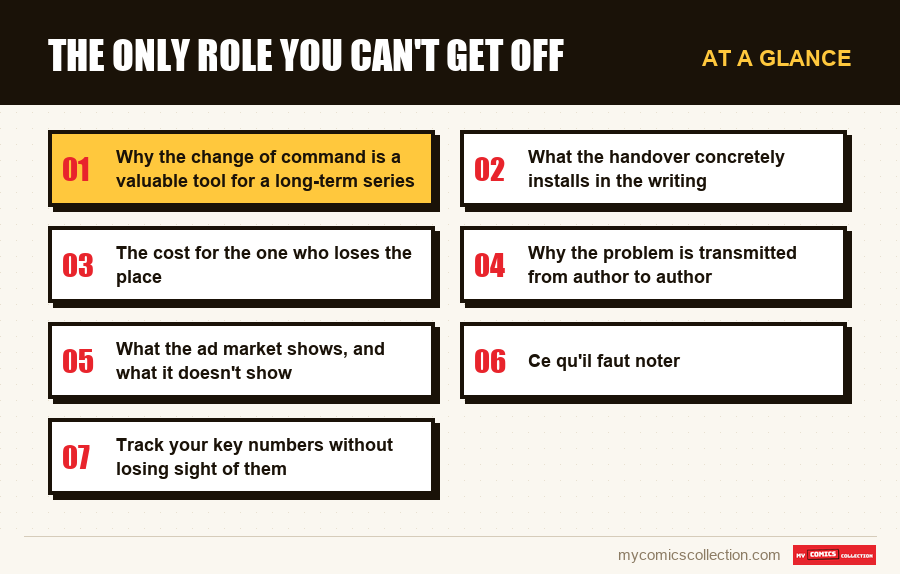
Why the change of command is a valuable tool for a long-term series
A monthly series that lasts lives on a paradox: it must change constantly to remain readable, and not change anything essential to remain itself. The usual levers are expensive. Making a character die means having to resurrect them sooner or later, which devalues the next death. Adding recruits inflates an already bloated cast and dilutes the available speaking time. Moving the team elsewhere cuts the links patiently built with the supporting roles. Each of these gestures buys movement by spending accumulated narrative capital.
The change of command does not spend anything. It takes a stable distribution and only changes the way its members talk to each other. The mission preparation scenes change their center of gravity. Tactical disagreements cease to be exchanges between equals and become tests of authority. A character who was giving orders begins to receive them, and the reader rereads all his lines in the light of this shift. For zero production cost, the series gets a brand new relationship game with exactly the same pieces on the board.
The second benefit is more subtle. The handover allows you to develop a character without deleting it. This is a recurring problem: when a figure has been written for twenty years in a single role, this role ends up defining her entirely, and the author who wants to move her often has only two options, remove her or betray her. Taking away its function by leaving it on stage creates a third way. The character remains available, remains recognizable, but he must reinvent himself before the eyes of the reader. This is exactly the kind of material that a long-running series lacks the most.
The third benefit relates to the nature of the conflict produced. An enmity between a hero and an enemy is settled by violence, therefore it is settled. A rivalry between two members of the same team cannot be resolved by anything: they cannot confront each other until the end, nor ignore each other, nor separate without breaking the series. Disagreement becomes a renewable resource, mobilized at each issue, never exhausted. Authors who inherit the situation have a free tension that they can use without ever having to justify it again.
What the handover concretely installs in the writing
A hierarchy made explicit
Before, the question of command did not arise: it was settled by usage. Afterwards, it is placed in black and white, which makes it questionable. A tacit status cannot be called into question; a designated status can, every time a decision goes wrong.
Deux légitimités concurrentes
The one who commands takes her place from a recent choice; he who has given up his own comes from seniority and habit. Both are defensible, which prevents the reader from deciding and forces the series to maintain the disagreement rather than close it.
A conflict that survives victories
Allies who win together usually reconcile on the last page. Here, the common victory does not change anything in the distribution of roles: the next day, the place is always occupied by the same person. The dispute leaves intact.
A retroactive rereading of the past
Everything the dispossessed character has done before can be read differently. His past decisions cease to be obvious and become questionable choices, since another exercise of command is now visible right next to him.
These four effects combine into a single practical consequence: the series gains an engine that runs by itself. No author needs to recall the founding episode to use it. Just put the two characters in the same room and have them make a decision. The reader does the rest of the work, because he knows what happened and he is waiting to see how everyone will behave. This is the highest return a screenwriter can expect from a scene already written by someone else.
One point deserves to be underlined: the handover is not a downgrade. The character loses neither his abilities, nor his belonging, nor the esteem of his teammates. He loses a function, which is both less serious and much more difficult to write than a clear decline.
It is precisely because nothing spectacular happens to him that he becomes a problem. A frank humiliation would call for a reconquest; an orderly withdrawal calls for nothing at all, and leaves the character without a program.
The cost for the one who loses the place
L'acceptation le vide
If he sincerely approves of the change and serves loyally under another authority, he becomes one implementer among others. Its singularity lay in the function; without it and without objection, it no longer has reason to occupy the forefront.
The protest makes it painful
If he protests, he does so within a team where the reader wants to see solidarity. Repeated over several issues, the objection ceases to be a position and becomes a character trait, and the trait is not flattering.
Aucune position intermédiaire stable
The half-measure-approve in public, doubt in private-works for a few episodes and then seems hypocritical. The serial format requires positions that are tenable over time, and this one is not.
The reconquest is a trap
Giving him his place cancels the gesture of 1986 and retrospectively proves his insistence justified. Not giving it back condemns subsequent authors to rewriting the same frustration indefinitely.
The past becomes a reproach
Every reminder of what he once was highlights what he no longer is. The scenes of nostalgia, which elsewhere serve to honor a veteran, function here as a statement of downgrading.
A legacy that no one chose
The writers who arrive next did not cause the situation but must manage it. Everyone tries a resolution; each resolution revives the subject instead of closing it, and confirms it as the character's dominant trait.
Collecting this series?
Track what you own, what you are missing and what your collection is worth. 7 day trial.
Start my trial →Why the problem is transmitted from author to author
A screenwriter who picks up the series twenty years later finds a character whose most readable characteristic is a bitterness of which he is often unaware of the original detail. He's not going to ignore it: that would be abandoning what long-time readers immediately identify. He's not going to remove it with the stroke of a pen either, because erasing an established line seems like clumsiness. He will therefore use it, and by using it he strengthens it. The mechanism is cumulative: each use makes the trait more central, therefore more obligatory for the next one.
The attempts at resolution almost all follow the same path and meet the same wall. We can give the character another team to lead: the question moves without being resolved, since the reader immediately compares the new position to the old one. We can make it succeed spectacularly where the authority in place fails: this revives exactly the debate that we claimed to close. We can make him admit publicly that he was wrong: the character loses his spine, and the next issue will have to invent another one. None of these outputs are wrong; all revive the subject they aimed to extinguish.
You have to add an effect specific to the format. Superhero series have no end, and irreversible actions are rare because returning to the previous state is the economic norm. However, the transfer of command is one of the rare gestures that going backwards does not repair: even when restored, the command now bears the trace of having been withdrawn once. The function has ceased to be a natural property of the character to become a transmissible object, and this information cannot be unlearned.
This is where, most likely, the complicated reputation that sticks to the character comes from. It is not the result of a moral fault that an author attributed to it, nor of a bad story. It is the logical consequence of a writing situation with no comfortable outcome, maintained by dozens of successive hands, each of which acted reasonably. The reader only sees the aggregate result: a character that we find difficult, and of whom no one knows exactly why.
We can draw a broader rule from this, valid well beyond this specific case. In a fictional team, all statuses are reversible without damage: you can stop being the most powerful, the youngest, the most popular, the best trained or the best loved, and the story absorbs the change without leaving a scar. Only one role escapes this reversibility, and that is that of leader. We can go up to it, never come down properly, because it is not a quality but a collective recognition, and removing it amounts to making the group say something that it can no longer deny. It is for this reason that the change of command is both the most profitable and the most irreversible tool available to a long-term series.
What the ad market shows, and what it doesn't show
A survey carried out on August 29, 2026 on the online advertisements devoted to this number gives an order of magnitude, provided that we remember from the outset that these are amounts requested by sellers and not concluded transactions. As for copies without independent certification, one hundred and twenty-five advertisements were listed, between 2.24 and 175.00 dollars, with a midpoint at 15.00 dollars. As for certified copies, there are only nine listings, spread between $45.00 and $1,500.00, for a midpoint of $69.99.
Nine advertisements is a small number, and it must be said clearly: at this level, each advertisement weighs enormously on the limits observed, and the maximum of 1,500.00 dollars reflects the hope of an isolated seller much more than an observed price. The certified midpoint, modest compared to this maximum, better describes reality: an abundant booklet, of which a single exceptional copy stretches the fork upwards without dragging the others. These figures are valid for the day of the reading and for nothing else; they do not allow any conclusions about a trajectory.
Ce qu'il faut noter
The handover is the most economical lever available to a long series. It produces a complete renewal of internal relationships without death, without recruits, without moving and without destruction. On the scale of a title that must hold hundreds of issues, this is a performance that few devices match, and this is the reason why it comes up regularly in team stories.
The conflict produced is lasting because it is structural. Two allies who differ on the legitimacy of command can neither confront each other to the end nor separate. Their disagreement has no natural outcome, which makes it reusable indefinitely: it is an advantage for the series and a problem for the characters.
The dispossessed is trapped between two bad options. Accepting serenely deprives him of what distinguished him; relentlessly challenging him turns him into an annoyance in the eyes of the reader. The lack of a tenable intermediate position over time is the real cause of the difficulty, not a character flaw.
The following authors inherit a problem they did not create. They find it installed, can neither ignore nor erase it, and every serious attempt to resolve it brings it back into focus. The trait is sedimented by the accumulation of individually reasonable decisions, which explains its persistence over several decades.
The figures recorded on August 29, 2026 illustrate, they do not demonstrate anything. Nine certified advertisements constitute too small a number to draw a conclusion, and an isolated maximum describes a seller's request, not a market price. The modest median compared to this maximum is the only solid lesson: the object is common.
An argument closes on the last page; a transfer modifies a permanent position. After it, each scene of collective decision implicitly replays the question, without any author needing to reformulate it. This is the difference between an event and a configuration.
Difficult, as part of an endless series. Recovering from it would imply either recovering the function, which would cancel the initial gesture, or stopping thinking about it, which would deprive it of its main force. Both outcomes cost more than they bring in.
A defeat calls for a revenge: the narrative program is provided with the problem. A removal from office does not call for anything, since the character was neither beaten nor disqualified. He remains on stage without an obvious objective, and it is this void that must be filled with each number.
No, and that is the strength of the system. The tension between the two characters is readable without explicit reference, because it manifests itself in the way they speak to each other. Knowing the founding episode adds a layer of understanding, it does not condition access to it.
That the copy is common and that certification concerns a tiny minority of offers. Nine certified announcements do not allow any generalization, and the difference between the median and the maximum indicates an isolated case rather than a price level. No development can be deduced from a single reading.
Track your key numbers without losing sight of them
Episodes that change the structure of a team are rarely the most flashy, and they are easily dispersed in a collection. A personal catalog allows you to know what you have, what you are missing and where each issue is located, without a homemade spreadsheet or approximate memory.