In the same series, a few issues apart in 1968, an artificial antagonist and the creature he makes arrive. As of August 29, 2026, the creature shows a median of $215.00 excluding verified copies and $519.99 for verified copies; its creator, $74.99 and $236.00. About three times more expensive, while it comes after it. These are amounts claimed by sellers on a single date, not completed transactions, and a single photograph says nothing about a trajectory.
The comic book market usually obeys a simple rule: what comes first costs more than what comes after. Priority is the easiest criterion to verify, the easiest to tell, and the one that everyone applies by default. However, there are configurations where this rule is completely reversed, and the couple formed by the Vision and the artificial antagonist who constructs it is the clearest example. The two appearances are close in time, published by the same title, in the same narrative movement. One precedes the other shortly. And it's the second that sellers charge three times as much.
The temptation would be to explain the difference by rarity, by a print run, by a difference in condition. Nothing in the data I have allows this to be done, and I'm not going to make it up. What I can do, however, is describe precisely what the readings show, set the limit of what they authorize to conclude, then propose a narrative reading of the gap: a creature who can turn against its creator is a richer character than the creator himself, and the market ends up recording this wealth.
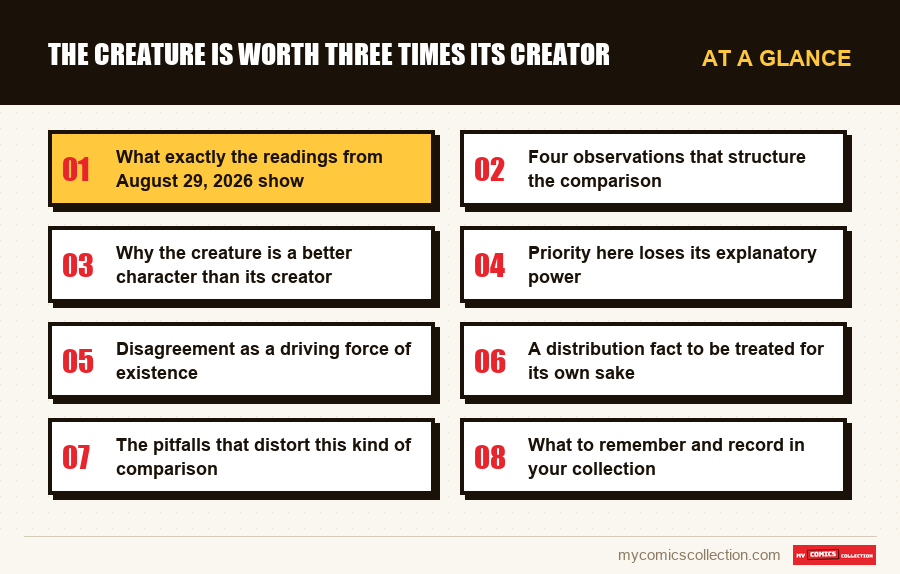
What exactly the readings from August 29, 2026 show
For the creature, there are forty-five ads without a verified copy, spread between $12.48 and $1,100.00, with a median of $215.00. There are eighty-one listings for verified copies, ranging from $44.99 to $14,999.99, with a median of $519.99. For creator, one hundred and sixteen listings without verification, $24.00 to $550.00, median $74.99; twenty verified listings, $70.00 to $999.95, median $236.00. These four figures are prices asked at the time of the reading. No one paid these amounts in front of me, and none of these amounts constitutes a concluded sale: they are proposals submitted by sellers, available for consultation on a given day, nothing more. The relationship between the two characters is in the two medians, and it is the same on both sides: approximately two times nine tenths excluding verification, approximately two times two tenths when verified. The creature dominates in both ad populations.
Four observations that structure the comparison
A stable relationship on both sides
The difference does not depend on the announcement regime chosen. Whether we look at batches without certification or verified copies, the creature remains far above its creator. A gap that only appears in one of the two populations would be a segment artifact; here it crosses both, making it significantly more difficult to brush aside.
Maximums that prove nothing
The peak observed on the creature side, $14,999.99, exceeds that of the creator, $999.95, by an order of magnitude. These two limits are not benchmarks of value: an isolated maximum expresses the ambition of a single seller, not a market level. They are mentioned to describe the form of distribution, never to justify a purchase or resale price.
A very low floor on both sides
At $12.48 for Creature and $24.00 for Creator, the low end of the ranges drops far below the medians. This almost always indicates the presence, in the same search, of objects which are not what we think we are looking for: lots, reprints, neighboring issues, derived elements. The floor describes the inaccuracy of the filter, not the price of a copy.
A low verified workforce on the creative side
Twenty verified ads are not many. We can describe this population, but we cannot derive a solid price level: a few atypical announcements are enough to move the median of such a group. The median at $236.00 is therefore a framing indication, to be handled with much more caution than the eighty-one announcements on the other side.
A final precaution is necessary before going further in the interpretation. The two searches which produce these figures do not delimit perfectly sealed groups: they contaminate each other, pick up neighboring objects in passing and probably let legitimate announcements escape. This is the structural defect of any measurement made on wording freely written by sellers. That being said, the difference observed is too marked to be attributed to this porosity alone. A ratio of one to three is not made with research noise; noise moves medians by a few tens of dollars, it does not triple a level.
This reading was taken on a single date. It therefore shows no evolution, no rise, no fall: a single photograph has no movement. Any sentence like “this number is climbing” would be a pure invention in view of this data.
The amounts quoted are what sellers were asking for on August 29, 2026, and verified copies are counted separately because they are not purchased under the same conditions as others.
Why the creature is a better character than its creator
An artificial creator, in fiction, is an intention. He wants something, he pursues it, he creates means. Its coherence is its dramatic strength and, at the same time, its limit: it does not deceive itself, it does not question itself, it executes. We can make it frightening, powerful, obsessive, we can multiply its returns; it cannot easily be made uncertain. But uncertainty is the fuel for lasting characters.
The creature is a conflict in itself. It was built for a function, and it simultaneously carries the possibility of refusing that function. The reader who opens it for the first time is immediately presented with an open question: will it do what it was made to do, or will it decide to be something else? No other type of character asks this question so head-on on its first page. The classic hero must learn to assume power; the creature must choose between two identities, one of which has been imposed on him and the other remains to be written.
This structure has a direct consequence on editorial longevity. A character built on a single intention becomes exhausted when the intention has been shown from all angles. A character built on an inner choice can be rewritten indefinitely, because the choice can be replayed in each era, with different stakes. Screenwriters who take up a creature do not need to invent a new motivation: they just need to reopen the same question in a different light. It is a narrative asset that cannot be consumed.
The market does not think in these terms, obviously. But he records the effects of this difference: continuous presence in the stories, reappearances, emotional depth, capacity to carry intimate scenes as well as confrontational scenes. A character that comes up often and is touching is a character that more collectors want to own originally. The request is formed there, not in a comparison of dates.
Priority here loses its explanatory power
The usual rule is that an earlier appearance is worth more. It works because it generally covers another reality: the oldest issue has circulated longer, has been less well preserved, and represents the entry point of a character from which everything else flows. But anteriority has never been a cause in itself. It is a convenient shortcut that correlates with real causes.
In our case, the two numbers are so close (same series, same year, a few numbers apart) that the seniority advantage is reduced to almost nothing. No decade separates the two objects, no different wave of conservation distinguishes them. The shortcut loses its substance, and what remains visible is the only factor that really varies between them: the narrative weight of the character introduced. When two appearances are contemporaneous, the chronology ceases to explain anything and the question once again becomes that of the character.
It is a teaching that can be transposed beyond this specific couple. Whenever a collector compares two issues separated by a few weeks of publication, he would do well to forget which came first and ask himself which of the two characters survived his era. The answer to this second question much better predicts what sellers display.
Disagreement as a driving force of existence
We must go further than the simple idea of rebellion. What makes a creature interesting isn't that it turns against its creator, it's that it has the ability to do so. A character only truly exists from the moment he can refuse. As long as a fictional being performs what is expected of it, it is a device; as soon as he can say no, he becomes someone.
Disagreement is therefore the founding mechanism, and not just a dramatic episode. It establishes an interiority that nothing else installs so quickly. The reader understands in a few pages that this character has a point of view distinct from the one who made him, and this understanding creates a particular attachment: we do not attach ourselves to a tool, we attach ourselves to a conscience which hesitates.
This mechanic also explains why such characters easily navigate creative team changes. A screenwriter who inherits a creature inherits an already established tension, not a specification. He can place it in a team, in an intimate story, in a cosmic conflict: the basic question remains usable everywhere. This portability is rare, and it has considerable editorial value over several decades.
Finally, let us note what the creator gains, because he is not the loser in the affair. By giving birth to someone who can reject him, he makes himself indispensable in a way that no other adversary can achieve. He becomes the only threat to which his creature cannot be indifferent. Faced with any other danger, she can act coldly; facing him, she is sent back to her origin and her founding question. It is a privileged antagonistic position, and it is enough to ensure its lasting presence in the stories, even if the advertising market values it less.
Collecting this series?
Track what you own, what you are missing and what your collection is worth. 7 day trial.
Start my trial →A distribution fact to be treated for its own sake
One item deserves a separate section because it doesn't talk about price but about circulation. The creature has eighty-one verified copies for forty-five unverified listings: the majority of what is offered has been subject to a verification procedure. The creator presents the opposite, and in a much more marked way: twenty verified ads for one hundred and sixteen unverified. In other words, most of its offer circulates without going through this stage.
The cautious formulation is necessary: the two objects do not circulate in the same way. We can see it, we cannot mechanically deduce a cause. Having a copy verified costs time and money, and this expense only makes sense if the seller anticipates that it will be recovered. It is consistent, but not demonstrated by these data alone, that holders of the most expensive number take this step more willingly. The direction of the link is not established either: we cannot say from this statement whether the verification follows the value or whether it contributes to it.
This imbalance has a practical consequence for reading medians. Comparing $519.99 to $236.00 is comparing a median based on eighty-one observations to a median based on twenty. The first is much more robust. The second remains useful for establishing an order of magnitude, but it would change a lot if a few announcements entered or left the selection. The reader who wants to form an opinion must therefore mentally weigh these two figures, and not treat them as two measurements of the same quality.
Symmetrically, the creator's unverified population is the largest of the four, with one hundred and sixteen ads. It is on this side that its median at $74.99 is best supported. The picture that emerges is consistent: an object that is commonly traded, in volume, in a relatively informal regime, compared to an object that is less abundant and more closely scrutinized by verification organizations.
The pitfalls that distort this kind of comparison
Overflowing research
Two characters born in the same series a few numbers apart often appear in the same ad wordings. A search on one brings back copies of the other, and vice versa. This is the porosity already noted: it blurs the edges of the two sets without explaining a difference of this magnitude.
Only one measurement date
The August 29, 2026 reading is a snapshot. It only allows us to compare the two characters with each other, at this moment. Any temporal reading would require at least two spaced readings, carried out with exactly the same filters, otherwise the difference observed would measure the method and not the market.
Prix demandé ≠ prix obtenu
An ad displays a seller's expectation. She can stay online for months without finding a buyer, or leave immediately after negotiation. The medians cited therefore describe sellers' demand, not what buyers actually agreed to pay.
Lots et objets dérivés
Very low values of the ranges almost always betray the presence of elements which are not the specification sought. A floor of $12.48 or $24.00 is not the low price of a copy: it is the price of something else, captured by a filter that is too broad.
Small staff treated like large ones
Twenty ads don't read like one hundred and sixteen. On such a small group, the median is sensitive to the slightest movement in the selection. Mentioning it is legitimate; deriving a firm statement about a price level from this is not.
Réimpressions et rééditions
The same content republished later is presented with wording very close to the original. Without checking the exact edition, a part of the cheap ads falls into this scenario and artificially pulls the bottom of the range towards the ground.
What to remember and record in your collection
Record the condition of the item, not just its condition. On this specific pair, the split between verified and unverified is not an administrative detail: it is the variable that separates a median of $215.00 from a median of $519.99 for the same character. A copy noted simply as “good condition” in an inventory loses half of the useful information.
Write down the two numbers together, as a pair. The creator and his creature do not understand each other separately, and their values are read in relation to each other. A collector who owns one has a direct interest in knowing where the other is, if only to correctly interpret an ad he comes across.
Write the date of each price record you keep. An amount without a date is unusable six months later, and worse, it becomes misleading: we read it as a current state when it describes a past moment. The date is part of the data in the same way as the number.
Keep track of the headcount behind each median. Writing “$236.00” without writing “out of twenty ads” amounts to giving yourself a confidence that the measurement does not deserve. Conversely, “$519.99 on eighty-one ads” can be reread without risk of overinterpretation.
Distinguish what you observed from what you deduce from it. The ratio of one to three between the two characters is an observation. The narrative explanation offered here, the creature carries a conflict that its creator does not have, is a reading. To mix them in the same note is to condemn yourself to no longer knowing, later, what was measured and what was assumed.
Because the difference in dates is too small to weigh. A few issues in the same series in 1968 do not create any difference in conservation or real age. What remains to explain the $519.99 compared to $236.00 as verified is the place held by each character in subsequent stories. Necessary clarification: this is an interpretation, the data provided does not contain any measure of popularity.
No. Each of the amounts cited is what a seller was asking for on August 29, 2026, stated as is. None correspond to a confirmed transaction. An asking price and a price paid can diverge significantly, in both directions, and this article has no information on the prices actually obtained.
That it describes a seller, not a market. An isolated high point in a list of announcements expresses an individual hope and never constitutes a benchmark. To put an order of magnitude, the median of the eighty-one verified ads, $519.99, is infinitely more informative than its upper bound.
No, and this is an absolute limitation of this work. A single reading has no direction: at least two measurements spaced over time, carried out with strictly identical criteria, would be required to speak of movement. Here, everything was observed on the same day, so no trend can be asserted.
The observation is clear (eighty-one against forty-five for the creature, twenty against one hundred and sixteen for the creator) but its explanation is not. We can only say that the two objects do not circulate in the same way. Having a copy verified represents a cost, and it is plausible that this cost is incurred more readily on the most expensive object, without these data making it possible to establish it.
Keep track of your copies and their statements
An inventory that notes the exact edition, the verification regime, the date of each statement and the number behind each median saves you from re-reading your own notes wrongly in six months. My Comics Collection is designed for this level of detail, on all series, not just those from 1968.