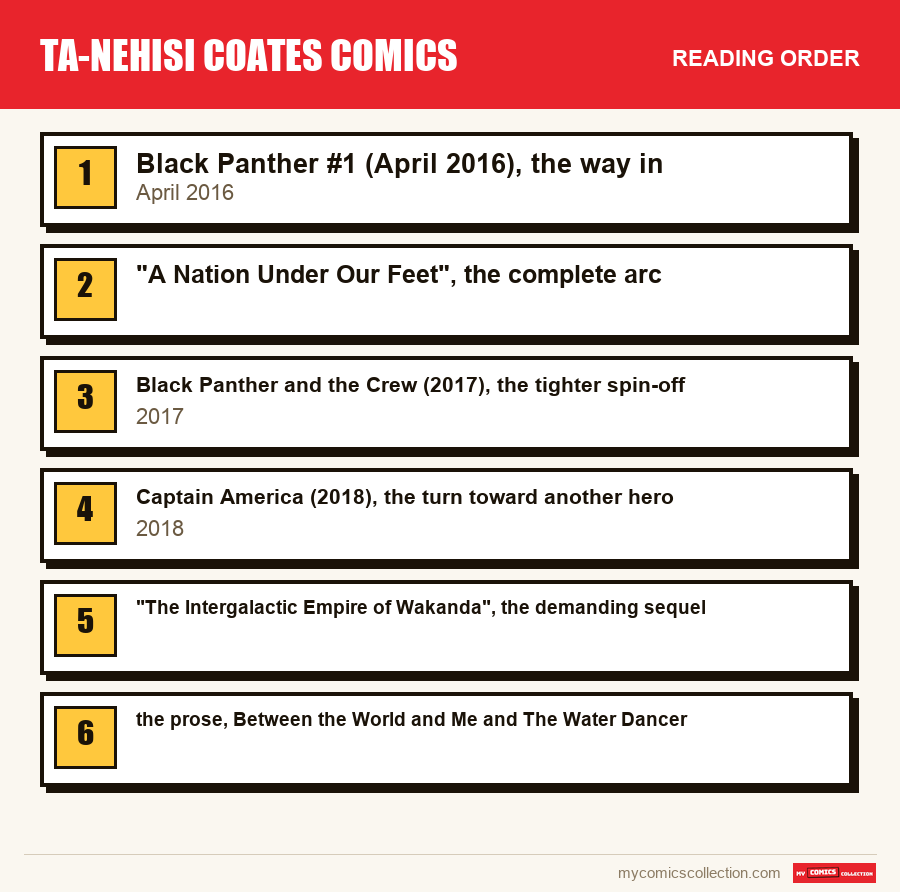
To read Ta-Nehisi Coates in comics, open Black Panther #1 (April 2016), drawn by Brian Stelfreeze, and keep going with the "A Nation Under Our Feet" arc. Then move on to Black Panther and the Crew (2017), then Captain America (2018) with Leinil Francis Yu, before tackling the intergalactic Wakanda years. Finish with the prose, Between the World and Me (2015), to understand the voice. Six steps, from the most accessible to the most demanding.
Ta-Nehisi Coates came to comics through the essay and journalism, which is why the Coates series read differently from most Marvel serials: the scenes talk a lot, and the chapters linger on institutions, oaths and the legitimacy of power. This guide offers a reading path so you do not get lost in more than five years of publications.
As always in this guide, only verified information (creators, issues, dates) is stated as fact; the analysis is our own, with no reproduction of protected panels or dialogue.
How we built this path
Coates's comics career spans few series, but those series are long, and chronological order is not the best order for discovering them. Each step was therefore judged on three points: does the reading require knowing Wakanda, does the story fit in one volume, is the item easy to gather? The most self-contained steps come first, the ones most dependent on continuity come last.
Here, the aim is not to retell a biography: the writer's hub gathers our articles, and we focus on the reading. A note on method: sources disagree on some end-of-series issue numbers, so we do not fix them.
Step 1: Black Panther #1 (April 2016), the way in
The series that made Coates known to comics readers opens in April 2016. Brian Stelfreeze draws the first issues, Laura Martin handles the colors, and the story places T'Challa before a Wakanda in crisis: the people challenge their king, and institutions that had always seemed untouchable begin to waver. The plot does not assume you know fifty years of continuity, which makes this first issue the safest entry point.
Why start here? Because the issue sets Coates's tone in a few pages: a hero who doubts, a kingdom that cracks, a story that takes its time. If you enjoy that deliberate slowness, the rest of the path will suit you. If it irritates you, you will know to skip step 2 and aim straight for Captain America.
As for format, the first 2016 issue is easy to find as a single issue: the series is recent and copies are not rare; no print run figure or variant cover is given here, out of caution. To judge the single issue in the context of the series, our Black Panther reading guide gives the order of the earlier periods.
Step 2: "A Nation Under Our Feet", the complete arc
The first twelve issues form a whole, published in three collected volumes under the title "A Nation Under Our Feet". A popular uprising defies the crown, recent violence has left Wakanda drained, and T'Challa must decide whether the power he holds through his lineage can still be justified. Several artists follow one another on these issues, which gives the volume a unity of tone more than a unity of line.
This step matters because it delivers the writer's thesis: the question is not "who beats whom" but "who has the right to govern". It is an arc aimed at the adult, patient reader, ready to follow long scenes of dialogue and deliberation. It rewards those who read slowly and reread.
For collecting, this is the step where the collected edition wins out: the three volumes gather the arc neatly, and you gain in reading what you lose in single issues. Our ranking of the best Black Panther runs explains how this period compares with those of Priest, Hudlin and the others.
Step 3: Black Panther and the Crew (2017), the tighter spin-off
In 2017 a short series appeared, Black Panther and the Crew, which Coates co-writes with Yona Harvey and which Butch Guice draws. The subject is tighter than that of the main series: a team of characters brought together around an investigation that plunges into America's racial tensions. The exact number of issues published varies by source; remember a brief series of a few issues.
Why at this step? Because it tests Coates's writing in an urban setting, far from the palace of Wakanda. It will please the reader who likes street-level stories, and it shows that the writer's voice does not depend on an imaginary kingdom as a backdrop.
For collecting, this is a short set, easy to complete in single issues: a cancelled series poses no completion difficulty, and the price of each issue depends on its condition, not on its scarcity. Still, check in the catalog that the issues you buy carry the right series, because several Black Panther titles sit side by side in this period.
Step 4: Captain America (2018), the turn toward another hero
In 2018, Coates takes on Steve Rogers in a series launched in July, with Leinil Francis Yu on art. The first arc, "Winter in America", follows on from Secret Empire, the 2017 event that shook confidence in the hero; the story asks what a national symbol stands for when citizens doubt it. The density of the dialogue recalls the Black Panther series, but the setting, a country rather than a kingdom, makes the question more familiar.
This step matters because it puts Coates in front of a character whose meaning is already fixed by nearly eight decades of publications, which forces Coates to write with or against a tradition. It is aimed at the reader who knows Captain America from the movies or from the Brubaker years, and who accepts a more political reading than a martial one.
As for format, the series lends itself to collected editions by arc, which makes reading easier. The first 2018 issue exists with several covers, and only those for which you have a reliable source deserve to be cited. To place this Captain America among the others, our ranking of the best Captain America runs gives the points of comparison.
Do you collect this series?
Track what you own, what you are missing and what your collection is worth. 7-day trial.
Start my trial →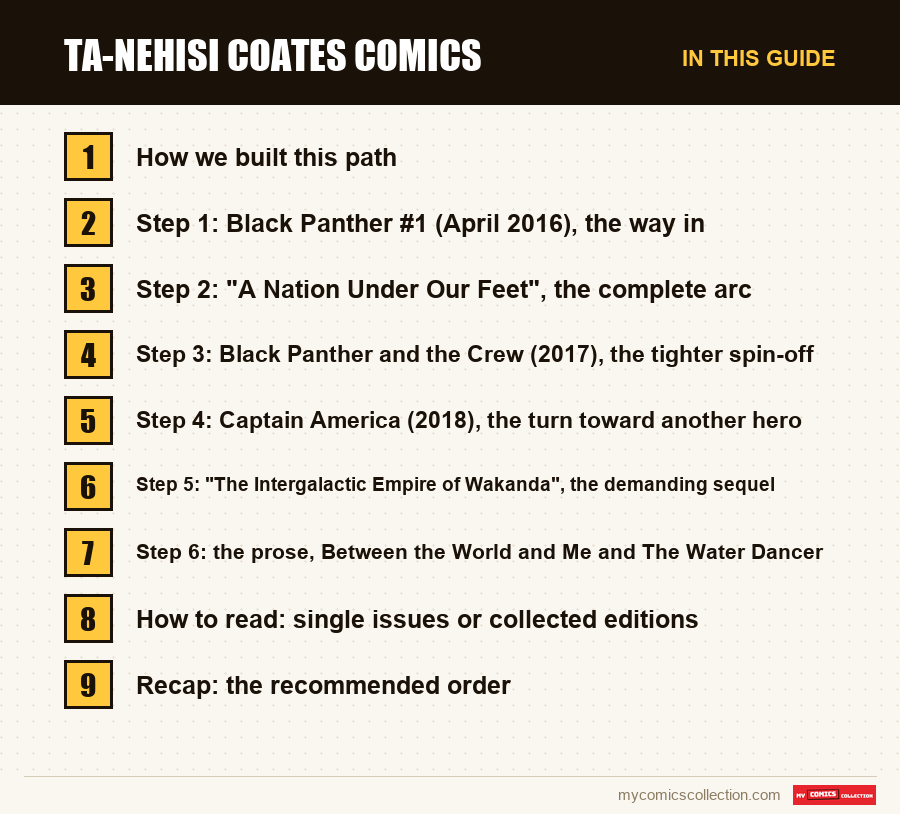
Step 5: "The Intergalactic Empire of Wakanda", the demanding sequel
After the founding arc, Coates's Black Panther series changes scale: the action leaves Earth and Wakanda becomes a galactic power, with characters and plots whose continuity goes back to the first issues. This part of the path requires having absorbed steps 1 and 2, because the allusions pile up and a reader arriving unprepared would lose a great deal.
It matters because it extends, over several years, the writer's thesis: can a power grow without losing itself? Who is it for? The committed reader, who loved the first steps and accepts a plot with many nested layers. Sources disagree on the exact end-of-series issue numbers, and we do not fix them: rely on the catalog credits rather than on a numbering quoted from memory.
For collecting, the single issues of this period are easy to find but numerous, and the collected edition by arc remains the clearest solution. Our article on the major Black Panther artists helps identify the artists who followed one another in those years.
Step 6: the prose, Between the World and Me and The Water Dancer
The last step leaves the panels. Between the World and Me, published in 2015, is an essay addressed to a son; it received the National Book Award the same year. The Beautiful Struggle (2008) is a memoir of childhood, and The Water Dancer (2019) a novel. The long article "The Case for Reparations", published in The Atlantic in 2014, belongs to the same thread.
These books are not comics, but they hold the key to the voice. Reading the essay, you understand why the Black Panther chapters dwell on the legitimacy of power and on a community's memory. It is the most demanding step in subject matter, and the most useful for anyone who wants to measure the gap between the comics and the rest of Coates's work.
As for format, these are bookstore books, with no collecting stakes in the single-issue sense: the edition that suits you is the one you will read. Since the article does not try to draw up a catalog, we refer you to the writer's hub for additional resources.
How to read: single issues or collected editions
For Coates's series, the collected edition is the most coherent format. Each arc was designed to be read in one sitting, the successive artists on Black Panther create style breaks that the volume smooths over better than the single issue, and the story is too dense to be read in episodes spaced a month apart. "A Nation Under Our Feet" exists in three volumes; Captain America is read by arc.
The single issue keeps its appeal for two profiles: the collector who wants Black Panther #1 from 2016 as an object, and the reader who likes the serial form. For the latter, the rule is simple: buy complete sequences, never an isolated issue in the middle of an arc. Check the series and the year on the cover before buying, because Black Panther numbering overlaps from one volume to the next.
A word on value: the 2016 to 2021 releases are too recent to have established a stable value. Only the writer's lasting reputation, an adaptation of the material for the screen and successive print runs will move these series, and we give no figure. If you hold a first issue, the free estimate places it based on its actual condition.
Recap: the recommended order
The recommended order is as follows. First step: Black Panther #1 (2016), to hear the voice. Second step: the rest of "A Nation Under Our Feet", in collected form. Third step: Black Panther and the Crew (2017), for the urban register. Fourth step: Captain America (2018) with Leinil Francis Yu, to see Coates face a national symbol.
Fifth step: intergalactic Wakanda, reserved for the already committed reader. Sixth step: the prose, to find the source of the themes. If time is short, stop at steps 1 and 2: they form the heart of the work and stand on their own.
And if you are coming from the other direction, from Captain America, step 4 remains a good entry point: read it first, then work your way back to Wakanda.

Frequently asked questions
With Black Panther #1, dated April 2016 and drawn by Brian Stelfreeze. The story requires no prior knowledge of Wakanda and sets up the writer's themes: a contested king, a weakened country. If the pace suits you, continue with the "A Nation Under Our Feet" arc.
No. The Captain America launched in 2018 with Leinil Francis Yu reads on its own, in the wake of Secret Empire. Only the style links the two series: dense dialogue, questions of legitimacy. You can therefore choose according to the hero who appeals to you most.
They are a complement, not a prerequisite. Between the World and Me (2015) and The Water Dancer (2019) shed light on the writer's voice, but the comics can be read without them. Put them in the last step, once the series are read, to understand where the themes come from.
The collected edition is the most coherent: "A Nation Under Our Feet" exists in three volumes that smooth over the changes of artist. The single issue keeps its appeal for the 2016 first issue, as a collector's item, but it is only worth buying in complete sequences.
No, it is a detour. This short 2017 series, co-written with Yona Harvey and drawn by Butch Guice, offers an urban register different from the main series. Read it if you enjoyed the first arcs and are looking for another facet of Coates's writing.
Is a 2016 Black Panther #1 or a 2018 Captain America sleeping in your boxes? Have its condition appraised before deciding whether to keep it or sell it.
Estimate my comic