Power Girl comes from a parallel continuity that its publisher ended up deleting by merging its universes into one. The character survived this operation, but not his past: dozens of episodes still tell a story that the house no longer considers to be true, without anything, neither on the cover nor in the pages, indicating where the border passes. The collector inherits the problem. On the announcement side, the August 29, 2026 statement includes 165 uncertified offers between $1.80 and $599.95, with a median of $9.99, and only 3 verified copies, from $43.99 to $65.00: three announcements do not allow any conclusion, and the search brings up so many issues from other series in the same family that we must stick to the order of magnitude.
There is a category of characters whose main difficulty is neither rarity, nor price, nor seniority: these are those whose original world the publisher has erased. Power Girl is the textbook case. It was not created in the main continuity, but in a parallel continuity that the house maintained alongside, with its own characters, its own timeline and its own rules. This continuity was then removed: the universes were merged, and what had happened there ceased to be considered as having happened. The character has been preserved. He therefore goes through the operation without his past: literally in the story, where he survives the disappearance of his world, and practically in the catalog, where his previous appearances continue to exist in printed fascicles without any official reference.
It's a strange situation for anyone who stores comics. A booklet is a dated, printed, numbered object: it is there, on the shelf, indisputable. What he says, on the other hand, may have been canceled by an editorial decision taken twenty years later. Nothing is reprinted with a warning banner, nothing is withdrawn from sale, nothing distinguishes with the naked eye an episode that “counts” from an episode that no longer counts. The thesis of this article is simple: when an editor abolishes continuity, the characters who come from it become documentary orphans. Their past remains materially available while becoming officially undecidable, and it is up to the collector to reconstruct, alone, a boundary that no one has ever drawn for him.
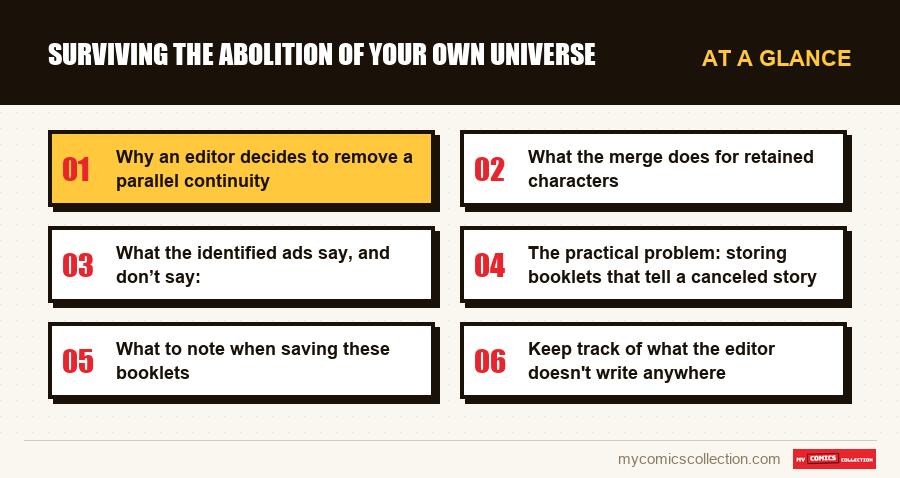
Why an editor decides to remove a parallel continuity
Parallel continuity is not a whim: it arises from a real need. When a house publishes continuously for decades, its oldest characters accumulate incompatible states. They grew old, then rejuvenated; they married, then were never married; they had beginnings situated in an era which, mechanically, moves away as time passes. Opening a parallel world is the most economical solution: we store the historical versions there, we keep the present clean, and everyone finds what they want.
The cost appears later, and it is double. The first is an entry cost. A new reader who picks up a series at random must now know not only who the character is, but in which universe what he is reading takes place: therefore which version of the facts applies. What was an internal management convenience becomes a toll at the entrance to the store. Two continuities are twice as many prerequisites to understand before the first page makes sense, and nothing more effectively discourages someone who was just trying to get started.
The second cost is a production cost. As soon as an event crosses both worlds (and this happens constantly, because crossovers sell) it is necessary to arbitrate. Who can meet who, under what rules, with what reversible consequences? Each intersection becomes a negotiation between two systems of truth, and each negotiation produces exceptions that must be remembered. After a certain number of years, the time spent maintaining consistency exceeds the time spent telling.
The merger solves both problems at once. We declare that there is only one world left, we redistribute the characters who are worth keeping, and we leave with a single entry point. From the publisher's point of view, this is a clean-up. From the point of view of the archive, it is an amputation: years of publications lose their address. They are not destroyed, they are not even contradicted outright: they simply cease to belong to something.
What the merge does for retained characters
An origin to rewrite
A character from a deleted world has, by construction, an origin which refers to this world. Preserving it requires inventing another one, compatible with the unique universe. Rewriting isn't an aesthetic choice, it's a technical obligation, and it immediately creates two competing versions of the same starting point.
Apparitions with undecidable status
Everything the character did before the merger still exists in booklets, but is no longer guaranteed. Some of these scenes will be tacitly reused, others tacitly ignored, without any list being published. The reader can only decide on a case by case basis, and often only after the fact.
Orphan relationships
The bonds of family, team and rivalry formed in the disappeared continuity lose their support. They are not denied, they float: the character is presented as linked to others without the episode where this link was formed being yet deemed to have taken place.
Un survivant thématique
The disappearance of the original world itself becomes a subject of story. The character is written as someone who comes from elsewhere and whose elsewhere no longer exists. Editorial quirkiness turns into a character trait, which makes it durable, and therefore reactivable in any era.
These four effects do not compensate for each other, they add up. A character from an abolished continuity doesn't just have a complicated past: he has a past that no one is responsible for saying if it's true. The editor does not publish an errata, successive authors draw according to their needs, and the reader notices the position of the cursor only when a story is explicitly based on an ancient event, or when it skirts it with visible care.
Merging universes does not delete any issues. It removes the guarantee which accompanied these fascicles. This is an essential distinction for a collector: the documentary value of the object remains intact, it is its narrative authority which becomes conditional.
In other words, we continue to own the episode where something happened. We only lose the right to assert, without caution, that this happened.
Why is this case more unstable than the others?
Many characters have gone through a merging of universes. Few find themselves in Power Girl's situation, and the reason is the nature of her starting point. Its origin has not only been rewritten: it has been re-explained several times, by different teams, without ever stabilizing sustainably. Where an ordinary character receives a new origin which replaces the old one and settles down, this has received successive explanations, none of which has succeeded in becoming the default reference.
The mechanism is understandable. When the first rewrite does not convince (because it is too complicated, because it cuts the character off from what made him interesting, or simply because it ages poorly) the temptation is strong to propose another. But the second attempt does not erase the first: it adds to it. After three or four passages, the question “where did it come from?” » no longer has a false answer and a true answer, it has several answers which have all been printed and none of which have been formally removed.
We must resist here a too hasty conclusion, that which would consist of saying that the origin has been rewritten in each era as if it were a general rule, or that the latest version is automatically authoritative. Neither is demonstrable from what we can observe. What we can say, on the other hand, is purely structural: when several explanations coexist without a published hierarchy, there is no consultable canonical version, and any categorical statement about "the true origin" is an opinion presented as fact.
This instability has a direct consequence on the ranking. For most characters, the bibliography can be split before and after, with an identifiable hinge. Here, the hinge is multiple. There is the moment when the original world disappears, the successive moments when the origin is reformulated, and the intermediate periods where the character appears without the question being resolved. Chronological ordering remains possible, publication dates are never ambiguous, but ordering by continuity is not.
This is why the most useful reflex, when building an ensemble around a character of this type, is to renounce the narrative classification as the main classification. Continuity is an additional layer of information, contestable and revisable; the publication date is material data, printed on the object, which will never change. Building on the second and documenting the first in annotation avoids having to redo the inventory with each new editorial rereading.
What the identified ads say, and don’t say:
A survey carried out on August 29, 2026 on the advertisements linked to this character gives the following orders of magnitude. For copies without certification, 165 offers, ranging from $1.80 to $599.95, with a midpoint at $9.99. For copies passed by a verification body, 3 offers only, between $43.99 and $65.00. These amounts are sums claimed by sellers at a given moment, not completed transactions: no one has necessarily paid these prices, and an ad can remain online indefinitely without finding a buyer.
Three certified announcements are not enough to conclude anything. It's not a sample, it's an anecdote: it only takes one seller to have a particular idea of what their copy is worth for the entire interval to change. I therefore refrain from drawing a price level, a difference with crude oil, or any certification premium. The only usable information is that there are very few verified copies offered simultaneously, which in itself is an indication of the depth of the market, not its level.
The raw reading also requires caution, for a different reason. The search is very porous: it massively brings back booklets belonging to other series of the same editorial family, where the character is only one presence among others or does not even appear. The 165 offers therefore do not describe a single object but a heterogeneous whole, and the gap between the floor and the ceiling reflects this heterogeneity as much as a difference in state. The median at $9.99 should be read as what it is: the center of gravity of a large and poorly defined set, not the price of an identified booklet.
Finally, a measurement taken on a single date shows no movement. There is no rise, no fall, no trend here: there is a photograph. Any sentence of the type « le personnage monte » or « le marché se réveille » would be an extrapolation without support, and we cannot say whether the maximum observed is an isolated accident or a repeated ceiling, for lack of a second measurement to compare. An isolated maximum, in particular, says what a seller hopes for, not what a buyer has agreed to.
Collecting this series?
Track what you own, what you are missing and what your collection is worth. 7 day trial.
Start my trial →The practical problem: storing booklets that tell a canceled story
Identifier la période concernée
Nothing on the object indicates that it belongs to a deleted continuity. Neither the cover, nor the number, nor the legal notice. The information is external to the booklet and must be reconstructed from the publication dates and the editorial chronology.
Fix a questionable hinge
The exact moment when the past ceases to be guaranteed is not published as such. Each reader places the clipping a little differently, and a collection organized around a personal clipping becomes illegible to anyone else: including oneself, years later.
Label without fixing a version
Writing “official origin” on a file amounts to settling a debate that the publisher has not resolved. Better is a descriptive label, “origin presented in this booklet”, which remains true regardless of subsequent rewriting.
Separate physically or not
Isolating the issues of the abolished continuity in a separate box is tempting, but makes the crossovers impossible to find: many episodes overlap the two regimes. Continuous storage with annotated markers causes less damage than physical separation.
Manage numbering that resumes at a
An editorial overhaul is often accompanied by a numbering restart. Two issues bearing the same number, separated by years, then coexist in the same collection, and merge into any list that notes only the title and number.
Compose a transmittable reading order
The order in which we read these fascicles no longer follows from the fiction, since the fiction has changed rules along the way. You have to build it yourself and write it down somewhere, otherwise it will be lost as soon as you no longer use it daily.
These six frictions have one thing in common: none can be resolved by manipulating the fascicles. They are regulated by recording, next to each copy, information that the copy does not carry. This is exactly the function of a properly maintained inventory: not to count what you own, but to keep what you understand about what you own.
What to note when saving these booklets
The release date before everything else. For a character whose continuity has been abolished, this is the only data that will never be revised. An origin can be re-explained, a world can be deleted, a numbering can be restarted: the month of printing is definitive. Making the date the primary key of the record, and all the rest of the secondary attributes, protects the inventory from the next editorial decision.
The regime of continuity, formulated as an observation and not as a verdict. Note "published before the universes merged" rather than "non-canonical". The first formulation is a fact verifiable by the date; the second is a judgment that can be contradicted by any subsequent publication reusing the episode. The nuance seems academic, it makes the difference between a sheet that ages well and one that needs to be redone.
What version of the origin this booklet presents. Since several explanations coexist without an established hierarchy, the only stable information is this: what this exemplar says, without trying to find out if it is right. One line is enough. It will prevent you, during a future rereading, from reopening ten booklets to find which one told what.
The exact source of the booklet when the research is porous. Since most listings for this character are actually for other series in the same family, note the series title and number exactly as they appear on the item, not as they appeared in the listing. A collection fed by labels from sellers ends up containing lines that cannot be linked to a real copy.
The amount actually paid, with its date. The 165 uncertified offers noted on August 29, 2026, with their median at $9.99 and their range from 1.80 to $599.95, are not transactions; your own purchases, yes. A dated personal history is the only set of concluded prices you will ever have with certainty, and it becomes usable from the second entry: something a public statement taken on a single date does not allow.
No: the deletion concerns the status of the story, not the subject. The booklet remains a dated print, with its edition, its condition and its place in the history of the publication. What changes is that we can no longer rely on it to assert a fact of fiction without specifying to which editorial era it belongs.
In practice, we only know it by observation: a recent publication reuses it, or avoids it. No official list of retained episodes is published after a universe merge. This is precisely what makes these characters documentary orphans: the border exists in fact, but it is not written anywhere.
This is not recommended. Many episodes straddle the two regimes, and a physical separation requires deciding cases that cannot be resolved. Continuous arrangement by publication date, supplemented by an annotation in the inventory, preserves the information without imposing an irreversible choice on the shelves.
None. Three advertisements, between $43.99 and $65.00, form a number too small to support the slightest calculation: a single atypical seller would move the entire interval. We can only observe that very few verified copies are offered at the same time, which describes the scarcity of the certified offer and nothing else.
Because the character's name appears in the descriptions of a large number of issues from the same editorial family, where it sometimes plays no role. An ad engine does not distinguish an appearance from a simple mention. This is why the statement of August 29, 2026 must be read as an order of magnitude over a large whole, never as the price of a specific issue.
Keep track of what the editor doesn't write anywhere
Date of publication, original version presented, regime of continuity, price actually paid: it is these annotations, and not the issues themselves, which make a collection readable when the publishing house changes its mind. My Comics Collection lets you save each copy with its notes, instantly find what you already own and build your own history of awarded prices.