
French newsstand issues from the 1950s to the 1990s fit almost no commercial container, which is sized for the North American format. Store them upright only if the spine can take it; otherwise lay them flat in short stacks, away from raw wood, rubber bands and any adhesive, in a dry, dark living space. Sort by title then by issue number, never by date, and record the location of each box in your inventory.
You have probably already had this experience: you buy protection for a collection of Lug or Arédit magazines, and nothing fits. The sleeves gape two centimeters at the width, the boxes let the issues tilt sideways, and the thicker ones, with square spines, do not fit at all. This is not your mistake: the whole range of protective products was designed for an object that is not yours. Organizing a collection of digest-format magazines therefore starts with accepting that you will have to improvise a system, and then maintain it.
As always on this guide, only verified information (creators, issue numbers, dates) is stated as fact; the analysis is our own, with no reproduction of panels or protected dialogue.

Why nothing on the market is your size
Comic protection sold in shops follows an implicit standard, that of the period North American comic book, and all the accessories derive from it: the width of the sleeve, the depth of the box, the thickness of the backing board. French newsstand magazines, for their part, were manufactured by publishers who sized their titles according to their own presses and to the shelf space of newsagents. The result: almost none has the same width as the standard, and several collections from the same house do not share the same height.
The problem is not aesthetic. An issue that is too small for its container no longer rests on its entire bottom edge: it slides, wedges itself at an angle, and a single corner carries all the weight. After a few months, that corner is crushed, and it stays crushed. An issue that is too large, on the other hand, has its cover protruding from the backing board, and so rubs against the edge of the box every time you flip through the row.
The honest conclusion: you will not buy a solution, you will assemble one. The two variables you actually control are the packing, so that nothing moves in a container that is too large, and the orientation, upright or flat, which depends on how each issue is bound.
Measuring before buying anything
Take three measurements of your copies, not from a spec sheet: height, width, and thickness at the spine. Do it on your smallest title and on your largest, because the gap between the two will dictate everything else. It is this gap, and not the average, that will tell you whether a single family of containers can suffice or whether you will need two.
Above all, do not assume that a title keeps the same dimensions throughout its life. Long series have spanned decades and changes of publisher: Strange starts in 1970 at Lug and carries its numbering up to 228, before the series continues under another publisher from 1989. Over an arc that long, thickness, binding and sometimes height have changed several times. Measuring an issue from the 1970s and deducing the storage for the entire series means condemning yourself to redoing the work.
Note these measurements somewhere, in your inventory rather than on a loose sheet of paper. You will reread them with each new arrival, and they will spare you from buying unsuitable supplies a second time.
What upright storage does to a glued spine
Not all your issues are bound the same way, and this is the real dividing line. Thin issues are stapled at two points: upright, they risk almost nothing, because the stress is spread along the fold. The thicker ones, the collected editions and the titles with square spines, are glued: upright, the inner block constantly pulls downward, and the glue is the only thing holding it.
Old glue does not give way all at once. It first splits at the top and bottom of the spine, over one or two centimeters, where the pull is greatest. If nothing changes, the split spreads and an entire signature eventually comes loose. You will see it through a discreet sign: the spine stops being perfectly perpendicular to the boards and takes on a slight S shape.
If you store upright, two precautions cover most of the risk. The row must be snug without forcing: full enough that nothing leans, but not so tight that you have to tug to extract an issue. And you need a rigid vertical support every eight to ten centimeters of shelf length: without one, the middle of the row sags and every issue works at an angle.
When it is better to lay them flat
Horizontal storage becomes the right choice as soon as an issue can no longer carry itself: a spine already split, a partly detached cover, a large soft format with no structure. Flat, the load no longer passes through the spine but across the whole surface, and a tired spine stops deteriorating simply from gravity.
The price of this choice is weight. In a stack, each issue carries everything above it, and the pressure concentrates where the relief is hardest, namely on the staples. Beyond about twenty issues, the copies at the bottom begin to take on the imprint of their neighbors' staples, in two aligned points along the fold. That mark does not come out. Keep to fifteen or twenty copies per stack, roughly ten centimeters, and place a rigid board between two stacks laid one on top of the other, rather than letting paper bear on paper.
A last point, often overlooked: do not cross stacks to save space. A stack laid across another concentrates its whole load on a narrow strip, and you get a sharp crease instead of a diffuse sag.
What must never touch the cover
Part of the damage visible on newsstand magazines does not come from time but from something a well-meaning collector placed in contact with them. The rubber band comes first: it cuts a groove into the cover within a few months, then ends up sticky and bonded to the paper. Metal clips and paper clips leave an imprint and sometimes a brownish mark where they touch.
Adhesive, in every form, is to be excluded, including for repairing a tear you judge minor: its trace spreads well beyond the strip applied, and it is irreversible. The same rule applies to self-adhesive filing labels. You will need labels, certainly, but they go on the sleeve, on the divider or on the box, never on the object.
As for supports, avoid raw wood and recycled cardboard in direct contact, as well as newspaper as packing material. If you have nothing else on hand, slip a neutral sheet between the shelf and the first issue: it is a basic barrier, and it costs one gesture.
Do you collect this series?
Track what you own, what you are missing and what your collection is worth. 7-day trial.
Start my trial →
Where to store them in the house, and where absolutely not
The three worst places are also the three most used: the cellar, the attic and the garage. The cellar brings humidity and rising damp through the floor, the attic brings temperature swings that stress the paper and the binding every season, and the garage brings both plus splashes. A collection that has come through forty years of newsstand sales can degrade faster in three winters in a basement than during its entire previous life.
In a living space, some locations should still be avoided: against an outside wall, under a window, above a radiator, and directly beneath a bathroom or kitchen on the floor above. Place your boxes about ten centimeters off the floor, which leaves you a margin in case of water damage, and leave a gap between the furniture and the wall so that air can circulate.
Remember one simple principle: stability matters more than perfection. A room that is a little too warm but constant all year treats your magazines better than a perfect spot for six months out of twelve. And darkness is part of the specifications: a row exposed to daylight loses the color of its covers along the visible edge, in a fully recognizable way.
Sorting by title, then by issue number
The right sorting is the one that mirrors the way you search. You never look for an issue except by its title and its number, because that is how it is designated in a listing, in a discussion between collectors, and in the catalog. The title therefore forms the first level, the number the second, without exception.
This arrangement has another merit: it makes gaps visible. A row ordered by number shows its holes to the naked eye, something no other order allows. On very long series, the question becomes physical: Ombrax has 242 issues, which amounts to several meters of shelf. In that case, divide the series into blocks of one hundred and label the block, not each issue, or you will spend more time labeling than searching.
For special issues and satellite titles, shelve them next to their parent series rather than in a "miscellaneous" section, which quickly becomes a dumping ground. A title such as Spécial Strange, launched in 1975, developed in parallel with the main magazine; the collector looking for one almost always looks for the other in the same movement, and the storage should follow that habit.
Why sorting by date does not hold up
Sorting chronologically seems appealing, and yet it is the choice that will cost you the most time. The first reason is that the date printed on a newsstand magazine is not a sale date: it told the retailer how long to keep the issue on the shelf, and several issues of the same title overlap on the calendar. A sort built on that date is therefore built on an approximate datum.
The second reason is more practical still: chronological order interleaves titles. Your issues of one monthly end up scattered among magazines from other publishers, the series ceases to exist as a set, and you no longer see any gap. You will have a charmingly historical shelf that is perfectly unusable.
There is one exception: collected editions bound by the publisher, which carry their own numbering and form their own collection. They are sorted among themselves, by collection number, on a separate row. Their weight and their glued spine justify separate handling from the rest in any case.
A sorting system you cannot find things with is useless
Physical storage and the inventory are not two separate subjects; they are one. Each location must have a name, even a rudimentary one: the room, the piece of furniture, the shelf, the box. And that name must appear next to the number in your inventory, or your collection stays organized for the person who organized it, on the day they did it, and for nobody else.
This link solves the two most costly problems for a collector. The first is the duplicate bought by mistake, because you knew you owned an issue but could not check in time. The second is the copy you cannot find: you have it, your list says so, and it takes two hours of searching. In both cases, what is missing is not memory, it is the correspondence between the line in the list and the real box.
So keep three pieces of information per issue, not just two: the reference, the condition, and the location. The condition will serve you the day you want to value a lot or part with some of it; the location will serve you every other day. If you are taking over an inherited collection or a large delivery, start with the most sought-after series, those that revolve around major superhero titles such as Spider-Man or Daredevil, then work down to the rest: you will have the essentials under control in a fraction of the total time. The other blog guides detail, series by series, what to note along the way.
Frequently asked questions
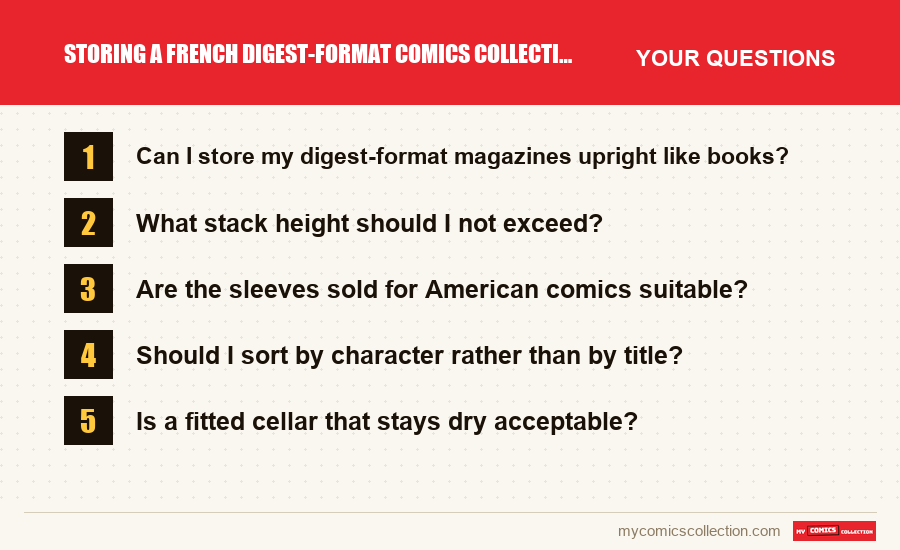
Yes for thin issues, stapled at the fold: the upright position asks almost no effort of them. No for thick glued copies, collected editions and any spine already split, which should lie flat. In an upright row, provide a rigid support every eight to ten centimeters and never let an issue lean.
Fifteen to twenty issues, roughly ten centimeters. Beyond that, the copies at the bottom take on the imprint of the staples of those above, in two aligned points along the fold, and that mark is permanent. If you must stack higher, insert a rigid board between the piles so the load is spread rather than leaving paper to bear on paper.
Rarely, because they follow the North American dimensions, whereas French newsstand magazines were sized by their publishers on other bases. A sleeve that is too wide lets the issue slide and rest on a single corner, which gets crushed. Measure the height, width and thickness of your own copies, and wedge whatever floats with a backing board.
No, because a French magazine published several series per issue: a single copy would belong on three shelves at once. Physical sorting therefore stays by title, then by number. The character view makes complete sense, but in the inventory, where one issue can carry several tags without being duplicated on the shelf.
It is better than an ordinary cellar, but it remains a poor choice: rising damp and humidity swings persist there, and water damage goes unnoticed longer than elsewhere. Prefer a cupboard in a normally heated room. If you have no choice, raise the boxes and check the state of the stacks twice a year.