On a Spawn #1 (May 1992), the difference between a newsstand copy and a direct edition is read off the barcode: newsstand carries a full UPC (14 digits, with a 2-digit block on the right), while the direct edition has a 5-digit block on the right (17 total), or a 2-digit block struck through with a diagonal slash, which also marks a direct edition. The newsstand version is far scarcer and trades at a documented premium. Spawn #1's eBay median, all editions and grades combined, is €15 (102 listings, June 2026).
Spawn is a 1992 comic (Image / Modern age), so there is no "Silver Age" or "Bronze Age" of the character. But its early popularity spawned several Spawn #1 variants, and some are now confused with one another: sometimes honestly, sometimes not.
This guide sticks to the verifiable: a live eBay median via our estimator, and documented distinguishing facts (barcode, indicia, reprints). When a precise figure can't be verified, we describe it qualitatively rather than inventing it.
Newsstand vs direct edition: the barcode decides
In 1992, Spawn #1 was printed for two distribution channels. The distinction changes nothing inside the comic: it is read solely from the cover barcode.
- Newsstand edition: sold through mainstream press outlets. The barcode is a "full" UPC: 12 digits on the left, then a second block of 2 digits on the right (14 digits total).
- Direct edition: sold in specialty comic shops. The right-hand block is wider, at 5 digits (17 total). A common variant: a 2-digit block struck through with a printed diagonal slash: that slash marks a direct edition, never a newsstand.
Why it matters: the newsstand print run was much smaller, and it sells far less often. GoCollect and the specialist Rare Spawn Comics database document a real price gap between the two in high grade: newsstand trading at a premium of several times the direct edition's value, despite a much lower sale frequency. If you're paying a "newsstand" premium, verify that barcode first.
Second printing: it all hinges on the indicia
If a comic was reprinted, it shows in the indicia, not on the cover. There is no reliable external tell on the cover: the "second printing" wording (or its equivalent) lives in the indicia: the copyright block inside, near the contents. That is the only arbiter.
Buyer's reflex: for any Spawn #1 sold as a "1st print," ask for a sharp photo of the indicia. A first printing carries no reprint notice; any "2nd printing" wording disqualifies the listing as a first print.
The 1997 black & white reprint (Spawn #65 incentive)
The variant most often mistaken for an "original Spawn #1" is in fact a late reprint. In September 1997, Image issued a black-and-white Spawn #1 with a new McFarlane cover, distributed as a retailer incentive for Spawn #65 orders at a ratio of 1 copy for every 50 ordered.
- How to spot it: a black-and-white cover with different artwork from the 1992 original (which is in color). Once you see the cover, there's no confusion.
- Documented values: raw copies typically start around $100 depending on condition, and a CGC 9.8 can exceed $550 (source: RecalledComics). It's a scarce object, but it is not the 1992 #1.
Red flags when buying
- "1st print" listings with no indicia photo. Always demand one. The cover alone proves nothing about the printing.
- A "newsstand" premium with no legible barcode. Newsstand vs direct is read only off the UPC: no clear photo, no premium.
- The "no black ink" error variant. Some first-printing copies shipped with the black ink partially or entirely missing. It's a genuine sought-after variant, but also fertile ground for vague descriptions. Verify the actual extent of the defect from photos.
- Grade drives price. Spawn #1's "all grades combined" eBay median (€15) blends beat-up raw copies and graded examples. On this series, the value gap between a raw copy and a high-grade CGC is about condition, not story rarity.
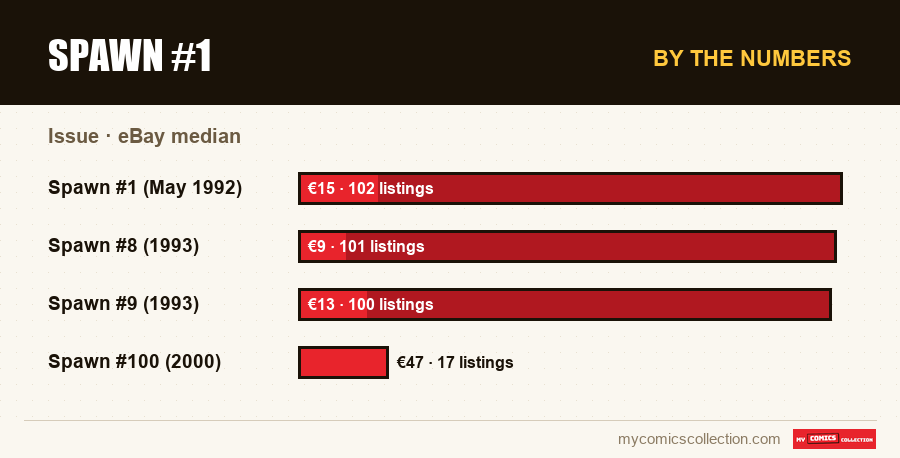
Value benchmarks (real eBay medians, June 2026)
Medians = active eBay listings, all editions and grades combined (our estimator, eBay.fr + eBay.com). Use them as an order of magnitude, not the price of a specific copy.
| Issue | Significance | eBay median |
|---|---|---|
| Spawn #1 (May 1992) | First appearance of Spawn | €15 · 102 listings |
| Spawn #8 (1993) | Common early-run issue | €9 · 101 listings |
| Spawn #9 (1993) | First appearance of Angela | €13 · 100 listings |
| Spawn #100 (2000) | Anniversary issue with variants | €47 · 17 listings |
Note: on Spawn #100, the low listing count (17) makes the median indicative only. Sources for distinguishing facts: RecalledComics, GoCollect, Rare Spawn Comics, SpawnWorld.
Own a Spawn #1 and unsure which edition it is? Get a free value estimate with our tool based on real eBay sales to learn its low, median and high value.
Frequently asked questions
It is all read on the cover barcode. The newsstand copy carries a complete 14-digit UPC, with a second 2-digit block on the right. The direct edition has a 5-digit block (17 in total), or a 2-digit block crossed by a diagonal, which always signals a direct edition.
Its print run was much smaller and it sells far less often. Specialist databases document a real price gap in high grade, with the newsstand version trading at a premium of several times the direct edition's value. Before paying that premium, check the barcode first.
There is no reliable outside sign on the cover. The "second printing" mention appears in the indicia, the copyright block inside, near the contents. For any Spawn #1 sold as a first printing, ask for a clear photo of the indicia: a "2nd printing" wording disqualifies the listing.
In September 1997, Image published a black-and-white Spawn #1, with a new McFarlane cover, distributed as an incentive to retailers for their Spawn #65 orders, at the rate of one copy for every fifty ordered. It is a rare object, but not the 1992 #1, whose cover is in color.
A "1st print" listing without an indicia photo, a "newsstand" premium without a readable barcode, or a "no black ink" error variant with vague descriptions. The latter is a genuine sought-after variant, but you must check the real extent of the defect in photos. Finally, it is condition that sets the price.