For Spawn, CGC grading only pays off on high grades and the right editions. Spawn #1 (May 1992) shows a €15 eBay median across all editions (102 listings, June 2026), yet a direct-edition CGC 9.8 trades closer to $60-85 , and the newsstand CGC 9.8 has a documented last sale of $367 (source: SellMyComicBooks). That's the whole point: on a comic printed at 1.7 million copies, value comes from grade and edition: not scarcity.
Spawn debuted in 1992 at Image Comics: it's a Modern-age title, with no "Silver Age" or "Bronze Age" to chase. The issues worth slabbing are few and always the same: the founding #1 and #9 (first appearance of Angela). The rest of the run is rarely worth the grading fee.
This guide sticks to the verifiable: real-time eBay medians (via our estimator) and documented sale records. When a precise figure can't be verified, we state it qualitatively rather than inventing it.
Why (and when) to grade a Spawn
CGC grading seals your comic in a tamper-proof slab with a 0.5-10 grade. On Spawn, it only makes sense in three cases:
- A genuine high grade (9.6 or 9.8). That's where the price gap becomes real. On an abundant comic, only the very top grade creates scarcity.
- A sought-after edition (newsstand, signed) where certification drives the whole difference in value.
- A first appearance like Angela in #9, where authentication reassures the buyer.
Conversely, grading a mid-grade copy (8.0-9.0) of a common issue often costs more than the value it adds. Grading doesn't invent value: it reveals the value the grade and edition already carry.
Spawn #1: the mass-print trap
Spawn #1 is, to this day, the best-selling independent comic in history: roughly 1.7 million copies in May 1992, of which ~1.25 million went to the direct market and ~200,000 to newsstands (sources: Wikipedia, Comichron). The direct consequence: the comic is extremely common, even in high grade. The CGC census records over 8,700 copies graded 9.8 (source: CGC census).
That's why the "all editions combined" eBay median stays low, at €15 (102 listings, €9-37 range). Grading only changes the math in two specific cases:
| Spawn #1 version | Value marker | Source |
|---|---|---|
| Raw, all editions/grades | €15 median (€9-37) | eBay · 102 listings |
| Direct CGC 9.8 | ~$60-85 | SellMyComicBooks |
| Newsstand CGC 9.8 (last sale) | $367 | SellMyComicBooks |
The gap between a €15 raw median and a $367 newsstand CGC 9.8 isn't about the comic being rare: it's the combination of rare edition plus very high grade. Before paying to grade a direct #1, ask yourself: does your copy genuinely hit 9.8? On a mass print run, a 9.6 or 9.4 barely moves the needle.
Spawn #9: the real grading target
Spawn #9 (1993) is the most interesting issue to grade. It holds the first appearance of Angela (and Medieval Spawn), written by Neil Gaiman: a character at the heart of a long rights dispute who moved to Marvel in 2013. Yet its eBay median stays accessible, at €13 (100 listings, €9-19 range).
The CGC census is tighter here: many copies in 9.8 (2022 reading), far fewer than #1. On the high end, a CGC 9.8 sale was documented around $499 (April 2021) (source: CovrPrice). That's exactly the profile that justifies a slab: a first appearance, a more reasonable print run, and a clear spread between raw and 9.8.
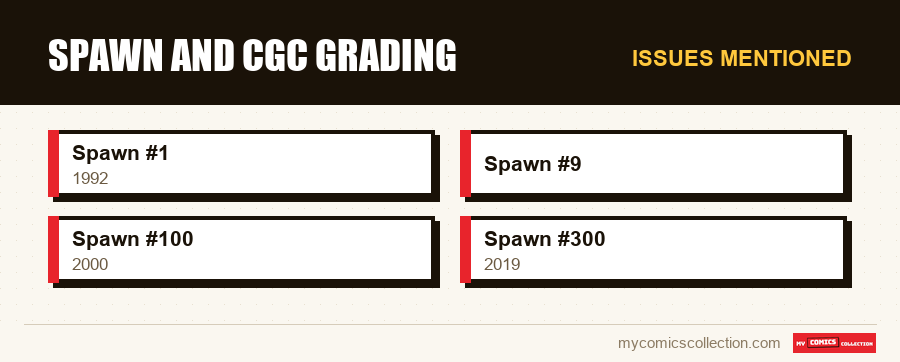
What about the other issues (#100, #300)?
- Spawn #100 (2000): € 47 eBay median, but on only 17 listings: an indicative marker, confirm live. An anniversary issue with multiple covers; only certain very-high-grade variants justify grading.
- Spawn #300 (2019): € 25 median (30 listings). A recent issue heavy on variants: grading only matters on the most coveted covers in 9.8.
Grading strategy (grounded in real data)
- #9 first. It's Angela's first appearance, with the best CGC-scarcity-to-affordability ratio. Grade it if your copy aims for 9.6+.
- #1: edition + grade above all. Only grade newsstand copies or an undeniable direct 9.8. A mid-grade direct #1 won't recoup the slab cost.
- Check the value live. The medians above are from June 2026 and prices move. Before any grading submission, weigh the cost against the expected gain.
Own a Spawn and unsure whether to grade it? Get a free valuation with our tool based on real eBay sales to find its low, median and high value.
Frequently asked questions
In only three cases: an authentic high grade (9.6 or 9.8), a sought-after edition such as the newsstand or a signature, or a first appearance such as Angela in #9. Grading an average copy of a common issue often costs more than the valuation gain.
It is the best-selling independent comic in history, with about 1.7 million copies in May 1992, including about 1.25 million for the direct market and 200,000 on newsstands. The census counts more than 8,700 copies graded 9.8, so only a very high grade on a sought-after edition creates scarcity.
Spawn #9 (1993), which contains the first appearance of Angela and Medieval Spawn, written by Neil Gaiman. Its census is tighter than that of #1: it is the profile that justifies a slab, with a first appearance and a clear gap between raw and 9.8.
Its print run is far smaller than the direct edition's, about 200,000 copies against 1.25 million. The valuation gap with a raw median is therefore not due to the comic's scarcity, but to the combination of a rare edition and a very high grade.
Only in specific cases. #100 (2000), an anniversary issue with multiple covers, justifies grading only for certain variants in very high grade, and #300 (2019), recent and abundant in variants, only for the most coveted covers in 9.8.