The 1988 story which made this character famous among the general public exists in at least six successive editions, all published under the same title, with the same pagination and the same content. Two copies placed side by side can therefore be strictly identical when read and have no relationship on the market. The asking price statement from August 29, 2026 shows this unambiguously: 133 gross listings range from $12.66 to $342.65 for a median of $46.99, and the five least expensive listings are all reprints, announced as such by their sellers: “2nd Printing Pink Logo” at $12.66, “Third Printing” at $12.99, “Rare 6th Print” and “6th Printing” at $14.99, “2ND PRINTING” at $15.00. On this object, a price that does not specify the edition describes nothing.
There are titles where identification is a formality: a number, a series, a state, and the object is designated. This one is not one of them. The name of the story, its cover, its summary and its number of pages are common to all impressions, and these are precisely the four things that an ad displays first.
The following explains why a successful story is reprinted several times, why subsequent editions are materially consistent with the first but commercially unrelated to it, how they are concretely recognized, and why an inventory which does not record the circulation ceases to be usable from the first resale.
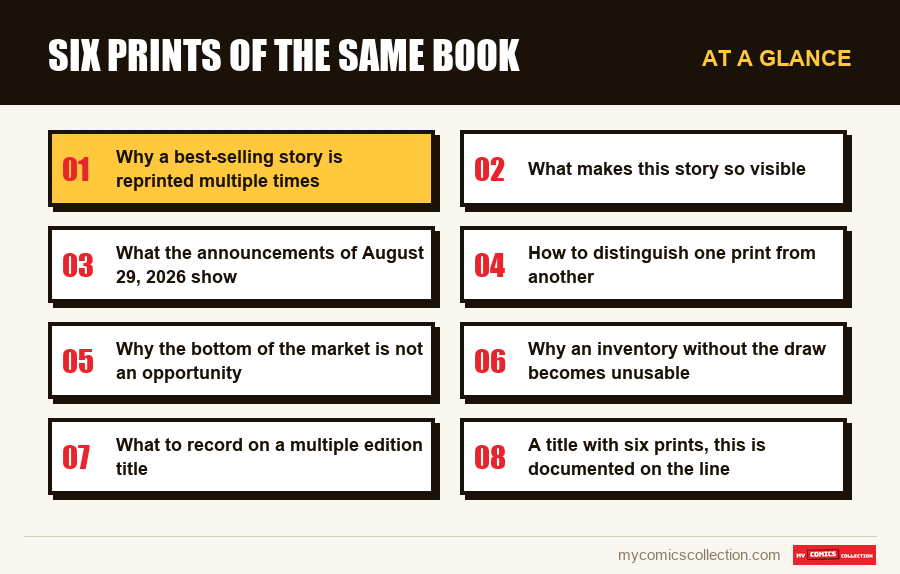
Why a best-selling story is reprinted multiple times
An ordinary booklet is produced in one go. The publisher estimates demand from distributors' orders, prints accordingly, and the matter is closed: what has not been sold remains on the shelves, what is missing will be missed. The next title appeared the following month and attracted attention.
A story that far exceeds its estimate breaks this cycle. The demand does not fall to the next issue, because there is no next number: the object is sufficient in itself, we talk about it, we recommend it, and buyers who were not readers of the title come to pick it up several weeks after its release. The publisher is left with live demand and depleted stock.
The industrial response is simple and inexpensive: restart the press. The printing films exist, the model is ready, no one has to recompose anything. A reprint is decided quickly, produced quickly, and meets demand where it is, that is to say in bookstores and boutiques, not on a collector's market.
This movement is repeated as long as the demand lasts. This is how we arrive at series of successive prints on a single story: each wave of notoriety (an adaptation, a recommendation that circulates, a generation of readers who discover the title) triggers a new impression. The 1988 story in question here has at least six, and the announcements noted on August 29, 2026 explicitly cite the second, third and sixth.
We must measure what this means from the point of view of the object. A title reprinted six times is a title that the publisher has deemed insufficiently available six times. This is the sign of prolonged reading success, and it is exactly for this reason that the first printing is rare: it corresponds to the initial estimate, the one which turned out to be too low.
What makes this story so visible
The notoriety of this album is not only due to its authors or its formal quality. It is firstly due to the fact that he inflicted serious and irreversible violence on the character, the consequences of which permanently modified his place in the stories that followed. It is an element of context, not a subject: it explains why this title is cited, discussed and republished so much, and nothing more.
This status of discussed story has a mechanical effect on the offer. A book talked about is a book sought after, and a book sought after is reprinted. The discussion itself fuels the waves of demand which trigger the successive editions, which explains why today we find impressions separated by entire years under identical covers.
It also has an effect on the composition of the market. A widely read title circulates second-hand in large quantities, in all states, and the majority of these copies come from the most abundant printings, that is to say reprints. The bottom of the market is not made of damaged copies of the first printing: it is made of ordinary copies of later printings.
What the announcements of August 29, 2026 show
What is cited below corresponds to asking prices observed on August 29, 2026 and not to completed transactions, the verified copies being kept separate from the others.
Crude, in volume
133 ads raw, of $12.66 to $342.65 requested, for a median of $46.99. A plentiful supply, which is consistent with a reprinted title.
The certified, in volume
49 ads verified, $49.99 to $24,500.00, median $199.00. Four times fewer, and a floor higher than the gross median.
The bottom of the market
THE five cheapest ads are all reprints and announce: $12.66, $12.99, $14.99, $14.99 and $15.00. None hide what they sell.
The amplitude
De $12.66 in gross at $24,500.00 in certified, a ratio of almost two thousand to one. This is the widest amplitude that can be encountered on a single title.
The most usable fact from this statement is not a number, it is a regularity. The five lowest proposals all have a draw mention in their title. The bottom of the market is therefore not a zone of good deals on a rare object: it is the segment of abundant prints, correctly described by the sellers themselves.
The summit calls for the opposite precaution. The $24,500.00 observed in certified is a seller's proposal, not an observed price. An announcement is a unilateral request; nothing in this statement indicates that a buyer accepted it, nor that there is any consideration at this level. To retain it as a value reference would be a reading error.
It is necessary to add the reservation which applies to all of the above. A count carried out on a single date provides information on what was offered that day, and not beyond. No price movement can be inferred from the above, in one direction or the other. These amounts record requests made on a given day, and their scope stops there.
A reprint is not a counterfeit, nor a degraded version. It's the same book, printed by the same publisher, with the same content and often equivalent or even better material quality: the paper and inking of late printings are not systematically inferior. To read the story, a sixth print does exactly the same function as the first.
The difference is elsewhere, and it is complete: the first print is a dated object, produced in limited quantity at a given time; the following are reproductions produced in response to a demand already noted. It is this manufacturing story, invisible to the reader, that the market values. Hence two identical objects in the hand and incomparable in an ad.
How to distinguish one print from another
The good news is that the information almost always exists; the bad thing is that it never appears where the eye first lands.
The printed notice of the print
This is the most reliable source: later printings generally carry an explicit mention in the front pages or the masthead. Absence of mention alone proves nothing, presence of mention definitely does.
Logo or color variations
Sellers regularly report differences in color on the title or banner: the title “2nd Printing Pink Logo” noted on August 29, 2026 is a direct example. It's a clue, not proof.
Le prix de couverture
A printed price which does not correspond to the original price immediately places the copy in a later printing. This is the quickest control to do on a photo.
L'intitulé de l'annonce
“Third Printing”, “6th Printing”, “Rare 6th Print”: the print is often written black on white. An announcement that is silent on this point is not necessarily misleading, but it is unusable as is.
La confrontation au catalogue
The catalog distinguishes between successive printings of the same title. This is the reference to question when the photo is ambiguous and the seller does not specify anything.
The box of verified copies
The certification bears the identification of the print on its label. This explains why a certified segment at a median of $199.00 coexists with a gross floor at $12.66: the uncertainty was removed upstream.
None of these six controls is sufficient in isolation, except the first. Taken together, they are enough to eliminate confusion in the vast majority of cases, and above all, they take seconds, compared to weeks to undo an acquisition made based on a misunderstanding.
Collecting this series?
Track what you own, what you are missing and what your collection is worth. 7 day trial.
Start my trial →Why the bottom of the market is not an opportunity
The temptation is immediate when faced with such a reading: if the raw median is $46.99 and we find the same title at $12.66, the difference looks like inefficiency. This is not the case, and the statement of August 29, 2026 itself explains why.
The five cheapest listings are reprints, and they say so. There is no error on the part of the seller, no negligence, no overlooked good deal: these prices are the normal valuation of abundant impressions, consistent with what they are. The market didn't misprice these copies, it priced them correctly.
The error consists of comparing a low price to a median calculated on a heterogeneous population. The median of $46.99 aggregates first printings and reprints; it therefore does not represent any specific object. Comparing an ad to this median amounts to comparing an identified object to an average of objects that are not.
The practical consequence is that there is no “story price”. There is an asking price for a given print, in a given condition, on a given date. Until these three pieces of information are gathered, the question “how much is it worth?” » has no answer, even an approximate one, and an approximate answer given nonetheless is more harmful than a refusal to answer.
This goes both ways. A buyer who pays a first printing price for a sixth printing has gotten a bad deal; a seller who liquidates a first print at the price displayed by the reprints also does one. Both errors have the same single cause: an unidentified object.
Why an inventory without the draw becomes unusable
A collection line that indicates the title, year and condition appears complete. In this specific story, it is not, and the lack is only seen when it costs something.
The first symptom appears during estimation. A line without a draw cannot be compared to any comparable advertisement, since comparable advertisements are distinguished precisely by the draw. The inventory then produces either an absent value, or a value borrowed from the wrong population, and this second option is the worst, because it has the appearance of a result.
The second symptom appears on resale. Writing an ad requires writing the print run; if the information was not recorded at the time of purchase, you must reopen the box, find the copy, look for the note. Multiplied by an entire collection, this reconstitution work costs more than the initial seizure would have cost.
The third symptom is the most insidious: confusion between copies. A collector who owns several printings of the same title (a commonplace situation, since one often acquires a reading copy then a conservation copy) can no longer distinguish them in his own inventory. Two identical lines no longer designate two different objects, they designate an apparent duplicate.
None of these three symptoms can be repaired after the fact without physical manipulation. This is what distinguishes the drawing from comfort information: it is not deduced from any other data on the form. Neither the title, nor the year of first publication, nor the condition, nor the price paid allow us to reconstruct it.
What to record on a multiple edition title
The useful sheet is not that of an ordinary booklet: it must say what the cover does not say.
The rank of the draw, and its source. Write “second”, “third”, “sixth”, and especially where the statement comes from: printed statement noted in the copy, certification label, or seller’s declaration. These three sources do not have the same solidity, and information from an announcement that has never been verified must remain marked as such, otherwise it will circulate in your inventory as if it had been acquired.
The cover price printed on the copy. It is the least expensive cross-check to record and the most useful to reread: it allows you to reopen a doubt about the print run later without taking the book out again, and it constitutes an objective trace where the memory of the purchase will have disappeared.
The visual features observed. Shade of the logo, color of the banner, variation in cover reported by the seller: these are the elements that will allow the copy to be recognized in a photo, including a photo taken by someone else. The title “2nd Printing Pink Logo” noted on August 29, 2026 shows that these characteristics circulate as identifiers in the real market.
The distinction between reading copy and conservation copy. On a title reprinted six times, having multiple printings is normal and desirable. The inventory still needs to know which ones, otherwise the collection contains apparent duplicates which are not duplicates, and the day one of the two leaves, it is the wrong one who leaves.
The asking price noted, with its date and segment. On an object whose propositions spread so widely, a number deprived of its date means nothing. Recording the amount claimed, the mention of the segment concerned and the day of the observation, the method followed here, retains what will still have meaning in six months: what was on offer at the time you looked, for the print you have.
At least six, all published under the same title and with the same content. The announcements noted on August 29, 2026 explicitly cite the second, third and sixth, with titles like “2nd Printing Pink Logo”, “Third Printing” or “6th Printing”. A story is reprinted when demand sustainably exceeds the publisher's initial estimate, which has happened here several times.
No. It's the same book, from the same publisher, with the same content and the same pagination; the manufacture of a late print is not necessarily inferior to that of the first. The difference is commercial and not material: the first print is an object produced in limited quantity on a given date, the following ones respond to a demand already noted.
First look for the printed mention of the edition in the front pages: this is the most reliable source. Then check the cover price, which immediately locates a later printing if it does not correspond to the original one. Logo or color variations reported by sellers constitute an additional clue, and the catalog distinguishes between successive impressions when the photo remains ambiguous.
Because they are reprints, and the sellers announce them. On August 29, 2026, the five lowest priced listings noted were all later impressions identified as such, asking $12.66 to $15.00. This is not a market inefficiency but the normal valuation of abundant impressions. They report what was available on that specific day, without authorizing the slightest assertion about a movement.
These are the two extremes of the August 29, 2026 reading: the floor of prices asked for raw and the peak of prices asked for certified, two segments counted separately. A ratio of almost two thousand to one reflects the extent of the differences in identification on a single title. Please note: the maximum is a seller's proposal, not an established price, and there is no indication that a buyer has accepted it.
A title with six prints, this is documented on the line
Rank of the edition, source of information, cover price, visual features, date of the statement: enough to know which of your copies you are holding in your hand, without reopening the box.