Nightwing was born in 1940 as a sidekick, took on an independent identity in the early 1980s, and didn't get a monthly series bearing his name until 1996. This fifteen-year gap between identity and title is not an accident of timing: it's the time it took for an editor to convince himself that a former supporting actor could carry a regular publication on his own. On the market side, the statement of August 29, 2026 lists 150 unverified advertisements, between $0.99 and $499.99, with a median of $7.99: amounts claimed by sellers, not concluded sales. A long and regular series produces volume, not rarity.
There is a category of characters whose editorial history is itself a subject: acolytes. They appear as a function before existing as individuals: someone to whom the hero must explain his plan, someone who must go and save, someone whose inexperience justifies the story slowing down to make it readable. This function is excellent for the mechanics of the series and catastrophic for the future of the character, because it defines him entirely in relation to another. Nightwing is one of the very few cases where this addiction has been converted into a trajectory rather than a dead end, and that's what makes his journey instructive well beyond his own title.
The thesis of this article is simple to state and difficult to achieve: an adult sidekick is the only type of character whose emancipation alone constitutes a story. No other archetype offers this. A solitary hero emancipates himself from nothing, a successor inherits without having to separate, an antagonist has no guardianship to leave. The acolyte, for his part, carries in his very definition the conflict which will allow us to tell the story of his departure. But this same particularity imposes a formidable constraint: emancipation must take place without breaking with the tutelary figure, otherwise the character loses exactly what made him interesting. Cutting the link means getting one more ordinary hero.
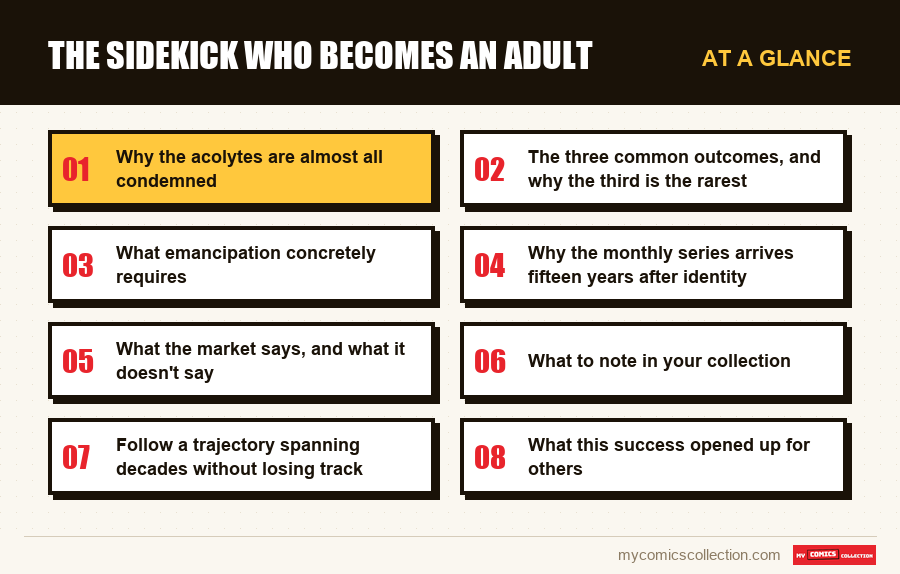
Why the acolytes are almost all condemned
The problem with sidekicks can be summed up in one sentence: they age, while the hero does not. This asymmetry is not a writing defect, it is a structural consequence of the format. A monthly series that lasts for decades assumes a stable, recognizable central character, available to a reader arriving at any issue. The hero is therefore maintained in a perpetual present: same apparent age, same situation, same costume, indefinitely. The acolyte cannot benefit from the same treatment, because his youth is not a decorative attribute: it is his reason for being. An acolyte, by definition, learns. But one cannot learn for forty years without the reader eventually realizing it.
This results in a contradiction that the editor must sooner or later resolve. Either the character stays young and becomes unlikeable, or he grows up and stops being a sidekick. An adult sidekick is a contradiction in terms: the position only exists as an apprenticeship, and an apprenticeship that never ends is not an apprenticeship. Many series push back the deadline by simply avoiding the subject, by never showing the character out of his role, by making him disappear between two arcs. This is a postponement, not a solution.
Added to this internal contradiction is external pressure: the readership changes faster than the catalog. A reader who discovered the character as a child has grown up himself; he expects something other than a repetition. A reader who arrives later does not understand why this adult character behaves like a subordinate. The sidekick then becomes the point where fiction shows its mechanics, the precise place where the reader sees that time does not flow normally in the universe he is reading.
Finally, the acolyte suffers from a commercial handicap that nothing compensates for at the start: he has no value of his own. Its presence on a cover adds little, because the reader comes for the hero. A publisher who plans to devote a separate publication to it must therefore bet on a demand which, by construction, has never had the opportunity to manifest itself. It's a gamble that very few characters get, and the rarity of these cases is the best proof of their difficulty.
The three common outcomes, and why the third is the rarest
Disappear silently
The most common outcome, and the least told. The character simply ceases to appear: no more mention, no more explanation, removal by omission. Nothing is recorded, which allows for a possible return, but the prolonged absence in fact amounts to an end. This is the least expensive solution for an editor who does not know what to do with a contradiction that has become annoying.
Being replaced in the same position
The function survives the person who occupied it. A newcomer takes over the role, younger, and the asymmetry starts again from scratch. This solution is elegant from the point of view of the main series, it preserves its structure, but it is brutal for the original character, who finds himself dispossessed of the only identity that the reader knew him to have, without having received another.
Truly emancipate yourself
The rare outcome. The character leaves the role without leaving the universe: he takes another name, another territory, another register, and becomes comparable to the hero rather than subordinate to him. This is the path followed in the early 1980s with the identity of Nightwing. It requires writing work that the other two solutions precisely avoid.
La fausse quatrième issue
There remains the temptation to deny: make the character an adversary of his former mentor to create conflict at little cost. It’s a shortcut that destroys the resource it claims to take advantage of, because it consumes in one arc the connection that could have fueled years of stories. Successful emancipation is distinguished precisely by its refusal of this facility.
These three outcomes are not equivalent in cost. Disappearing costs nothing. Replacing costs a transition number. To emancipate yourself requires a complete conception: you have to invent a name which does not refer to the mentor, a place which is not yours, adversaries which do not belong to your gallery, a tone which is not the same. In other words, you have to build everything that a solo hero already has, and build it from a character whose dependence readers have memorized for forty years. It's a work in progress, not an adjustment.
We must measure what the gap between 1940 and the beginning of the 1980s represents. For four decades, this character existed without an autonomous identity, defined solely by his relationship to another. No main hero's trajectory has such a waiting period.
Then a second gap, of another fifteen years, separates the taking of identity of the monthly series of 1996. The narrative emancipation and the editorial emancipation are two distinct events, and the second does not automatically follow the first.
What emancipation concretely requires
An identity that does not cite the mentor
The new name must not refer to either the hero or his symbolism. A derivative of the original name would maintain the subordination in another form. The identity must be readable alone, without a footnote.
A timeline that agrees to flow
The character must be allowed to have a dated past, a progression, an accumulation of experience. This is exactly what the main hero cannot afford, and this is what makes the former sidekick more mobile than him.
A city of one's own
As long as the character patrols the same territory, he remains an auxiliary, regardless of his costume. Giving him a distinct terrain mechanically creates issues, institutions and adversaries that belong only to him.
Un registre différent
If the tone replicates that of the original series, the reader has no reason to follow two publications. The difference in register (lighter, more mobile, more focused on relationships with others) is what justifies the existence of a second title.
A link preserved, not cut
The central paradox: emancipation must preserve the original relationship. The character draws his interest from coming from somewhere. Removing filiation would amount to removing the very subject of its emancipation.
Time to install all of this
None of these are installed in one issue. It takes years of regular appearances for the new name to stop being perceived as a disguise and to become, in the reader's mind, the name of the character.
Why the monthly series arrives fifteen years after identity
The gap between the early 1980s and 1996 is the most revealing element of this entire trajectory. He indicates that in the eyes of an editor, taking on an autonomous identity and having a regular title are two things with no automatic relationship. The first is a narrative decision, reversible, inexpensive: it is written in an existing series and does not require any budget of its own. The second is an industrial commitment (a team, a periodicity, a place in the catalog, a share of the commercial space available at retailers) and it is judged on other criteria.
An editor only grants a title to a character that he is sure stands on its own. This certainty cannot be deduced from a good idea: it is observed. It can be seen in the character's capacity to sustain extended appearances outside the original series, to occupy a cover without the hero appearing there, to return to readers' conversations without being brought back there. Fifteen years is how long it took to accumulate this evidence. This isn't slowness, it's a demonstration requirement.
There is also a logic of risk. Launching a title is expensive and failure is visible: a series interrupted after a few issues damages the character for a long time, often more than the absence of a title. A prudent publisher therefore prefers to let an observable demand mature rather than provoke it. This caution explains why so many former acolytes never obtain their title: not because they failed, but because they never had the opportunity to accumulate the proof that was required of them.
Finally, the date 1996 says something about the state of the market as much as the character. A title launched at this time fits into a context where catalogs are large and internal competition is real: each new series competes for the attention of the same readers. Obtaining a place under these conditions assumes that the character brings something that the catalog does not already have. The emancipation of a former sidekick, precisely, is an angle that no solo hero can offer.
Collecting this series?
Track what you own, what you are missing and what your collection is worth. 7 day trial.
Start my trial →What the market says, and what it doesn't say
The survey carried out on August 29, 2026 gives, for unverified copies, 150 advertisements ranging from $0.99 to $499.99, with a median of $7.99. These amounts are those that sellers display, not those at which copies have changed hands: an announcement is a request, not a transaction. And since this is a photograph taken on a single date, it shows absolutely no movement: neither rise nor fall. To talk about evolution, we would need at least two comparable surveys spaced over time, which is not the case here.
The most exploitable fact of this statement is not a price but a number: one hundred and fifty simultaneous proposals, with a floor below the dollar. Such a volume of available offering reflects a direct editorial characteristic. A long and regular series produces volume, not rarity: every month for years, copies are printed, bought, preserved, and today they return to the market in numbers. The $7.99 median is consistent with this abundance: it describes a widely available set, where the buyer chooses from many offerings rather than chasing just one.
The maximum displayed at $499.99 should not change anything in this reading. An isolated amount at the top of a distribution expresses a seller's hope, not an observed price: there is no indication that a buyer has accepted this level, or even that he has considered it. Reading it as a reference value would amount to confusing the ceiling of what is demanded with the center of what is exchanged. The median sums up the whole: it is the benchmark to remember.
In terms of verified copies, the statement only includes 4 advertisements, between $110.00 and $480.00, with a median displayed of $280.00. Four announcements do not support any conclusion. A workforce of this size does not allow us to establish a price level, nor to usefully compare to the unverified segment, nor to calculate anything: the removal or addition of a single ad would move the median by several tens of dollars. I mention these figures because they appear in the statement, and I refrain from drawing the slightest interpretation from them. On this segment, there is no information: there are four points.
What to note in your collection
Distinguish the appearance of 1940 from the identity assumption of the 1980s. These are two milestones of a different nature and they do not concern the same issues. The first belongs to a series which is not that of the character; the second also occurs in a publication of which he is not the owner. Saving these events as two separate entries, each attached to its host series, avoids the classic mistake of lumping everything under the 1996 solo title.
Separate the 1996 title from previous appearances under the same name. The same character name here covers two bibliographical realities: scattered appearances in third-party series for fifteen years, then a monthly series of its own. A record that mixes the two makes any verification of completeness impossible, since we no longer know whether a missing number belongs to the followed series or to the long tail of external appearances.
Plot the actual state rather than the segment average. On a set as abundant as that described by the survey, the difference in value between two examples of the same number is almost entirely due to their condition and their mode of conservation. Noting the condition observed upon purchase, and not an estimate taken from an ad, is what makes the sheet useful two years later.
Date and time stamp each amount recorded. A price without a date is dead data: it allows neither comparison nor monitoring, and it becomes misleading as soon as we forget it. Systematically recording the date of the survey, as the August 29, 2026 figure cited here does, is the only way to later transform a series of isolated observations into a verifiable trend.
Mark key numbers as reading benchmarks, not as purchase targets. The stages that structure the character's trajectory (first appearance, change of identity, launch of the title) are of obvious interest in understanding. Saving them with a note explaining what they change in the character's journey gives the collection a coherence that numbering alone never produces.
Because its function is based on learning, and indefinite learning ceases to be credible. The main hero can remain the same for decades, his stability even being an asset; the sidekick is defined by progression. Held in the same position for too long, it becomes the point where the reader perceives that time is not flowing normally in the series.
A costume change changes appearance without affecting position. Emancipation modifies the position: it supposes a name which does not cite the mentor, its own territory, adversaries who do not belong to the original gallery, and a different narrative register. Without these elements, the character remains a better-dressed auxiliary.
Because the rupture destroys the resource it claims to exploit. The character's interest lies in the fact that he comes from somewhere; removing the filiation means obtaining one more solitary hero, without the subject that distinguished him. The difficulty of writing consists precisely in obtaining autonomy while maintaining the link.
Nothing. Four observations do not constitute a usable sample: adding or removing a single ad would significantly change the result. These figures are mentioned so as not to conceal anything from the statement, but no conclusion on a price level, nor any comparison with the unverified segment, can be drawn from them.
It is first of all a sign of abundant supply, which is not the same thing. A high volume of proposals, with a lower floor per dollar, describes an easy-to-find set. This is the expected consequence of a long and regular publication: many copies were printed and preserved, and they circulate in large numbers today.
Follow a trajectory spanning decades without losing track
An appearance in 1940, an identity in the early 1980s, a title in 1996: three milestones distributed in different series, which numbering alone does not connect. Save each number with its home series, its status and the date of your statements, and find at a glance what you are really missing.
What this success opened up for others
The scope of this trajectory goes far beyond the character concerned. By demonstrating that a former supporting actor could carry a regular title, she turned hypothesis into precedent, and precedent changes the nature of editorial discussion. Before, proposing a series to an acolyte amounted to defending an idea without example. Afterwards, it amounts to invoking a known case and discussing the conditions of its reproduction. This is not a nuance: it is the difference between a bet and a model.
This model first benefited other former acolytes of the same catalog, who found themselves in the same structural impasse. The demonstration made thinkable, for them too, a journey in three stages (subordinate function, own identity, independent publication) and provided along the way the list of conditions to be met: a name that does not mention the mentor, a distinct territory, a different register, and a sufficient duration of installation. The characters who later followed this path did not have to invent the method.
It has also changed the way a catalog treats its own depth. An editor who has a successful track record stops viewing his supporting cast as inert stock and begins to see them as possible candidates, to be evaluated according to observable criteria. This rereading does not produce titles on an assembly line, the conditions remain demanding and the commercial risk remains, but it sustainably broadens the scope of what a catalog is capable of offering.
The fact remains that the precedent does not erase the difficulty. The fifteen years between identity and title continue to measure what emancipation really costs, and the fact that so few acolytes have traveled the entire journey reminds us that the third outcome remains the exception. What this success made possible was not the ease, it was the credibility of the attempt, and for a character born in 1940 as a simple narrative function, that is already considerable.