
Shadowhawk is based on a device that the masked vigilante genre systematically avoids: the character knows that he is going to die. Seriously affected in his health, he acts while he still can: which removes from the story the two usual springs of the genre, unlimited time and reversibility. Each intervention consumes a reserve which is not replenished. This explains its brutality, its errors, and the fact that the series is significantly darker than its cover announces.
This device is the only really interesting thing about this series, and it's also what no one talks about when classifying it in its decade.
This article analyzes what the character's condition changes, what the story does with it, what it misses, and why this type of device is so rare.
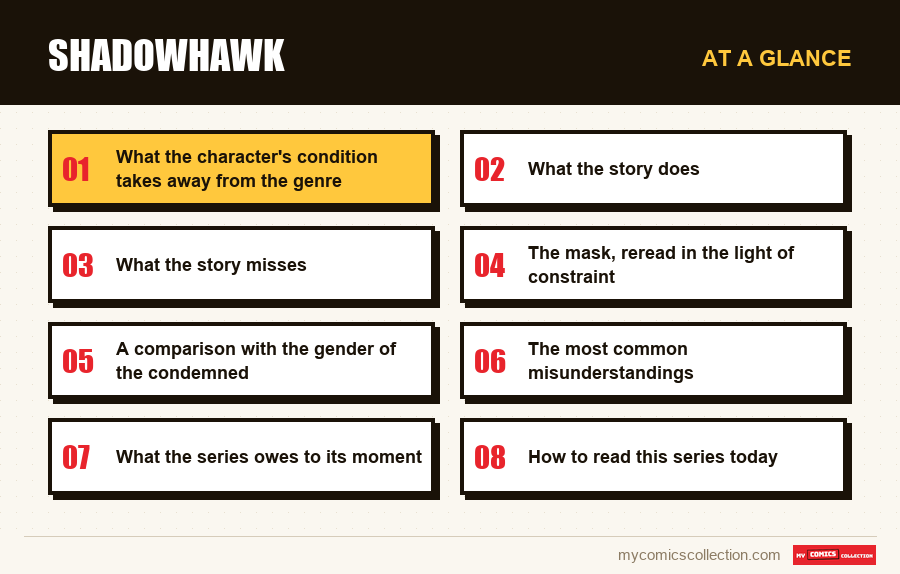
What the character's condition takes away from the genre
Unlimited time
An ordinary vigilante can procrastinate, let an adversary slip away, return to a case years later. This one can't.
All the logic of the soap opera, which supposes an indefinite future, ceases to work.
Reversibility
The genre is based on situations that recover: we lose, we get back up, the next episode starts again. Here losses accumulate without compensation.
La retenue calculée
Not killing an opponent requires being able to manage his return. A character who will no longer be there to manage it does not have this option: hence its brutality.
L'identité secrète durable
Protecting those close to you from a revelation requires a long term. When this disappears, the trade-off between secrecy and efficiency arises differently.
What the story does
Three uses stand out, and they are more consistent than one would expect from a series from this period.
Violence becomes a consequence, not a style. Where contemporary production multiplied brutality as a selling point, here it arises from a posed situation. The character hits hard because he cannot afford otherwise, which is a reasoning and not an aesthetic.
Les erreurs comptent. Acting in a hurry produces bad decisions, and the story does not erase them in the next episode. This is the direct corollary of the loss of reversibility.
The question of utility arises. A character whose time is limited must choose what to devote it to, which introduces a moral arbitration that ordinary vigilantes do not have to formulate.
These three consequences all follow from the same premise. This is the mark of a sustained system rather than an initial idea quickly abandoned, and this is what sets this series apart from many of its contemporaries.
A successful system is not a guarantee of success. The idea is good and its implementation is uneven: the pace slackens on the restarts, and certain plots borrow from conventions of the moment that the premise should have prohibited.
We sense an author who has a good idea and who must simultaneously produce a monthly publication, found an editorial structure and learn the profession of publisher. The series bears the traces of this dispersion.
What the story misses
You have to be specific about the weaknesses, because they are real and they all concern the same place.
L'entourage est sous-exploité. A condemned character should produce considerable reactions among those close to him. The story sketches them without ever giving them the place they deserve, preferring action.
The adversaries remain conventional. Faced with such a unique premise, the antagonists are those of any urban series of the time. Nothing specifically addresses the protagonist's situation.
The countdown continues. A condition that was supposed to impose urgency ends up lasting, which is the structural problem of any device of this type in an open series.
This last point is the most serious, and it has no simple solution. A monthly series needs to continue; a doomed character needs to end. The two requirements are incompatible, and the format always wins.
Why is this device so rare?
The contradiction that we have just named explains almost everything, but it must be developed.
A character from a long series must be able to return indefinitely. Any limitation placed on its duration conflicts with the commercial model of the soap opera, which is based on renewal.
Authors who nevertheless pose such a limitation find themselves faced with three outcomes, all of them unsatisfactory. To make it last, which empties the premise of its meaning; heal the character, which betrays the initial contract; or conclude, which ends a profitable security.
This is why the genre prefers reversible limitations: a power that depletes and recharges, a curse that lifts. They produce tension without committing the future.
This series chose true limitation, and it paid the narrative price. It’s a choice that deserves to be recognized even when its execution disappoints.
The mask, reread in the light of constraint
An element of the genre takes on an unusual meaning here, and it is worth paying attention to.
In the ordinary vigilante story, the mask protects a double life: it allows you to have loved ones, a job, a normal existence on the side. It is a device geared towards preserving the future.
For a character whose future is short, this calculation is reversed. The mask no longer protects a life to lead: it protects those who will remain afterwards. It is no longer a convenience, it is a testamentary provision.
This rereading changes the tone of scenes that would otherwise appear conventional. Each precaution taken to preserve the secret becomes a gesture aimed at the future, which the story never emphasizes but which is felt.
This is the place where the premise produces the most effect with the least means: a generic element of the genre, left intact, which means something completely different because a single fact has changed.
A comparison with the gender of the condemned
It is enlightening to place this device in a tradition broader than that of comics.
The character who learns of his imminent end and decides to do something about it is an old motif, present in the cinema as in the novel. He generally produces assessment stories: we repair what we can, we say what we hadn't said, we put things in order.
This series does almost none of that, and that is both its originality and its limitation. His character does not take stock: he acts, and the question of what he leaves behind remains largely off-screen.
We can read it as a loyalty to the genre (a vigilante acts, that's his definition) or as a missed opportunity, the premise opening a door that the story does not take.
The two readings are defended. What is certain is that the device contained more than what was extracted from it, and that an author less busy with other obligations would probably have done more.
Collecting this series?
Track what you own, what you are missing and what your collection is worth. 7 day trial.
Start my trial →The most common misunderstandings
Judgment by date
Placed in a poorly judged decade, the series is dismissed without reading, like the other productions of the period.
The misleading cover
Covers with effects announce a spectacle that the content does not provide, and put off the reader who would be interested in the content.
Brutality mistaken for style
It follows from the premise; reading it as a period one-upmanship misses the argument.
Reminders read first
Three series follow the first and dilute it. Going into it that way gives a much lower impression than the premise is worth.
What the series owes to its moment
A final contextual remark, which helps to situate the ambition of the project.
The series appears at a time when its author has just left a major publishing house to publish under his own label. The principle he defends is that the author must be able to do what he wants, and he therefore had to do something that the big house would not have allowed to be done.
A convicted vigilante, whose brutality stems from a medical situation and whose arc must logically end, falls exactly into this category. It is a project that a structure based on the indefinite renewal of its characters would not have accepted: and proposing it was a way of demonstrating that the new framework was useful.
This explains the firmness of the initial premise, and it also explains its subsequent relaxation: once the title was established and profitable, the same renewal pressures were exerted, this time from within.
How to read this series today
Three recommendations, which arise from the analysis.
Read the original series alone. It is designed as a single unit, concludes, and presents the device in its most intact state. Reminders are based on another logic.
Read it as a constraint story, not a superhero story. The interest is not in the confrontations but in what the constraint forces the character to decide.
Don't wait for the conclusion that the premise promises. The format did not allow this, and this is a fact of production rather than an authorial failure.
Read like this, the series holds up much better than its reputation. It does not become a masterpiece however.: it becomes a serious attempt in a context which did not encourage any, which is already remarkable.
What to record
For this series, the useful field relates to the reading and not to the subject, which distinguishes it from the other sheets in this bibliography.
The state of the constraint over the numbers. The character's condition evolves, loosens at times, tightens at others, and nothing in the numbers recapitulates where we are. Noting this progression is what allows us to identify where the device holds and where it is diluted, a central question in this series.
This is also what makes rereading profitable: we then follow a curve rather than a succession of episodes.
The series where each number belongs, otherwise your constraint tracking will mix up four distinct stories that don't tell the same timeline.
These two fields deal with a narrative object rather than a physical object: an unusual use of an inventory, but the only one that really serves here.
Frequently asked questions
He knows he is going to die. Seriously affected in his health, he acts while he still can: which removes from the story unlimited time and reversibility, the two usual springs of the genre. Each intervention consumes a reserve which is not replenished.
Because restraint presupposes being able to manage the return of an adversary, which a character who will no longer be there cannot do. The violence therefore arises from a situation rather than from an aesthetic of the period: it is a reasoning, and reading it as an escalation misses the point.
Not entirely, and that's the structural problem with any device of this type: a monthly series needs to continue, a doomed character needs to end. The two requirements are incompatible and the format wins. The countdown ends up stretching out.
Three, and they come together: the entourage is outlined while a condemned relative should produce considerable reactions; the adversaries remain those of any urban series of the time, without responding to the singularity of the protagonist; and the promised urgency is diluted over time.
No: the original series alone, designed as a single unit and concluding, presents the device in its most refined state. The three relaunches are based on another logic and dilute it; Going into it that way gives a very low impression of what the premise is actually worth.
Where does the device still fit?
The constraint evolves without any number summarizing where we are.