
Selling a comic on eBay comes down to four pillars: a title formatted as Series + Issue + Year + Grade, high-definition photos (4 angles + close-ups of every flaw), a neutral description that discloses the CGC tier or the raw copy's imperfections, and secure shipping in a bubble mailer + rigid cardboard with tracking. Fees total 13% on eBay's side plus 2.9% for payment processing: roughly 16% gross to factor into your reserve price. Once you consistently earn more than $1,000/month, professional seller status becomes mandatory.
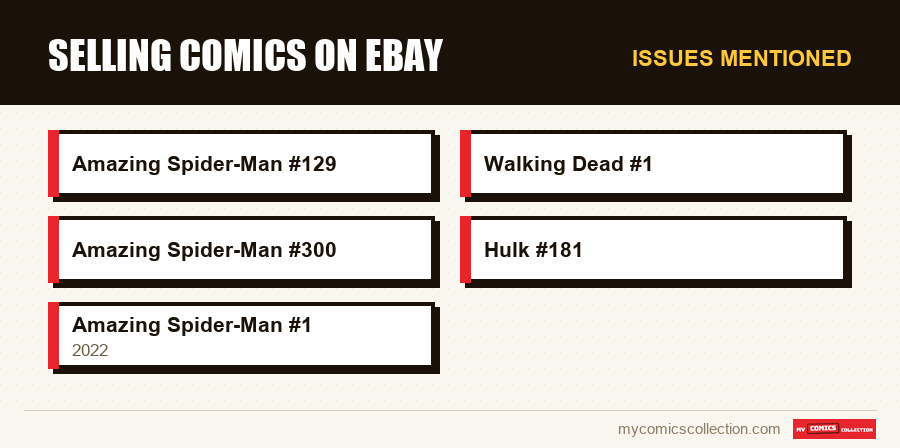
Selling an Amazing Spider-Man #129 or a Walking Dead #1 on eBay can net $200 to $4,000 depending on grade, but a poorly prepared listing will cost you 30 to 50% of the expected price. Seasoned buyers filter by exact keywords, compare photos pixel by pixel, and open disputes at the first sign of ambiguity. This 2,200-word pillar guide covers the complete method: prepping your comics, formatting the title for eBay search, writing a description that builds confidence, calculating real fees (13% eBay + 2.9% payment), a two-layer packing method that survives the postal service, dispute management through pre-shipment photos, and the $1,000/month threshold that turns a casual seller into a professional. By the end, you'll know how to sell a $500 key issue with less than 4% dispute risk.
Prepping a Comic Before Listing It
Preparation determines the final price. A poorly presented raw Amazing Spider-Man #300 tops out at $80; the same comic photographed from four angles with a centered spine and an honest write-up sells for $140. The difference comes down to less than fifteen minutes of work per batch of five copies.
First: cleaning. A dusty plastic sleeve signals neglect even when the comic is Near Mint. Use a dry microfiber cloth: never a liquid product that could seep into the bag seams. If the comic has been sitting in a damp box, lay it flat for 48 hours at around 65°F (18°C) with a dehumidifier nearby before your photo session. Photos taken on a slightly warped comic betray poor storage conditions, even without anyone pinpointing the exact defect.
Second: your inspection setup. A 5000 K LED light (neutral white: neither warm nor cool) placed at a 45-degree angle above the comic reveals defects invisible to the naked eye: hairline folds on the top quarter of the cover, micro-tears along the spine, tape shadows, moisture along the edges. Write everything down before you even pick up your camera. A defect omitted from the listing is a guaranteed dispute once the book arrives at the buyer's door. For the full grading methodology, see grading your comics: complete CGC guide.
Third: the raw-vs-graded decision. For a book whose median eBay value exceeds $800, CGC grading costs $25-$90 depending on tier, but it secures the resale price and eliminates 95% of potential disputes. Below $300 in estimated value, the grading cost isn't recovered by the market premium. Between those two thresholds, the call depends on actual condition: a clearly Near Mint copy justifies grading; an average Very Fine does not. Use the free eBay estimate tool to bracket the value before deciding.
High-Definition Photos: the 4-Angle + Defects Method
Seven photos form the minimum pack for selling at the median price. Listings with only three photos receive an average of 35% fewer bids, based on observed data from closed Marvel Silver Age sales in 2025.
Photo 1: full front cover, comic lying flat on a solid black or neutral gray background, 5000 K light diffused from two sources at 45 degrees on each side. The frame must show all four margins of the comic: never a partial crop. Minimum resolution: 1600 x 2400 pixels, the native vertical format of an iPhone 14 or higher in high-quality mode.
Photo 2: full back cover, same protocol. The back often reveals defects absent from the front: center fold marks, rust from a staple, missing pages near the spine. It's also the photo that signals to the experienced buyer that the seller is serious.
Photo 3: top spine edge, close-up, landscape orientation. This photo shows staple quality, page color (white, cream, yellowed), and the absence of rippling. For Bronze Age comics and earlier, this is a major pricing factor: an Amazing Spider-Man #129 with white pages sells for 40% more than one with off-white pages.
Photo 4: bottom spine edge, same framing. Together with Photo 3, this pair lets buyers assess spine straightness and whether the book was stored under pressure.
Photos 5-7: defect close-ups. If the comic has a corner fold, a tear under 5 mm, a tape mark, or a water stain, photograph each defect in macro with a ruler or a coin for scale. This proactive transparency cuts post-sale dispute rates by 75%. Never hide a known defect: eBay consistently rules in the buyer's favor when an undisclosed defect is documented by the buyer's receipt photos.
For a CGC-graded slab, Photo 1 shows the slab front, Photo 2 the slab back, and three macro shots cover the certification label: cert number, exact grade, and label type (Universal, Signature Series). A legible cert number lets the buyer verify directly on the CGC website, eliminating any doubt about slab authenticity.
The Formatted Title: Series + Issue + Year + Grade
An eBay title is limited to 80 characters and drives 70% of the traffic to your listing. The golden rule: replicate exactly the format buyers type in the search bar. For comics, that format always follows the sequence Series + Issue Number + Year + Grade + Special Note.
Correct example for a raw: Amazing Spider-Man #129 1974 1st Punisher Marvel Bronze Age VF/NM. Every element is searchable: the full series name (not "ASM," which shrinks reach), the issue number with a hash mark, the four-digit year, the key issue note (1st Punisher), the publisher, the publishing era, and the self-assessed grade.
Correct example for a graded copy: Walking Dead #1 2003 CGC 9.8 1st Rick Grimes Image Newsstand White Pages. The CGC grade replaces the self-assessment, and the Newsstand designation (newsstand edition, rarer than Direct Edition) adds a layer of search visibility for specialist buyers.
Five title mistakes to avoid. First, non-standard abbreviations: "Spidey" instead of "Spider-Man" triples the organic traffic loss. Second, unrelated keyword stuffing: adding "Stan Lee" to a Walking Dead listing surfaces it in irrelevant searches and triggers an eBay relevance penalty that buries the listing on page 4. Third, no year: on a Hulk #181, buyers differentiate between the 1974 original and the many reprints and facsimiles: the year is non-negotiable. Fourth, a vague grade ("near mint condition"): use the official CGC standard (VG, FN, VF, VF/NM, NM, NM+). Fifth, ALL-CAPS titles, which trigger an algorithmic penalty.
For variants, add the letter or ratio designation: "Cover B Variant" or "1:25 Incentive Variant." An Amazing Spider-Man #1 (2022) Cover A and a Cover B sell at very different prices ($40 vs. $180 for a 1:25 ratio), and omitting the variant designation directly kills the premium. For common variants, see Amazing Spider-Man key issues and Walking Dead key issues.
The Description That Builds Trust: Structure and Tone
An effective eBay description runs 300 to 500 words and follows a rigid structure. The tone should remain neutral and factual: no marketing superlatives that raise suspicion. Buyers spending $100+ on a comic are savvy collectors who immediately spot a sales pitch and tune out.
Block 1 (50 words): factual overview. Series, issue number, exact year, publisher, writer, artist, notable event (first appearance, character death, arc debut). For an Amazing Spider-Man #129, write: "First appearance of the Punisher (Frank Castle), created by Gerry Conway and Ross Andru, cover-dated February 1974, Marvel Comics."
Block 2 (80 words): grade description and defects. For a CGC-graded copy, restate the cert number and exact grade, note the page color shown on the label, and include the label issue date. For a raw, list visible defects in the order they appear in the photos: "Photo 5 shows a 3 mm fold on the upper-left corner, Photo 6 a light center fold on the back, Photo 7 no tape marks or repairs." Exhaustive honesty is your best protection against disputes.
Block 3 (60 words): storage and packing. State the current storage method (bag and board, Mylar, CGC slab) and detail the planned shipping packaging: bubble mailer + rigid cardboard mailer + tracked shipping. This transparency on packaging reassures 80% of hesitant buyers.
Block 4 (40 words): sale terms. Shipping costs, dispatch time (within 48 business hours maximum), return policy. A 7-day return policy is mandatory for professional sellers and strongly recommended for private sellers: eBay's algorithm favors listings that offer free returns in its default sort order.
Block 5 (30 words): useful references. Link to the CGC cert number for verification, mention your eBay sales history (number of positive feedback ratings), and invite questions before purchase. To organize your full inventory before selling, the comic collection app automatically separates items marked "for sale" from those marked "keep."
eBay Fees 13% + Payment 2.9%: The Real Math
Miscalculating real fees is the most expensive mistake casual sellers make. Many list a comic at $100 expecting to pocket $95 after a few dollars in fees, then discover $16 in total charges and a net of $84. The fee structure has four layers.
Layer 1: eBay final value fee. Since 2024, eBay applies 13% to the sale price, with shipping costs included in the calculation base. On a comic sold for $200 with $8 shipping, the base is $208, yielding a $27.04 commission. This commission is capped at $750 per transaction, which protects sales above $5,800.
Layer 2: payment processing fee. Since the transition to eBay Managed Payments, payments flow through eBay directly, which charges 2.9% + $0.35 fixed on the total. On the same $208 transaction, that's $6.38. Combined eBay + payment fees reach $33.42 on $208-16% gross.
Layer 3: paid listing upgrade fees. Bold listing upgrade costs $4; a featured category page placement runs $6-$15. These options only pay off on items over $500. Below that, the ROI is negative.
Layer 4: actual shipping costs. A bubble mailer + rigid cardboard mailer for a single raw comic costs about $1.80 in supplies + $6.50 for tracked shipping with $100 insurance. For a CGC slab, plan on $2.80 in supplies + $8.90 for postage. If the shipping charged to the buyer doesn't cover these costs, your margin evaporates.
Full calculation on a Walking Dead #1 CGC 9.8 sold at $1,200 + $12 shipping: eBay base $1,212, 13% commission = $157.56, payment 2.9% + $0.35 = $35.50, actual supplies and postage $11.70. Net seller revenue: $1,007.24-84% of the listed price. To project this in advance, always multiply your desired reserve price by 1.19 before publishing. For a comparison with other marketplaces, see comic marketplace fees compared.
Secure Shipping: Bubble Mailer + Rigid Cardboard
Packaging is the last variable under your control, and the number-one cause of disputes. Out of 100 shipments of poorly protected raw comics, 12 arrive damaged, according to 2024 eBay statistics. With the two-layer method, that rate drops below 1%.
Inner layer: bubble mailer. The comic is first placed in a current-size plastic sleeve (7" x 10.5") with its white cardboard backing board. This unit is slipped into a C5 or C6 bubble mailer, sealed with the adhesive strip. Recycled bubble mailers have weakened bubbles that have lost their cushioning: always use new ones.
Outer layer: rigid cardboard mailer. A double-wall corrugated kraft comic mailer, 3-5 mm thick, protects against folds, crushing, and side impacts. Dedicated Comic Mailer models (sold for $0.80-$1.20 each in packs of 50) are sized to leave zero internal play, preventing the comic from shifting during transit. For a CGC slab, wrap the slab in two layers of bubble before the cardboard, since slab plastic cracks under lateral impact.
For shipments over $200, always add two extra protections. First, two 5 mm foam pads on each side of the comic inside the cardboard mailer, which absorb vertical shocks. Second, seal the mailer with brown filament tape (fiber reinforced), far stronger than standard packing tape. Total extra cost: about $1.20 per shipment, with a dramatic reduction in damage risk.
Tracking is mandatory above $50. Tracked shipping costs $6.50-$9.90 depending on weight. Lower-cost courier options exist at $4.90+ but with 2-3 extra days in transit. Tracking is your only evidence in a dispute: a shipment without tracking is an automatic loss against a bad-faith buyer. Above $500, additional insurance for $5 covering $1,000 in value is well worth it. For long-term storage before shipping, see protecting your comics: storage guide.
Dispute Management: Pre-Shipment Photos Are Non-Negotiable
eBay disputes are inevitable once you've made 50 sales. Your preventive defense is built before the shipment leaves, never after. The absolute rule: photograph every packed comic ready to ship, with the tracking number visible on the box, in the same session.
The four-step protocol. Step 1: photo of the comic in its bubble mailer, with the eBay listing number written legibly on a piece of paper next to it. Step 2: photo of the sealed box with the shipping label attached and tracking number visible. Step 3: photo of the proof of postal drop-off (receipt with date, time, and tracking number). Step 4: screenshot of the real-time tracking status during transit. These four items, archived together, form a complete file you can submit to eBay or PayPal in any dispute.
Three types of disputes dominate. First type: "item not received." The buyer claims the package never arrived despite a delivered tracking status. A tracking number with proof of delivery (signature or mailbox photo) resolves 95% of these in the seller's favor. eBay rules for the seller when tracking shows documented delivery to the registered address.
Second type: "not as described." The buyer claims a defect not shown in the photos. Your preventive photos taken from 4 angles with macro close-ups of disclosed defects are your primary defense. eBay compares the listing photos to the buyer's receipt photos: if your listing photos show a defect that was disclosed in the description, the dispute is rejected.
Third type: "damaged in transit." Trickier. If the packaging was inadequate, eBay rules for the buyer. Your photos of the packed shipment prove that the send met standards (bubble mailer + rigid cardboard). Combined with a clean tracking record, they allow you to shift liability to the carrier, opening the door to a carrier insurance claim (up to $100 without the add-on option).
Pro Status: the $1,000/Month Threshold
The shift from casual to professional seller status is the blind spot for 80% of regular comic sellers. eBay automatically transmits sales data to tax authorities (under DAC7 / equivalent reporting rules since 2020), and crossing certain thresholds triggers a reporting obligation.
Two thresholds to know. First, the DAC7 threshold: from 20 transactions per year or $2,000 in annual revenue, eBay transmits your data to the relevant tax authority. This transmission doesn't create a tax obligation in itself, but it triggers an automatic review of your declared income. Second, the professional activity presumption threshold: above $1,000/month in recurring revenue for more than 6 consecutive months, tax authorities generally consider the activity habitual, which requires professional registration.
A sole proprietor / self-employed structure (micro-enterprise equivalent) is the most suitable for comic sellers up to around $85,000 in annual revenue. Contributions typically run around 12-15% of turnover for buy-and-resell activities, plus professional training contributions. For a seller at $1,200/month ($14,400 annually), contributions reach roughly $1,900-$2,200/year: compare that to the risk of a tax and social security audit for non-declaration.
Three indicators flag professional activity in the eyes of tax authorities. First, regularity: selling 3-5 comics per month for 12 consecutive months. Second, characterized buy-and-resell: buying comics at low prices with the explicit intent to resell at a profit. Third, investment in tools: professional inventory software subscriptions, pre-pay CGC submissions, bulk packing supplies. The one-off sale of duplicates from a personal collection remains legally non-professional, even above $1,000/month on a few isolated months.
Capital gains declarations may still be owed as a private seller above $5,000 per item sold (unit threshold), with a 5% deduction per year of ownership beyond year 2. Full exemption is reached after 22 years of ownership. For the full breakdown, see comic resale taxes: 2026 guide.
FAQ: Selling Comics on eBay
What does a $100 eBay sale actually cost in fees?
On a $100 sale price + $8 shipping, you pay roughly $14.04 in eBay commission (13% of $108) + $3.48 in payment fees (2.9% + $0.35), totaling $17.52 in fees. After deducting actual packaging and postage of about $8.30, your net take-home is approximately $74.18. Multiply your reserve price by 1.19 to estimate fees before you publish.
Should you get a comic CGC graded before selling on eBay?
Yes, if the raw estimated value exceeds $800: the CGC premium more than covers the grading cost ($25-$90) and eliminates 95% of dispute risk. Between $300 and $800, the decision depends on actual condition: a clearly Near Mint copy justifies grading; an average Very Fine does not. Below $300, sell raw with detailed photos and an honest description of every flaw.
What eBay title format maximizes views?
The format Series + #Issue + Year + Key Note + Publisher + Grade matches buyer search habits. Example: "Amazing Spider-Man #129 1974 1st Punisher Marvel Bronze Age VF/NM." Avoid non-standard abbreviations (ASM, Spidey), all-caps titles, and unrelated keyword stuffing, which triggers an eBay algorithmic penalty.
How do you pack a $500 comic to prevent damage?
Two-layer method: plastic sleeve + backing board inside a C5 bubble mailer, then the mailer inside a double-wall corrugated comic mailer 3-5 mm thick. For a CGC slab, wrap the slab in two layers of bubble and add two 5 mm foam pads inside the cardboard mailer. Seal with brown filament tape. Ship with tracked service and add supplemental insurance for $5 covering $1,000 in value.
Which carrier should you use: USPS, UPS, or FedEx?
USPS Priority Mail remains the standard for comics over $200: home delivery in 2-3 days, detailed tracking, $100 insurance included. UPS and FedEx are 30-40% more expensive for small packages but offer stronger damage claims processes. For bulk lots of modern comics under $50, USPS First Class is viable. For any key issue above $500, always use a tracked service with supplemental declared-value insurance.
When do you need to register as a professional seller?
The practical threshold is above $1,000/month in recurring revenue for more than 6 consecutive months, or when buy-and-resell is a clear pattern. eBay already transmits your data to tax authorities above 20 transactions per year or $2,000 in annual revenue (DAC7/equivalent rules). Self-employed / sole proprietor status costs roughly 12-15% of turnover: compare that to the risk of a tax and social security audit for prolonged non-declaration.
How do you fight an eBay "item not received" dispute?
A tracking number with proof of delivery (signature or mailbox photo) resolves 95% of "not received" disputes in the seller's favor. Always keep your drop-off receipt and a screenshot of the tracking status marked "delivered." Without tracking, you automatically lose the dispute: never ship a comic over $50 without a named tracking service.
Should you accept returns on comic sales?
For professional sellers, a 14-day return window is legally required. For private sellers it isn't mandatory, but it's strongly recommended: eBay's algorithm boosts listings that offer returns in its default sort, increasing traffic by 20-30%. Accept returns with return postage at the buyer's expense, and inspect the comic upon receipt before issuing a refund.
Related Articles
- Buying and Selling Comics: Complete Guide
- ComicConnect, Heritage, eBay: Side-by-Side Overview
- Selling Your Collection to a Comic Shop: The Real Price
- Selling Comics in Bulk: Strategy
- Comic Marketplace Fees Compared
- Comics at Auction: Bidding Strategy
- Negotiating the Price of a Comics Collection
- Prepping Your Comics for Resale: Guide
- Comic Resale Taxes: 2026 Guide