
Here is the Secret Empire reading order: start with Captain America: Steve Rogers #1 (2016), then read the prelude and opening issues, the main series by Nick Spencer (Marvel, April to August 2017: a #0, ten issues, then Secret Empire Omega #1, drawn by several artists including Steve McNiven, Leinil Francis Yu and Andrea Sorrentino), and finally the tie-ins. Slot in the issues Spencer wrote for Captain America, then the crossover's miniseries.
Few recent Marvel events are read across as many series at once: a single writer holds the reins of the main series and of several Captain America titles, while some twenty neighboring series offer their own take on the same crisis. This page gives you a path that keeps the essentials and leaves the rest to your completist appetite.
As always on this guide, we only state verified facts (creators, issues, dates); the analysis is our own, with no reproduction of protected art or dialogue.
What to read first
An event of this size assumes a long setup. Here, it comes mostly from two monthly series written by Nick Spencer, launched before the crossover and carried right up to it. Here are the landmarks, from most useful to most optional.
- Captain America: Steve Rogers #1 to #16 (starting in 2016): the series is written by Nick Spencer, following on from Avengers: Standoff! (2016), by the same writer. It is the essential prelude: issue #1 sets up the starting situation. Spoiler warning: from that very first issue, the hero of this series appears in the ranks of Hydra, and the whole event flows from that editorial choice.
- Captain America: Sam Wilson, especially #7 and #8: this parallel series, also written by Nick Spencer, ends with issues #22 to #24, which are tied to the crossover. It follows the other bearer of the shield, and provides the moral counterpoint the crossover builds on.
- The three "opening" issues: Captain America: Steve Rogers #15, Thunderbolts vol. 3 #12 and U.S.Avengers #5 are presented as the direct lead-in to the event. If you are not reading the full series, these three issues are the minimum to slot in.
- Secret Empire Prelude: this May 2017 collection gathers Captain America (vol. 7) #21 and #25, Captain America: Sam Wilson #7 and #8, the stories Assault on Pleasant Hill Alpha and Omega, as well as Captain America: Steve Rogers #1 and #2. It is a handy entry point if you prefer a single volume.
The reader in a hurry can settle for Steve Rogers #1 and #2, then the three opening issues: that is enough for the main series' #0 to make sense without reading anything else.
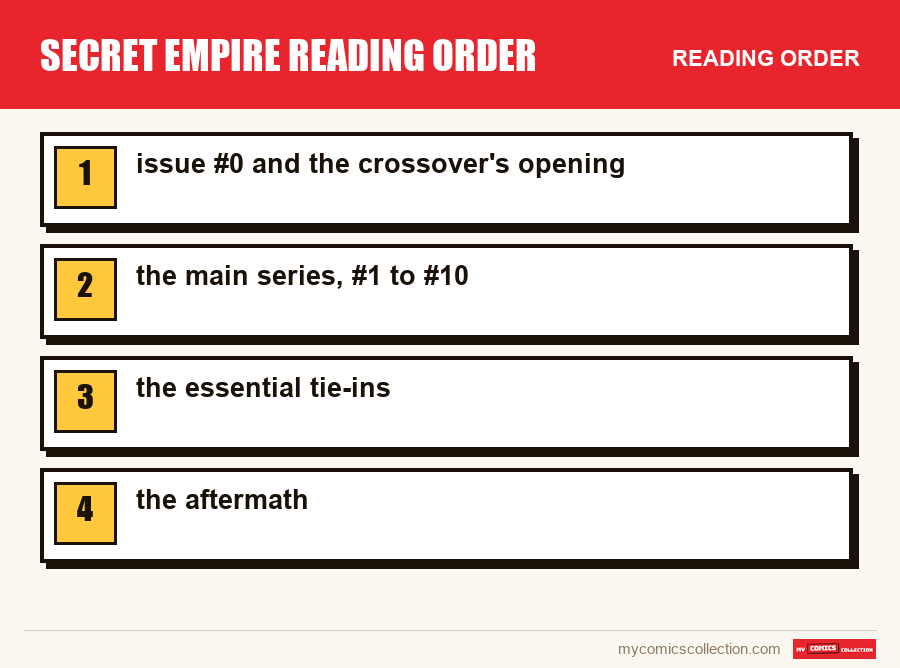
Phase 1: issue #0 and the crossover's opening
Secret Empire #0 came out on April 19, 2017 and serves as a prologue: it precedes issue #1, released on May 3, 2017, by two weeks. Read it before #1, and don't skip it just because it carries a zero. The main series runs from April to August 2017, with Nick Spencer writing from start to finish.
The art is shared among several artists. Rod Reis, Daniel Acuña, Steve McNiven, Leinil Francis Yu and Andrea Sorrentino split the pages of the series. Keep in mind that the miniseries changes hands several times: the contrast in styles is part of the reading experience.
The titles launched before the crossover keep coming out during those weeks. If you read the opening issues in cover-date order, you arrive at #1 with the full context.
Phase 2: the main series, #1 to #10
The simplest approach is to split the miniseries into three reading blocks, following the issue numbering alone:
- Block A, #1 to #3: the setup. This is where you decide whether or not to add the tie-ins: if you only want one block of miniseries at this stage, take Secret Empire: Brave New World #1 to #5.
- Block B, #4 to #7: the middle of the series. The issues of the Captain America series (see below) are read in sequence, by cover date.
- Block C, #8 to #10: the end of the event. Finish the main series before opening an aftermath collection, so as not to spoil the conclusion.
To keep the count straight, the safest way is to look for the "#0 to #10" mention on a collected edition; that is what the Secret Empire collection released in July 2018 contains, and it also gathers Secret Empire Omega #1 and Captain America #25.
Phase 3: the essential tie-ins
The list of tie-ins is long. We only keep those that directly extend the Captain America series written by the event's writer, or that make up a dedicated miniseries.
- Captain America: Steve Rogers #17 to #19: the last three issues of that series, which tie into the crossover. They are written by Nick Spencer.
- Captain America: Sam Wilson #22 to #24: the last three issues of the Sam Wilson series, also written by Nick Spencer.
- Captain America #25: this issue is a direct tie-in and is also included in the 2018 Secret Empire collection.
- Secret Empire: Brave New World #1 to #5: a five-issue miniseries tied to the event.
- Secret Empire: Underground #1, Secret Empire: United #1 and Secret Empire: Uprising #1: three one-shots you can read in an afternoon.
- Secret Warriors vol. 2 (2017) #1 to #5: a series launched in 2017, tied to the event.
For the team books, the method is this: read the tie-in when its cover date falls between two issues of the main series. Online catalogs let you sort by date; sorting by cover date avoids the mistakes that alphabetical lists produce.
Phase 4: the aftermath
Several titles come out after the end of the miniseries and carry its effects forward. The most important is Secret Empire Omega #1, which closes the main story. Next come:
- Avengers vol. 7 #11, Champions vol. 2 #12, U.S.Avengers #10 and Deadpool vol. 6 #36, which extend team or character series;
- Secret Warriors vol. 2 #6 and #7, the direct follow-up to the series launched in 2017;
- Uncanny Avengers vol. 3 #26 and #27, and Black Bolt #8;
- Tales of Suspense #100 to #104, and The Punisher, vol. 11 (#218 to #228) then vol. 12 (#1 to #16).
For a reader interested only in Captain America, Secret Empire Omega #1 is enough. The other titles on this list are for those who already follow those series.
Do you collect this series?
Track what you own, what you are missing and what your collection is worth. 7-day trial.
Start my trial →
The tie-ins you can skip
Skipping a Secret Empire tie-in does not mean missing out on a bad comic: each one tells the crisis as seen from another series, without changing the thread Nick Spencer holds. Among the linked titles, those that mostly show the event's effect on a given team or character can wait: The Amazing Spider-Man vol. 4 #29 to #31, Avengers vol. 7 #9 and #10, Champions vol. 2 #10 and #11, Deadpool vol. 6 #31 to #35, Doctor Strange vol. 4 #21 to #24, Mighty Captain Marvel #5 to #8, X-Men Blue #7 to #9 and X-Men Gold #7 and #8.
The reason is simple: each of these blocks belongs to a series with its own continuity, which reads better in context (the full volume) than cut into pieces. If you already follow one of these series, read its block when you get there. Otherwise, don't force yourself: the main story remains understandable without them.
The more anecdotal titles, such as Not Brand Echh #14 or All-New Guardians of the Galaxy Annual #1, are a matter of completist curiosity.
Single issues or trade paperbacks: how to read it
Two approaches compete, and the right one depends on what you collect.
In single issues. You follow publication order, which reproduces the experience at the time: #0 came out two weeks before #1, and the tie-ins arrive in parallel. Plan on a printed checklist, because the series cross over. One tip: check off each block of issues after reading, and note the ones missing from your box before you start.
In trade paperbacks. Two verified volumes open the way: Secret Empire Prelude (May 2017) for the setup, and the Secret Empire collection (July 2018), which contains Secret Empire #0 to #10, Secret Empire Omega #1 and Captain America #25. The Captain America: Secret Empire collection (2017) gathers the six issues of the two Captain America series that tie into the event. For the other tie-ins, look for the collections by series, and check the table of contents before buying: one volume's contents may not match another's list of issues.
In every case, reread the opening issues before #0 and keep the aftermath for the end.
The key issues to know
Here is a method for spotting them rather than a ranking.
- Captain America: Steve Rogers #1 (2016): the founding issue, the one that launches the series from which everything flows. It interests the collector as the starting point of a story cited everywhere.
- Secret Empire #0 and #1: the opening of the main series. The main cover of #1 is by Mark Brooks; spot it before buying a variant.
- The last issue (#10) and Secret Empire Omega #1: the end of the story is often the part you find least easily in a complete lot.
To value a copy, look first at its condition and its cover version, then compare it to several completed sales rather than to listings.
Recap: the complete order
- Captain America: Steve Rogers #1 and #2 (2016)
- Captain America: Sam Wilson #7 and #8, Captain America vol. 7 #21 (optional, collected in Secret Empire Prelude)
- Captain America: Steve Rogers #15, Thunderbolts vol. 3 #12, U.S.Avengers #5 (opening)
- Secret Empire #0 (April 19, 2017)
- Secret Empire #1 to #3
- Secret Empire: Brave New World #1 to #5
- Captain America: Steve Rogers #17 to #19 and Captain America: Sam Wilson #22 to #24
- Secret Empire #4 to #7
- Secret Empire: Underground #1, United #1, Uprising #1
- Captain America #25
- Secret Empire #8 to #10
- Secret Empire Omega #1
- Aftermath of your choice: Avengers vol. 7 #11, Secret Warriors vol. 2 #6 and #7, U.S.Avengers #10
Frequently asked questions
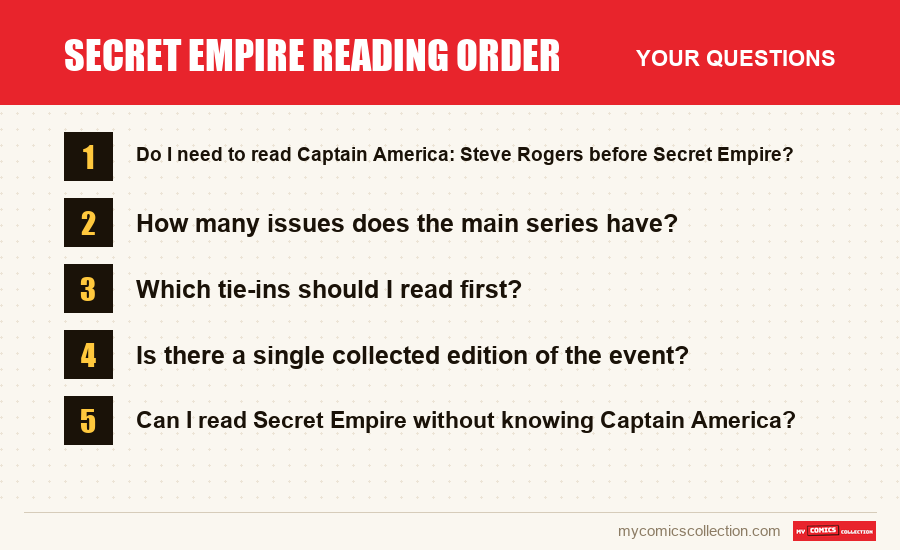
Yes for the first two issues and for the opening issues: they set up the event's starting point. The series runs through #19, but a reader in a hurry can limit themselves to #1, #2 and #15, then move on to the main series' #0.
The main series has ten issues, preceded by a #0 released on April 19, 2017, and continues with Secret Empire Omega #1. It is written by Nick Spencer and drawn by several artists, including Steve McNiven, Leinil Francis Yu and Andrea Sorrentino. It ran from April to August 2017.
Priority goes to the Captain America issues written by Nick Spencer: Steve Rogers #17 to #19 and Sam Wilson #22 to #24, plus Captain America #25. Then add the miniseries Secret Empire: Brave New World #1 to #5. The other titles can wait until you follow the series in question.
The Secret Empire collection, released in July 2018, contains Secret Empire #0 to #10, Secret Empire Omega #1 and Captain America #25. It does not include every tie-in: for the side series, you need to look for each series' collections.
Yes, as long as you read Captain America: Steve Rogers #1 first: without that issue, the context of the main series stays murky. The rest makes sense by reading the opening issues, then the main series in order, from #0 to #10.
Your Secret Empire and Captain America: Steve Rogers single issues deserve a serious valuation before they go into a lot.
Estimate my comic