The most undervalued Sandman issue is, without question, The Sandman #1 ( Sleep of the Just, January 1989), Neil Gaiman's very first chapter: an €8 eBay median across 76 active listings (our estimator, June 2026). For the founding issue of a landmark series, that's almost nothing. #2 and #4 (Lucifer's appearance) follow at the same price level. Here's where the gap between value and significance is widest.
Gaiman's Sandman is Morpheus, one of the Endless, and a 1989 character: Copper/Modern age. So there is no "Silver Age" or "Bronze Age" grail of this series: every issue dates from 1989-1996. That's exactly what keeps the hunt accessible.
This guide sticks to the verifiable: real-time eBay medians (all editions and grades combined) and documented facts. When a listing count is too low for a figure to be reliable, we say so, and stay qualitative rather than inventing it.
The undervalued Sandman issues (real values, June 2026)
Values = median of active eBay listings, all editions and grades combined (our estimator, eBay.fr + eBay.com). We only treat a figure as a "precise value" when an issue has at least 15 listings; below that the sample is too thin and we flag it.
| Issue | Significance | eBay median | Verdict |
|---|---|---|---|
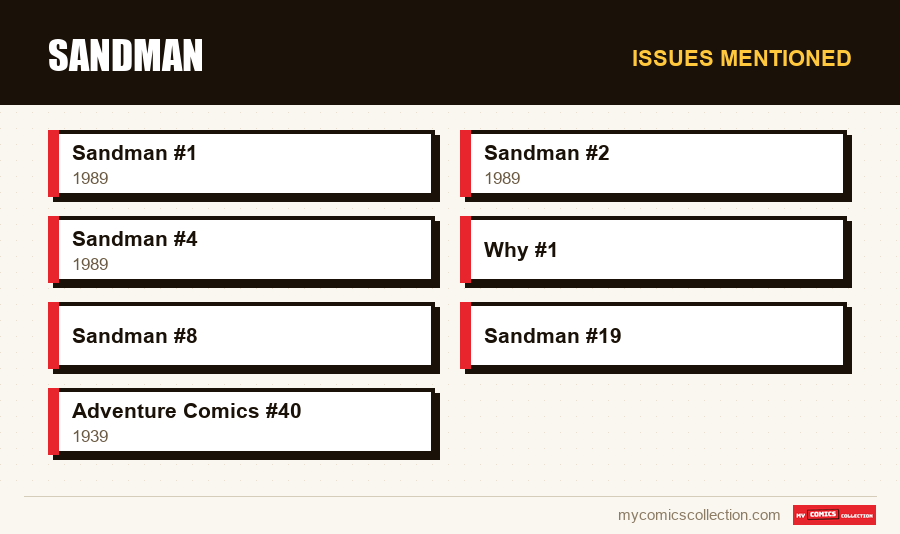
| Sandman #1 (Jan 1989) | First issue, Sleep of the Just | €8 · 76 listings | Undervalued |
| Sandman #2 (1989) | Direct continuation of the opening arc | €8 · 29 listings | Undervalued |
| Sandman #4 (1989) | Lucifer's appearance | €6 · 16 listings | Undervalued |
All three trade for the price of a current newsstand comic, yet they open one of the most awarded series in the medium's history. That's the textbook definition of undervalued.
Why #1 is the best significance-to-price ratio
- The starting point of everything. Sleep of the Just introduces Morpheus and the entire mythology of the Endless. No other issue carries that founding weight.
- High liquidity. 76 active listings: you can find one at any time, which keeps the median low (€8) and makes buying at fair price easy.
- The spread is in the grade. The "all grades combined" median is pulled down by raw copies; our estimator's range runs from €5 (low grade) to €37 (top end). A high-grade CGC slab changes the whole equation: always check condition before buying.
Key issues where the value is misleading
Two major chapters deserve a mention, but with an honest caveat on the numbers.
- Sandman #8: first appearance of Death, Morpheus's sister. Our estimator shows a median around €66, but on just 8 listings: the sample is too thin to be a reliable value, so treat it as indicative only. On the documented-record side, a CGC 9.2 editorial variant from Neil Gaiman's own collection reached $5,040 at Heritage Auctions: a different order of magnitude, reserved for exceptional graded copies.
- Sandman #19:A Midsummer Night's Dream. It's the only comic ever to win the World Fantasy Award (Best Short Story, 1991). Our estimator lists only 3 copies: no way to derive a serious value from that. Here, historical reach, not raw price, is what makes it rare, and what makes it an issue to secure while it stays affordable.
The "era" nuance to know (and not confuse)
If someone offers you a "Golden Age" or "Bronze Age" Sandman, be careful: that is not Gaiman's character.
- Wesley Dodds, the Golden-Age Sandman (the man with the gas mask and the sleeping-gas gun), debuts in Adventure Comics #40 (July 1939). He's an entirely separate character.
- The 1974 Sandman (Garrett Sanford), created by Jack Kirby and Joe Simon, is yet another character, from the Bronze Age.
- Morpheus's series runs 75 issues (1989-1996, DC then Vertigo). For that Sandman, the only true keys are #1, #8 and #19: all post-1989.
Own a Sandman comic? Get a free valuation with our tool based on real eBay sales to find its low, median and high value.
Reading and collecting Sandman arc by arc
Neil Gaiman's series runs 75 issues published between 1989 and 1996, first at DC then under the Vertigo imprint. It was designed in relatively self-contained chapters, which makes it an ideal title to collect by arcs rather than issue by issue. Here is the structure as the collected editions follow it, with the corresponding issue ranges.
The nine major cycles
- Preludes & Nocturnes (#1-8): the opening, from Sleep of the Just to Death's first appearance in #8.
- The Doll's House (#9-16): the cycle that widens the universe of the Endless.
- Dream Country (#17-20): four standalone episodes, including A Midsummer Night's Dream (#19).
- Season of Mists (#21-28): a long arc centered on Hell.
- A Game of You (#32-37): a more intimate story, with new characters.
- Brief Lives (#41-49): a quest that places Morpheus face to face with his family.
- Worlds' End (#51-56): a collection of tales told in an inn.
- The Kindly Ones (#57-69): the series' great cycle.
- The Wake (#70-75): the conclusion.
Between these cycles a few standalone episodes are interspersed, gathered in other collections: if you follow only the nine cycles, you miss some issues.
A collection that is easy to split up
The first cycle, Preludes & Nocturnes, already gathers the three most useful issues for a starter collection: #1 as the entry point, #4 for the appearance of Lucifer and #8 for Death. You can therefore start small, see whether the series suits you, then continue cycle by cycle without ever ending up with an incoherent collection.
Three markers for buying without mistakes
Do not confuse the Sandmen. Wesley Dodds debuts in Adventure Comics #40 (July 1939), and the 1974 Sandman, Garrett Sanford, is a creation of Jack Kirby and Joe Simon. They are distinct characters from Morpheus: an issue labeled "Sandman" does not by itself tell you which one it is.
Check the date. The whole Morpheus series dates from 1989-1996. A listing mentioning a "Silver Age" or "Bronze Age" concerns another character.
Keep the gap between importance and price in mind. A historic issue, like #19, the only comic to have won the World Fantasy Award, remains accessible because the series is old and widely reprinted. Securing these pieces before renewed interest makes them scarcer is the simplest strategy.
Frequently asked questions
The Sandman #1 (Sleep of the Just, January 1989), Neil Gaiman's very first episode. For the founding issue of a cult series, its price is derisory, and #2 and #4 follow at the same level.
It is the first appearance of Death, Morpheus's sister. An editorial variant copy from Neil Gaiman's personal collection reached a documented record, but the everyday market remains far below it.
A Midsummer Night's Dream is the only comic to have won the World Fantasy Award (Best Short Fiction, 1991). Its historic significance, not its raw price, makes it a piece to secure.
Not for Gaiman's character: his series has 75 issues from 1989 to 1996. Wesley Dodds, the Golden Age Sandman, debuts in Adventure Comics #40 (July 1939), and the 1974 Sandman is Garrett Sanford, created by Jack Kirby and Joe Simon.
Morpheus is one of the Endless and the hero of Neil Gaiman's series. Sleep of the Just introduces his character and the whole mythology of the Endless.