To collect Neil Gaiman's The Sandman , you're after the 75-issue run (January 1989 to March 1996, DC then Vertigo) plus the specials. In singles, the entry point stays very accessible: Sandman #1 shows an €8 eBay median across 76 active listings (June 2026, all editions and grades combined). The one genuine priced key is Sandman #8, the first appearance of Death of the Endless. Here's the roadmap, grounded in real values.
Gaiman's Sandman (Dream, or Morpheus, one of the Endless) is a 1989 character: Copper/Modern age. That means there is no "Silver Age" or "Bronze Age" issue of HIS series: don't go hunting for a 1960s grail under this name, it doesn't exist (see the nuance below). The good news for collectors: almost the entire run is affordable, and the real challenge is completeness and format rather than chasing a rare key.
This guide sticks to the verifiable: real-time eBay medians via our estimator, and documented publishing facts. When the listing count is too thin for a reliable median, we say so qualitatively rather than quoting a misleadingly precise figure.
The core run: 75 issues + specials
The heart of any Sandman collection is the continuous 75-issue run written by Neil Gaiman, launched in January 1989 at DC (#1, Sleep of the Just, art by Sam Kieth then Mike Dringenberg, covers and design by Dave McKean) and moved under the Vertigo imprint when it was created in 1993. The series ends with #75 in March 1996. Around that trunk orbit a set of specials and one-shots: The Sandman Special #1 (Orpheus), The Sandman: Endless Nights (2003), The Dream Hunters , and the prequel Sandman: Overture, published between 2013 and 2015.
The key issues to know (real values, June 2026)
Values = median of active eBay listings, all editions and grades combined (our estimator, eBay.fr + eBay.com). Watch the listing count: under 15, the median is indicative rather than a firm market price.
| Issue | Significance | eBay median | Reliability |
|---|---|---|---|
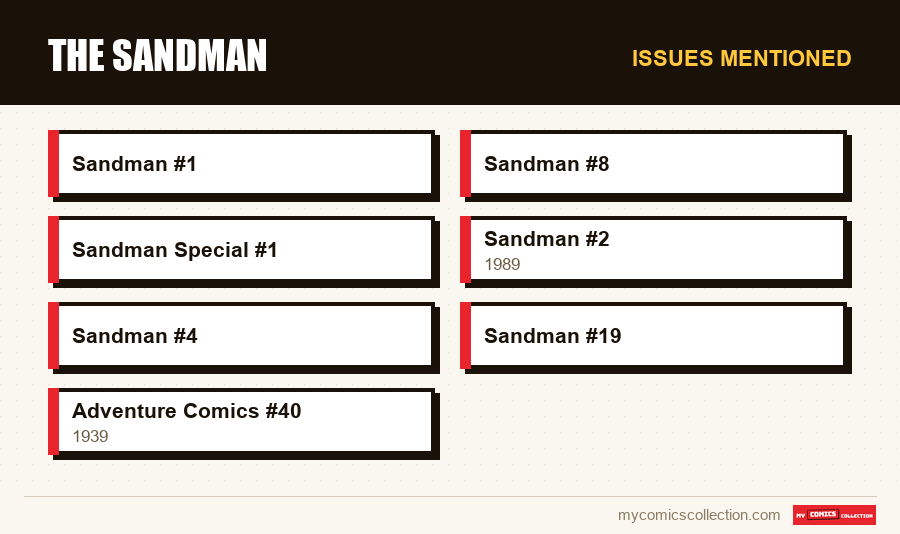
| Sandman #1 (Jan 1989) | First issue, Sleep of the Just | €8 · 76 listings | Solid |
| Sandman #2 (1989) | Direct continuation of the opening arc | €8 · 29 listings | Solid |
| Sandman #8 (1989) | First appearance of Death of the Endless | ~€66 · 8 listings | Thin volume: indicative |
Sandman #8 is the one issue that clearly stands apart: it's the first appearance of Death, Dream's sister and one of the series' most beloved characters. Its apparent median (~€66) rests on just 8 listings, though: too thin a sample to treat as a reference price. High-grade CGC copies run well beyond that; for this issue, always check the live value before buying. Sandman #4, which features Lucifer (and later inspired the spin-off series), stays very affordable. Sandman #19, A Midsummer Night's Dream, is historically major: it's the only comic ever to win a World Fantasy Award (Best Short Story, 1991), but that distinction doesn't translate into a premium on the singles market.
Singles, deluxe or omnibus: which format?
This is the real decision for a Sandman collector, because the story has been reprinted in nearly every format imaginable:
- The singles (75 issues). The "purist" format. Affordable, most issues sit around a few euros, but also the most time-consuming to complete, and the condition of 1990s copies is uneven.
- The 10 classic TPBs. The reference breakdown into ten volumes (Preludes & Nocturnes , The Doll's House , Dream Country , Season of Mists, etc.) covers the entire run. It's the cheapest and most readable way in.
- The Deluxe Edition (5 hardcovers). An oversized Black Label reprint that gathers the run into five books: a quality/price compromise many collectors appreciate.
- The Omnibus. The ultimate bricks: the complete collection in two large hardcover volumes (plus a third for expanded material). The most impressive on a shelf, but also the priciest.
Our practical advice: if you read, go for the TPBs or the Deluxe; if you chase the object and issue-by-issue completeness, do the singles and secure #8 and #1 first.
Important nuance: "Sandman" means three different characters
To avoid buying the wrong thing, know this trap: several distinct characters carry the Sandman name, and only Gaiman's issues concern Dream/Morpheus.
- Wesley Dodds, the Golden-Age Sandman, debuts in Adventure Comics #40 (1939). He's a gas-mask hero with no connection whatsoever to Morpheus.
- The 1974 Sandman, created by Joe Simon and Jack Kirby (Bronze Age), is yet another, separate character.
- Dream/Morpheus, Neil Gaiman's Sandman, only begins in 1989. No issue of his series exists in the Silver or Bronze age.
If a seller offers you a "vintage 1960s Sandman" while tying it to Gaiman, that's a confusion (or worse). Always verify the character and the year before paying.
Own a Sandman issue? Get a free valuation with our tool based on real eBay sales to find its low, median and high value.
Frequently asked questions
The main series has 75 issues, from January 1989 to March 1996, written by Neil Gaiman. It launched at DC and moved under the Vertigo imprint when it was created in 1993. Specials and spin-offs orbit this core.
The Sandman #1, "Sleep of the Just", has art by Sam Kieth then Mike Dringenberg, with covers and design by Dave McKean.
#8, the first appearance of Death of the Endless, Dream's sister and one of the series' best-loved characters. Its market is narrow: always check the price against recent sales, especially as graded copies go well beyond.
Singles are the purist format, accessible but slow to complete and uneven in condition for the 1990s. The 10 classic TPBs are the most economical and readable entry; the Deluxe Edition (5 hardcover books, Black Label imprint) is a quality-price compromise; the Omnibus is the most impressive but the most expensive. To read, TPB or Deluxe; for completeness, singles.
No. Three characters bear the name: Wesley Dodds, the gas-mask hero of the Golden Age (Adventure Comics #40, 1939), the Joe Simon and Jack Kirby Sandman (1974) and Dream/Morpheus, who only begins in 1989. If a seller ties a 1960s Sandman to Gaiman, it is a mix-up.