On Neil Gaiman's Sandman, CGC grading really only makes sense on two issues: #1 (1989, first appearance of Dream/Morpheus) and above all #8 (first appearance of Death of the Endless). Raw, #1 trades around an €8 eBay median (76 listings, June 2026); a high-grade CGC copy is worth a multiple of that. #8 is the series' one true grail. Here's when to grade, and when not to.
Sandman is a 1989 series (Copper/Modern age): every copy is relatively recent and well-printed, which makes high grades attainable, but also very common. So grading only pays where the value gap between a raw copy and a high-grade slab is real.
This guide sticks to the verifiable: live eBay medians (via our estimator) and documented records. When a sample is too thin (fewer than 15 listings) or a figure can't be verified, we state it qualitatively rather than inventing it.
An era nuance to settle first
Watch the trap: several characters are called "Sandman." The Golden-Age Wesley Dodds (first appearance in Adventure Comics #40, 1939) and the 1974 Kirby/Simon Sandman (Bronze Age) are different characters, unrelated to Gaiman's. Morpheus's Sandman has no issues in the Silver or Bronze ages: his series begins in 1989. This guide is only about that series.
The issues that justify CGC grading
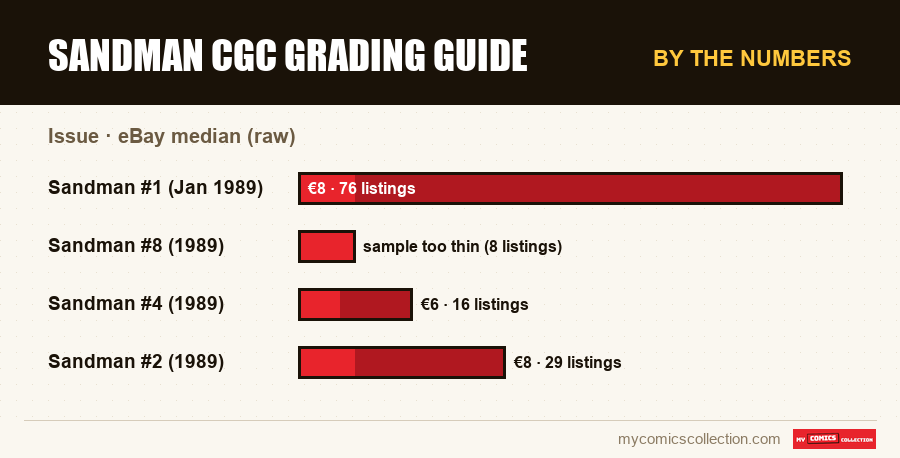
Raw values = median of active eBay listings, all editions and grades combined (our estimator, eBay.fr + eBay.com, June 2026).
| Issue | Significance | eBay median (raw) | Grade it? |
|---|---|---|---|
| Sandman #1 (Jan 1989) | First appearance of Dream/Morpheus, Dave McKean cover | €8 · 76 listings | Yes, high grade only |
| Sandman #8 (1989) | First appearance of Death of the Endless | sample too thin (8 listings) | Yes: the one true grail |
| Sandman #4 (1989) | Lucifer appearance | €6 · 16 listings | Rarely justified |
| Sandman #2 (1989) | Continues the opening arc | €8 · 29 listings | No |
Note: #8 shows only 8 active listings: too few for a reliable median. So we cite no precise figure for it and treat it qualitatively.
#8: the one issue to slab without hesitation
Sandman #8 is the first appearance of Death, the most beloved character in the entire Endless pantheon. It's the most expensive issue in the series, by a wide margin. Our estimator returns only 8 active listings: too few for a reliable median, but that very scarcity confirms the demand. On records, a copy of the very rare "Editorial" variant sold for $10,200 in CGC 9.8 (source: CGC boards): note that's a variant, not the standard edition. On the standard edition, the gap between a raw copy and a high-grade CGC slab is the central argument: that's exactly where grading protects and reveals value.
#1: grade only the very top end
Sandman #1 (January 10, 1989, Dave McKean cover, $2.00) is abundant: printed in large volume, it survives in good shape in quantity. Hence a very low "all grades" eBay median:€8 across 76 listings, a €5-€37 range. The direct consequence: grading an average copy makes no sense, since the grading cost would exceed the comic's value.
The math changes at the very top end. Historically, CGC 9.8 copies traded around $700 (2008) , then settled near $550 on average (a 2019 peak) (source: GoCollect), before easing after the speculative run tied first to the film and then to the Netflix series (2022). The lesson is clear: on #1, only the 9.8 (or a signed 9.6) justifies the grading fees; below that, stay raw.
Understanding the CGC grade tiers
- 9.8 (NM/MT). The tier that matters on a 1989 series. This is where the premium concentrates, because the very top grade stays sought-after despite the abundance.
- 9.6 / 9.4 (NM+/NM). Lovely copies, but on #1 the premium over raw is thin here: grading often costs more than it gains.
- 9.2 and below. On #1, rarely worth grading. On #8, a slab even at 9.0-9.4 still makes sense given the scarcity and demand.
Grading strategy (grounded in real data)
- #8 first. It's the one issue where grading is almost always justified: real scarcity, durable demand, a meaningful raw-to-slab spread.
- #1: 9.8 or nothing. Below the very top grade, keep it raw: the €8 median won't cover the fees.
- Check live. The medians above are from June 2026 and prices move, especially in step with Netflix news. Always verify condition and value before paying for a grade.
Own a Sandman #1 or #8? Get a free valuation with our tool based on real eBay sales to find its low, median and high value before you send it off to grade.
Frequently Asked Questions
Only two: #1 (1989, first appearance of Dream/Morpheus) and above all #8, the first appearance of Death of the Endless. For the rest of the series, the grading cost exceeds the value gap between raw and graded copies.
It is the first appearance of Death, the best-loved character in the Endless pantheon. It is the most expensive issue of the series by far, and listings are scarce, which confirms the demand.
Only in very high grade. Issue #1 (January 10, 1989, cover by Dave McKean) had a large print run and survives in good condition in quantity: grading an average copy makes no sense, as the cost would exceed the comic's value.
Neil Gaiman's Sandman is a 1989 series, from the Copper/Modern Age: it has no Silver or Bronze Age issue. Beware of namesakes: Wesley Dodds (Adventure Comics #40, 1939) and the Kirby and Simon Sandman (1974) are other characters.
Yes. High-grade prices fell back after the speculative rush tied to the 2022 film and TV series. Prices move with announcements: always check condition and market value before paying for grading.