Saga #1 (March 2012, Image Comics) is the key issue of the series: an initial print run of approximately 37,641 copies (Comichron), sold out within days, followed by five successive printings. Our eBay estimator returns a median of €6 across 46 listings (June 2026), but that figure is distorted by reprints and does not reflect the value of an original first print. The rarest piece in the entire run is the Diamond Retailer Summit variant (~500 copies), valued at approximately $2,500 in CGC 9.8 (GoCollect, March 2026). And no: there is no film or television adaptation of Saga to date.
Saga, written by Brian K. Vaughan and illustrated by Fiona Staples, launched in March 2012 from Image Comics. The series follows Hazel, narrated from birth as the daughter of Alana (a soldier from the planet Landfall) and Marko (a deserter from the moon Wreath), two civilizations locked in an endless war. Equal parts space opera, fantasy, and family drama, Saga resists easy categorisation and has established itself over a decade as one of the most significant works in American independent comics. It has accumulated Eisner Awards since 2013 and remains an ongoing series.
This guide sticks to the verifiable: eBay medians from our estimator (eBay.fr + eBay.com, June 2026) and data documented by GoCollect, Comichron, and specialist press. Any eBay median based on fewer than 15 listings is not cited as a price reference: several issues in the run are thinly represented on the secondary market. One point to establish upfront: Saga has no film or TV adaptation, and this is not an oversight: it is a deliberate choice by its creators.
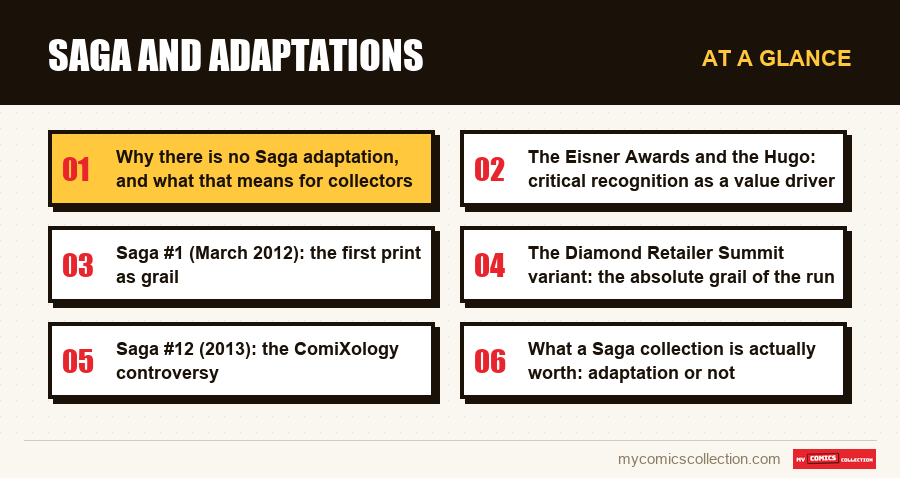
Why there is no Saga adaptation, and what that means for collectors
Brian K. Vaughan is one of the most sought-after comic writers in Hollywood: he has adapted others' work and signed studio deals for his own. But on Saga, the answer has consistently been no. In multiple interviews, Vaughan has explained that the series is designed to do what only comics can: a visual and narrative freedom no film budget can replicate, and creative control that any studio co-production would inevitably erode. Eric Kripke, showrunner of The Boys, publicly pleaded with Vaughan and Staples for the TV rights; they declined. At New York Comic Con 2025, Vaughan confirmed the position had not changed. As of June 2026, Saga has no announced or in-development screen adaptation.
This context matters for understanding the series' market value. With properties like The Walking Dead (AMC) or Invincible (Amazon Prime), an adaptation announcement immediately drove demand for early issues. Saga has had no such catalyst, and yet its key issues hold meaningful value. The demand rests entirely on editorial fundamentals: a scarce first print, a sustained run of top-tier awards, and a loyal readership that has kept the series a durable independent bestseller. That is organic valuation, with no announcement effect. Some collectors see this as an upside: if an adaptation were ever announced, the leverage on first-print prices would be immediate and significant.
The Eisner Awards and the Hugo: critical recognition as a value driver
Saga won Eisner Awards from its first year of eligibility. In 2013: Best New Series, Best Continuing Series, and Best Writer for Brian K. Vaughan. In 2014: Best Continuing Series, Best Writer, and Best Painter/Multimedia Artist for Fiona Staples. In 2015: Best Continuing Series and Best Penciller/Inker. In 2017: four further Eisners including Best Continuing Series, Best Writer, Best Cover Artist, and Best Penciller/Inker: an unprecedented sweep for an independent series. The first collected TPB also won the 2013 Hugo Award for Best Graphic Story.
This accumulation of awards had a direct effect on the collector market: each new Eisner cycle renewed interest in the early issues and brought in reader-collectors seeking the origins of the series. The Eisner is the most recognised quality signal in comics, and Saga has deployed it more consistently than any other independent title of the 2010s.
Saga #1 (March 2012): the first print as grail
Saga #1 was under-ordered by retailers who had no way to anticipate the phenomenon. The initial print run came in at approximately 37,641 copies according to Comichron: a modest figure for an Image launch of that era. The issue sold through in days and went through five successive printings to meet demand, each identifiable by an explicit notation on the cover. Only the first print, which carries no reprint notice, constitutes a collectible reference copy.
Our eBay estimator returns a median of €6 across 46 listings (June 2026). That figure must be read carefully: eBay listings for this issue mix all five printings without distinguishing them, and reprints circulate for a few euros. It does not in any way reflect the value of a first-print copy in good condition. CGC-graded market data for high-grade first prints is tracked separately on GoCollect and PriceCharting and sits at a substantially higher level than the blended eBay figure suggests.
The Diamond Retailer Summit variant: the absolute grail of the run
The rarest piece in the entire Saga collecting universe is the Diamond Retailer Summit variant of issue #1, distributed at the Diamond conference and C2E2 in Chicago in 2012, exclusively to attending retailers. The print run is estimated at approximately 500 copies. This variant features a distinct cover from the standard edition and no consumer barcode. In CGC 9.8, its value is documented at approximately $2,500 (GoCollect, March 2026; WorthPoint confirms transactions in this range). It is by a significant margin the most sought-after piece in the series, and one of the most desirable Image variants of the modern era.
Saga #12 (2013): the ComiXology controversy
In April 2013, Saga #12 briefly disappeared from the ComiXology platform, which was immediately interpreted as Apple censoring the iOS App Store. The reality, clarified the following day by ComiXology itself, was different: it was ComiXology that had pre-emptively pulled the issue, misreading Apple's content policy and assuming that two panels depicting a same-sex sexual act would be rejected. Apple had given no such instruction. The decision was reversed within 24 hours. The episode generated substantial media coverage on questions of censorship and adult content in digital comics, and Brian K. Vaughan issued a public statement making clear he, Staples, and Image Comics stood behind the book.
On the market side, Saga #12 has only 2 active eBay listings in our estimator: far below the 15-listing threshold for citing a reliable median. The issue's significance in the editorial history of the series gives it real narrative weight, but documented public transactions are too sparse to establish a stable market price.
What a Saga collection is actually worth: adaptation or not
Saga demonstrates that a comic series can build meaningful collector value without the support of a screen adaptation. The real drivers are: a first issue that was under-printed and definitively exhausted, a record of Eisner wins unmatched among independent series, an active readership sustaining back-issue demand, and a genuinely scarce variant (the Retailer Summit copy) that anchors value at the top of the market. For a collector, it is also a long position on the future: if Brian K. Vaughan were ever to license an adaptation, first prints would be among the first, and sharpest, beneficiaries.
Own a Saga comic? Get a free valuation with our tool based on real eBay sales to find its low, median, and high value.
Frequently asked questions
No, and it is a deliberate choice by its creators. Brian K. Vaughan explains that the series exploits what only the comics medium allows, with visual freedom and total control over the work. As of June 2026, no adaptation is announced or in production.
The first print run (March 2012), under-ordered by retailers, is about 37,641 copies. The issue sold out in days and went through five printings; only the first, with no reprint notice on the cover, is the reference copy.
From 2013, Eisner Awards (best new series, best continuing series, best writer), then more in 2014, 2015 and 2017, including best cover artist. The first collected volume also received the 2013 Hugo Award for best graphic story.
The Retailer Summit variant of #1, distributed in 2012 exclusively to retailers attending a trade show, with an estimated print run of about 500 copies. Its cover differs from the standard edition and it has no mass-market barcode.
In April 2013, the issue briefly disappeared from a digital reading platform, which was taken for censorship. The platform had in fact misread a device maker's content policy and pulled the issue preemptively, before reversing its decision in under 24 hours.