A commemorative reissue uses the title, number, cover and interior pages of the original edition. She can therefore announce “first appearance” without lying. The only element that betrays it in the advertisements noted is the name of its editorial line, “Marvel Milestone Edition”, accompanied by the year 1992. On the query “Sabretooth Iron Fist 14” observed on August 30, 2026, the five cheapest proposals all belong to this reissue, between $3.99 and $6.00, while the median of advertisements for verified copies is at 550.00. $. These two numbers do not relate to the same item, and neither constitutes a concluded sale: they are amounts claimed by sellers on a single date.
The trap in question here is neither counterfeiting nor lying. The commemorative reissue is an official publication, printed by the publisher himself, sold openly under the name of his collection. What it offers is exactly what it announces: the story in which a character appears for the first time, faithfully reproduced. The seller who writes « première apparition de Sabretooth » on such an ad is saying something true about the content. The buyer, for his part, hears something else: he believes he is buying the object from 1977, the one which was printed the month in which the character was created, and which only exists in a finite number of physical copies having survived fifty years.
Between these two readings of the same sentence, there is a considerable price difference. The survey carried out on August 30, 2026 on a general auction site in the American market shows, for the query “Sabretooth Iron Fist 14”, seventy-seven advertisements for unverified copies: the lowest amount requested stands at $3.99, the median at $37.50, the highest amount at $7,499.99. Copies passed by a verification body are counted separately: one hundred and eight advertisements, minimum $60.00, median $550.00, maximum $7,000.00. None of these numbers describe a completed transaction. They only describe what sellers were hoping to get on a given day.
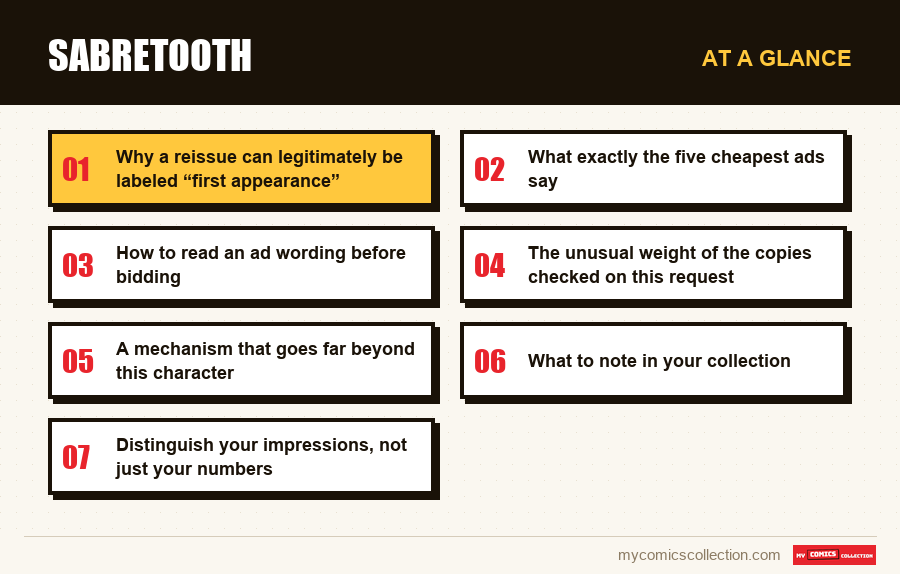
Why a reissue can legitimately be labeled “first appearance”
An editor who republishes an old story does not rename it. It takes the title of the series, it takes the issue number, it takes the cover illustration, and it assembles everything under a collector's cover which signals the operation. The narrative content is identical: the same boards, the same story, the same scene where the character appears on stage for the first time in his editorial existence. To say of this volume that it contains a first appearance is therefore strictly accurate from the point of view of the narrative.
What the reissue does not share with the original is anything related to the object. The printing date is not the same. The paper is not the same. The printed cover price is not the same. The print run is not the same, and it has not suffered the same losses: a commemorative booklet produced fifteen years after the original story arrives on the collectors' market, in the hands of people who store it carefully, while the initial edition was first a newsstand item, read, folded, thrown away. It is this difference in survival, and this alone, which explains the price difference.
The market does not automatically sort the two categories. A search by title and number brings them together in the same results page, since they have the same title and the same number. The buyer who scans a list sorted by increasing price therefore first comes across the reissues, without any warning intervening. Nothing stops him from concluding that he has just found an exceptional opportunity on an item that others are selling for hundreds of dollars.
This confusion is not exotic in the editorial history of the character. An antagonist who has become central over the decades sees his first appearances republished in several successive formats, and each republication creates a new object which bears the same name as the old one. To situate these covers in the character's chronology, the detour through l'histoire éditoriale de Sabretooth allows us to understand when the publisher deemed it useful to put this story back into circulation.
What exactly the five cheapest ads say
The only announcement that warns
At $3.99, there is wording explicitly stating that this is a reprise, with the word "REPRINTS" placed before the mention of the first appearance. It is the only one of the five to write in black and white that the proposed booklet reproduces a previous story. The buyer who reads the entire line cannot be wrong.
The statement attached to a state
At $4.99, the ad combines the name of the commemorative collection, a numerical condition notation, and the phrase “1st Sabretooth.” The juxtaposition of a status note and a first appearance claim gives the wording a technical appearance that can make one lower one's guard, while the name of the editorial line is the only decisive information.
The most explicit announcement of the year
At $5.02, the label names the collection, mentions the author of the cover, gives a condition range, and displays the year 1992. It claims no first appearance. It is the one of the five which provides the best information on the nature of the object, precisely because it bears the printing date of the proposed volume.
The two announcements which affirm without qualifying
At $6.00, two labels claim "1st App" and "First Appearance of Sabretooth" respectively. Neither contains the word reissue. The only clue remains the name of the commemorative collection, and for one of the two the year 1992, slipped into the middle of the rest of the title of the ad.
The count is clear: of the five least expensive proposals in the query, only one signals the resumption with a dedicated word. Two claim a first appearance without any reservation other than the name of their collection. All five, without exception, are the same reissue from 1992. In other words, the bottom of the observed price range does not measure anything at all on the original edition: it measures the price of another object, which happens to bear the same number.
The amounts cited in this article were noted on August 30, 2026 among advertisements then in progress on a general auction site on the American market. These are amounts requested by sellers, not amounts paid by buyers. A survey carried out on a single date also does not allow any movement to be observed: it gives a photograph, not a trajectory. Nothing here says whether these amounts are rising, falling or stagnating.
The highest ask of the unverified group, $7,499.99, should be read for what it is: an isolated seller's hope, posted with no known counterpart. It does not describe any market level and should not serve as a guide for anyone. The same caution applies to the maximum of the verified group.
How to read an ad wording before bidding
Search for a collection name
In the report, the only discriminator present in the text of the advertisements is the name of the editorial line under which the cover was published. It generally appears at the top of the label, before the title of the series. Its presence is enough to rule out the hypothesis of an original edition; its absence, on the other hand, proves nothing at all.
Find the printed year
Two of the five advertisements observed display 1992. A year several years later than the publication of the story is a strong signal. Be careful, however: many sellers indicate the year of the original story rather than that of their copy, and the year displayed is therefore not a guarantee in itself.
Ask for the cover price
The price printed on the cover belongs to the item and cannot be rewritten. It necessarily differs between a period impression and a cover made much later. This is one of the two photographs to request before committing to an ad whose wording remains silent.
Claim the mentions page
The page where the legal notices appear bears the actual printing date of the volume you have in front of you. A clear photograph of this page settles the question without possible discussion. A seller in good faith has no reason to refuse to send it.
Don't trust the number alone
The issue number is strictly identical on both objects, since the cover reproduces it. Sorting by number therefore systematically mixes them. The number identifies the story, not the impression, and has no discriminating value in this specific context.
Be wary of formulas valid for both
“First appearance” describes the content, not the copy. The formula is exact on both objects and therefore never makes it possible to decide between them. It is not a lie in any of the cases noted; it is simply ineffective as a purchasing criterion.
Collecting this series?
Track what you own, what you are missing and what your collection is worth. 7 day trial.
Start my trial →The unusual weight of the copies checked on this request
One detail of the statement deserves to be highlighted, because it reverses a common distribution: on this request, there are more announcements of copies passed by a verification body than announcements of unverified copies. One hundred and eight against seventy-seven. The majority of proposals therefore concern objects whose condition has been assessed by a third party and which are sold sealed in a case.
This distribution has a direct consequence on the reading of prices. The verified group starts at $60.00 and has a median of $550.00; the unverified group starts at $3.99 and its median at $37.50. Comparing these two medians would make no sense, since the unverified group aggregates at least two distinct objects: the original edition in various states, and the commemorative reprint which we have just seen occupies the very bottom of the scale. The verification concerns an identified and documented object.
We must therefore resist the temptation to express the difference between reissue and original by a numerical ratio. The available data does not provide two clean and separate measurements: on the one hand they provide a range which starts at $3.99 and which mixes objects of different nature, on the other hand a median of verified at $550.00. These two numbers do not describe the same object and cannot be divided by one another to produce a ratio. What we can say without being mistaken is that the sums requested are not at all in the same order of magnitude depending on whether the announcement concerns the recovery or a documented period impression.
This abundance of verified copies also indicates that the booklet is treated by the market as a collector's item in its own right, the condition of which is subject to systematic examination. To understand what this attention owes to the importance of the character in the confrontations which established him, we can refer to the key booklets of the rivalry between Wolverine and Sabretooth.
A mechanism that goes far beyond this character
Nothing in the above is unique to any particular antagonist or series. The mechanism is general: as soon as a publisher puts an old story back into circulation without changing either the title or the number, he creates an object which is placed alongside the original in all searches and in all catalogs indexed by the title. The more the original story is researched, the more likely the resumption is to exist, and the greater the risk of confusion.
This logic applies to all the significant entries in an editorial universe: the beginnings of characters who have become popular, the founding stories of a series, the episodes that readers demand and that the publisher reprints to meet demand. The list of Wolverine key numbers illustrates the same phenomenon: each title that counts ends up existing in several impressions, and each of these impressions appears under the same name.
This has a practical consequence for those who buy online. The question to ask is never “does this booklet contain the first apparition?” ”, since the answer is yes in both cases. The question is “what impression is this?” ". Formulated this way, it calls for a factual and verifiable response: a date, an editorial line, a cover price. It renders useless any discussion on the intention of the seller, which is not at issue in the advertisements noted.
It also has a consequence on the way we classify what we already have. A reader who bought the reprint to read it and who placed it under the original number finds himself with an inventory sheet which describes an object that he does not own. The distinction is not only of interest at the time of purchase: it conditions the accuracy of everything that one subsequently writes about one's own collection. To place this booklet in a coherent reading path, independently of the impression held, the reading guide dedicated to the character proposes an order of discovery.
What to note in your collection
An “edition” field distinct from the “number” field. The number is not enough, since it is shared identically by the reprint and the original print. Without a dedicated field that accommodates the name of the editorial line, two objects that have neither the same age nor the same rarity occupy the same inventory line and become indistinguishable as soon as the box is closed.
The year the copy was printed, not the story. These are two different pieces of information and must be stored separately. The year of the story is used to place a story in a reading chronology; the year of printing is used to identify the physical object placed on the shelf. To confuse the two is to erase precisely the distinction that this article seeks to establish.
The printed cover price, noted on the item. This is the hardest data to falsify and the easiest to verify yourself: it's written on the cover. Noting it at the time of receipt, while the copy is still in your hands, avoids having to take out the box months later to decide on a hypothesis.
The exact mention of the ad wording at the time of purchase. Copying the wording used by the seller, including any claims of first appearance, makes it possible to reconstruct later what was promised and what was delivered. It is also the only way to remember why we paid a certain price, when the memory of the transaction has faded.
The verification status, with its date. A copy sealed by an organization and a raw copy are not comparable, and the statement of August 30, 2026 shows this clearly since the two sets were counted separately. Recording this status, specifying the date on which it was noted, avoids putting amounts side by side that do not relate to comparable objects.
No. This is an official publication from the publisher, printed and distributed under the name of an identified collection. She does not try to pass herself off as something else: her clothing announces what she is. The misunderstanding arises from the partial reading of the wording by the buyer, not from a maneuver by the seller.
In the advertisements noted, the name of the commemorative editorial line is the only textual element which distinguishes the two objects, sometimes accompanied by the year 1992. It generally appears at the beginning of the wording. Its absence does not guarantee anything: it requires asking the seller for a photograph of the legal notices page and the cover price.
Not necessarily. The formula describes the content of the booklet, and this content is indeed that of the original story. Of the five cheapest ads observed, two claim a first appearance without further clarification, which remains accurate from a story point of view. Only one of the five adds a word indicating that it is a repeat.
The statement does not allow us to answer this question, because it relates to amounts requested and not to sales concluded. It only indicates that the unverified range starts at $3.99, a price that corresponds to the recovery, and that the median of verified copy listings is $550.00. These two numbers do not describe the same object, and a reading dated a single day does not provide information on any trend.
Above all, you should not take them as benchmarks. The unverified group maxes out at $7,499.99, but this is a single ask, isolated at the top of the distribution. An extreme value of this type reflects what a seller wants to get, without knowing whether anyone has ever agreed to it.
Distinguish your impressions, not just your numbers
Record for each issue its edition, its year of printing and its cover price, and two objects which bear the same number cease to occupy the same line. Your inventory then describes what you really own, not what the story contains.