Robin 1991: the threshold under which no one checks a comic
On August 30, 2026, a search for the fifth issue of the 1991 Robin mini-series, on a general auction site oriented to the American market, returned 124 advertisements for unverified copies and no advertisements for copies encapsulated by a verification organization. Zero, on the entire request, on the same day. Amounts claimed by sellers ranged from $0.99 to $125.00, with a median of $8.00. These are prices asked at a given moment, not concluded transactions, and a single photograph by construction does not show any evolution. But it is enough to establish a fact: below a certain price level, having a booklet authenticated and encapsulated costs more than the booklet itself, and the verified market purely and simply ceases to exist.
Most reasoning about the value of a comic implicitly assumes that a third party can decide. We imagine that in case of doubt about the condition, there is a remedy: send the copy, obtain a note, resell with an enforceable guarantee. This hypothesis holds for only part of the market. It collapses as soon as the object is worth less than the operation itself, and this collapse is not progressive: it is clear. The reading of August 30, 2026 gives an unusually clean illustration of this, because the count of verified copies does not go down to three or four units that are difficult to interpret: it goes down to zero.
This observation deserves to be taken seriously, because it does not concern a marginal curiosity. The 1991 mini-series is an installed title, widely distributed, present in quantity in stores and in stocks. What is missing is therefore not the material: 124 advertisements are available simultaneously for a single issue. What is missing is the economic benefit of verification. Understanding why, and above all what this concretely imposes on those who maintain a collection, changes the way in which we document our own copies.
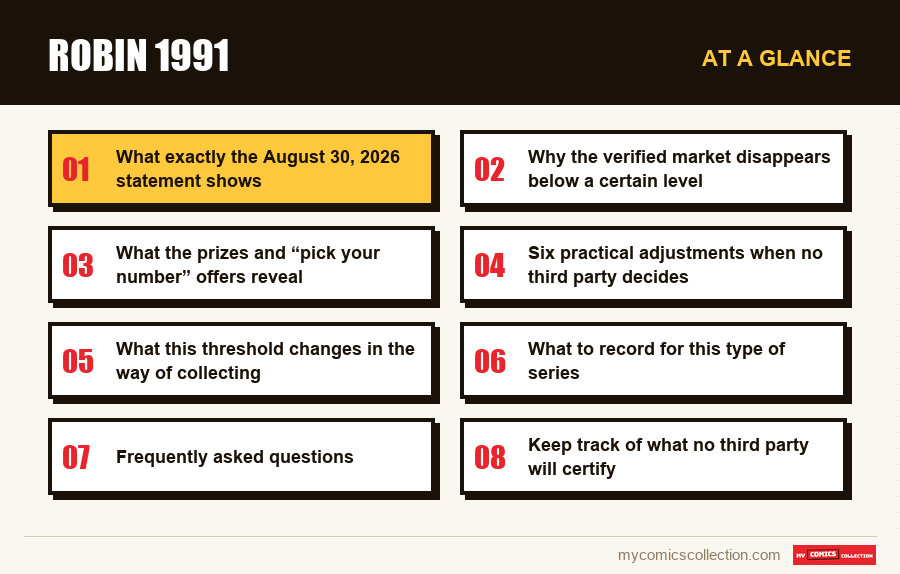
What exactly the August 30, 2026 statement shows
We must first say what these figures are, and what they are not. They come from advertisements published and still active that day, on a general auction site, on the American side. An amount displayed in an ad is a request from the seller. Nobody paid for it. Maybe no one ever paid for it. Between the price claimed and the price obtained, the gap is sometimes considerable, and nothing in an ad statement allows it to be measured. I point this out bluntly because confusion between the two is the most frequent source of error when valuing a collection: we add up the sellers' hopes and we believe we have counted a value.
Second clarification, just as important: this reading was taken only once, on a single date. A single measurement does not describe any movement. It does not say whether the amounts claimed are rising, falling or stagnating, because there is no second point of comparison. Any sentence like “this title is progressing” or “this title is dropping” would here be a pure fabrication. What the measurement allows is a description of the state of the market at that moment, and a reading of its structure. That's already a lot, but that's all.
Of these 124 ads, the dispersion tells something. The minimum claimed is $0.99, the median is $8.00, the maximum is $125.00. The maximum is more than fifteen times the median. Such asymmetry, in a group where half of the announcements are around eight dollars, does not indicate that the title is “worth” one hundred and twenty-five dollars. She points out that a seller, in isolation, set this amount. An extreme point in a distribution is not a market level; it is at best an individual intention, sometimes an input error, often a copy whose description promises something that nothing corroborates. The median holds up much better: sixty-two ads would have to be moved to move it.
The cheapest ads found that day give the texture of the bottom of the distribution. An issue #5 of the 1991 miniseries fetched $0.99. A number 3 out of 5 advertised « NM- » at $1.50. A number 5 announced « F+ » at $1.60. A « choisis ton numéro » offer covering the entire mini-series at $1.79. A set of numbers 3, 4 and 5, described as medium to high condition, for $1.95. Five propositions, five different ways of selling the same thing, all under two dollars.
Why the verified market disappears below a certain level
The mechanism is arithmetic before being cultural. Having a booklet verified involves an expense that does not depend on the value of the object: you have to protect it, ship it, pay for a service, insure it during transport, wait, then recover it. The same gesture applied to an eight-dollar booklet and an eight-thousand-dollar booklet costs approximately the same thing. I do not have any figures on the prices charged and I am careful not to give one, but the important thing is not the exact amount: it is the fixed nature of the expenditure compared to a variable value.
A cost that does not adapt
The verification expense is structurally independent of the price of the booklet. It does not diminish because the object is modest. Faced with a claimed median of $8.00, the operation cannot mechanically be reimbursed, whatever its exact price.
Zero is not missing data
Out of 124 ads on one side, no verified copies on the other. This is not too small a sample to conclude: it is a complete count on an entire query, on a specific date. The absence here is the result, not a lack of measurement.
A maximum is not a level
$125.00 versus median of $8.00: The spread describes a seller's willingness, not the state of the market. Using the high point of a distribution to estimate your own collection amounts to confusing the exception with the rule.
No arbitrator, therefore no recourse
Without a verified copy in circulation, there is no external reference to compare an advertised condition to. The seller's description becomes the only information available, and it is his sole responsibility.
We must measure what this implies. In a segment where verified copies are circulating, a buyer can at least reason in terms of discrepancies: a given state is usually priced within a given range, an unverified copy is traded at a discount which reflects the uncertainty. This reasoning assumes the existence of a shared scale. Here, scale does not exist. The mentions “NM-” and “F+” noted in the advertisements at $1.50 and $1.60 borrow the vocabulary of the ratings without any third party having validated them. These are self-assessments. They can be honest, diligent, made by someone who has been handling fascicles for twenty years, or not.
A condition announced in an announcement is not a rating. It is an opinion formulated by the person who has an interest in the sale. When no verified copy exists on the same title, this opinion faces nothing.
This does not make sellers suspect: it simply shifts the burden of evaluation to the buyer, who must rely on photographs, notices of defects and their own reading. It's doable, but it's work, and you have to know you're doing it.
What the prizes and “pick your number” offers reveal
Two formats noted in the cheapest ads deserve a stop. The “choose your number” offer at $1.79, which covers the entire mini-series, and the bundle of issues 3, 4 and 5 at $1.95 for three issues described in average to high condition. These two formats say the same thing under different guises: at this price level, selling the booklets one by one no longer brings in enough to justify the effort of processing them separately.
A seller who offers “choose your number” at a single price has given up trying to differentiate his copies. He no longer seeks to promote the fact that a certain number would be more sought after than another within the mini-series: everything is aligned with the same amount. A seller who groups three issues under one overall price goes a step further: he even abandons the idea of describing each copy precisely, since the announced range covers "medium to high" without saying which issue occupies which position in this range.
For a collector, the consequence is direct and rather liberating. If the market itself has ceased to treat the single issue as the relevant unit, there is no reason to persist in completing issue by issue while paying postage five times. The relevant unit has become the complete series, and so it must be searched for, stored and recorded. This shift is found elsewhere in the univers du personnage as soon as we leave the fascicles identified as structuring.
There is a reservation to be made. The five examples cited are only five advertisements taken from the bottom of the distribution: this is too small a number to deduce anything about a general price level. They illustrate sales practices, they do not measure a market. It is the 124 advertisements and their median at $8.00 which carry the quantitative information; the five examples bear none.
Six practical adjustments when no third party decides
Note the state yourself, and take responsibility for it
Since no external rating exists for this type of series, the only evaluation you will have is your own. Do it, write it down, and write down the date you did it. A dated appreciation is infinitely better than a memory.
Date each price statement
The 124 listings and their $8.00 median describe August 30, 2026, not a constant. Without the date attached to the number, you will never know later if you are looking at fresh or outdated information.
Separate price claimed and price paid
The amounts noted are requests from sellers. What you actually paid for your own copies is another magnitude. Record the two separately, otherwise your inventory mixes facts and intentions.
Save batches as batches
A set of three numbers purchased at a global price cannot be broken down into three unit prices without invention. Note the price of the lot and the composition, and leave the breakdown by number blank rather than making it.
Distinguishing numbers in a mini-series
A « n° 5 » means nothing outside of its series: it's the fifth issue of this 1991 miniseries, not an absolute fifth issue. Without the exact title and year, the reference is ambiguous as soon as we leave the context.
Photograph rather than qualify
Since the state vocabulary is not validated by anyone in this segment, a photograph of the cover, spine and corners is better than an abbreviation. It remains readable in ten years, the abbreviation depends on who wrote it.
Collecting this series?
Track what you own, what you are missing and what your collection is worth. 7 day trial.
Start my trial →Where does the border cross, and how to spot it yourself?
The obvious question is: at what level do verified copies reappear? I don't have the numerical answer, and I'm not going to make it up. This statement concerns a single title, a single date, a single request. It establishes that at this level, the verified is absent. It does not say where exactly the tipping point is, nor whether it is the same across periods or publishers.
On the other hand, the method for spotting it yourself is simple and reproducible, and it is probably the most useful lesson of this whole exercise. On any title that interests you, run the same search twice: once all ads combined, once filtering on verified copies. Compare the numbers. If the second count is zero or almost zero, you are below the threshold, and you immediately know that you will never have external arbitrage on this security. If the two populations exist and are of comparable size, you are on top, and you can reason in terms of differences.
This test has a virtue that a price figure does not have: it is robust. A claimed amount changes every day, depends on a seller, a mood, a season. The presence or absence of an entire population of professional salespeople does not change overnight. When a category has zero ads out of one hundred and twenty-four, it is not an accident of timing.
Be careful, however, of a reading trap. A zero count of verified copies does not prove that no verified copies exist in the world. It proves that none were offered for sale on this channel, that day, under this request. The difference matters: a copy can exist and remain in a private collection for years. What the statement measures is the liquidity of the auditee, not its existence.
What this threshold changes in the way of collecting
A collection of which a large part is below this threshold is not a collection without value: it is a collection whose value cannot be proven by a third party. They are two different things, and confusing them leads either to overestimating what we have or to unfairly depreciating it. One hundred and twenty-four active ads for a single issue indicate a living, circulating title that people are looking for and buying. The $8.00 median is not an insult: it is the price of an abundant item.
Concretely, this means that the conservation effort becomes more profitable than the valorization effort. On a fascicle below the threshold, no external expenditure will improve its market position, since the market has no way of recognizing this expenditure. On the other hand, anything that prevents the condition from deteriorating (a suitable pouch, rigid cardboard, vertical storage, the absence of direct light) preserves the only thing that matters: the honest description that you will one day be able to make of it.
This also means that completeness takes precedence over unity. A mini-series of five complete, coherent issues, with homogeneous and documented states, presents itself and is transmitted infinitely better than three mismatched issues for which we paid dearly for an isolated copy. The bundled offers noted on August 30 only confirm, on the seller's side, what the collector has an interest in doing on the buyer's side. This whole series logic is found in the way of approaching a ordered reading path, where interest arises from the sequence and not from the isolated booklet.
Finally, it gives back its weight to personal documentation. Where a third party arbitrates, the note replaces the story: a number on a label is enough to describe the object. Where no one referees, the story is all that remains. Where the copy came from, when it was purchased, at what price, in what condition, with what photographs: no one but you will produce this information, and it cannot be reconstructed after the fact. The same logic applies when we compare characters whose ratings diverge greatly, as shown by examining the Nightwing key numbers.
What to record for this type of series
The date of the statement, systematically. The figures cited here apply to August 30, 2026 and nothing else. A median without a date is not information, it is a rumor. In your follow-up, each estimate must include the day you noticed it, otherwise you will be unable, in six months, to say whether it is still worth looking at. It is also the only way to construct, reading after reading, the series of points which will one day allow us to speak of evolution: something that an isolated measurement never allows.
The nature of the amount: claimed, not concluded. The $0.99, $8.00 and $125.00 are seller requests on current listings. Your inventory should explicitly distinguish this category from what you actually paid and what someone actually cashed out. Three different sizes, three different columns. Merging them into one produces a total that looks precise and means nothing.
The absence of a verified copy, noted as a fact. On this title and on this date, verification is not part of the market. Write it down. This will save you having to reopen the question every six months, and it documents why your status assessment is your own and not that of an organization. This is market information, not a gap in your listing.
Your condition assessment, in words and with photographs. The mentions noted in the advertisements: “NM-” at $1.50, “F+” at $1.60: are seller self-assessments, not validated. Yours will be just as likely, and that's normal. Describe what you see rather than applying an abbreviation: corners, folds, spine, whiteness of the edges. Add images. A concrete description survives the change of conventions; an acronym no.
The exact composition of the lots. The lot of numbers 3, 4 and 5 at $1.95 illustrates a common case: a single price for several issues of unequal condition. Record the scope of the lot and its overall price without attempting to artificially distribute the amount by number. An invented breakdown contaminates all subsequent calculations, and it is unrecoverable once you forget how you made it.
Frequently asked questions
No. It means that the value of the object is lower than the cost of verification, which makes the operation of no economic interest. A title that displays 124 active ads for a single issue on August 30, 2026 is, on the contrary, a title that circulates a lot. Abundance and lack of certification go together: it is precisely because the copies are numerous and accessible that no one incurs a fixed expense to have them authenticated.
The median, without hesitation, and again with caution since these are amounts claimed and not sales concluded. The maximum is an isolated value in a distribution of 124 advertisements: it reflects the decision of a single seller. An extreme point only becomes information on the market if it is accompanied, which is not the case here where half of the announcements are around eight dollars.
Absolutely not. It was taken only once, on August 30, 2026. Describing a movement requires at least two comparable measurements taken on different dates, with the same request and the same perimeter. With just one point, any claim of trend would be made up. On the other hand, nothing prevents you from repeating the same survey later and constructing the comparison yourself which is missing today.
Do two counts on the same search: the total number of ads, then the number of verified copy ads. If the second is zero or fits on the fingers of one hand, you are below the threshold and you will not obtain any external arbitration. If the two populations coexist with comparable numbers, you are on top. It is a binary test, much more stable than a price comparison.
Because at the price level observed, processing each booklet separately costs more than what it brings in. A single price offer on the entire mini-series at $1.79 or a set of three issues at $1.95 show that the seller has given up trying to differentiate his copies. This indicates a market where the relevant unit has become the complete series rather than the isolated issue, and this also applies to the buyer.
Keep track of what no third party will certify
When no organization arbitrates the condition of your issues, your own inventory becomes the only reliable source: observed conditions, photographs, purchase dates, prices actually paid and time-stamped statements. My Comics Collection lets you hold it all in one place, series by series, without making anything.